The Simple Question Socialism Couldn't Answer
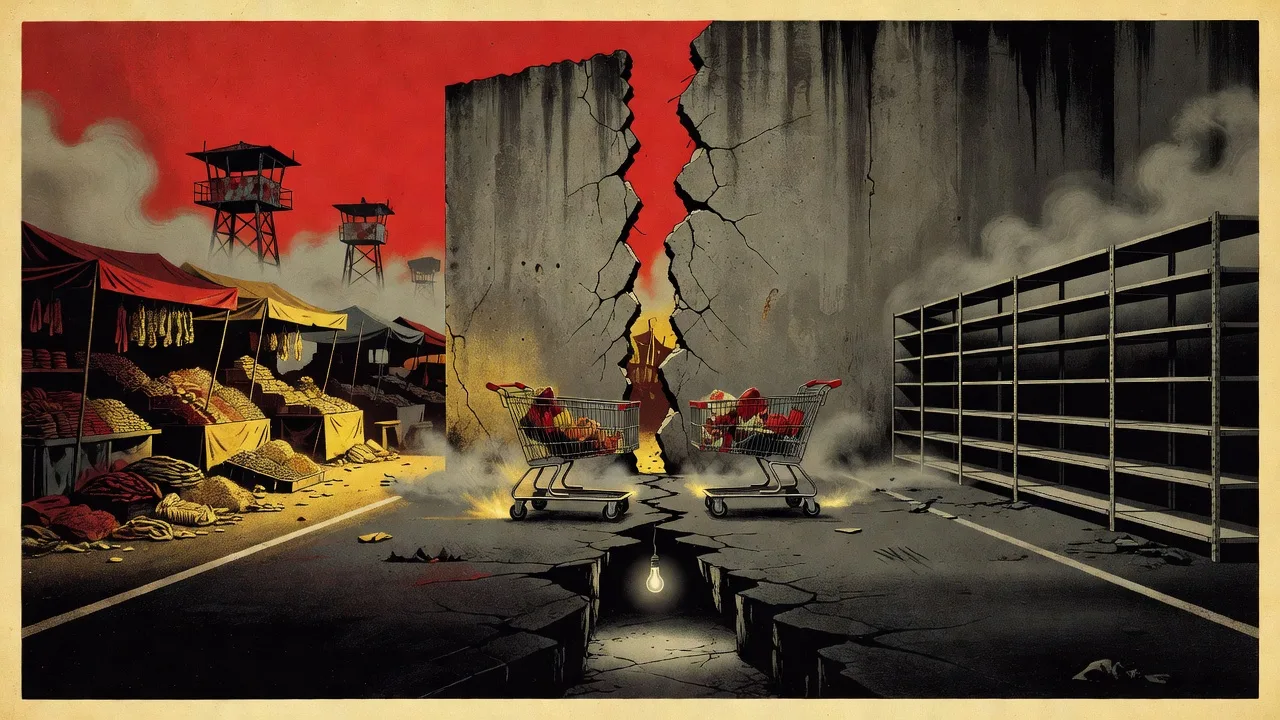
Two grocery stores, twenty minutes apart, thirty years apart. The finest natural experiment ever run on central planning. The verdict is in the shelves.
The argument, in brief
The planet is 71% water, 29% land, and only about a tenth of it is useful to us. Every system humans have built is an answer to one question: who owns what, and who gets to decide? Berlin 1961–1989 ran the cleanest experiment ever staged on the two competing answers. The West ran bottom-up: thousands of stores, each stocked by signals from the checkout line. The East ran top-down: a Politburo in Moscow decided what a grocery store in Berlin should carry, priced bread at one percent of the lowest wage, and let a ten-year wait accumulate for a car unchanged in thirty years. When the Wall fell, the East's shelves held 3,000 items; the West's held 15,000. East Berliners died two and a half to three years earlier than West Berliners, and the gap vanished within ten years of reunification. The simple question the plan could not answer: how do you know what to make? The answer is the exhibit's thesis: no center can know, so let millions of decisions decide, let systems compete for the people inside them, and let everyone be able to opt out. That is the difference between a system and a cage. Berlin already ran the experiment; the verdict is in the shelves.
Who owns what, and who gets to decide?
The Etymological Court has adjourned. This is the exhibit.
The Finite Land Problem
The planet is finite: 71% water, 29% land. Roughly half that land is useful to us: a little more than a tenth of the planet, fought over since the first two tribes met on the same hunting ground. Scarcity, and the question of who owns what, drives every economic system humans have ever built.
I have been hearing a lot lately about one of those systems: socialism.
Ask ten people to define socialism and you get ten different answers: the government owns the businesses, free health care, Sweden, equality. “I am a democratic socialist.” “When you call it socialism, I think it’s a misnomer.” “Socialism or capitalism? Capitalism.” “I think it depends on your interpretation.” “I don’t know anywhere in the world where true socialism has…” It is a word wars have been fought over, a word that pulls emotion out of people, a word almost everyone has an opinion on. And some of those opinions are changing; more people express interest in socialism today than they have in decades.
So why did it ever come about? Why has it stood the test of time? Does it mean the same thing today? What exactly is socialism?
At first there was no need to think much about ownership. We walked around and ate what we hunted or picked out of the ground. But as the population grew, we started bumping into each other. Tribes became clans, clans became civilizations. Skirmishes grew into battles, battles into wars, and with few exceptions the leader of whichever group won became the owner of whatever land they controlled. It was theirs to give.
From Feudal Lords to the Industrial Revolution
The population kept growing. Kingdoms got bigger. One man could not defend every border, judge every dispute, or till every field. So rulers started giving land to trusted warriors and lords: hold this land as your own, defend it, and in return send me your knights when I need them. Those lords, facing the same problem on a smaller scale, divided the land further and gave it to people to work: hold this land, grow food on it, and in return I’ll protect you. The names and details varied from place to place, but the basic idea was the same. This system, feudalism, was how most of the world operated. A handful of well-connected people owned the land.
Then people started to travel further. Ships got bigger. Villages turned into towns, towns into cities. Growing something to sell for money in a distant town or country, instead of consuming it yourself, changed how people looked at land. That change transformed everything that followed.
Kings, queens, and emperors began changing what they demanded from the lords they had given land to. Forget your knights. I’ll build my own army from now on. You pay me taxes: gold, silver, coin, or goods I can trade to other kingdoms. That land I gave you can do more than feed your estate. Figure out how to turn a profit on it, and give me some of that profit.
“Yes, Your Highness.” And as was tradition, the lords turned right around and said the same thing to the people working their estates and workshops. New plan: everybody grows more than they need, sells the surplus at market, and hands over a cut of the profit.
Changing what made land valuable, from fight for me when I call to pay me money, meant it no longer really mattered who owned the land. As long as the owner could pay the taxes, the ruler was happy. So rulers had an interest in letting people buy, sell, and mortgage land. The trade began slowly, but over a couple of centuries many people came to own land.
This was the beginning of the arrangement we live under today. It broke with thousands of years of tradition in which nobody even conceived of you, dear peasant, owning land.
Two consequences followed. First, this made the world less violent. The only way to acquire land stopped being raise an army, kill a bunch of people, take what they were standing on. You could just buy it. These remained violent times, but buying land gave people another option. Second, if someone figured out how to get more out of land than someone else, they would eventually use that profit to buy the other person’s land, expand whatever they were doing, make more profit, buy more land: building more and more capital.
The Enclosures and the Factory Towns
Letting anyone, in theory, own land instead of only some people was a big, messy transition. Anyone could own land, but that did not mean everyone did.
Peasant life was brutal and dangerous, and you didn’t live long. You couldn’t leave the estate you were tied to without the lord’s permission. You had few freedoms and no real rights. But it was stable. Life on the manor wasn’t half bad: a sturdy cottage, your own strip in the open fields, the commons where the pigs rooted and the wife gathered kindling. The lord took his share, sure, but come feast days we danced, drank, and slept like kings. The seasons ruled us, not some clock. We ate what we grew. We knew every soul in the village, stable as the old oak.
Then the enclosures came. One spring they arrived with ropes and talk of “improvement.” The commons were fenced for sheep; the strips folded into the big man’s profitable fields. Progress, they said. Most of us couldn’t pay to stay. Suddenly we were free: free to leave the land that had fed us, to trudge to town with nothing but calloused hands and rumbling bellies.
Now I stand at the factory gate before dawn, trading my hours for coins that vanish on rent and stale bread. No commons, no strip, no village dance; just the endless clatter of machines, and the knowledge that I made some distant bastard rich while my children cough in a damp room.
Oliver Twist, Les Misérables, and A Christmas Carol tell larger versions of that story. Those who couldn’t establish themselves had few, if any, safety nets beyond workhouses, poorhouses really, which were not that different from prisons. Employers could pay and treat the lowest rungs of society basically however they wanted, because those workers needed the money to stay out of the poorhouse. The work and the pay were terrible. Get hurt, and you’re out of a job completely. Add child labor, and all the worst parts of work you’ve ever heard of belong to this period.
It is no wonder socialism developed during this period: that the people as a group, not rich individuals, should get the fruits of their labor. At first it was a utopian idea, based on right and wrong; what if we just did things like this? There was no reason why it would happen, only that it would be nice.
Until one book raised the stakes.
Marx, Engels, and Capital
Capital, or Das Kapital in the original German, began as one volume and eventually became three. Karl Marx, most famous for The Communist Manifesto and the man who lent his name to Marxism, had written what would become an enduring piece of history.
Karl Marx was not a factory worker. He never stood at a factory gate before dawn. He was a middle-class kid from what is now Germany, born in 1818, a lawyer’s son with a good education and a PhD in philosophy. He wanted to be a professor; his politics got in the way. So he became a journalist, and he was good at it. Good enough to get his newspapers shut down by the government. Then he was kicked out of Paris, then Brussels. By 1849 he had landed in London, broke, and he stayed there for the rest of his life.
People rarely dwell on the decades Marx spent in deep poverty, pawning his coat in the winter. Three of his children died young, and at one point he couldn’t afford a coffin. The man writing the book about capital had none of it. He survived on two things: freelance journalism, including a decade of writing for a New York newspaper, and money from his best friend and writing partner, Friedrich Engels, co-author of The Communist Manifesto. Engels’ family owned cotton mills in Manchester, England. Factory profits funded the book that would inspire revolutions against factory owners.
Marx sat in the reading room of the British Museum, day after day, year after year, reading everything: parliamentary reports, factory inspectors’ records, economic data. He asked one simple question: why does this system produce so much wealth and so much misery at the same time?
Capital, Volume One, came out in 1867. Almost nobody noticed. Marx died in 1883; eleven people came to the funeral. None of them could have guessed that within forty years, a third of the planet would be governed in his name, rallied by one very simple, very potent idea:
Profit is unpaid labor.
When you walk into a store, you see prices on the shelves. You don’t see the workers who made the product, how long they worked, or how much they were paid. The relationship between the person who made the thing and the person who buys it is hidden. Your purchase looks like a simple transaction: money for a shirt. But hidden inside that shirt, Marx argued, is unpaid labor. The worker created more value than they were paid for, and that difference, the profit, goes to the capitalist. Not necessarily because capitalists are evil, Marx would have said, but because it’s built into how the wage system works. Rich owners keep getting richer and more powerful; workers compete for jobs, which keeps wages down.
To escape this, Marx concluded, the people as a whole must own the means of making the shirt. It’s the only way out of oppressive wage labor.
The Profit Debate: Reward vs. Exploitation
Here the two sides reach an impasse over what profit is. The capitalist says: what about losses? The socialist answers: losses are just failed exploitation. Without profit, there can’t be prices, so how will you know what to make?
We’ll know.
It is that final question, how do you know what to make?, that has proven very hard for socialist societies to answer. Experiment after experiment has had to try, each in its own way. Probably the most interesting thing about Capital, the key text of socialism, is that it does not say how things should work.
Marx offered no system, no outline, no blueprint. It is a thorough critique of capitalism, but the other side of the equation is left almost completely to interpretation. His followers are left to answer deceptively simple questions: how do you decide what to stock a grocery store with?
How Prices Work: Bottom-Up vs. Top-Down
Walk into any grocery store, along with the hundreds of other people who visit each day. As you move through the aisles choosing what you will and won’t put in your cart, committing to some items and paying for them, you are saying to whoever makes them: yes, I want this. Against the infinite number of other things I could buy with five dollars, I’ll take it.
Add your choice to everyone else’s decisions about how to spend their five dollars, and useful signals appear for the people who make things. The group that made what sold earns enough to keep making it. The group that didn’t is now aware they shouldn’t keep making it, at least not at that price. If they can’t find a price that works and don’t sell for long enough, then the materials, the labor, everything that went into the losing product eventually stops being used for it, and becomes available to some new maker who wants to try their hand at chocolate bars.
Day after day, signals flow in from people of all walks of life: keep making that. Don’t keep making that. A bottom-up system that lets people vote, with their wallets, on how the world’s scarce resources should be used.
Now walk into a different grocery store. These shelves were stocked months ago by a group of planners who sat in a room and decided how much bread this store would need, how much bread every store would need, how much wheat to grow for that bread, how many tractors to harvest that wheat, how much steel to build those tractors. There’s no vote to add up, because the deciding has already happened. The signal doesn’t travel from your cart up to the maker; it travels from the plan down to the factory. The factory’s job isn’t to figure out what you want; it’s to hit the number it was given. Make 10,000 chocolate bars this quarter. Whether anyone wants those chocolate bars is a separate question. It is not the factory’s question to answer.
And when nobody buys them, nothing stops. The materials, the workers, the machines: none of it gets released to some new maker with a better idea, because it was never the factory’s to release. It stays right where the plan put it until a new plan says otherwise. The feedback that took one bad sales week in the first store takes months here, a year, sometimes never. Day after day, decisions flow in one direction: from the few at the top to the many below. A top-down system, where a small group of people decides how the world’s scarce resources will be used.
Berlin gives us the real-world experiment: one city, one people, split down the middle for 28 years, then rejoined. It is the finest natural experiment the world has ever run on socialism.
The Berlin Natural Experiment
The setup is almost too good. During World War II, the Allies worked together to beat Germany, but they were not all friends. In one group, the capitalists: the United States, England, France, and others. And then the Soviet Union, a fully socialist country, which became that way with considerable help from the writings of Marx, Capital and The Communist Manifesto, including the claim that revolution is necessary to tear down the system, because it will not tear itself down. This is what Vladimir Lenin used during the Bolshevik Revolution.
With Germany defeated, the usual splitting up of the loser’s territory began. Germany was divided into four zones, each administered by one of the Allied powers. But Berlin was too important; it was the capital. France, the US, and England were not about to accept that, just because the city sat deep inside the Soviet zone, they didn’t get to be there. So Berlin, completely surrounded by Soviet-occupied Germany, was itself split into four zones: the US, Britain, and France in the west; the Soviets taking the east. A tiny sliver of democracy and capitalism inside Soviet territory: an affront to the Soviet system.
So the Soviets tried to force the issue. They cut off the rail lines, blocked the roads, tried to starve West Berlin into submission. It didn’t work.
“275,000 flights, at an estimated cost to America and England of over $300 million, defeated the Russians’ diabolical plan. They gave up the blockade on May 12th, 1949. The free world had called Russia’s bluff in the high-stakes poker game of international politics.”
For eleven months, the West fed two million people from the sky: some 277,000 flights, a plane landing every 62 seconds at the peak, two-thirds of the cargo being coal. The Soviets blinked, lifted the blockade, and Berlin settled into being two cities wearing one name.
Then the quiet part started. People left. Not dramatically; a metro ticket, a suitcase, get on the train, ride a few stops, don’t come back. Between 1949 and 1961, 2.7 million East Germans exited Soviet-occupied Germany through this one open seam, stepping over the line between East and West Berlin. The most disturbing part for the Soviets: half of them were under 25. Doctors, engineers, teachers. The East lost a quarter of its physicians.
That many departures could not go unnoticed. Everyone could see where this was heading. So, twelve years after the last airlift plane landed, East Germany’s leader held a press conference. A journalist asked about rumors of the border closing. His answer: “Nobody has the intention of building a wall.”
The journalist hadn’t asked about a wall. Nobody had asked about a wall. He introduced the word himself; a Freudian slip, since he certainly knew what would happen 59 days later.
The barbed wire was strung, streets torn up, train lines severed, all in one night. No wall when the sun went down; wake up, and there’s a barrier running 96 miles through the center of the city and wrapping around the edges of West Berlin, cutting it off from East Berlin and the East German countryside. The concrete came within a week. We’ve all seen walls, but this one had everything. Guard towers, dog runs, tripwires. And all of it facing inward.
So now our two imaginary grocery stores are real. And they’re twenty minutes apart.
East side: the supermarket at Leninplatz carries about 3,000 items; one of each. Not yellow mustard and spicy mustard. One mustard.
West side: one of 120-plus West Berlin stores, carrying about 7,000 items, competing with three other chains; including what would become today’s Aldi.
The West side is a normal market. People buy things; the prices of those things are set by the store; if something doesn’t sell, or sells faster than normal, the store manager adjusts the next order.
The East side is the much more interesting story.
Inside Soviet Central Planning
Historical documents show exactly how the economy was planned for East Berlin and for the Soviet Union as a whole. Follow the decisions from top to bottom.
The decision about what goes into the East-side grocery store begins a thousand miles away in Moscow, at the head of the Soviet Communist Party: the Politburo. A committee of eleven men sets the priorities for the entire Soviet Union for the next five years. What do we want for our population? How do we prioritize the military? Which industries do we develop? Which do we shut down? All of it written down in the official Five-Year Plan; a beast of a document, hundreds of pages long.
The Five-Year Plan is then handed to the State Planning Commission, whose roughly 3,000 staff map it all out in physical units: this much grain becomes this much flour becomes this many loaves of bread. Some 2,000 commodities; grain, coal, gravel, glass; all balanced in a ledger, with the explicit goal of ensuring fairness in the spirit of from each according to his ability, to each according to his contribution.
But early on, the planners realized that if they simply handed things out, here’s your pair of shoes, here’s your bread for the week, people would feel like medieval peasants. Terrible for morale, and more importantly, terrible for getting people to work. Somebody still has to bake the bread. So the State Planning Commission was also put in charge of deciding how much people should be paid. On top of the ledger of stuff to make, they created a wage scale, dividing the entire workforce into a handful of broad pay bands. You could not earn more than the top band, and you could not earn less than the bottom.
This is where the arrangement gets confusing. People receive wages, so they must have something to buy, even though everything is supposedly provided. What can they spend their money on? The system needs prices. How, then, is the price of a loaf of bread decided?
Enter the Office of Prices; its real name. It’s handed the ledger of stuff to make and the wage scale. From the wage scale it can see total wages to be paid; from the ledger, total stuff to be made. With all that data, the Office of Prices asks questions like: how much should a family of four spend on bread? It should be cheap; no more than about 1% of the lowest-paid worker’s income. If the lowest-earning worker makes a thousand marks a month, and the ledger allots them ten loaves a month, then a loaf of bread should cost about one mark. Ask this kind of question over and over, for every product, until the numbers balance: wages paid against goods allotted. Milk, furniture, car tires, gasoline, medicine: every price was tagged, stamped, or even engraved into the product before it left the factory. The price was simply the price, set not by supply and demand but by a judgment about how much of a thing a person should need in a year, and how much of their pay should go toward it.
With prices set, the Office of Prices hands everything to East Germany’s Ministry of Trade and Supply, which assigns quotas and allotments across the regions; fifteen districts, Berlin being the fifteenth. You have this many people; you get this much. This bakery makes this much bread, so it gets this much flour. Everything is assigned to a physical location. State bakeries in the fifteenth district receive flour by truck, bake the bread, put it on a truck, and the grocery store manager unloads whatever arrives.
The Trabant, Life Expectancy, and Economic Signals
The experiment had many visible results. By the time the Wall came down, the East Berlin grocery store still carried about 3,000 items, while the Western ones pushed toward 10,000; the big markets past 15,000. The clearest appeared in two very different parts of life.
Cars. By 1989, the wait time for either of the two cars you could buy in the East was over ten years. The main car available, the Trabant, was the exact same car the state-run auto company had been producing when the Wall went up: same materials, about the same engine, no upgrades in over three decades. Used Trabants sold for more than new ones, because people didn’t want to wait ten years. West Berlin, meanwhile, had dozens of models; and you could drive one home the same day.
Health. Over those same thirty years, neighbors, friends, and family diverged despite sharing a city, breathing the same air, and carrying the same genetics: East Berliners had a life expectancy two and a half to three years shorter than West Berliners. It’s well documented and deeply studied. And within ten years of reunification, 1989 to 1999, the gap was completely erased. East Berliners ended up with the same life expectancy as West Berliners.
What’s not clear to me, though, is whether this, the true top-down kind of society, is what people mean today when they talk about socialism.
Are the Nordic Countries Actually Socialist?
The Nordic countries are free markets. Sweden, Norway, Finland: prices are set by the grocery store owner. The government then collects a lot of tax from everyone, not just the wealthy. Businesses can hire and fire at will; there’s nothing fundamentally different about their capitalism from a place like the US. There’s simply a massive safety net, funded by taxes. To make it concrete: if the average income is about 70,000, then in Denmark, earning 1.5 times that, about 105,000, means paying roughly 54% in total taxes. Everybody is taxed, and heavily. But the means of production are most definitely not owned by the government or “the people.”
In fact, the Nordic countries set themselves up this way intentionally. They watched what happened in the early years of the Russian Revolution and said: no, we’re not doing that.
So we’ve never seen a true socialist system of any size fulfill the ideas Marx laid out. We’ve seen very real, dedicated efforts, and they’ve all ended up in about the same spot. Why?
Absolute Power: The Incentive Traps of Centralization
Stalin: 29 years. Mao Zedong: 27 years. Fidel Castro: 49 years. The average rule of long-serving socialist leaders runs well past fifteen years; many dying in office. These men were not good people. Still, no words could be truer than these:
The basic rule is: you get what you reward. A center that decides where everything goes; that is the ultimate place of power.
Put a human in charge of the flow of calories, electricity, and medicine, with so much power radiating from one point, and you change the incentives of everybody in the system.
The manager of the East Berlin grocery store has no reason to care what customers actually want. If the store runs out of milk by 10 a.m., the manager doesn’t lose a dime. In fact, fewer customers means less work. Croissants are incredibly time-consuming to make; layer by layer, just right, or they don’t puff. The bakery is far better off producing dense, thick loaves that take a fifth of the time and fill the quota faster. There’s no competing bakery, so there are no consequences. The truck driver is measured on weight moved; gravel, nails, bricks, machinery all go before bread, because the faster the truck is emptied, the faster the driver is done.
Why would anyone work longer than they have to, when the planning board has already said what they’ll be paid? Doing better is just more work with no reward attached.
And the 3,000 people in the planning commission? They just want to report that the quotas assigned to them were hit. The last thing the commission chief wants is to tell the Politburo they made a mistake; it’s all downside. And the people at the very top don’t want to hear that the area they’re responsible for isn’t working either. With so much power concentrated at the top, and no way to get there except being selected, a weakness in your area becomes someone else’s political ammunition. So a very small group runs the system blindly because no one brings them problems. The exception is someone trying to climb, who becomes a threat to whoever occupies one of the few top spots. Better to get rid of the noisy one and install someone who reports that everything is going well.
The leader hears no bad news and would be skeptical if he did, made paranoid by years of watching people claw toward the center of power to bend the system in their favor. Because bending the whole system in your favor, or taking someone else’s power, is the only route to getting more. You can’t start a business. You can’t get elected. The pie is fixed, so one person doing better means taking from someone else.
The result, again and again, has been one person and a tiny circle of trusted advisors consolidating control of two things: the military and the means of production. A monopoly on violence and a monopoly on production. Human nature is simply not built to hold that much power. It’s too tempting to put your thumb on the scale to stay there. As the old saying goes: power corrupts, and absolute power corrupts absolutely.
The Exit
Genuine, massive abundance might change that. If there were no scarcity, socialism, even communism, would seem almost natural: no reason for markets, prices, or power structures, because everything is simply available, enough to go around, no need to fight over who gets what. Perhaps the flaws in our nature would smooth themselves out.
But we aren’t there yet. We still live on a planet that is 71% water, 29% land, and finite in everything that matters. Because of that, the question of who owns what is not going away. Both systems we have examined are human attempts to solve the same problem: how to manage scarcity. One system trusts the chaotic decisions of millions; the other trusts the collective vision of a plan.
Is the right answer to first take something away from people who own it, just to redistribute, and then watch it slowly siphon back to the new overlords who supervise the mechanism? Some will always be more equal than others. By merit, or by cronyism.
Maybe the ultimate system isn’t one we’ve tried yet. Or maybe, until we reach a world of true abundance, we’re destined to keep shifting the needle back and forth between the security of the collective and the freedom of the individual.
Whatever the future holds, it will still turn on that basic human question: who owns what, and who gets to decide?
The tyranny of a system is decided entirely by its answer to that question.
Our answer is the right to leave the system you’re in, rather than another system to put you in.
Let systems compete for the people inside them. Give every member the ability to opt out, with reputation intact. That is the market’s verdict on systems, and it is the only structural answer the twentieth century left standing: the 19th century’s tyrannies all shared one feature, the door was locked from outside. Every central-planning state in this essay died of the same disease; it could not be left. The East German who stepped over the line in 1961 was the whole argument. By 1989, the shelves said the rest.
Competition between systems, and exit from any of them. That is the difference between a system and a cage. Berlin already ran the experiment; the verdict is in the shelves.
Series: The Etymological Court · Previous: The Post-Liberal Path