The Etymological Court: Words Are Evidence
Seventeen stolen words. One rule: first school wins.
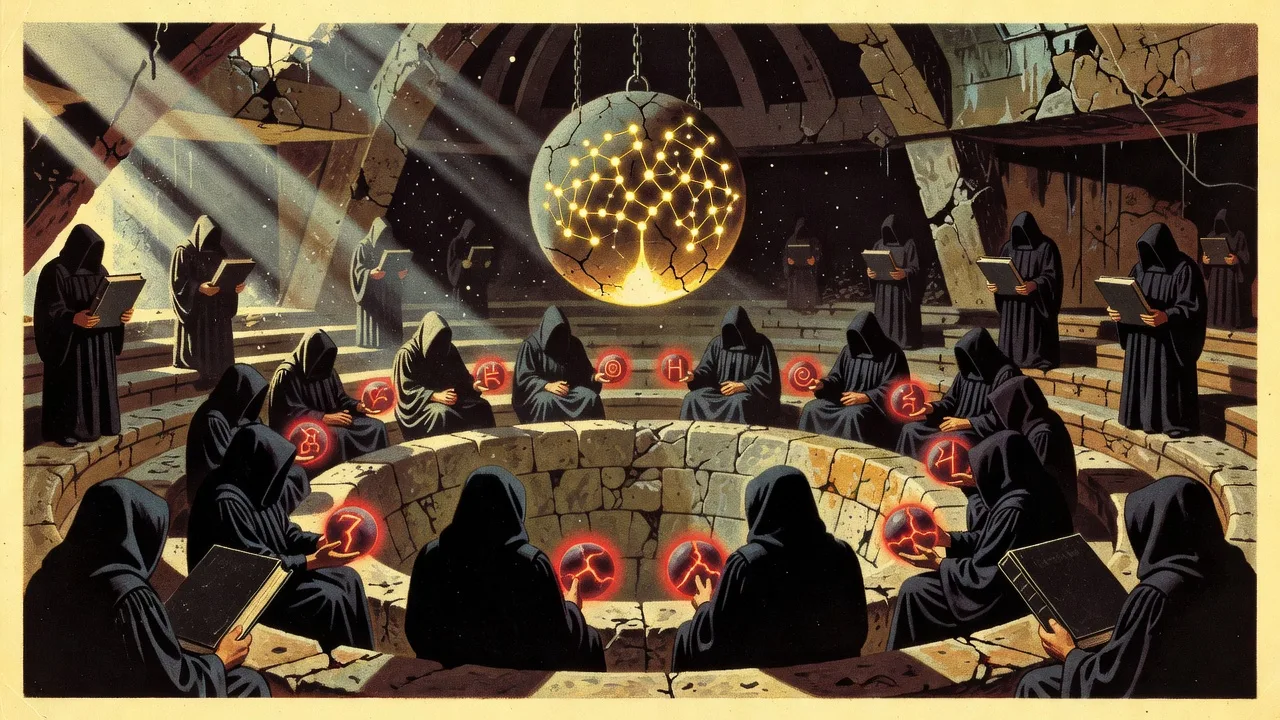
First school wins. Later usurpers, especially 20th-century American electoral marketing, are overruled.
The most effective form of theft is renaming
You cannot conquer a people and keep them grateful. But you can rename what they are, and they will defend the new name with their lives.
The deepest form of conquest was never the occupation of territory. It was the occupation of the dictionary. Keep the word. Replace the referent. Keep the emotional payload. The voters who voted for “democracy” in 2026 were voting for a word that meant, to its first school, the direct rule of the people by the people; and got, in exchange, the pleasure of choosing between two pre-selected oligarchs every four years. The word did the work. The meaning did not need to.
This is not a metaphor. This is the most efficient propaganda machine ever built, and it runs on a single move: rename the enemy’s weapon before he can fire it. You cannot file a complaint against a system when the word for the complaint has already been reassigned to describe the system. “Liberalism” meant liberty under law; the people who emptied it still call themselves liberal. “Conservatism” meant the organic evolution of inherited institutions; the people who emptied it defend the demolition. Every argument you try to make arrives already translated into your opponent’s dictionary.
We spent a century arguing with stolen words. This series is where we go to get them back.
There is a particular sting in noticing who stole them. Not philosophers. Not priests. Not generals. Brand managers. Twentieth-century American electoral marketing is the most successful ideological operation in human history, and it worked by the simplest possible trick: leave the word on the building, change what happens inside, collect rent on the label. The tenants think they live in the original. They have never seen the deed. They never will, because the deed was filed in Athens in 508 BC, in Rome in 509 BC, in Lyon in 1843, in Cádiz in 1812, and the squatters are not giving it back.
This court gives it back.
The court
Two earlier essays established the terrain. The Conspiracy of -Isms showed that the supposed enemies of the last century, capital and communism, were dancing together while we picked sides; the dialectic was false. Every -Ism Needs Neurotoxin argued that no ideology should be trusted as a destination, only respected as a compass; every one of them needs the anarchic stress test, the black flag injected like a vaccine.
The Etymological Court is where those two meet. If the dialectic was false, then the words were stolen, and this is where we find out who owns them. And every ideology that comes before this court, whatever the verdict, faces one question that outranks all the others:
Can they leave?
That is the question Exitarianism asks of every system on earth, and it is the question this court asks of every -ism in the docket. A democracy that cannot be abandoned is a democracy in name only. A socialism that arrests its own critics is a prison with a slogan. The label means nothing. The door means everything.
The hinge of the nineteenth century
Before the docket opens, one name belongs at the center of the picture, because three of the words in this series will be claimed by his heirs for the rest of the proceedings, and the courtroom deserves to know whose word it really was.
Pierre-Joseph Proudhon is the hinge of the nineteenth-century anti-statist left, and most of the twentieth-century left has never forgiven him for it. The mutualist says Proudhon. The anarchist says Proudhon. The syndicalist says Proudhon. Three schools, three different programs, all claiming the same man, and the reason is that the man they are claiming actually wrote the question they are each answering. What is Property? (1840) is not a slogan. It is a hinge. It separates possession from property: the user from the deed-holder. It separates the wage relation from exchange. It separates the state from the economy. From those separations, every later anti-authoritarian left descends: mutualism keeps the market and abolishes usury; anarchism keeps the federation and abolishes the state; syndicalism keeps the union and abolishes capital. None of them owns him. All of them owe him. And the descent has a chronology the court keeps straight: mutualism is his own doctrine, from his own pen; anarchism came through Mikhail Bakunin, the man who called himself Proudhon’s direct political heir and fought Marx for the soul of the First International; syndicalism was built a generation later, from Bakunin’s inheritance. Grandfather, son, grandson: the family resemblance is real, and so are the arguments at every generational step. The court will return to him three times; he deserves the credit in advance.
That is also why the American twentieth century worked so hard to bury him. A man who had already abolished property in 1840 is hard to sell a property tract to. The squatters needed him gone, and they renamed him into oblivion: the mutualist word into a folksy prequel, the anarchist word into a bomb-throwing cliché, and the libertarian word into a defense of the very wage relation he spent his life dismantling. Three thefts, one victim.
He is on the docket. The court will hear his cases in order. The hinge stays in the middle of the room.
The method
Charity first. The court reads each ideology at its best before it rules. What did it want? Not what did its worst practitioners do with it; what did the first school genuinely hope to build? That is the minimum standard of honesty in this series: understand the goal and the why before delivering the verdict. A verdict about a doctrine you were never willing to understand at its best is not a verdict. It is an insult wearing a robe.
The exception is the obviously-bad tranche. Some words were never hijacked because their first schools were already terrible; the court does not perform charity on them. It performs precision. Fascism gets a full entry for exactly that reason: as the negative control. When you use “fascist” to mean “any authoritarian I dislike,” you have stolen a specific, documented, 1932 doctrine and replaced it with a mood. That is the same crime this court prosecutes; you just committed it in the other direction.
The Damage Report
Eight words, stolen, with the rightful owners named. This is the roadmap for the first two weeks of the docket:
| Word | Rightful owner (first school) | The squatter | Ruling |
|---|---|---|---|
| Democracy | Athens, 5th c. BCE: direct rule by the demos, sortition, immediate recall | Representative systems: electing an oligarch every four years | Democracy = direct participation. The rest is a republic |
| Liberalism | Locke, Hume, Smith: natural rights, limited government, free markets | American welfare-state “liberalism” | Liberalism = liberty under law. US “liberals” are social democrats |
| Conservatism | Burke, 1790: organic evolution, accumulated wisdom | Nationalist reaction, religious fundamentalism, populism | Conservatism = continuity. Burke was a Whig |
| Socialism | Owen, Fourier, Leroux: cooperative production for use | ”When the government does stuff”: taxes, roads, healthcare | Socialism = social ownership of capital, not a tax rate |
| Communism | Marx & Engels, 1848: stateless, classless, moneyless | USSR, PRC, DPRK: massive authoritarian states | Communism = no state. What existed was state capitalism |
| Anarchism | Proudhon, 1840: “no rulers,” not no rules; mutual aid | The chaos stereotype, the bomb-thrower caricature | Anarchism = ordered self-management without coercion |
| Libertarianism | Déjacque, 1858: Le Libertaire, a synonym for anarchist communism | Rothbardian pro-capitalists, property absolutism | Libertarian = anti-state and anti-capitalist. The Americans hijacked it |
| Fascism | Mussolini & Gentile, 1932: totalitarian corporatism | The generic internet insult for “authoritarianism I dislike” | Fascism = a specific doctrine. Use it precisely or not at all |
The docket
One case a day. Seventeen cases, in order of defensibility: the constructive visions first, the hard cases at the end, the negative control last of all. Then, on the final day, the court takes its newest entry: Exitarianism, the only -ism in the docket whose first school is the meta-rule itself.
You will recognize it if you have read the Libertaria Federation Constitution. Axiom Zero: no Chapter may prevent, delay, penalize, or disincentivize the departure of any Sovereign. And beyond that floor, Chapters are fully autonomous. Democracy, monarchy, consensus, markets: all permitted. Every -ism in this docket may govern a Chapter. None may lock the door. That is the capstone this whole series has been building toward: the one -ism whose first school decided that the only political principle worth constitutionalizing is the right to leave the others behind.
After the court adjourns, the founders state their own answer, for their own Chapter: The Post-Liberal Path. And then the exhibit: The Berlin Coda, the record of the twentieth century’s largest experiment in centralized ownership, and the one question the plan could never answer.
The Door
Why go to all this trouble over words?
Because if you cannot name the theft, you cannot exit the meaning. Language is the first lock on every door. The twentieth century taught us to argue inside stolen vocabulary, “democracy” against “communism,” “liberty” against “tyranny,” and both teams were speaking a language neither owned. The people who wrote the definitions won every argument before it started.
This court is the undo button. Every verdict returns a word to its owner. And every returned word is a door opened: the door out of the false binary, out of the stolen label, out of the meaning you never consented to.
Seventeen cases, one a day, through September. Then the founders’ answer. Then the exhibit. One rule.
First school wins. The squatters are overruled. Every -ism in this docket gets one day in court, and every verdict hands the word back to the people who first wrote it.
Now read the first case. Tomorrow we begin.
Series: The Etymological Court · Next case: Democracy