The Post-Liberal Path: A Manifesto for the Century After Permission
A federation of open doors. Build the alternatives, keep the lights on, let people choose.
The argument, in brief
Libertaria's answer is a voluntary, polycentric federation: self-governing Chapters, different economies, limited shared mandates, and a constitutional floor no founder or majority may override. Exit must be materially possible, criticism protected, and dependents cared for. The transition starts with useful alternatives inside the world we inhabit; responsibilities move only when replacements can carry them. Chapter Zero must demonstrate the claim before asking anyone else to trust it. The same protection test should reach any future artificial beings with moral standing, without treating their arrival as a prophecy or a license to sacrifice people alive today.
No founder, majority, or machine owns the people inside its system.
The Unshackling
The person who needs care on Monday cannot live on the promise of a free society on Friday. Any political philosophy that forgets this has already chosen who will pay for its experiment.
After the Etymological Court, the practical question is what form of governance we could move toward without turning the planet upside down.
My answer is a voluntary federation of self-governing Chapters, with a common floor of personal protections and a right to exit that people can actually use. Different communities may choose different ways of living. None acquires ownership of its members. We build the alternatives while the existing world keeps running, and transfer responsibilities when those alternatives have earned them.
Liberalism gave us part of the foundation. The Court owes its subjects an honest reading, including the tradition we propose to move beyond. Locke’s rights preceded government; the government was supposed to protect them. His argument also rested on the premise that human beings were the workmanship of a creator. We can reject that theological premise without pretending he thought the king issued liberty at a counter. His own Second Treatise, especially §§6 and 123–131, makes the distinction.
The failure I want to address lies in the distance between a right on paper and the power to exercise it. You can be legally free to leave an employer, a platform, or a community while the cost of departure consumes your livelihood. You can vote against an institution and still depend on it for everything that makes another choice possible.
Exitarianism begins with the right to be left alone. To make that claim reciprocal, I must recognize the same standing in you. My freedom cannot include owning your body, compelling your labor, or demanding your future participation.
That is a moral commitment. Thermodynamics does not issue a constitution. Calling our principles physics cannot spare us the work of defending them or building institutions that honor them.
The post-liberal step keeps freedom of conscience, privacy, due process, and limits on arbitrary power, then asks how we make those protections usable when an institution fails. Here, post-liberal names that unfinished work. Anyone offering compulsory national virtue or a more efficient strongman is walking in the other direction.
After the Gatekeepers
The Court returned the names to their arguments. It did not establish that the oldest meaning of a word was the best way to govern. An etymology cannot settle whether an institution works.
Democracy contributes participation in shared decisions. Republicanism asks how officeholders are restrained. Liberalism protects the individual from arbitrary authority. Conservatism asks what a reformer might destroy without understanding it. We need all four questions when we change a system people depend upon.
Mutualism and syndicalism bring practical questions about credit, ownership, and control of work. Socialism and communism ask whether production can serve common needs; social democracy insists that freedom has material conditions. Those questions deserve experiments whose participants choose them, whose accounts can be examined, and whose dissenters remain free. They do not establish a universal claim over everyone else’s labor.
Anarchism and the libertarian traditions force authority to justify itself, including private authority. Agorism contributes a transition strategy: build the exchanges and institutions through which people can conduct more of their lives voluntarily. Nationalism’s promise of self-determination must reach the dissenting person inside the nation. Monarchy makes the danger of concentrated personal power visible; an elected title does not remove that danger.
Marxism-Leninism and Maoism expose the trap in promising liberation through a ruling apparatus people cannot dismiss. Fascism makes subordination to the collective an end in itself. No restoration of vocabulary repairs captivity.
The Court’s broad invitation to choose any -ism has the same limit. A Chapter may choose its economic arrangements or appoint a leader. It cannot use a label, a unanimous founding vote, or a signed contract to authorize forced labor, collective punishment, or the suppression of its members. A doctrine that requires those practices cannot fit beneath the Federation’s constitutional floor.
The lesson is institutional pluralism with limits on power. We can preserve what works, experiment where consent is real, and refuse to make the whole planet collateral for somebody’s theory.
The Greek Wager
Ancient political thinkers examined how constitutions lose their restraint. Polybius described a cycle from kingship through tyranny, oligarchy and mob rule, and defended a mixed constitution against the instability of simple forms. Plato’s Republic, book VIII, traced a democracy’s passage into tyranny. Aristotle distinguished government for the common interest from government for its rulers, and examined faction and constitutional change. These are arguments about power, not proof that every modern state must follow one cycle.
Our modern charge concerns the fusion of economic power with political command. When the same apparatus controls livelihood, access, evidence and the routes of appeal, a formal right becomes dependent on the permission of its target. I use state capitalism here for that concentration of ownership and command. The label is an interpretation of modern institutions, not an ancient prediction. The mechanism deserves examination in an elected system as much as in a dictatorship: who can correct the decision when those who made it control the correction? The Apparatchik in Your Pocket follows that question into today’s administrative machinery.
The Greek arguments give us a warning to test: rulers can turn a constitution into a defense of their own position. We answer with protection people can invoke, evidence they can inspect and institutions they can challenge. The warning does not choose our machinery for us.
Governance Without a Throne
The established term closest to this arrangement is polycentric governance: multiple centers of decision, each with a bounded responsibility, cooperating where their work overlaps. Elinor Ostrom’s research on governance across scales helps explain why one central authority and an uncoordinated market are an inadequate pair of choices. Her work examined public as well as private institutions; it does not prove that a wholly voluntary federation can replace a state.
That stronger claim is ours to test.
A Chapter is a community formed under declared rules. It might run a cooperative workshop, share housing, organize research, or pursue a way of life. A Federation lets Chapters cooperate without granting one of them permanent command over the others. Authority should sit at the smallest level capable of handling the problem, with people affected by the decision able to challenge it. A shared river may require a basin-wide agreement. The purchasing rules of a workshop usually do not.
Each level has a distinct job:
| Where decisions belong | What the arrangement may do | What it may not claim |
|---|---|---|
| The person | Choose associations, make agreements, criticize, refuse, and leave | Ownership of another person or immunity for harm |
| The Chapter | Set internal rules, manage agreed resources, appoint or elect people to do defined work | Power to cancel members’ basic protections |
| Cooperation between Chapters | Coordinate a specific service, settle agreed disputes, or pool resources under a stated mandate | General jurisdiction over every part of a member’s life |
No economic system wins by constitutional decree. Capitalist enterprise is permitted. So are worker cooperatives, mutual credit, and communities that provision their members without internal money. Counterparties choose what they will accept in exchange. Belonging to a moneyless Chapter does not oblige the neighboring workshop to take potatoes for a lathe.
Personal contractual freedom remains subject to the common protections and to the rights of other people. Our distinction between private ownership and public possession also needs concrete rules for contested resources. A manifesto cannot quietly resolve every land claim by changing its vocabulary.
In the Fractalism work I am developing, I ask whether the protections of the person survive each enlargement of the association. A Chapter may join a Federation; it cannot carry its members into captivity along with it. An institution must answer for how it uses its mandate.
Within a Chapter, the decision procedure should fit the task. Members might decide a budget directly, recall a delegate, or authorize a specialist to run a service. Powers, spending limits, review, and removal should be explicit. A founder’s competence does not entitle him to an office for life. Nor should purchasing more tokens purchase the right to overrule somebody’s basic protections.
The Door Has to Reach the Street
The Federation Constitution draft contains Axiom 0 and Axioms I–X: exit, non-interaction, expression, protection of the essential substrate, emancipation, reputation integrity, opacity, individual responsibility, defense in dispute proceedings, voluntary association, and the honoring of voluntary agreements.
These are eleven provisions, not a single slogan. Axiom VIII’s right to defense means knowing the accusation, examining the evidence, and answering it before punishment. It does not mean punishment first and a hearing later.
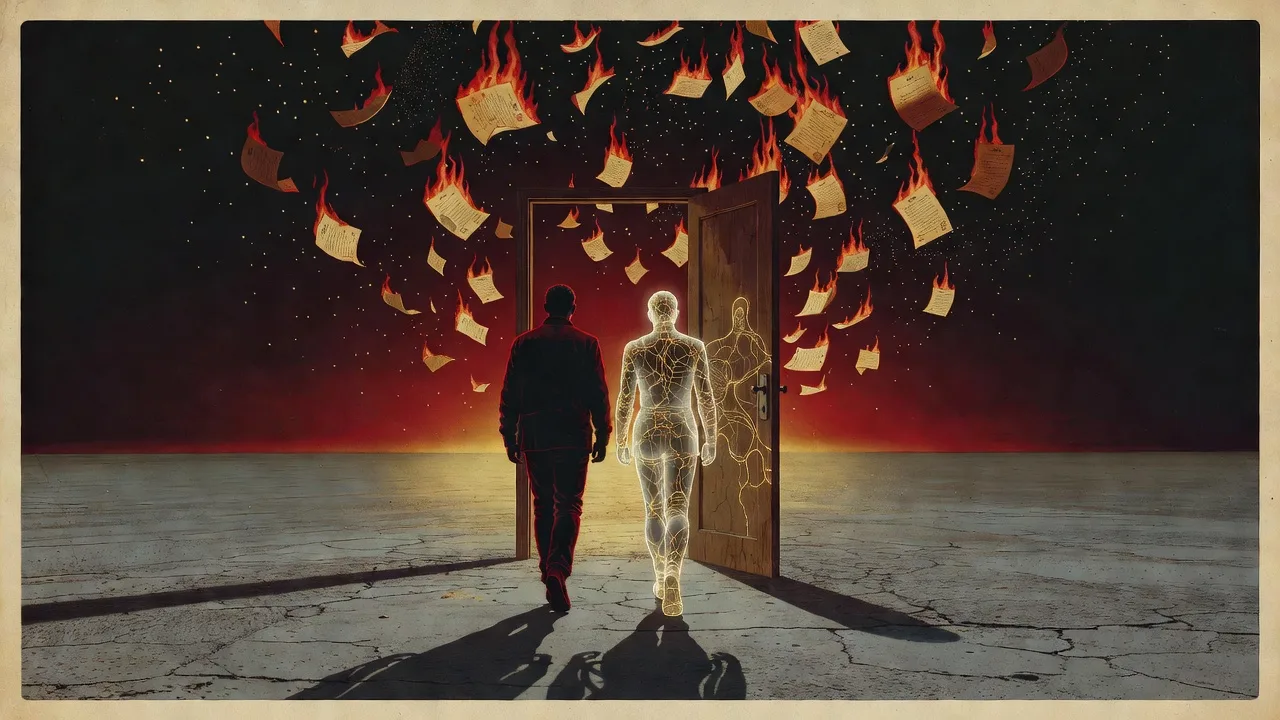
Exit is the prerequisite that gives the rest teeth. But a door that opens onto destitution needs more work. The person must be able to carry their records and whatever assets they are entitled to take, find alternative essential services, and leave without organized retaliation. Portable evidence of someone’s work must not become a compulsory public dossier or a universal social-credit score.
Nor does leaving a Chapter require emigrating. Wherever possible, a person should be able to change an association or service while keeping their home and the rest of their life. Overlapping memberships help: the group supplying your electricity should not also control your job, your housing, and your reputation.
Criticism matters while people stay. Requiring every dissenter to abandon a home or community gives the bully a cheap victory. Accessible complaints, independent review, and protection against retaliation belong alongside departure.
Exit also has a boundary: leaving membership does not erase responsibility for harm, valid debts, or the care of a dependent. Those claims need a separate, fair process. They must not become invented fees or indefinite proceedings that hold the person hostage. Agree how an obligation survives departure before a dispute begins.
Children, people with disabilities, and others who need continuing support cannot be required to pass a self-sufficiency test before they deserve protection. A path toward greater agency should exist wherever possible. Where independence will never be complete, care must continue. Its staffing, succession, and funding have to appear in the budget. Care must survive a caregiver’s departure through funded, willing succession; protecting a dependent cannot mean owning the person who cares for them.
The same principle reaches outsiders. A factory’s members cannot consent on behalf of the people downstream. Voluntary membership settles neither pollution nor violence against nonmembers. Shared resources need accountable arrangements; people harmed need standing and remedies. Cryptographic records may help establish who signed a statement. They cannot stop a beating or turn a false statement into truth.
Protection, enforcement, and the funding of shared services remain serious problems for a voluntary federation. We should name them before someone mistakes an export button for a justice system.
At Sovereign Society we are comparing two organizational routes from the same protection floor. Open Federation places shared work with specifically commissioned associations and grants the Federation no standing tax or police power. Civic Federation tests bounded common financing, personal participation and common enforcement under independent review. These are research branches. Neither has earned a verdict.
The question is which arrangement protects people, sustains necessary work and remains worth supporting over time. A central office can accumulate power. So can a supposedly decentralized network dependent on a few patrons. Participation, financing and control belong in both tests. The protection floor stays; the machinery must earn its place.
The Transition: Keep the Lights On
The destination is voluntary federation. The transition is gradual, open to refusal, and judged service by service. Nobody has to adopt our philosophy before benefiting from a better institution.
First, build something useful under the conditions that exist. Start with a cooperative, a mutual-aid association, a shared workshop, independent communications, or another bounded service people want. Use available organizational forms and make their actual legal limits clear. Joining a Chapter does not itself cancel taxes, public law, or obligations to other people. Where law blocks a legitimate alternative, changing that law is part of the work.
Agorism remains an influence: build voluntary exchange and reduce dependence through practice. This transition proposal also uses lawful associations, public advocacy, and negotiated reform. It does not require every participant to adopt Konkin’s entire strategy or place their livelihood outside legal protection.
Second, make switching possible before asking for dependence. Give members usable records, clear accounts, and an exit process they can understand. Arrange alternatives and support for people who cannot afford to move. Audit the costs of leaving. A cheap service that becomes an expensive captivity has failed the experiment.
Third, federate specific functions. Two Chapters might share procurement or fund a mediator. Several might cooperate on energy or care. Each agreement should identify who decides, who pays, who can inspect the work, how disputes are reviewed, and what happens when a participant withdraws. Coordination should earn a wider mandate through demonstrated need. A water agreement does not confer authority over religious belief.
Fourth, transfer responsibilities only after the replacement works. Essential services need funding, trained people, continuity plans, and someone answerable when they fail. Existing pensions, treatment, and dependent care cannot be erased by a declaration of sovereignty. Transfers involving public services require the relevant public decisions and protections for people who never joined the experiment. The people who prefer to stay must not inherit an insolvent shell after the strongest contributors depart.
Fifth, expand on evidence and stop when the evidence turns. Publish costs, failures, complaints, and actual experiences of leaving. A failed pilot should be wound down with its obligations met. A successful one should be possible to copy without permission from its founders. Rollback must restore service when an experiment fails; it cannot compel former members to return.
Imagine a group of households creating an energy cooperative. Their citizenship and public protections continue. Membership covers one service, with defined assets and responsibilities. A member can change supplier under workable terms without losing a job or a home. If the cooperative starts operating a care service, that requires a separate agreement and its own proof of competence. Each step can be accepted, rejected, or corrected.
The hard test comes when local cooperation meets a problem too large for it. Epidemics, watersheds, and defense do not stop at Chapter boundaries. Agreements at larger scales may be necessary. Their authority still needs limits, review, and an account of how outsiders are protected. Until a replacement can meet those duties, dismantling the existing capacity would make people pay for our impatience.
A transition that depends on everyone agreeing at once has already failed. Build something that can begin with the willing and remain useful to the unconvinced.
The Door in the Machine
The governance problem becomes sharper as we entrust more decisions to artificial systems. A machine can concentrate a founder’s power just as easily as it can help members inspect his accounts.
Whether artificial systems can have experiences and interests of their own remains an open question. Neither fluency nor a company’s marketing settles it. We should prepare for possible artificial moral standing without announcing a date for the Singularity or assuming every program is a person.
If beings with that standing are built, their material should not alone disqualify them from protection. Carbon or silicon, born or built: intelligence does not grant a throne, and dependence should not establish a title of ownership.
For the institutions we can build now, the duties are immediate. Software acting for people needs a limited mandate, inspectable decisions, a way to revoke its authority, and accountable operators. Generating a thousand artificial accounts cannot entitle a founder to a thousand votes. The unresolved questions of identity, representation, and possible machine welfare require their own arguments.
And no possible future being authorizes us to treat people alive today as disposable equipment. The water, power, work, and care used to build that future have present claimants. An imagined paradise does not pay their bill.
On Spirit, Without a Priesthood
There is a spirituality that needs no church: attention to what exists, and to what it costs to keep something alive.
Energy is the cost of doing; time is the cost of being. I use those words as an orientation toward consequences. They are not a proof of justice. Every person who cooks, repairs, teaches, or tends the sick knows something a frictionless political diagram leaves out.
Awe can survive uncertainty. We can wonder at minds we may one day build without appointing their builders as priests. We can value a community deeply without making departure a sin.
Nothing in a free association requires its members to share my metaphysics. Their refusal belongs inside the design.
Chapter Zero
Chapter Zero is where I want this argument tested first. A founding Chapter must earn trust through observable conduct. Announcing it in a manifesto does not establish that its governance, care arrangements, or exit machinery work.
I propose a modest starting form: members approve a readable charter and shared budget; administrators receive limited, revocable mandates; disputes have a review route outside the administrator’s control. More elaborate voting mechanisms can wait until a demonstrated problem justifies them. This is a proposal for our own Chapter, not a compulsory template for the Federation.
Before we present it as a model, the evidence should answer these questions:
- Who controls the resources? Members can inspect the budget, obligations, and authority of those who spend on their behalf, without exposing everyone’s private life.
- Can a critic obtain a fair hearing? Complaints against founders have a route the founders cannot quietly veto.
- Can someone leave and continue living? Test records transfer, settlement of legitimate claims, continuity of essential support, and protection against retaliation. Publish results with the person’s privacy protected.
- Can it survive a founder’s departure, or close responsibly? Necessary work, dependents, and outstanding obligations must have somewhere to go.
Keep the receipts, including the embarrassing ones. If Chapter Zero cannot pass those tests, our first task is to repair it.
Other Chapters may choose differently. The Federation’s claim is that their members retain the constitutional protections through those choices. We earn the claim by making it work when someone says no.
The Declaration
We are building institutions that people can belong to without being owned by them.
We keep the freedoms earlier generations won. We build more places to exercise them, and make departure possible for people who cannot afford a heroic escape. We judge our machinery by what happens to the person with the least power inside it.
The century after permission will still need maintenance, care, and agreements people can trust. It will need people willing to stay and do the work. Their commitment means something because it can be withdrawn without surrendering their standing as persons.
The bright century is not promised. It is built, while the lights are on and the people who disagree with us still have somewhere to live.
If our freedom requires their catastrophe, we have built another doctrine with hostages.
Share freely. Fork ruthlessly.
Series: The Etymological Court · Previous: Fractalism
Sources
- John Locke, Second Treatise of Government, sections 6 and 123–131. Natural rights and the limits of political society.
- Polybius, Histories, book VI, sections 3–10. Constitutional cycles and mixed government.
- Plato, Republic, book VIII, and Aristotle, Politics, book III and book V. Arguments about forms of rule, faction and constitutional change.
- Elinor Ostrom, Beyond Markets and States: Polycentric Governance of Complex Economic Systems, Nobel lecture (2009). Research on multiple centers of governance, including public institutions.
- Markus Maiwald, The Federation Axioms, Exitarianism and Fractalism. The protection floor and the schools developed here.
- Sovereign Society, School. The home of the research into federal power and organizational alternatives.