The Etymological Court #18: Fascism
A specific, documented 1932 doctrine: not a mood, not a vote you dislike, not 'authoritarianism I dislike.'
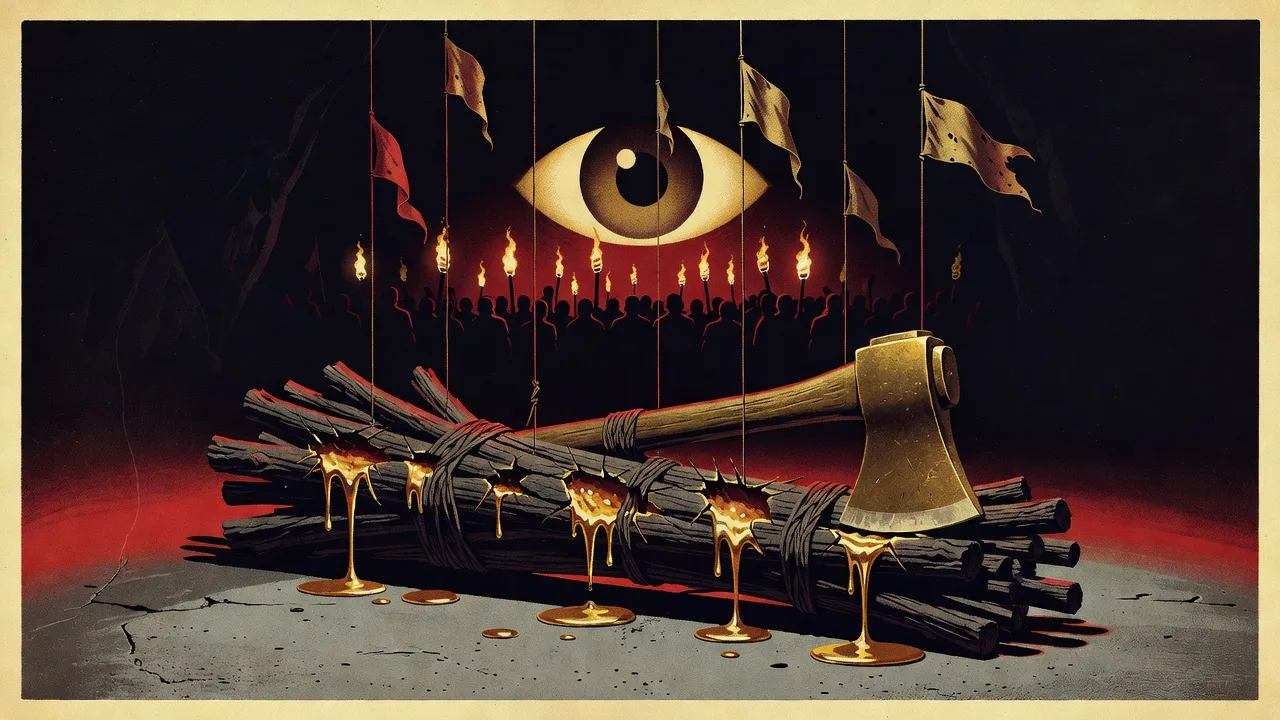
The word named one specific, documented, dated regime. The squatter didn’t steal its virtue; he stole its precision.
The Word
fascio. Italian for bundle. The fasces: rods tied around an axe, carried before Roman magistrates as the sign of authority. The single rod breaks; the bundle does not, and that was the promise, and the whole lie.
The Fascist party took the image and made it a name: the fascio littorio, born of the Fasci Italiani di Combattimento (the Italian Fasces of Combat), founded in Milan in 1919, carried to power by the March on Rome in 1922. A fringe squad of blackshirt veterans had become the state.
Notice what the symbol already admitted. The rods don’t bind themselves. They are bound from outside, by the lictor. Unity by coercion, dressed as unity by nature: the symbol was the doctrine before the doctrine had a name.
What It Was
No charity. This is the court’s negative control: no reading at its best, because it has no best, only precision.
Mussolini and Giovanni Gentile published The Doctrine of Fascism in 1932. Read it and you will not find a mood. You will find a list:
The totalitarian state. “Everything within the State, nothing outside the State, nothing against the State.” The state is not a framework for society; it is society’s whole content. There is no private sphere it does not claim.
Corporatism. Not workers owning the workplace; the state owning both. Capital and labor organized into state-controlled syndicates, each side folded into state bodies until the class war ends not by justice but by absorption. The state becomes the only employer and the only boss.
Actual idealism. Gentile’s philosophy, the intellectual engine: the individual mind is real only insofar as it is absorbed into the state-mind.
The subordination of the individual. The doctrine’s own proud claim: the individual exists only in the state, through the state, for the state. There is no “I” the state does not own.
And then: extreme nationalism, militarism, anti-liberalism, anti-communism. Fascism sold itself as the third way that abolished both capitalism and communism. It was the first way that abolished the individual.
The court quotes without endorsing a syllable. Finding: this is what the word names. Nothing else does.
Why It Mattered
The problem it claimed to answer was real. Post-war Italy: “mutilated victory,” inflation, the Biennio Rosso, two years of factory occupations and uprisings. Liberal democracy looked exhausted, revolution closer, parliament a theater where nothing got decided. Fascism offered the frightened answer: a state that acts instead of deliberates.
What it actually did was larger. It built the template every totalitarian regime after it would copy: the mass party, the street army, the cult of the leader, the one-party state, the controlled press, the police state. Nazism copied it openly. Every one-party regime of the century is in debt to the model Italy finished building in the 1930s.
It mattered because the century’s central question became whether the individual survives the state, and fascism answered first, completely, on an industrial scale, philosophy supplying the warrant. It proved a modern people would consent. That proof is the core horror: not the doctrine, but the willingness of millions to live under it.
The First School
Mussolini’s Italy: not a gathering of founders but a functioning regime. The March on Rome, October 1922, a coup dressed as a parade, and the king handed over the government. By 1932 the doctrine was written down: The Doctrine of Fascism, composed by Mussolini with Giovanni Gentile, published in the Enciclopedia Italiana, the regime’s theory of itself, signed, dated, filed.
Its content is the list above, in the regime’s own hand: the totalitarian state; corporatism as the state’s control of both capital and labor; the individual subordinated to a “collective will” administered by the party, and the party administered by one man.
This is the court’s point. The first school here is not romantic; it is documented. Fascism is the rare -ism whose first school wrote its own textbook. There is no hidden generous core to recover. The meaning is on the record, dated 1932.
What Happened
The usurper arrived later, not from another party but from the comment section.
“Fascist” became the internet’s all-purpose insult for “authoritarianism I dislike,” and since everyone dislikes something, it was soon applied to everything: a tax hike, a vaccine requirement, a moderation decision, a speech you find annoying, a government you didn’t vote for. The emotional payload was kept: dread, moral certainty, the weight of history. The referent was discarded.
The same crime this court prosecutes everywhere, committed in the other direction. The usual squatter steals a word’s virtue. The fascism squatter stole the word’s precision, the exact, dated, documented referent of a specific evil, and replaced it with a mood. The theft destroyed the one thing the word was for: naming the exit-killers precisely.
And the damage was not abstract. When “fascist” means everything, it names no one. The regimes and heirs that most resemble the 1932 doctrine (absorbing the individual, capturing the press, abolishing the opposition, sealing the borders) went unaccused for decades, the accusation spent on the enemies of the week. The squatter did the real fascists’ work for them. You cannot indict a system when the word for the indictment already means everything.
The Verdict
Fascism = the totalitarian-corporatist doctrine of Mussolini and Gentile, 1932: everything within the State, nothing outside the State, nothing against the State. Use it precisely, or not at all.
First school wins, and note what winning means here. The court is not returning a good name to good people; it is returning a sharp instrument to its only use. If you mean a leader you dislike, a law you hate, a policy you find harsh, the language has precise words: authoritarian, strongman, tyrant, autocrat. Fascism names one specific, documented thing. Reach for it, and you should mean that thing.
Every dilution is a small amnesty for the regime that built the doctrine. Every “literally fascist” about a tweet is a day the word does not indict the people it was forged to find.
The Door
Can they leave?
Under fascism: no. Not by accident; by the doctrine’s own proud first sentence. “Everything within the State, nothing outside the State, nothing against the State” is the exit right abolished in advance. Totalitarianism is the abolition of the door by definition: there is no outside to go to, because the state is the only reality there is. The regime did not merely punish departure; it declared departure impossible, no “you” that could depart, only a citizen of the state, or nothing.
That is why the word must stay precise.
When “fascist” means everything, the exit-killers face no accusation. The people who build the no-door regime (the party that absorbs the individual, the press it owns, the border it seals, the opposition it dissolves) are exactly the ones the word exists to find. Dilution is their alibi. Overuse is their protection. Precision is the only door the court can leave open.
So the test stands, applied to the negative control with the same ruthlessness as everywhere else: can they leave? If the answer is no, by the regime’s own stated doctrine, the word that names the no-answer must be kept sharp. A word that cannot accuse is a door that cannot open. Keep the bundle bound to one meaning, and the exit-killers stay named.
Series: The Etymological Court · Previous: Monarchism · Next: Exitarianism