The Etymological Court #19: Voluntaryism
A doctrine built on consent, and a state that calls compulsory payment voluntary.
The argument, in brief
From voluntas, the will: human association by consent, with no exemption for the state. Victorian voluntaryists fought compulsory support for churches and schools; Auberon Herbert developed the broader creed. Carl Watner, Wendy McElroy, and George H. Smith revived the name in 1982 and rejected electoral politics as consent to coercive rule. The IRS uses voluntary for self-assessment within a compulsory tax system. The same question follows the word into private life: can you refuse and leave, or has the other party deliberately blocked the alternatives?
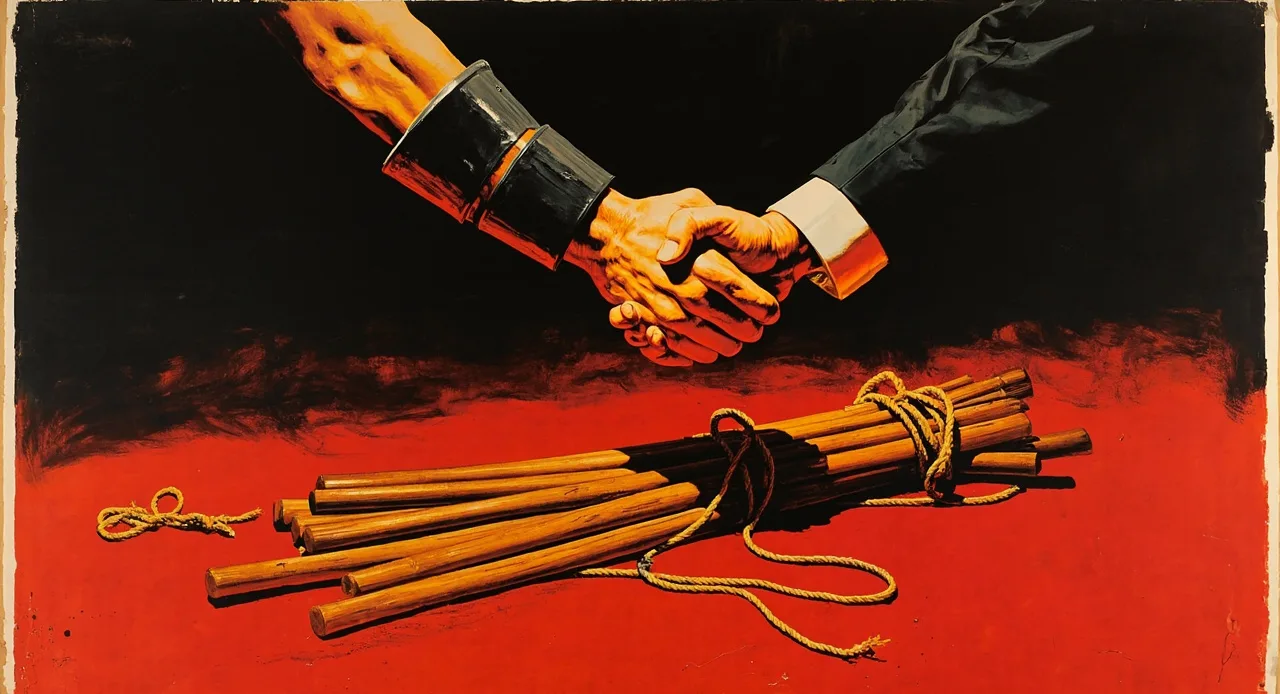
The tax authority lets you calculate what you owe. Refuse to pay, and it can collect by force. It calls this arrangement voluntary compliance. Somewhere between the form and the collection notice, the word lost the part about your will.
This case brings the state itself before the Etymological Court. The other defendants borrowed good words to dress up their doctrines. Here the authority has borrowed the word that tells you whether you agreed to the arrangement at all.
The Word
The Latin voluntarius means willing, of one’s own free will. It comes from voluntas, the will, and ultimately velle, to wish. English had voluntarie by the late fourteenth century, with the same requirement: the act proceeds from your own choice, without external constraint (Etymonline).
The political noun grew out of British disputes over churches and schools. By the 1830s, voluntaryism named the principle that both should remain independent of the state and receive voluntary contributions. Supporters opposed compulsory funding as well as official control; paying for somebody else’s religious instruction was already enough of an objection (Carl Watner, “On the History of the Word ‘Voluntaryism’”).
The school dispute made that objection concrete. Voluntary societies and churches provided much of elementary education in England and Wales, alongside government grants introduced in 1833. Forster’s Elementary Education Act of 1870 kept the existing voluntary schools and added locally elected school boards, funded from local rates, to supply places where provision was insufficient. Voluntaryists failed to keep education independent of compulsory public funding. Their objection survived the defeat.
Auberon Herbert carried it beyond the schoolroom. His Free Life, launched in 1890, made voluntary funding a test for government itself. Nearly a century later, Watner, Wendy McElroy, and George H. Smith revived the name for a movement that rejected electoral politics altogether. The dispute had widened from who should pay for the school to who had agreed to be governed.
What It Wanted
Every human association should be voluntary. The doctrine applies that requirement to employers, churches, communities, and governments. A useful service still needs your consent; roads, schools, and national defence cannot supply it on your behalf.
It begins with self-ownership: you belong to yourself. Nobody acquires a right to command you by claiming to know what you need. Herbert allowed defensive force against aggression, including fraud, while denying any individual or government the right to initiate it. A larger crowd cannot create a moral permission that its members do not possess separately (The Principles of Voluntaryism and Free Life, 1897).
That leaves compulsory taxation with a problem no election can solve. The payment remains compulsory whoever wins. You can approve of the hospital, use the road, and still never have agreed to the tax. The voluntaryist asks the state to justify the means by which it funds the service, instead of treating the service as its own justification.
Herbert called the alternative voluntary taxation. Institutions would have to persuade people to fund them and accept refusal. He retained a limited government for protection; the later American revival rejected the state. Both denied it an exemption from the consent it demanded in ordinary dealings.
For the 1982 movement, that also meant refusing the ballot. Voting helped legitimize an authority that would rule voters and non-voters alike. Its founders proposed education, peaceful withdrawal of cooperation, and the building of voluntary alternatives. McElroy set out the strategy in “Neither Bullets Nor Ballots,” in the first issue of The Voluntaryist.
The demand was plain: the state must ask for its funding and take no for an answer.
Why It Mattered
The doctrines tried in this series have offered rival authorities: a crown, a party claiming to speak for a class, a state claiming to embody the nation. Voluntaryism asks each to produce the person’s agreement. Changing the ruler leaves that question unanswered.
Lysander Spooner had already pressed the objection in No Treason, No. VI: The Constitution of No Authority, published in 1870. He argued that a constitution could not bind people who had never agreed to it, and that voting under an imposed government proved no such agreement. A person could vote to protect himself from rulers he had never authorized. Participation under those conditions supplied the rulers with no consent.
Voluntaryism turned that objection into a way of organizing. Schools, mutual aid, trade, and protection had to be built through willing participation. It gave this court a standard that survives a change of flag: a doctrine can promise equality, prosperity, or national glory, but the promise grants it no authority over somebody who refused.
The First School
Auberon Herbert (1838-1906) came from the English governing class and had served in Parliament. He knew the institution whose authority he challenged. Influenced by Herbert Spencer, he developed his argument in The Right and Wrong of Compulsion by the State, published in 1885, before founding Free Life. The paper ran from 1890 to 1901, first weekly and then monthly (Wendy McElroy, “Auberon Herbert”).
Herbert kept government subordinate to the individuals who created it. Protection against force was a legitimate task; taking peaceful people’s money against their will was not. His Voluntaryist Creed, delivered as a lecture in 1906 and published posthumously in 1908, extended the argument against compulsory rule. Benevolent intentions gave nobody ownership of another person’s life.
The American founders returned to that inheritance in 1982. McElroy recalled their meeting in the Hollywood apartment she shared with Smith: Watner visiting, the three discussing how to abandon electoral politics and demonstrate voluntary institutions in practice. They deliberately revived an old name for that purpose (“Voluntaryism: Some Personal Reminiscences,” 2019).
Their first issue appeared in October 1982. The Voluntaryist continued through December 2020, the month Watner died, leaving an archive of thirty-eight years of argument. The newsletter debated libertarians who still voted and preserved the work of earlier opponents of compulsion. Its founders sought change through persuasion and withdrawal of cooperation, rather than a campaign to occupy the offices they opposed.
The two schools differed over government. The demand for voluntary support remained recognizable across the distance between them, which makes the word’s later career especially obscene.
What Happened
The United States tax authority uses voluntary to describe a system in which taxpayers calculate and report their own liabilities. Its Revenue Ruling 2007-20 spells out the meaning: filing and payment are compulsory; the taxpayer makes the initial calculation instead of waiting for the government to assess the bill. The adjective describes cooperation with collection, while the power to compel payment remains intact.
You do the arithmetic on your own coercion. The state keeps voluntary on the form and removes your choice from the transaction. It could call the procedure self-assessment, but that would leave the compulsion rather more exposed.
This borrowing follows the word into other institutions. Consider a regulator offering a voluntary code while threatening to impose the same terms by law, or a platform demanding agreement while blocking the transfer of a user’s records to a competitor. The regulator can turn refusal into an offence; the platform can make departure depend on surrendering what belongs to the user. Each can collect an apparent yes after obstructing the no.
The I agree button finishes the paperwork. A click records acceptance, but proves little about the conditions that produced it. Calling an arrangement voluntary cannot settle whether its participants understood it, could refuse it, or could leave with their rights intact.
The state has the largest advantage in this trade: it can enforce the arrangement whose name denies the enforcement. Private enthusiasts can borrow the adjective too. A business owner who advertises voluntaryism while trapping staff or tenants deserves the same examination. The name supplies no exemption to its friends.
The Verdict
Voluntaryism means human association by consent, with no exemption for the state. Its claim stands or falls with the person’s ability to refuse.
The court returns the word to those who accept that requirement. An offer must allow refusal without retaliation for refusing. The tax authority’s definition fails it: you remain liable however clearly you say no. The paperwork gives you responsibility for the calculation and no choice about the obligation.
The first school wins on the meaning. Its successors must meet the same requirement in their own institutions. That brings the case to the question this series has asked at every door.
The Door
Can they leave? An association that begins by consent must permit its members to end that association. A voluntaryist community that prevents departure has violated the principle it claims to embody.
Departure also depends on the conditions outside. The socialist cases in this docket raised the hungry worker signing a wage contract. Hunger makes the choice urgent; offering him work does not itself create the hunger or constitute aggression. A better offer than his other options remains an offer, even when those options are poor.
The question changes when the employer has used coercion, exclusive licences, or control over access to close those other options. A contract signed after somebody has deliberately blocked your alternatives cannot establish the voluntariness of the arrangement that blocked them. The court must examine how the dependency was created, rather than stop at the signature.
That examination reaches the state, the employer, and the community promising open membership. An existing debt can survive departure. A penalty imposed for departure itself makes membership compulsory. The distinction has to hold in practice: you must be able to leave with what is yours, without needing the institution’s permission to remain yourself.
The next case, Exitarianism, follows that person through the exit. An unlocked door is of little use if the institution keeps everything you need to live on the other side.
Series: The Etymological Court · Previous: Fascism · Next: Exitarianism
Sources
- Douglas Harper, “Voluntary,” Online Etymology Dictionary. Latin roots and the late-fourteenth-century English adjective.
- Carl Watner, “On the History of the Word ‘Voluntaryism,’” The Voluntaryist, no. 130, third quarter 2006. Church and school disputes, nineteenth-century usage, and the modern revival.
- UK Parliament, “The 1870 Education Act”, and House of Lords debate on education, 5 July 1839. Voluntary provision, the 1833 grants, and rate-funded school boards.
- Auberon Herbert, The Right and Wrong of Compulsion by the State, 1885, and The Principles of Voluntaryism and Free Life, 1897. Self-ownership, defensive force, limited government, and voluntary contributions.
- Auberon Herbert, The Voluntaryist Creed and A Plea for Voluntaryism, 1908. The creed was delivered as the Herbert Spencer Lecture on 7 June 1906; the volume appeared after Herbert’s death.
- Wendy McElroy, “Auberon Herbert,” The Voluntaryist, no. 153, second quarter 2012, first published in Freedom Daily, February and March 2011. Herbert’s parliamentary background, intellectual development, and Free Life.
- Wendy McElroy, “Neither Bullets Nor Ballots,” The Voluntaryist, no. 1, October 1982, and “Voluntaryism: Some Personal Reminiscences,” no. 182, third quarter 2019. The founders’ anti-electoral strategy and account of the revival. The newsletter archive records continuous publication from October 1982 through December 2020.
- Lysander Spooner, No Treason, No. VI: The Constitution of No Authority, 1870, sections I-IV. The argument against inherited constitutional obligation and treating voting as consent.
- Internal Revenue Service, Revenue Ruling 2007-20, Internal Revenue Bulletin 2007-14, 2 April 2007. Self-assessment and compulsory filing and payment.