The Etymological Court #16: Maoism
Peasant revolution against the new elite; it became the new elite.
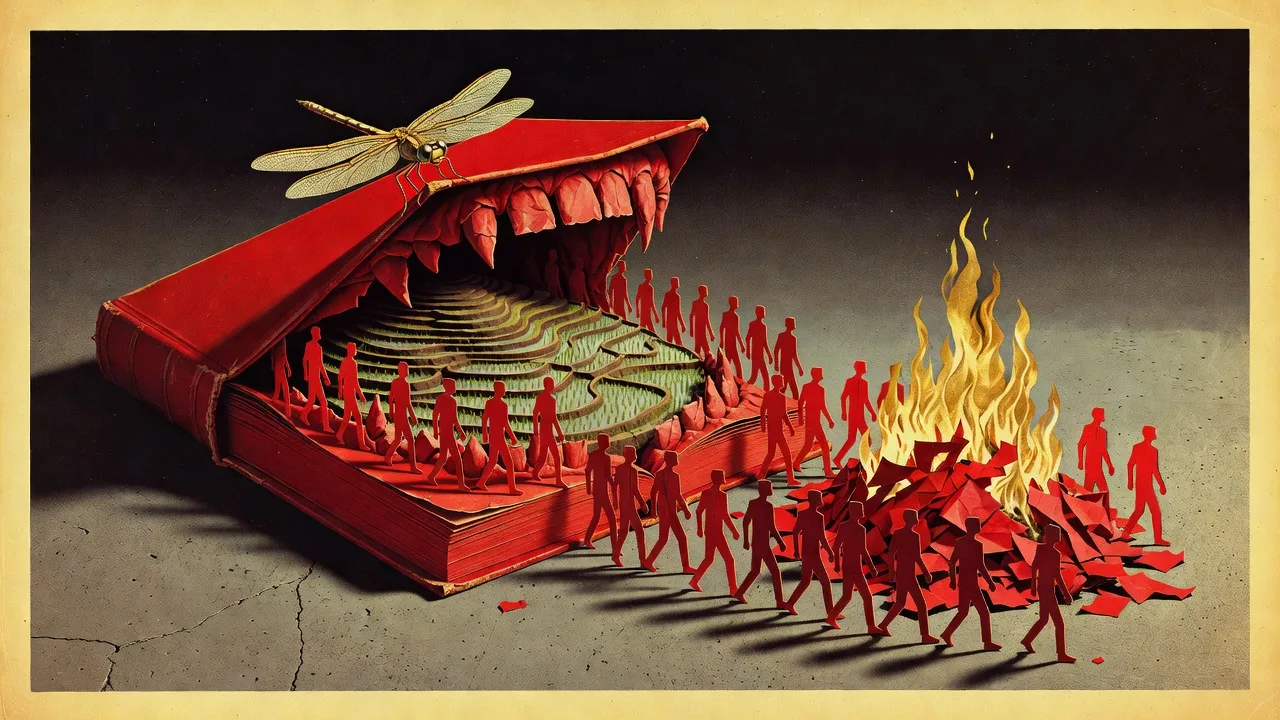
The argument, in brief
Mao Zedong Thought entered the Party’s canon in 1945; Maoism became an international revolutionary tradition. Rural strategy and the mass line addressed conditions in China but supplied no secure protection against coercive leadership. The Great Leap famine killed tens of millions, and the Cultural Revolution brought persecution and institutional destruction. Its anti-bureaucratic promise must answer for the command it enabled. Exit and dissent remain personal protections, not favors granted by the revolutionary leadership.
The war against the new elite became the new elite. Hard case: the court is precise, not kind.
The Word
Mao, the surname of one man, born in Hunan in 1893, plus -ism, the suffix of doctrine. Maoism: a doctrine named after a single man. Where other doctrines name their theories, Maoism binds its claim to its theorist’s name. The title carries its own confession.
A doctrine carrying a person’s name must answer for that person’s argument and conduct. Lenin developed revolutionary organization and governed through it; he did not stand outside the experiment later named after him. Mao likewise tested his political thought while holding power. The Court judges that record without inventing a founder who had already disowned the doctrine.
The Party canonized Mao Zedong Thought at its Seventh Congress in 1945. The name Maoism became internationally prominent around the Sino-Soviet split and the movements identifying with Mao’s strategy. It is not merely a Western label with a single birth in the 1960s. The doctrine’s international followers developed their own claims from the Chinese argument.
What It Was For
Maoism must answer for what its claims produced. Its real insights deserve credit; the practice that devoured them deserves an indictment, without a charitable gloss.
1. Marxism for peasants. Marx wrote the revolution for the industrial proletariat. China was a sea of peasants; the factory worker was a sliver. The first school’s answer: the countryside surrounds the cities, and the peasant is the revolutionary class. The diagnosis was correct beyond China: the twentieth century’s agrarian revolutions proved Marx’s industrial focus a European provincialism.
2. Protracted people’s war. Rural insurgency, guerrilla war from the countryside, trading space for time until the enemy drowns in the interior. A serious strategic insight, demonstrated in the field by the people who wrote it.
3. The mass line. From the masses, to the masses. Cadres gather the scattered wisdom of ordinary people and return it as policy. Knowledge begins in practice. A genuine epistemology, and one the bourgeois academy is still catching up to.
4. Anti-bureaucracy, continuous revolution. The fear that the revolution would harden into a new ruling class, and the claim that class struggle continues even after power is seized, so the new elite, the “capitalist roaders,” must be overthrown again and again by mass action. The fear was real; the remedy was murder. Mao deserves credit for naming the danger and must answer for what he did in its name.
Why It Mattered
Mao’s rural strategy answered the conditions of a predominantly agrarian China and the defeat of urban revolutionary efforts. That does not mean Marx had never considered peasants or agrarian communities. The relevant distinction is strategic: Mao made rural organization and protracted war central to the revolutionary project he pursued.
The second: the bureaucracy. Even a successful revolution builds a state, and a state builds officials, and officials build a distance between ruler and ruled that compounds faster than any slogan can close. Mao named the danger a new class. A revolution that installs a new elite is a lie wearing a flag. The first school identified both failures, a real intellectual achievement. Its answer was the Great Leap and the Red Guard. The diagnosis earns credit; the prescription earns the charge.
The First School
The Long March began in 1934 and brought surviving forces to northern Shaanxi in 1935. Yan’an became the later revolutionary center; it was not the destination reached at the end of that march. The struggle furnished the movement’s account of endurance and legitimacy. Endurance in a campaign does not itself establish consent to the government its survivors later formed.
In Yan’an the doctrine was written: On Contradiction, On Practice, On Protracted War, On Guerrilla Warfare. The strategy was precise: strategic retreat, stalemate, counteroffensive; the enemy’s strength dissolves in the countryside like ink in water. The politics were precise too: serve the people, the party as spearhead, not master. The mass line concealed a fatal premise: someone had to interpret what the masses said. One man heard them, read the reports from the countryside and decided what they meant. The doctrine that started with the peasant ended with the helmsman.
What Happened
The doctrine’s record is written in the death toll.
The Great Leap Forward and famine. Collectivization, production campaigns and coercive procurement accompanied a catastrophe that killed tens of millions. Ashton, Hill, Piazza and Zeitz’s demographic study estimated almost thirty million premature deaths during 1958–1961. The scale does not need an unsupported list of the highest and lowest estimates. The political problem is the destruction of correction: when officials answer to targets and punishments rather than reliable evidence, reporting failure becomes dangerous precisely when it is most necessary.
The Cultural Revolution, 1966–1976. Mao’s campaign against alleged enemies within the revolution unleashed persecution, violence and institutional destruction. Even the Party’s 1981 historical resolution judged it a grave catastrophe and assigned Mao principal responsibility. That was a later Party judgment, not Mao grading his own achievement at seven parts success and three parts failure. The mass line offered no reliable protection to a person denounced by the mobilized mass.
The usurpers. The PRC state: after Mao died, the party built a capitalist economy while keeping its own monopoly. State capitalism with Mao as logo, his face on the hundred-yuan note, the revolution’s corpse embalmed and put in circulation as currency. And the Western campus Maoists, who wore the Little Red Book as a talisman and chanted for the Red Guards from campuses in countries with open borders and a free press: fashion, at full discount. The cost was paid entirely by Chinese peasants who never made the curriculum. Fashion never has to face its own consequences; that is the privilege of the lecture hall.
The Verdict
Maoism = Marxism adapted to peasant revolution: protracted people’s war, the mass line, continuous revolution against the new elite. Its own practice (the Great Leap, the Cultural Revolution, tens of millions dead) became exactly the thing it claimed to fight. The first school loses its own case. The court is precise, not kind.
The rule of this court is first school wins. Here the first school needed no usurper; it devoured itself, publicly, at industrial scale, with body counts that ended in eight figures. The doctrine that claimed the peasant as its subject made the peasant pay for the doctrine with his harvest, his family, his life. The doctrine that named the new class became the new class’s founding myth. A word named after a single man is not an analysis; it is a logo, and logos are for loyalty, not for truth.
The Door
Can they leave?
The regime’s border enforced its refusal.
Under Maoism, exit was the ultimate betrayal. Emigration was defection, an application to leave a confession that the revolution had failed. The border was a crime scene: watchtowers, electrified fences, a river where the escaping drowned or were shot. The doctrine that claimed to liberate the peasant could not survive a single peasant walking away from it. The wall was the confession.
A revolution that prevents its members from leaving has built a holding pen with a slogan. Every -ism in this docket faces one question that outranks all the others: can they leave? The first school of Maoism answers with walls. The door is the test, and the test is failed at the fence.
Series: The Etymological Court · Previous: Marxism-Leninism · Next: Monarchism
Sources
- Mao Zedong, Report on an Investigation of the Peasant Movement in Hunan (1927), On Protracted War (1938) and Some Questions Concerning Methods of Leadership (1943). Rural revolution, strategy and the mass line.
- Basil Ashton, Kenneth Hill, Alan Piazza and Robin Zeitz, Famine in China, 1958–61 (1984), Population and Development Review 10(4), 613–645. The demographic estimate used here.
- Chinese Communist Party, Resolution on Certain Questions in the History of Our Party since the Founding of the People’s Republic of China (1981). The Party’s later judgment of Mao and the Cultural Revolution, to be read as the Party’s own account.