The Etymological Court #15: Marxism-Leninism
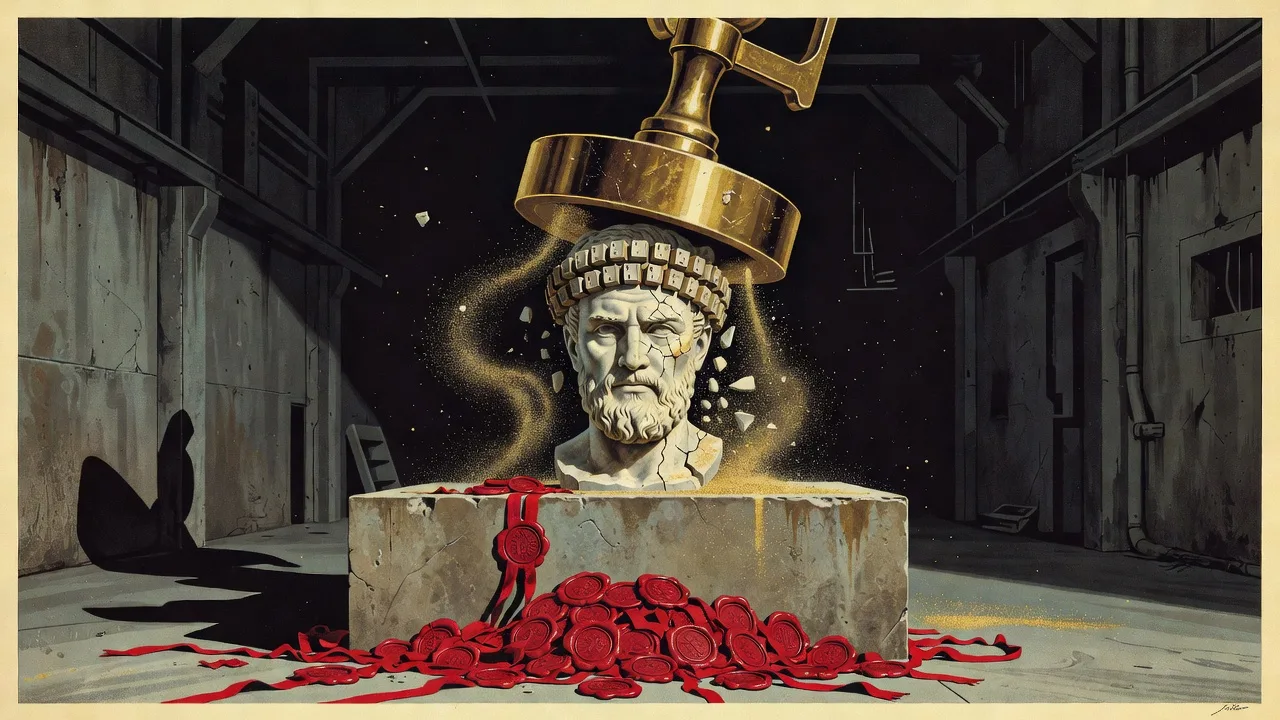
The party claims to be the class. The class loses the right to dismiss it.
The argument, in brief
Leninist ideas and the label existed before Lenin died. Stalin codified a particular interpretation in The Foundations of Leninism in 1924; he did not invent the entire school from nothing. Marx also envisaged a transitional dictatorship of the proletariat, while Lenin made organized revolutionary leadership central to his strategy. The Court judges the resulting claim to permanent party authority: no apparatus becomes the working class by declaring itself its consciousness. The right to dissent and withdraw cannot depend on the party deciding that history permits it.
The party says it is your consciousness. Disagree, and it calls you unconscious.
The Word
Marxism-Leninism joins two names and attaches a claim of authorized succession. Marx supplies the account of class and capital. Lenin supplies the revolutionary organization. The governing party declares itself their interpreter.
The chronology matters. Lenin was already arguing against opponents’ use of Leninist in 1911. Trotsky discussed Leninism in The New Course in 1923. Stalin’s Foundations of Leninism, delivered in 1924 after Lenin’s death, codified a doctrine whose ideas and name already circulated. The compound became the Soviet party-state’s official ideological framework.
Stalin did not manufacture every ingredient. He claimed the authority to settle their meaning. That claim, rather than a fictitious clean birth after Lenin’s death, is the case before this court.
What It Was For
Lenin’s What Is to Be Done? made organized revolutionary leadership central to the struggle against the Tsarist state. Professional revolutionaries would coordinate work that isolated workplace struggles could not accomplish. Repression shaped the design; the ambition extended beyond surviving a police raid.
The argument answers a real organizational problem. Scattered people face a disciplined opponent. An organization collects knowledge, protects continuity and turns separate grievances into common action.
The dangerous step comes when the instrument becomes the subject. The party ceases to serve workers who can dismiss it and starts claiming to embody the class itself. Its leadership then speaks in their name even when particular workers refuse.
That is the transfer we prosecute: an apparatus acquires authority over the people whose emancipation supposedly justifies it.
The First School
Marx cannot be reduced to an uncomplicated promise to abolish every state immediately. In the Critique of the Gotha Programme, he described a political transition between capitalism and communism as the revolutionary dictatorship of the proletariat. The later party-state did not invent the problem of transitional coercion; it inherited it.
Lenin’s The State and Revolution likewise argued for smashing the existing state machinery, establishing proletarian power and reaching a society in which the state would wither away. The promised disappearance followed a period of coercive rule. The people subjected to that period needed protections in the present, not merely an account of its eventual end.
In Foundations of Leninism, Stalin presented Leninism as an international theory of revolution and proletarian dictatorship, with the party as the leading force. He turned one interpretation into a claim to doctrinal command.
Lenin’s final Letter to the Congress supplies a separate, concrete fact. In its January 1923 addition, he proposed removing Stalin as General Secretary because of his conduct. That criticism does not erase Lenin’s own commitment to centralized revolutionary organization. Nor does it make Stalin the heir Lenin personally endorsed. Read the disagreement without inventing either an absolution or a blessing.
What Happened
Under Stalin, party authority hardened into dictatorship over the society it claimed to liberate. The leader and apparatus determined which disagreements counted as legitimate, which counted as deviation and which demanded repression. A dispute about policy could become an accusation against history itself.
The contradiction reaches the workplace. Workers are told that public ownership places production in their hands. But a worker who cannot challenge the managers, organize independently or remove the rulers does not acquire control because the deed carries the state’s name.
I judge ownership by actual power over production and its consequences. On that measure, the bureaucracy became a ruling power. State capitalism names one critical interpretation of this arrangement; bureaucratic collectivism names another. They are arguments about the regime’s structure, not interchangeable entries in a neutral dictionary.
The common indictment is more direct: calling the owner the workers does not establish that workers govern it.
The Verdict
Marxism-Leninism authorizes a revolutionary party to lead in the name of the working class. The claim fails wherever the class cannot hold that party answerable.
An account of exploitation can be illuminating. An organization can accomplish work its members could not do separately. Neither achievement establishes a permanent title to govern those members.
The doctrine’s promise of eventual emancipation cannot cancel the person’s present protection. A prison does not become a transitional institution because its governor publishes an account of the future.
The Door
Can they leave? Can they criticize while staying? Who judges the answer?
A leadership that decides when dissent is permissible also decides when its own power can be challenged. A departure permitted only after ideological approval is permission to apply for a door.
Exitarianism adds a demand the party cannot satisfy by speaking for the class: each person retains protection, voice and effective departure. Legitimate obligations remain, but allegiance cannot become an obligation for life. A Chapter can organize production collectively; it cannot turn membership into obedience to an undismissable apparatus.
No party acquires your consent by claiming to understand your interests better than you do.
Series: The Etymological Court · Previous: Communism · Next: Maoism
Sources
- V. I. Lenin, The New Faction of Conciliators, or the Virtuous (1911). Evidence that the label Leninist circulated before 1924.
- Leon Trotsky, The New Course, chapter 5 (1923). A pre-1924 discussion of Leninism.
- V. I. Lenin, What Is to Be Done? (1902), especially chapters II and IV, and The State and Revolution (1917), chapters III and V. Organization, revolution and the transitional state.
- Karl Marx, Critique of the Gotha Programme, part IV (1875). The political transition and dictatorship of the proletariat.
- Joseph Stalin, The Foundations of Leninism (1924), introduction and chapter VIII. Stalin’s codification and account of the party.
- V. I. Lenin, Letter to the Congress (December 1922–January 1923), addition of 4 January 1923. The proposal to remove Stalin as General Secretary.