The Etymological Court #14: Communism
No state. No classes. No money. The gulag was not the destination.
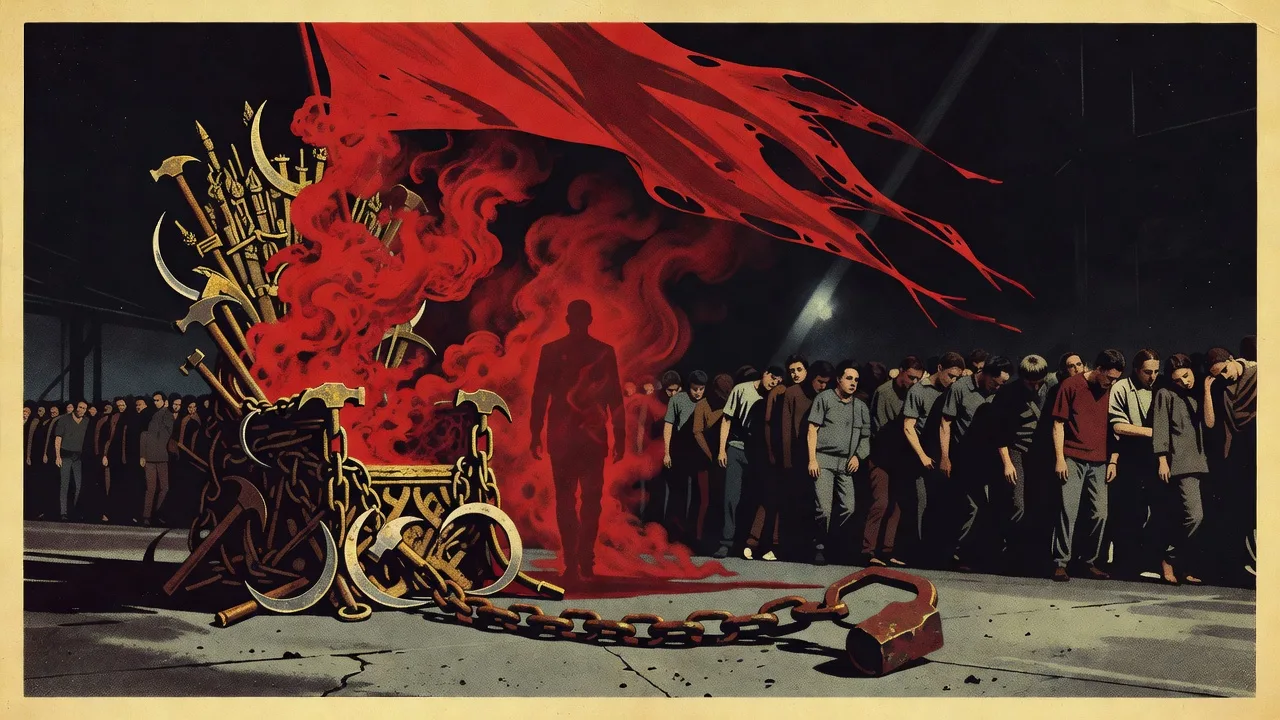
Communism meant the end of the state. Then the state put on the name.
The Word
Communis. Latin for common, shared; from com-, together, and munus, the duty that binds people into a public thing. Before it was a program, it was a claim about the good life: what is held in common is held freely, not rented back. The etymology is generous and the history has been anything but.
The word surfaced among working-class radicals in 1830s France and England: the sharper sibling of “socialism,” the respectable salon cousin; communism was the word of the barricades, the one that made the police nervous. By 1847 the Communist League, a network of émigré German workers, decided the old socialism was not radical enough and commissioned a manifesto. Published in London in February 1848, it opened with a warning: “A spectre is haunting Europe, the spectre of communism.”
That is the birth certificate. Marx and Engels did not coin the word; the workers did, but they took possession of it in print, in twenty-three pages that detonated a century.
What It Wanted
Read it charitably, and it is staggering.
Communism’s first school wanted the end of rulers. Not better ones, not reformed ones, not ones who smile for the cameras and consult their ratings. The end. After the revolution the proletariat would take power, but only long enough to dissolve the conditions that made power necessary. With the bourgeoisie expropriated, no class would remain to oppress; with no class to oppress, the state, a machine for class rule, would have nothing left to do. Engels gave the doctrine its famous phrase: the state withers away. A society with no state, no classes, and no money. Wage labor gone. Commodity production gone. Nobody buying, selling, or being owned; everyone giving by ability, everyone receiving by need. The ambition was total and the theory behind it was the most careful anyone had written.
Now: why did honest, intelligent, decent people devote their lives to this?
Because they had seen the alternative up close. 1848 was not a century of rhetoric but a century of children working thirteen-hour days in textile mills, of workers whose whole lives were owned by the man who owned the machine. In the Manifesto’s own words, the state was “a committee for managing the common affairs of the whole bourgeoisie.” Tell a man who has been told his whole life that the factory is a contract that the factory is a cage, and he will not call you naive. He will call you right.
The dream was real and radical; precisely because it was radical, it could not survive contact with the people who came to “realize” it.
Why It Mattered
Because capital had turned freedom into a costume and was running it as a brand. The worker was “free” to sell his labor; as free as a man with no food, no land, and no product. Wage labor was a contract in name and serfdom in fact. And behind the wage stood the state: the army that broke strikes, the police that kept the starving from the granaries, the judges who signed the eviction orders in the morning and went to church in the evening. The owners’ club, armed, and the door locked from the inside.
Communism answered the question everyone else was too polite to ask: what if the people who do the work ran everything, not “earned a fair share” but everything; not an eight-hour day but no day sold at all? The first school’s radicalism was not its economics but its refusal to compromise on the destination: the point was to abolish the arrangement, not renegotiate it.
The First School
Marx and Engels. London, February 1848. The Manifesto of the Communist Party, commissioned by the Communist League: twenty-three pages that detonated a century.
The doctrine, precisely: abolition of private property in the means of production; abolition of wage labor; abolition of commodity production; and the withering away of the state itself. The Manifesto’s own ten-point program was transitional (centralization of credit, state ownership of industry, common labor), means not ends. Even at its most statist-sounding, the first school was careful: this was scaffolding, to be torn down.
That detail matters. The first school never asked anyone to live inside the transition. The state was a historical corpse: useful for a moment, then gone. They were emphatic about this. The corpse did not get the message.
What Happened
The corpse got a second life, and a longer one than the first. In March 1918, five months after the October coup, the Russian Social-Democratic Labour Party renamed itself the Communist Party and began the largest state in history. The Chinese Communist Party built a bigger one. The Korean one built the smallest and most airtight ever constructed. Three empires, each with a sealed border, each running the institution the Manifesto promised to abolish. The word did not evolve. It was occupied. The regimes were not the destination; they were the scaffolding, nailed shut and declared permanent. What they built was not communism by any definition. The honest names are state capitalism (the state as sole shareholder in everything) or bureaucratic collectivism, a new class owning everything through the state and calling the arrangement equality. The distinction is the difference between a critique of rulers and a plan for ruling, and the failure to make it is the central act of intellectual dishonesty of the twentieth century.
The court adds one footnote, because the Stalinist years coined a word of their own. “Trotskyism” was born as a smear. In the 1920s and 1930s, Stalin and the Comintern deployed it to mean sabotage and betrayal: the label for anyone scheduled for a purge, whatever they had actually said or done. An insult with a firing squad attached. Then Trotsky’s followers, banished and leaderless after his 1940 assassination, picked it up off the floor and wore it as an identity: Trotskyist, Fourth International. Same word, inverted; from accusation to badge of honor. Mark it: if the Stalinists could mint an insult and have it returned as a title, they could certainly borrow a doctrine’s name and return it as a gravestone.
And the gravestone was real. The word died in the gulag it raised; in the camps, the famines, the trains that carried men east for criticizing the harvest. The USSR called itself the state of the whole people while running a prison the size of a continent.
The Verdict
Communism = no state, no classes, no money. What the party-states built was state capitalism or bureaucratic collectivism: a ruler’s empire wearing a revolutionary’s name. First school wins.
Marx and Engels promised the end of rulers. The usurpers built the biggest rulers in history. The regimes are not a version of the vision; they are its refutation wearing its clothes. The honest names exist: state capitalism, bureaucratic collectivism, a holding pen with a slogan. The court insists on them.
The Door
Can they leave?
The party-states answered with a wall. A border crossing was a defection; an emigration application was a confession. Asking to leave the “worker’s paradise” made you an enemy of the workers. The regimes made exit a crime. This is the giveaway: a doctrine whose members cannot leave is not an association, it is a holding pen. A commune you can walk away from is voluntary; a commune you are shot for leaving is a barracks with a slogan.
The first school never faced the test, because it never built the thing. But the test survives it. Communis, what is held in common. A commons is only real when the person standing in it can walk out with their reputation intact. If the exit is guarded, there is no common. There is only the guard.
Series: The Etymological Court · Previous: Socialism · Next: Marxism-Leninism