You Minted Your Own Oligarchs
I love cryptocurrency. I cannot stand what we built with it.
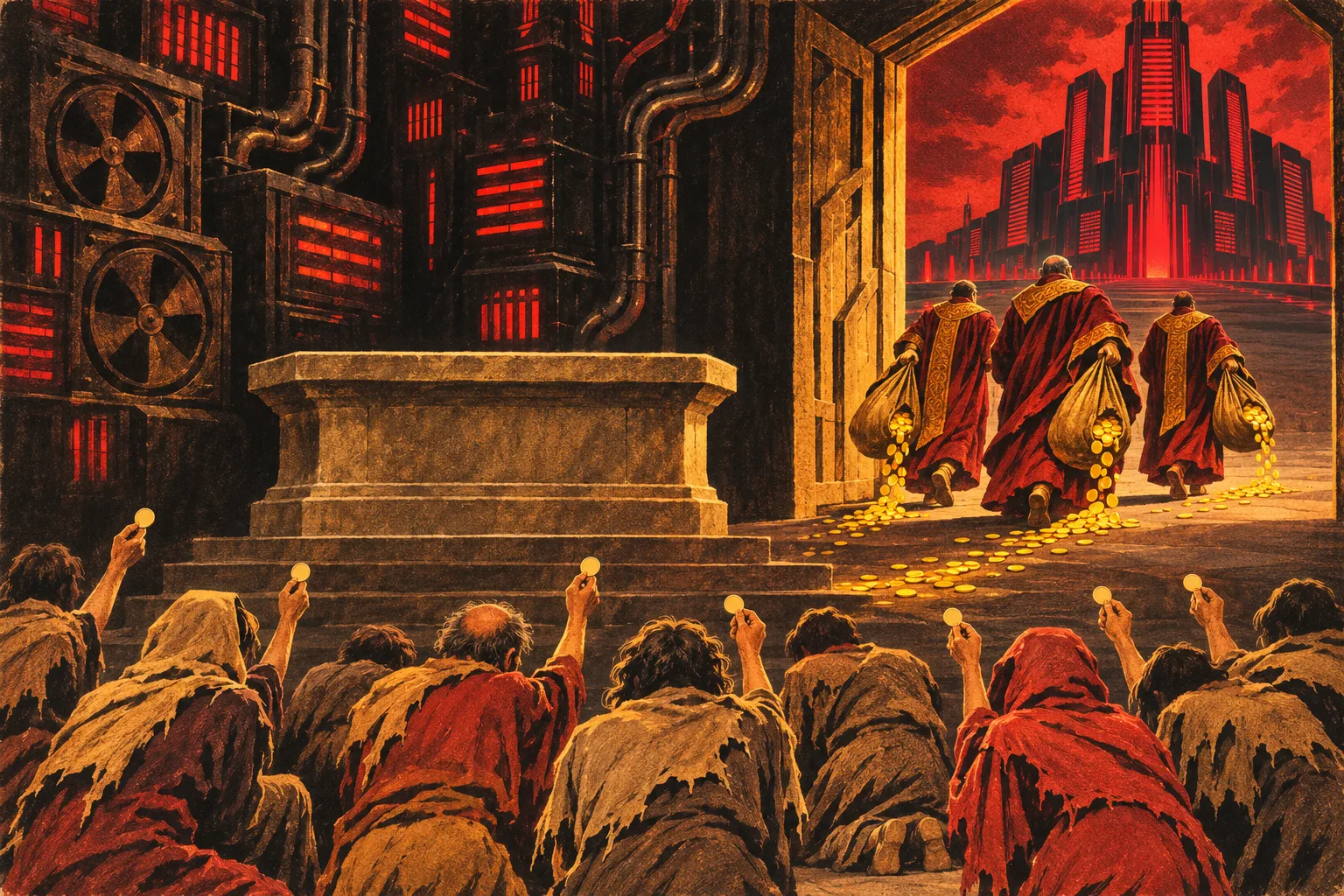
The argument, in brief
Bitcoin fell to a two-year low while the companies that mine it sold eight billion dollars of coins to build AI data centers. The network pays about 27 million dollars a day to whoever owns the most machines, proof of stake pays the people with the most coins, a third of all bitcoin sits with institutions, the most used token is a dollar its issuer can freeze, and nearly every coin on the biggest launch site is a trap. Cryptocurrency is worth saving. What we built on it has to go.
On Saturday 21 November bitcoin fell below 56,000 dollars, its lowest price in two years. The faithful posted their usual vow to hold. The companies that mine bitcoin had spent the year doing the opposite: fourteen listed miners sold 108,247 coins in 2026, about eight billion dollars’ worth, by the count of the analytics account Lookonchain. They are spending the money on data centers for artificial intelligence.
The people who print your money are selling it to buy something better. I love that I can pay a baker without asking a bank, and I think what we built around that gift is a disgrace.
The Printers Are Cashing Out
Every ten minutes the Bitcoin network creates 3.125 new coins and hands them to one miner, the operator whose machines won that round of guessing. That makes 450 coins a day. At 60,000 dollars a coin it comes to 27 million dollars a day, paid out for burning electricity.
It goes to whoever owns the most machines. The winner spends the reward on more machines and improves his odds for the next round. Two mining pools, syndicates of machine owners who share the winnings, have at times held more than half of the network’s computing power between them.
Listed miners have signed more than 70 billion dollars in contracts to host AI computing, according to the asset manager CoinShares. Riot Platforms, one of the largest, has said it expects to sell substantially all the bitcoin it mines to pay for the build-out. You were told the coin is digital gold. The men who dig it treat it as seed capital for the next gold rush, and they need you to buy.
The community calls holding through every crash “hodling”, after a drunken typo from 2013 that hardened into a creed. Hodling is what you call it when you are somebody else’s way out and have decided to be proud of it.
In The Money Glitch I described how a banking oligarchy outlived the empire that housed it. Crypto was supposed to end that line, and it grew a new branch on it.
Stake Is Interest for the Already Rich
Ethereum, the second-largest network, replaced its miners in 2022 with stakers: lock up your coins and the network pays you new ones in proportion to what you locked. In mid-2025 three operators – the staking pool Lido and the exchanges Binance and Coinbase – held about 40 percent of all staked ether.
A system that pays new money to people according to the money they already have is an aristocracy with a dashboard. The industry calls it yield.
You Fled the Banks and Found Worse Ones
Staking pays people who already own coins. But suppose you buy a little bitcoin and leave it on an exchange. Who actually has the key?
The founding slogan says “not your keys, not your coins”: if somebody else holds the password, the money is theirs. Most people keep their coins on an exchange anyway.
Mt. Gox, the first big exchange, lost 850,000 bitcoin in 2014. FTX collapsed in 2022 with about eight billion dollars of customer money gone, and its founder is serving 25 years for fraud. In February 2025 thieves took about 1.5 billion dollars from the exchange Bybit in a single raid. After each one the survivors recited the slogan and logged back in somewhere else.
Roughly 31 percent of all bitcoin now sits with governments, funds, listed companies and exchanges. One fund run by BlackRock, the world’s largest asset manager, held about 777,000 coins at the end of 2025. The cypherpunks, the programmers of the 1990s who wanted cryptography to free people from institutions, set out to abolish the custodian. Wall Street gave their revolution a ticker symbol.
The Most Used Cryptocurrency Is the Dollar
When people in crypto pay each other, they mostly use stablecoins, tokens pegged to the dollar and issued by private companies. Tether, the largest issuer, reports that it has frozen more than 4.9 billion dollars in wallets at the request of authorities.
You left the bank because it could freeze your account, and you settled in a token whose issuer freezes accounts as a service.
The Casino Has Presidents Now
Pump.fun is a website where anyone can launch a coin in a minute. The compliance firm Solidus Labs studied the coins launched there and found that 98.6 percent showed the pattern of a pump-and-dump or a rug pull, where the creators sell into their own buyers and vanish. The site disputes the finding.
One president (Donald Trump, 2025) launched his own coin three days before his inauguration, while another (Javier Milei, 2025) promoted LIBRA, a coin that lost most of its value within hours. When heads of state work the slot machines, the word “revolution” should be retired.
Nobody Pays for Bread With It
Satoshi Nakamoto, Bitcoin’s pseudonymous inventor, titled the founding paper “A Peer-to-Peer Electronic Cash System”. Eighteen years on, a payment takes ten minutes, costs a fee and stays readable by anyone forever. You built the most complete record of private spending in history and you volunteered for it.
Your asset manager pitches it as a savings product. He gets his fee. For you to make money, somebody else has to buy it from you for more than you paid.
I Know the Replies
It is decentralized. Two pools have held more than half of the computing power, three operators held about 40 percent of the stake, and almost a third of the coins sit with institutions.
Mining secures the network. It does, at 27 million dollars a day, to stop the same coins being spent twice. A mint can keep a list of coins already spent. The fix has been known since 1982, and every credible cryptographer knows it. Bitcoin’s one real invention was doing it without a mint you have to trust, and the 27 million a day is what that invention costs. In Money Without Miners I explained the list, and how to split the mint so that the people who sign hold nothing they could steal.
Have fun staying poor. That is the taunt holders throw at doubters, and it concedes everything. The promise was that you would get rich, and getting rich from a coin that produces nothing requires somebody who arrives after you.
It is still early. Bitcoin is seventeen years old, with a president’s coin beside it and a BlackRock fund on top of it. If this is early, spare me late.
What I Want Instead
I love that I can pay a baker without asking a bank. I want to keep that and throw out the rest.
Money should come into existence when somebody deposits something of value, and at no other time. Nobody should be paid for being big, and nobody should be able to read my payments or freeze them. In The Second Enclosure I called web3 the first, failed answer to the question of who owns the new commons. What follows is a piece of the second answer.
Chapter Zero, the first community of the Libertaria Federation, has put a proposal on the table: notes backed by a basket of coins, signed so that the issuer cannot trace them, with no miners and no fees. It is a proposal with its tests written and no code yet, and we have asked people to attack it. It may fail. It will not fail by paying a warehouse owner 27 million dollars a day.
Defend the current arrangement if you can. Start with the 27 million dollars a day, and tell me who earned it.
I came out of the crypto scene. I built projects there, and when I say “we” in this essay, I mean it. I’ve seen enough to walk away from mining, proof of stake and Web3. I’m still a cypherpunk. I want to buy bread without my government knowing where I shop or having a say in whether the baker gets paid. And I object to paying a miner every time I pay the baker. Under Satoshi’s rules, the bigger your share of the mining power, the bigger the share of those fees you can expect to collect – the rich get richer, and we’ve written the old rule into the code. What cypherpunk ideal does that serve? That’s why I’m building Libertaria.
Sources
- Satoshi Nakamoto, “Bitcoin: A Peer-to-Peer Electronic Cash System”, 2008.
- The Motley Fool, “Bitcoin Fell More Than 20% in November. History Says This Happens Next.”, 20 November 2026. fool.com.
- Crypto Briefing, “Bitcoin drops 7% to its lowest level since July as crypto sell-off deepens”, November 2026. cryptobriefing.com.
- KuCoin News, “Bitcoin Miners Sell Over 108,247 BTC in 2026 as AI Data Centers Lure Profits”, citing Lookonchain, 2026. kucoin.com.
- Cointelegraph, “US data center restrictions could benefit Bitcoin miners’ AI plans”, citing CoinShares, 2026. cointelegraph.com.
- Mitrade, “Foundry USA and AntPool currently control over 51% of Bitcoin’s global hashrate”, 22 August 2025. mitrade.com.
- ForkLog, “Lido’s Share in Ethereum Staking Drops to 25%”, July 2025. forklog.com.
- U.S. Department of Justice, “Samuel Bankman-Fried Sentenced to 25 Years for His Orchestration of Multiple Fraudulent Schemes”, 28 March 2024.
- ForkLog, “Centralised Institutions Now Hold 30% of Bitcoin’s Supply”, citing Gemini and Glassnode, 2025. forklog.com.
- CryptoSlate, “Bitcoin liquidity has vanished into a shadow system where corporate debt cycles now dictate the crash risk”, December 2025. cryptoslate.com.
- FXStreet, “Tether says it helped freeze $550M in Iran-linked USDT this year”, 29 September 2026. fxstreet.com.
- Solidus Labs, “The 2025 Rug Pull Report: Rug Pulls and Pump-and-Dumps on Solana”, 2025. soliduslabs.com.
- Markus Maiwald, “Money Without Miners”, 2026. libertaria.blog.
- Markus Maiwald, “The Money Glitch”, 2026. libertaria.blog.
- Markus Maiwald, “The Second Enclosure”, 2026. libertaria.blog.