The Money Glitch: How the City of London Outlived Its Empire
Three imperial funerals, no body. The banking oligarchy that rented the nation forked itself to Wall Street and kept the conveyor running.
The argument, in brief
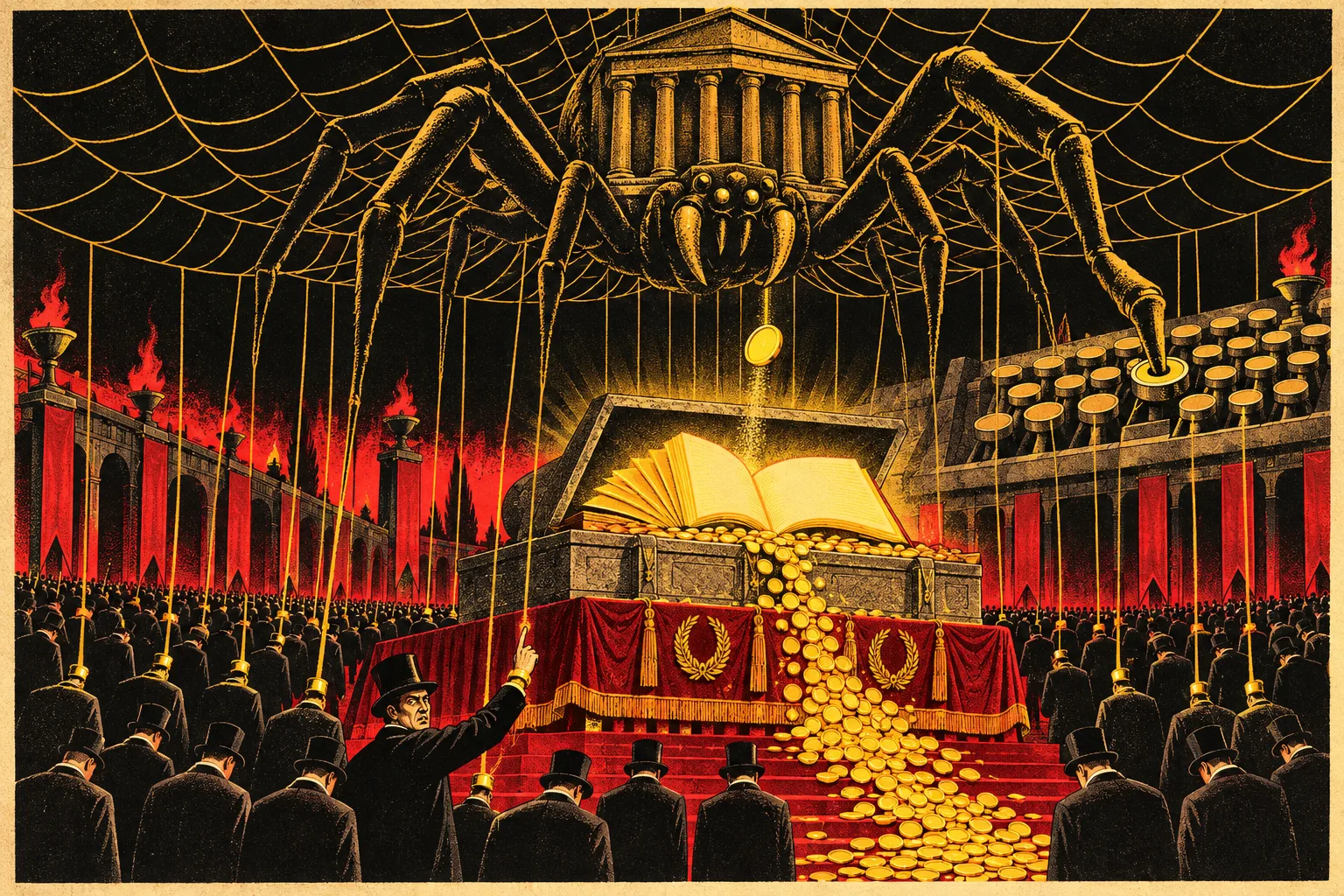
Empire is not a property of nations; it is a financial oligarchy renting one. That frame explains four centuries: the Bank of England was founded not as a conquest but as a loan, 1.2 million pounds at eight percent in 1694, and every expansion from the East India Company to the Opium Wars to Suez arrived first as a credit line and only later as a regiment. The empire's three funerals, India 1947, Suez 1956, Hong Kong 1997, were all attended by the City of London, which came home richer each time: in 1955 British banks dodged sterling restrictions by taking dollar deposits instead, the Bank of England decided to see nothing, and the Eurodollar market was born; the 1986 Big Bang let Wall Street merge into the fork. The second empire is Shaxson's spider's web of Crown Dependencies and Overseas Territories: no colonies, only accounts. The glitch itself: commercial banks create deposit money when they lend, the loan is an asset from the first keystroke, and the collateral is political control over whoever signed the concession, which is why the West cares so intensely who runs Lagos, Caracas, Tehran and Baghdad. Enrico Mattei threatened the conveyor with an energy system that kept the margin in the producing country, and his plane fell out of the sky in 1962; the reopened investigation found an explosive device and named no hand. You cannot vote the Remembrancer out, and regulating him misses the point. The exit is plumbing: auditable issuance, settlement that does not route through a correspondent bank in London or New York, self-custodied keys. The empire did not die. It is in the room, behind the Speaker's chair, watching the legislation.
There is a man who sits behind the Speaker’s chair in the House of Commons who was not elected by anyone. His title is the Remembrancer. He is paid by the City of London Corporation, the government of one square mile of London that has its own police, its own Lord Mayor, and an electorate in which companies cast votes. His job is to watch legislation on behalf of the banks. He has been doing it since 1571.
Keep that image. It explains more about the last four hundred years than any map with pink on it.
The empire was never the navy
Schoolbooks teach empire as a property of nations: the Spanish had one, the Dutch had one, the British had the biggest. The frame is wrong, and the error is not innocent. An empire is a financial oligarchy that rents a nation. It borrows the nation’s fleet, its diplomats, its flag and its young men, and it pays rent in the form of national pride. When the host weakens, the oligarchy does not die with it; it moves house.
The move from Amsterdam to London happened in 1688, when a Dutch prince took the English throne and brought his bankers with him. Six years later those bankers lent William III 1.2 million pounds at eight percent interest. In exchange they received a charter to issue notes against that debt. That institution is the Bank of England. The founding act of modern British power was not a conquest; it was a loan.
An empire is a balance sheet with an army attached.
From there the pattern is boringly consistent. The East India Company was a joint-stock enterprise before it was an occupying force. The Opium Wars were fought over a trade deficit. The Suez Canal was bought with a Rothschild loan. Every territorial expansion shows up first as a credit line and only later as a regiment.
The fork
The standard story says the empire died somewhere between India in 1947, Suez in 1956 and Hong Kong in 1997. Pick your funeral. The square mile attended all three and came home richer each time.
In 1955, after a sterling crisis, the Bank of England restricted British banks from financing foreign trade in pounds. The banks responded by taking dollar deposits instead: dollars sitting in London, outside the reach of the Federal Reserve, outside American reserve requirements, outside American interest-rate caps. The Bank of England looked at this new market, understood it, and decided to see nothing. That market is the Eurodollar market. Within a decade it was larger than the domestic American banking system in some measures, and every major Wall Street bank had opened a London branch to use it.
The City did not lose to New York. The City forked, and Wall Street merged into the fork. The 1986 Big Bang, when Thatcher let American investment banks buy the old London partnerships outright, completed the operation. Since then London and New York have been one organism with two time zones, and the organism has a nervous system that runs through Jersey, Guernsey, the Cayman Islands, Bermuda and the British Virgin Islands, all of them British Crown Dependencies or Overseas Territories, all of them nominally outside British law, all of them with a Governor appointed from London. The journalist Nicholas Shaxson calls this the spider’s web. It is the second British Empire, and it has no colonies, only accounts.
The glitch
Now the mechanism. People hear “debt slavery” and picture a loan shark. The real machine is more elegant and far more profitable.
A country has oil under the ground. Call it Nigeria, because it is Nigeria. To get the oil out you need rigs, pipelines, terminals and a port, and that costs billions before a single barrel ships. The country does not have billions. So a Western major, Shell, say, signs a concession with the government for the exclusive right to develop a field for fifty years. Shell takes that paper to its bankers. The bankers do not take a billion dollars from somewhere else and hand it over; they write a billion-dollar deposit into Shell’s account and a billion-dollar asset onto their own balance sheet. The Bank of England confirmed this in a 2014 bulletin that is still worth reading: commercial banks create money when they lend. There is no vault, only a keystroke.
The bank’s balance sheet grew by a billion. The loan will be repaid at two to three times its face value over its life. The collateral is a sovereign resource that the lending bank now effectively controls. Shell builds the infrastructure and carries the operational risk, and for most of the twentieth century the Western majors earned returns that barely cleared their cost of capital, a finding the industry’s own consultants published without visible embarrassment. The oil company is the conveyor belt. The bank owns the belt.
This is the money glitch. A loan is an asset the moment it is issued. The repayment stream is guaranteed by the one thing the lender needs: political control over the government that signed the concession. That is why the West cares so intensely who runs Lagos, Caracas, Tehran and Baghdad. Not because the petrol stations would run dry, since Switzerland has no military bases and no shortage of diesel, but because a change of government can void the paper, and the paper is the asset.
Debt is the colony. The flag is optional.
Scale the loop out. The IMF lends a country dollars it cannot earn, attaches conditions that open its assets to foreign development, and the development loans flow back through the same banks. Yugoslavia entered the 1980s with twenty billion dollars of foreign debt and an IMF programme; the austerity that followed hollowed the federation out years before the first shot. The man who then centralised Serbia, Slobodan Milošević, had spent the late seventies running Beobanka and shuttling to New York. You do not need a conspiracy theory to see the pattern. You need to read who signed what, and when.
The man who tried to unplug it
In 1957 the head of Italy’s state energy company offered Iran a seventy-five to twenty-five split on oil revenue when the Anglo-American majors were offering fifty-fifty. He signed a pipes-for-crude deal with the Soviet Union. He built refineries in North Africa so that producing countries would process their own oil and sell Italy the product. His name was Enrico Mattei, and he coined the phrase the Seven Sisters for the cartel he was undercutting.
On 27 October 1962 his plane fell out of the sky near Bascapè on approach to Milan. The Italian authorities called it weather. In 1995 a prosecutor in Pavia reopened the case and, after eight years, concluded the aircraft had been brought down by an explosive device. The investigation never named a hand. The journalist who was reconstructing Mattei’s last days in 1970 vanished in Palermo and was never found.
I will not tell you who killed Mattei, because I do not know, and neither does anyone who claims to. I will tell you what he threatened: an energy system in which Italian wealth stayed in Italian banks and Italian pensions, and in which producing nations kept their margin. That is the only crime the conveyor belt does not forgive.
What you can actually do about it
You cannot vote this out. The Remembrancer has sat through every government since Elizabeth I. You cannot regulate it, because the regulators are drafted from the same square mile and return to it. Calling it corrupt misses the point; it is running exactly as designed.
What breaks the loop is refusing to be collateral. That means money whose issuance you can audit, settlement that does not route through a correspondent bank in London or New York, and communities that fund their own infrastructure from their own balance sheets instead of leasing them back from a lender who created the principal with a keystroke. It means owning your keys, because the entity that holds your keys holds your concession.
None of that is a political programme. It is plumbing, and Libertaria builds the plumbing because arguing with the Remembrancer is a four-century-old waste of breath.
The empire did not die. It is in the room, behind the Speaker’s chair, and it is watching the legislation.
Sources and further reading:
- Alex Krainer in conversation with Pascal Lottaz, Neutrality Studies, “Alex Krainer and the Undead Empire” (second episode). The framework of empire as a host-switching banking oligarchy is developed there at length.
- Nicholas Shaxson, Treasure Islands (2011): the City of London Corporation, the Remembrancer, and the offshore web.
- Bank of England, Quarterly Bulletin Q1 2014, “Money creation in the modern economy.”
- Catherine Schenk, “The Origins of the Eurodollar Market in London, 1955-1963,” Explorations in Economic History (1998).
- Procura della Repubblica di Pavia, Mattei investigation (1995-2003), prosecutor Vincenzo Calia.