The Second Enclosure
Web3 asked who will own the machines. It answered with a casino.
The argument, in brief
Cheap intelligence will not end work; Jevons guarantees more of it. It ends the bargaining power work used to carry, and the surplus flows to whoever owns the machines. Basic income repeats Speenhamland: a stipend priced to prevent revolt. Web3 tried to answer the ownership question with tokens and delivered a casino. The answer is a sovereign commons: vote for shared AI ownership instead of technocracy, and build parallel systems on local AI so that the vote carries weight. Build it for the people at risk of being left behind, or it is a gated community with better uptime.
This week Wigy, a friend, sent me a video with a single line attached: what about the people who get left behind?
The video is twenty-eight minutes of a consultant thinking out loud. Tom Scryleus has billed by the hour for twenty years and expects AI to make that work unnecessary by next year – not in some distant future. Scryleus nearly drowned in the accounting of a new business, ignored the standard advice to hire a bookkeeper, and built AI assistants instead: one for the books, one for tax returns, one for the annual accounts, one that watches the health of the business. No bookkeeper was ever hired. “Technically, I’m the one holding the knife.”
It is a fantastic video – honest in the way few are, because the author points the camera at their own hands. It walks the whole board: the end of work, the abundance myth, basic income as a golden cage, the billionaire with no employees, the split between people who own productive AI and people who merely use it. The conclusion is that abundance does not automatically create access; ownership decides who gets in. I would put it colder:
Abundance is a fact about production. Access is a fact about property.
I see all this less bleakly than most people right now, and less bleakly than I did a few months ago. The jobs worry me less because of a Victorian economist. Ownership worries me more, and blockchain – the first serious attempt to answer the ownership question – did not deliver.
Jevons Saves the Work, Not the Terms
In 1865 William Stanley Jevons published The Coal Question and ruined a whole genre of optimism. Watt’s engine burned coal far more efficiently than the engines before it, and British coal consumption exploded anyway, because cheaper use made more uses worth it. Jevons wrote it flatly: “It is wholly a confusion of ideas to suppose that the economical use of fuel is equivalent to a diminished consumption.”
Run the same arithmetic on cognition. When thinking gets cheap, everything becomes a thinking problem: every contract read in full, every supply chain simulated, every child tutored at its own pace, every legacy codebase finally documented. Demand for cognition goes vertical.
In 2016 Geoffrey Hinton told an audience in Toronto to stop training radiologists, because deep learning would outperform them within five years. Ten years later radiology departments cannot hire fast enough, and they read more images than ever, much of it with machine help. Cheaper reading produced more reading, and a human still signs the report.
Jevons protects the volume of work. It says nothing about the terms. What AI removes is the scarcity premium – the fact that certain kinds of thinking could only be bought from a human being. For two centuries that premium was the floor under wages and the only grip the propertyless ever had on the propertied. The work comes back; the bargaining power stays gone.
The surplus flows to whatever remains scarce. Software, media, translation and diagnosis race toward zero marginal cost. Energy, land, silicon and the ownership structure itself do not, and they absorb everything the falling prices free up. Scryleus has the right image for it: we will all afford the robot vacuum and never own the floor it cleans. A product that costs one dollar is still too expensive for someone holding zero.
Speenhamland, Version Two
The video predicts universal basic income, priced at the minimum that keeps people buying and off the streets. England already ran that experiment. In 1795 the magistrates of Berkshire met at an inn in Speenhamland and tied poor relief to the price of bread: when wages fell short, the parish paid the difference. Employers did the arithmetic. Why pay a living wage when the parish tops it up? Karl Polanyi made the system the cautionary tale of The Great Transformation, and historians have fought over the evidence ever since. The mechanism survives the dispute. When someone else pays the difference, the employer stops paying it.
UBI in the automation age is Speenhamland with the parish replaced by the platform. The owners stop paying you to work and start paying you – through taxed margins – to keep consuming. The payment will exist because the machine still needs customers, and it will be priced at exactly the level that prevents revolt.
A dividend is paid because you own something. A stipend is paid because you might riot.
The most disarming moment in the video is a memory from before the money: searching the couch for coins, returning bottles for pizza, and being happier than today with savings in the bank. Nobody should read that as praise of poverty. The variable that mattered was autonomy, and no stipend buys autonomy. Comfort without ownership is a lease with the landlord’s name redacted.
Web3 Was the First Answer
Blockchain deserves credit before it gets the verdict. Bitcoin proved that strangers who distrust each other can keep a shared ledger without a bank. Web3 then took on the exact question this video asks – who owns the machines – and answered it with tokens: tokenize the network, the compute and the model, and everyone holds a piece of the automated economy.
Web3 did not deliver. It broke on four facts:
- Settlement is not production. A ledger can record who owns the machine. It cannot put one on your desk. Most “decentralized AI” runs on the same handful of clouds, inherits its weights from a handful of labs, and bolts on a token that securitizes the story.
- A token is a claim on a narrative. Most people hold crypto the way they hold lottery tickets. The projects that promised shared ownership became Swiss foundations with securities lawyers, which is to say landlords who publish whitepapers.
- Token governance is plutocracy. Whoever accumulates the most tokens rewrites the rules – the manor came back with a voting interface.
- AI erases copyable moats. When an agent can clone your protocol in an afternoon, the only thing left that cannot be copied is the anchor: the irreversible timestamp proving that something existed at a given moment.
The last point is the one worth keeping. Libertaria kept the notary and fired the casino. Transport, identity and governance – the layers every Chapter must run – carry no token at all. Economics sits on an optional layer above them, and a Chapter that needs settlement anchors to Bitcoin or Kaspa instead of minting yet another chain. Ownership lives in the hardware you hold and the commons you belong to; the ledger only takes notes.
The Sovereign Commons
What replaces the token? My answer to Wigy was two things, and each fails without the other.
First, the ballot. Vote for the parties that put AI ownership in common hands, and refuse the ones selling technocracy. A national AI ministry staffed by the consultants who sold us the platforms is a manor with a pension plan. Shared ownership looks different. Alaska has paid its residents a yearly dividend from its oil fund since 1982, on the principle that the oil belongs to Alaskans. The models were trained on everything all of us ever wrote in public; the same principle applies, and it turns the stipend into a dividend.
Second, the parallel system. Parliaments move slowly and lobbies move fast. Meanwhile the price of building your own collapses, because Jevons cuts both ways. Compute rents by the hour, and ternary models with open weights run on a Raspberry Pi. The marginal cost of a personal automated workforce is falling toward the price of electricity, and electricity is the one input physics still lets a household own outright. The sun does not invoice monthly.
The stack, owned layer by layer:
- Hardware you hold: a cell on your desk instead of a region in someone else’s cloud.
- Software without landlords: an operating system and a toolchain that no vendor can revoke or reprice.
- Identity you hold: in a world where sounding human is suspicious, the manor will offer to certify you at its gate. Accept the certificate and you have accepted the leash.
- Federation instead of platforms: peers coordinate without an intermediary taxing the conversation.
- Agents bound by capabilities: your agents run on your machine, with authority you grant and revoke.
The Amish ask one question of every new tool: does it make the community dependent on forces it cannot govern? It is the only AI policy question worth asking, and this stack is an answer to it written in code.
Albert Hirschman explained in 1970 why the two halves belong together: voice carries weight when exit is credible. A vote for shared AI ownership means something only when a working alternative already runs outside the manor. A parallel system without political cover stays a hobby for engineers.
The People Left Behind
Wigy’s question is the right one, and it cuts against my own camp. Today the parallel stack favors people who can compile a kernel. A commons that only engineers can enter is a gated community with better uptime.
Germany solved a version of this problem in 1864. Rhineland farmers were falling into the hands of usurers because no bank would lend to them, and Friedrich Wilhelm Raiffeisen’s answer was a credit cooperative they could join without learning banking. A hundred and sixty years later, the cooperative banks descended from that idea still hold the savings of millions.
That is the shape of a sovereign commons. The grandmother does not administer the cell; she is a member of the Chapter that runs it, and she holds a share and a key. The people most at risk of being left behind are the commons’ quorum, not its charity case. Build for them or build a gated community; there is no third design.
Two Futures
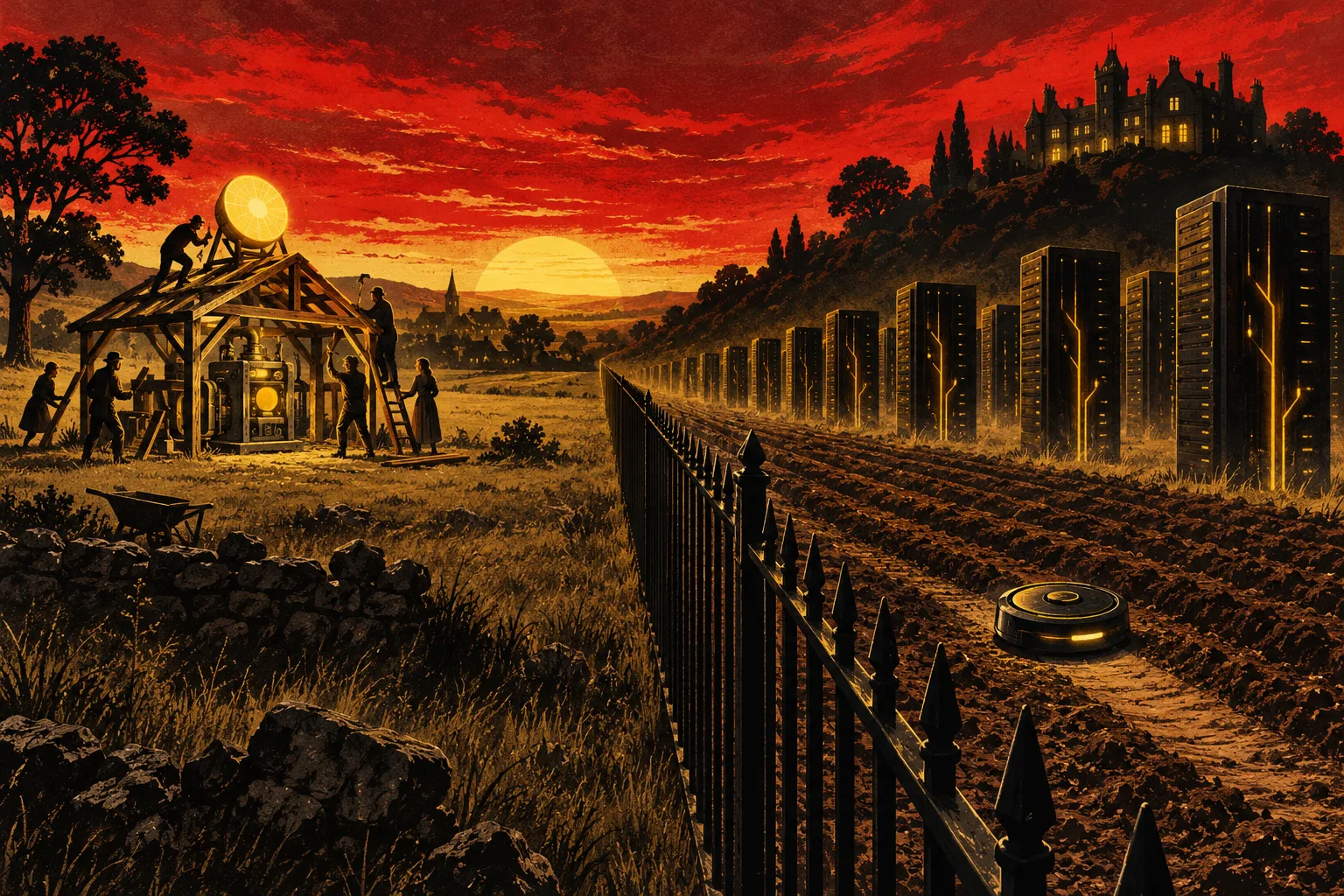
The algorithmic manor. The rails are already laid. Agent-first firms skip one graduating class, then the next. Stipend pilots arrive, sold as liberation and priced as sedation. Proof-of-human checks appear at every gate, run by the companies that sell the agents. Compute consolidates into a few manors while property locks out another generation. The stipend class is fed and entertained, with an AI companion for the evenings. Nobody starves – Scryleus is right that it never needs to come to that. Comfort is the cage’s best material. Politics shrinks to choosing from a menu, and exit stays perfectly legal while becoming unaffordable.
The sovereign commons. Cells hum in basements, and families and villages own their compute and their energy. Chapters federate across borders with no platform in the middle. Work does not vanish – Jevons guarantees it won’t. Income decouples from bargaining power instead, because a household with its own productive estate no longer has to persuade a company to buy its hours.
Both futures run on the same silicon and the same weights. Which one wins is an institutional question, settled by what people vote for and what they build in the meantime. Rails get laid by whoever shows up with track.
The Question Beneath the Question
The video ends by correcting itself: the real question is not whether AI takes our jobs but who ends up owning it. Correct, with one level to go.
In 2003 the legal scholar James Boyle named the land grab in intellectual property the second enclosure movement. Boyle was early. The first enclosure took more than five thousand Acts of Parliament and three centuries to fence the English commons and manufacture the landless. The second fenced the public word: every sentence we ever posted trained the machines, and the machines are now rented back to us by the token. The next fence needs no Act of Parliament. It needs a terms-of-service update, accepted on a Tuesday between two other things.
Here is the question I sent back to Wigy:
Will you own anything that works while you sleep, or will you sleep while everything that works belongs to someone else?
Sources
- Tom Scryleus, People Have No Idea What’s About To Happen…, YouTube, 2026. Video.
- William Stanley Jevons, The Coal Question, Macmillan, 1865, ch. VII, “Of the Economy of Fuel”.
- Creative Destruction Lab, Geoff Hinton: On Radiology, YouTube, 2016. Video.
- Karl Polanyi, The Great Transformation, Farrar & Rinehart, 1944, ch. 7, “Speenhamland, 1795”.
- Fred Block and Margaret Somers, “In the Shadow of Speenhamland: Social Policy and the Old Poor Law”, Politics & Society 31 (2), 2003.
- James Boyle, “The Second Enclosure Movement and the Construction of the Public Domain”, Law and Contemporary Problems 66 (1–2), 2003. Duke Law Scholarship Repository.
- UK Parliament, “Enclosing the land”, Living Heritage. parliament.uk, section “Enclosure by Act”.
- Albert O. Hirschman, Exit, Voice, and Loyalty, Harvard University Press, 1970.
- Alaska Department of Revenue, Permanent Fund Dividend Division. pfd.alaska.gov.
- UNESCO, “Idea and practice of organizing shared interests in cooperatives”, Representative List of the Intangible Cultural Heritage of Humanity, 2016. UNESCO.
- Libertaria, “The Economics of Exit: Optional Production Layer”, 2026. libertaria.blog.