Patriotslose Weltenbürger: The Elite That Belongs Nowhere and Wants to Own You
Three passports, no fatherland, a balance sheet instead of a home. The debt machine's end product wants programmable money and a hackable population. Its mirror image is the only thing that beats it.
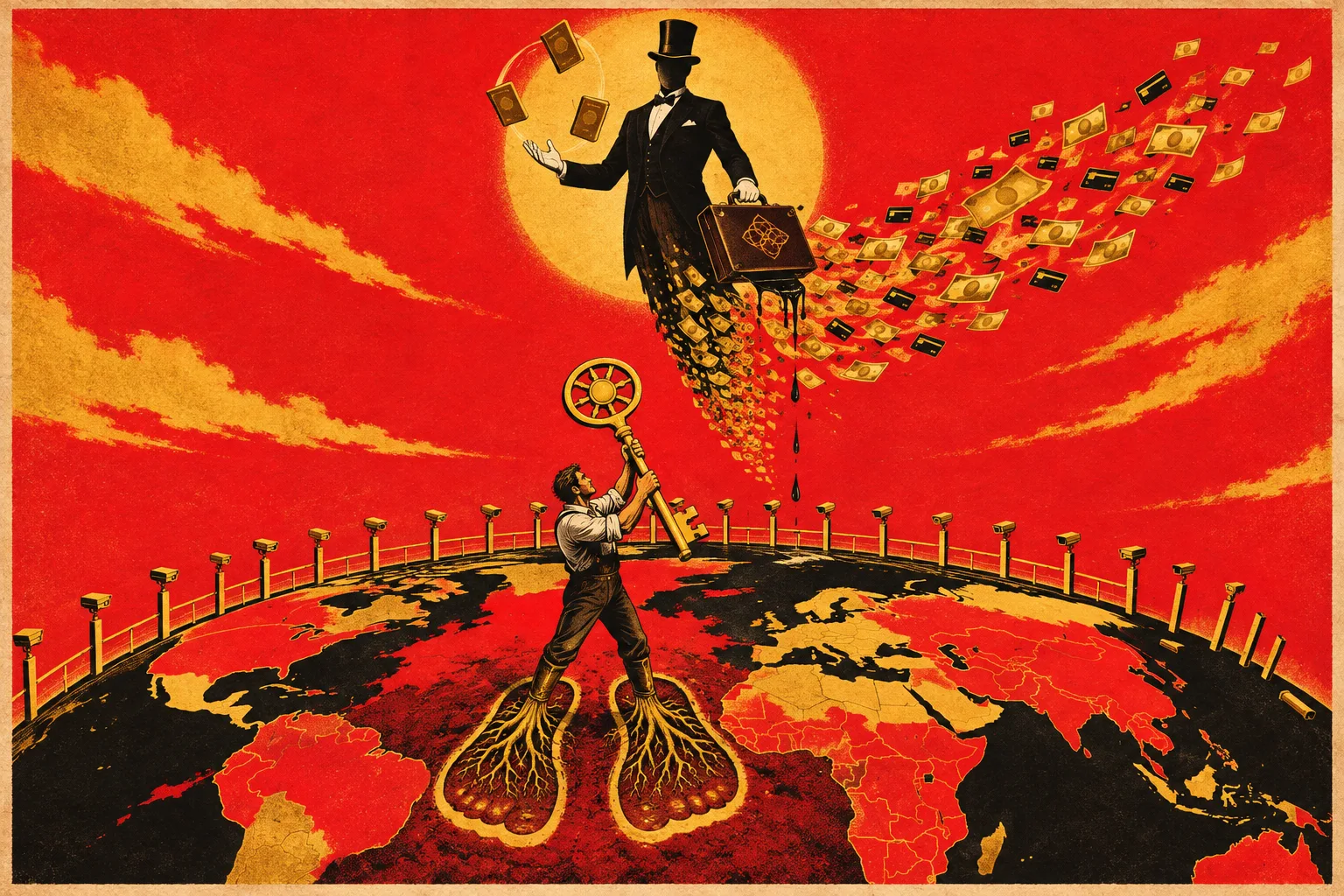
The argument, in brief
The debt conveyor's end product is a class, not a person: world-citizens without a fatherland, three passports deep, domiciled everywhere, loyal to no jurisdiction because every jurisdiction is a line item. The essay takes them seriously enough to read their risk sheet: a population that can leave is a volatile asset, so programmable money, expiring currency, freezable accounts, zoned movement and biometric identity are one product shipping in modules, each with its own benign spokesperson. The toolkit is already documented: the ECB's own digital euro papers distinguish its money from programmable money while describing conditional payments running on top; China's digital yuan pilots distributed vouchers that evaporated at a deadline; Canada froze hundreds of accounts under emergency powers in February 2022; Nigeria's cash restrictions failed to push eNaira adoption past one percent, and the lesson the planners took was to remove the choice first. The mirror is not nationalism. It is Collectivist Individualism: skin in the game, roots by choice, exit by right, and the asymmetry the elite engineered, downside always landing on someone else's balance sheet, reversed by communities that fund their own infrastructure and hold their own keys. The old control grid assumed three channels: the newspaper, the bank account and the broadcast tower. It did not plan for a billion phones that talk without asking permission. Awareness is not exit. Hold your keys, build the community that holds them with you, and be the exception they did not model.
In Davos, in front of an audience that had paid five figures to be there, the historian Yuval Noah Harari explained that human beings are now hackable animals. The age of the free will, the sovereign individual, the soul: over, he said, because an algorithm with enough biometric data knows you better than you know yourself. The room did not walk out. The room took notes.
Harari is not a villain. He is a court philosopher, and court philosophers describe what the court already intends. The court in question has no country.
The definition
A Weltbürger, in the sense Immanuel Kant gave the word, is a citizen of the world who still has a home. Kant himself never travelled more than a few miles from Königsberg. He thought you could owe something to all of humanity precisely because you owed something to a particular street first.
What the debt machine breeds is a different animal. I call them patriotslose Weltenbürger, world-citizens without a fatherland, loyal to no jurisdiction because every jurisdiction is a line item. They hold three passports and feel none of them. Their children are schooled in Switzerland, their companies are domiciled in Delaware, their trusts sit in Jersey, their art hangs in a Geneva freeport, and their opinions are formed at the same four conferences every year. Ask one of them where he is from and he will tell you where he was last Tuesday.
It is the end product of the mechanism I described in The Money Glitch. When wealth stops being produced somewhere and starts being extracted from everywhere through loan contracts, the people at the receiving end of the conveyor belt no longer need a somewhere. Soil is a liability. Soil has neighbours who remember you.
A man with no exit cost has no loyalty. A class with no exit cost has no country.
Strategic empathy: what they are actually afraid of
Dismiss them as evil and you will never beat them, because you will never predict them. So take their position seriously for three paragraphs.
If you own the belt, your asset is not oil or copper or farmland. Your asset is the predictability of the people who service the debt. A population that can leave (move its money, move its labour, move its children, move its data) is a volatile asset. Every exit is a default waiting to happen. From inside that balance sheet, programmable money is risk management.
Klaus Schwab’s book on the Fourth Industrial Revolution says it almost gently: the coming technologies will change not just what we do but who we are. Read that as a manager would. A workforce whose identity is upstream of the system is a workforce that can quit. A workforce whose identity is downstream of the system cannot. The project is to move humanity downstream.
That is the whole agenda, and once you see it the individual policies stop looking like a grab bag of unrelated bureaucratic fashions. They are one product with several modules.
The toolkit, shipped in pieces
Conditional payments. The European Central Bank states in writing that the digital euro will not be programmable money, and the same design documents describe conditional payments, where a transfer executes only when a rule is met. The ECB’s distinction is that the bank will not program your money, but may let others build conditions on top of it. A knife is not a weapon either, until someone holds it.
Expiring money. China’s digital yuan pilots handed out vouchers that evaporated if unspent by a deadline. Stimulus with a timer, and the timer is the feature.
The account as a leash. In February 2022 the Canadian government froze several hundred bank accounts belonging to protesters and their donors under emergency powers, without a court order, within days. In 2023 Britain’s oldest private bank closed a politician’s accounts over his views, and the internal dossier said so in plain English. Nigeria tried to force its population onto a central-bank digital currency by restricting physical cash withdrawals; adoption stayed under one percent, which tells you what people do when they still have a choice. The lesson the planners took from Nigeria was to remove the choice first.
The city as a feedlot. The fifteen-minute city is, on paper, harmless urbanism: everything you need within a short walk. Pair it with licence-plate cameras, movement permits and a wallet that only works inside the zone, and the walk becomes the perimeter. Oxford’s residents noticed this in late 2022 and were called conspiracy theorists for reading the planning documents.
The body as the terminal. Biometric identity tied to payment tied to health status. For the planners, Harari’s hackable animal is a product spec.
Each module ships separately, with its own benign justification and its own spokesperson. Nobody announces the assembled machine. You are supposed to notice it after the last bolt goes in.
The mirror
I will aim this at myself first.
I live between Berlin and Budapest. My company is a German GmbH. My foundation is Dutch. I think in German, write in English, and spend my evenings in rooms where the native language is cryptography. By the definition above I am a textbook Weltenbürger, and a hostile reader could stop here and accuse me of describing my own class.
He would be half right, and the other half is the entire argument.
Both the stateless elite and the sovereign communalist are mobile, so mobility is not the difference. The difference is skin in the game, in the sense the risk theorist Nassim Taleb gave the phrase: you carry the downside of your own decisions. The patriotless cosmopolitan has engineered a life in which the downside always lands on someone else’s balance sheet, a Nigerian pensioner or a Greek hospital. The communalist builds a life in which his neighbours can fire him. He chooses his roots, and precisely because he chose them, he cannot pretend they are not his.
This is what I mean by Collectivist Individualism. Radical market freedom at the level of the individual, radical loyalty at the level of the group you chose. You keep the exit. You also keep the obligation. The elite kept only the exit, and then set about removing yours so that the asymmetry would be permanent.
Roots by choice, exit by right. Remove either and you get a slave or a parasite.
Why they will lose, and how slowly
The old control grid ran through three channels: the newspaper, the bank account and the broadcast tower. Every one of the plans above was written by people who grew up in that world and assumed it. They did not plan for a billion phones that talk to each other without asking permission. They did not plan for a Croatian hedge fund manager and a Swiss academic recording two hours of heresy from Monaco and Kyoto and having it watched in Lagos.
That is the honest ground for optimism, and it is thinner than the optimists admit. Awareness is not exit. Knowing the account can be frozen does not unfreeze it. The hackable animal is the one whose keys someone else holds.
So hold your keys. Hold them for your money, your identity, your messages and your records, and build the community that will hold the keys with you when you are asleep. The patriotless class is betting that you will keep complaining in their comment sections while they finish the perimeter.
They are usually right about people. Be the exception they did not model.
Sources and further reading:
- Alex Krainer in conversation with Pascal Lottaz, Neutrality Studies, “Alex Krainer and the Undead Empire” (second episode), for the framing of technological control as the end state of the debt system.
- Yuval Noah Harari, “Will the Future Be Human?”, World Economic Forum Annual Meeting, Davos, January 2018.
- Klaus Schwab, The Fourth Industrial Revolution (2016).
- European Central Bank, digital euro design documentation and FAQ on programmability and conditional payments.
- Immanuel Kant, Zum ewigen Frieden (1795), on cosmopolitan right.
- Nassim Nicholas Taleb, Skin in the Game (2018).
- Companion piece: The Money Glitch: How the City of London Outlived Its Empire.