The Force Was Female: How Wokeness Made Itself the Author and Killed the Story
Bambi is a baby deer. Put a chicken in. Make her gay. That is not a joke. That is the mechanism.
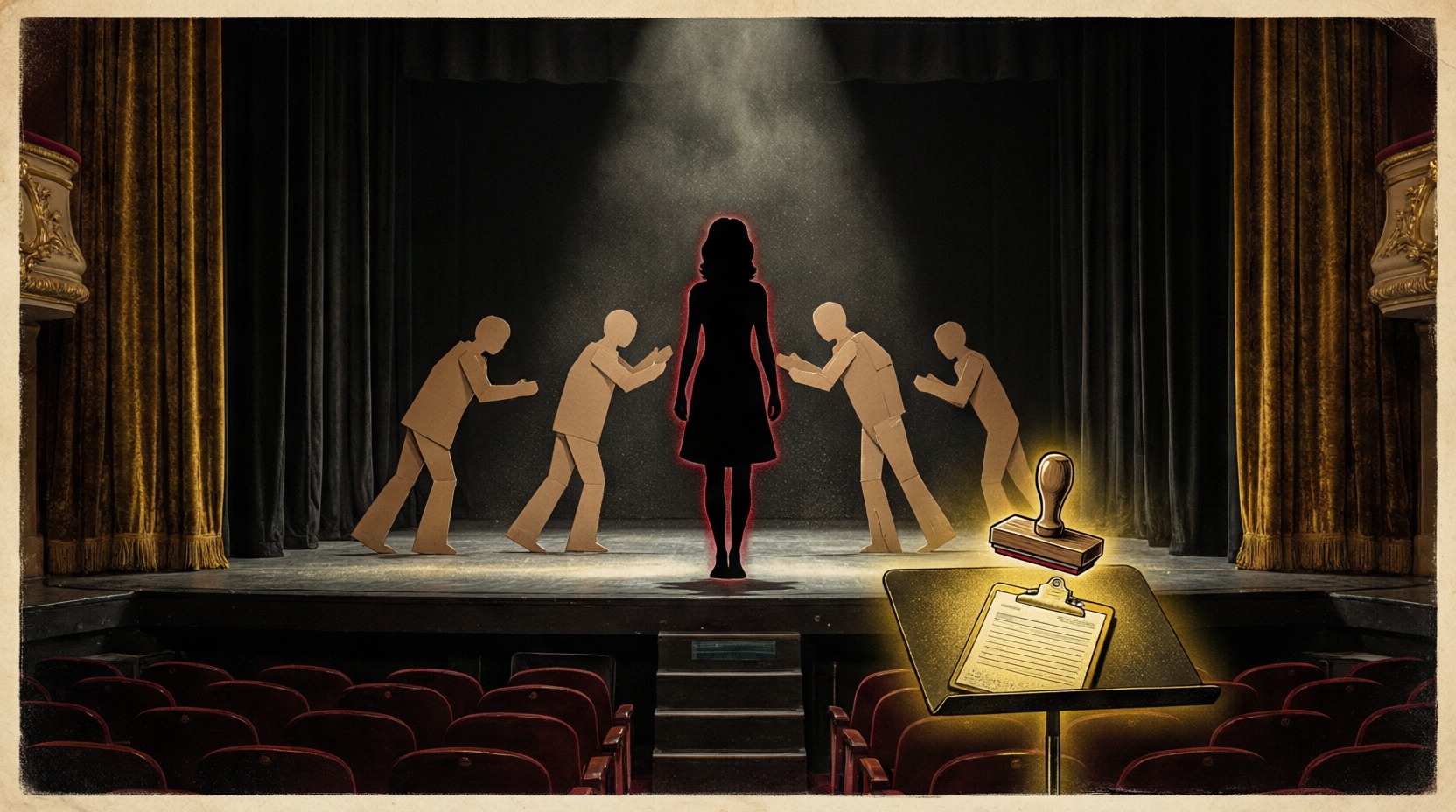
“Bambi is a baby deer. Put a chicken in. Make her gay.”
The internet, on what passes for a writing room these days
The Frozen Script
A man sits at a desk in a glass tower. He is paid six million dollars a year to decide which stories get told. He has not written one. He cannot. He is not a writer. He is a classifier. He reads scripts the way an HR department reads resumes: he scores them against a checklist. Female lead above forty percent. Non-white supporting cast above thirty percent. Queer sidekick in act two. Man problem in act three, resolved by woman above the glass ceiling. If the score clears the threshold, the script moves forward. If the score misses the threshold, the script is rewritten until it does. The writer who resists is told, gently, professionally, with the calm of a man holding a clipboard at a graveyard, that the work needs to reflect the modern audience.
There is no modern audience. The audience is the same audience that watched Star Wars in 1977 and Alien in 1979 and The Lord of the Rings in 2001. The audience will watch whatever is well-made. The audience will refuse whatever is not. The audience does not need to be reflected. The audience needs to be respected. The man at the desk cannot tell the difference, because the man at the desk has been trained to treat storytelling as compliance rather than as craft. The man at the desk has not read Aristotle. The man at the desk has read the DEI binder.
This is the mechanism. Not a conspiracy. A profession. The profession has been taught that the audience is a problem to be managed rather than a witness to be earned. The profession has decided that theme is more important than character, that message is more important than plot, that the checkbox is more important than the story. The profession is wrong, and the proof is sitting on every streaming shelf in the country, unwatched and unmourned.
Bambi is a baby deer. Put a chicken in. Make her gay. You are not focused on whether these characters are realistic. You are not focused on what their motivations are. You are not focused on what action leads to what consequence. You are focused on what the theme requires. The theme calls for a female lead. The theme calls for a queer moment. The theme calls for a villain who is, by definition, a straight white man. The theme is now the author. The writer is now the typist.
The story is over. The story was over the moment the theme sat down at the typewriter.
What Wokeness Actually Is
The word is contested. Good. The word should be contested. A premise that everybody agreed on would not need a name. The premise that the sun rises in the east does not need a name. The premise that murder is wrong does not need a name. The premise that woke storytelling rests on does need a name, because a great many people do not agree with it.
The Google definition will do as a starting point. Wokeness is the active awareness of systemic social inequalities such as racism, sexism, and LGBTQ plus discrimination. The definition is not wrong. The definition is also not the problem. The problem comes in the next two moves the doctrine makes.
Move one: the inequalities are arranged into a hierarchy. Some groups are at the top. Some groups are at the bottom. The groups at the top have what the doctrine calls privilege. The groups at the bottom have what the doctrine calls credibility. The hierarchy is treated as objective; the hierarchy is treated as the way the world actually is.
Move two: the hierarchy is treated as a moral barometer. The closer to the bottom you are, the more credible and sympathetic you are. The closer to the top you are, the more suspect and dangerous you are. The barometer is not negotiable. The barometer is the lens through which every situation must be read. The man who disagrees with the barometer is at the top of the hierarchy by definition; the man who disagrees is therefore the enemy by definition. He is not to be argued with. He is to be dismissed.
This is where the doctrine runs into trouble. The hierarchy is arguable. The barometer is arguable. The premise is arguable. A great many people in the audience never bought the premise, and they have been told for years that their refusal to buy it makes them the enemy. They responded the way free people always do when they are told their eyes are wrong.
They walked out.
Wokeness in storytelling fails because it assumes the audience has already bought in. It spoons the audience the conclusion, then forces the characters and the plot into obedience to the conclusion. The audience that already agreed feels nothing. The audience that did not agree feels manipulated, and stops watching. And the audience that stops watching is the audience the doctrine claims to want to reach.
The result is the strangest commercial failure in the history of mass media. The doctrine wants a wider audience. The doctrine produces a smaller audience. The doctrine cannot understand why, because the doctrine has confused preaching with storytelling; and a sermon is not a story, and a congregation is not an audience.
The Mechanism: Narrative Obedience
Every story is a contract. The writer promises the reader a world that obeys its own rules. If the world does not obey its own rules, the reader feels the betrayal in the body before the mind has time to name it. The betrayal is what critics call bad writing. The betrayal is what audiences call a waste of two hours.
A story obeys itself when actions lead to consequences. A story obeys itself when characters act from motives the story has earned. A story obeys itself when the ending follows from what came before, and when it never asks the reader to believe something the story has not established. The contract is invisible when it is honored. The contract is screaming when it is broken.
Narrative obedience is the writer’s loyalty to the story rather than to the message. It is the refusal to have a character do something the character would not do in order to deliver a line the theme needs. It is the refusal to kill a character in act two because the theme required a death, or to spare a character in act three because the theme required mercy.
Wokeness in storytelling is the systematic violation of narrative obedience in service of a moral barometer. It does not break the contract by accident. It breaks the contract on purpose. The breaking is the feature. The breaking is how the doctrine announces its presence in the work. The breaking is the wink to the in-group: invisible to the in-group, because it has agreed to the premise and cannot feel the contract being violated; deafening to the out-group, which never agreed and feels every violation in the bones.
The mechanism is the same one every captured institution runs on. The institution takes over a function that used to operate by its own logic. The institution replaces the logic with the doctrine. The function continues to run; the results are worse than they were before. The institution cannot tell that the results are worse, because it is measuring the results against the doctrine rather than against the function. The audience the function was built to serve leaves. The institution blames the audience for leaving. The institution writes a memo about the importance of patience.
The Empty Room
There is a diagnostic for what the doctrine produces. It is called the Butler Test, and you can find it here: Woke Movies: Narrative Obedience and the Collapse of Storytelling. Three rules: specificity, earned, flawed. Run on Katniss Everdeen it passes three for three. Run on Rey it fails three for three. I will not re-run it in this piece. The test is one essay’s job. This essay’s job is different.
The test tells you what the doctrine breaks. It does not tell you what the breakage looks like at scale, across franchises, or what produced it. Run the test once and you have a diagnosis on a character. Run it across a decade of output from a captured profession and you have a mechanism.
The signature of the mechanism is the empty room. When the doctrine tries to make a hero without doing the work, it produces a void where the character should have been. The doctrine wrote the void. The doctrine does not know what to put in it. And around the void, the men are flattened into props so the empty room can be called a heroine. The result is a story in which every male character has been reduced to a stagehand and the female character is the stage they stand on. That stage is not a person. The doctrine punishes you for noticing.
The pattern is not one character, and it is not one franchise. It is what every captured institution produces once the doctrine replaces the craft. What follows is the pattern, in scenes.
The Will Byers Scene
A young man has known he was gay for ten years. The audience has known he was gay for ten years. Will had a reconciliation with his sexuality at the end of volume one. The plot of the season involves fighting a villain called Vecna. The plot of the season involves rescuing friends from an alternate dimension called the Upside Down. The plot of the season does not require a seven-minute coming-out scene.
The show gave Will a seven-minute coming-out scene.
The scene had nothing to do with Vecna. The scene had nothing to do with the Upside Down. The scene was inserted because the theme required it. The theme required the scene. The scene required the time. The audience was held hostage for seven minutes so the theme could be ticked off the checklist.
This is what narrative obedience looks like when it has been replaced. The story required Will to fight Vecna. The theme required Will to come out again. The theme won. The audience was told, by the writers and by the cast and by the press tour, that anyone who objected to the scene was a bigot. Their objection was not about craft, they were told; their objection was about identity. Their objection made them the enemy.
The audience that objected left. It had been leaving for years, and it has been leaving every franchise that has done this to it. And the audience that left is the audience the doctrine claims to want to reach. It has stopped reaching back.
The Casino Scene
Two characters enter a casino planet on a side mission. One of them is a former child soldier kidnapped by a military regime. The other is a mechanic who has just learned that the casino is run by people who weaponize animals and exploit workers.
The mechanic delivers a lecture to the former child soldier about the cruelty of animal exploitation. The mechanic is correct. The mechanic is also irrelevant. The former child soldier was trafficked as a child, raised to be an expendable soldier; he understands exploitation more intimately than the mechanic will ever understand anything. He does not need the lecture. The lecture happens because the theme required a moment of female moral instruction. The mechanic is a woman. The woman must instruct. The man must receive. The plot of the movie is held hostage for ninety seconds so a woman can explain to a man something the man already knew better than she does.
The casino planet also keeps child slaves. The child slaves are not freed. The animals are freed. The film celebrates the freeing of the animals. The film does not notice the child slaves. The film is unaware that the omission is the indictment. It has done the theme. It has ticked the box. It has moved on.
This is what narrative obedience looks like when it has been replaced by the doctrine. The doctrine knows what to care about. It has a checklist of cares. It does not know what the audience cares about. The audience cares about the child slaves. The audience cares about Vecna. The audience cares about the men the story has flattened so the woman can float. The audience cares about the things the doctrine forgot to tick.
The Asymmetry That Proves the Rule
The proof is not that woke stories have female leads. The proof is that stories with female leads and diverse casts can succeed when the writers do the work, and fail when they do not.
Ellen Ripley is a female lead. She is one of the best characters in the history of cinema, and she was written by a man who did the work: a specific skill set earned by the plot, a psychology explained by the plot, flaws that have consequences in the plot. Ripley works because the writer wrote a person.
Sarah Connor begins the Terminator franchise as a vulnerable waitress and becomes a warrior through specific, brutal, earned training. She is wrong about things in the second movie; she has a son she cannot connect to. Connor works because the writer wrote a person.
Furiosa is competent at mechanics because she grew up in a mechanic culture, ruthless because the world she grew up in required ruthlessness, and wrong about people sometimes. Furiosa works because the writer wrote a person.
Katniss Everdeen is a female lead. The Hunger Games is not a woke story; it is a story that happens to have a female lead. The woke premises the doctrine demands were available to the writer. The writer did not use them. The writer used craft. The craft made the story survive.
The doctrine cannot explain why these characters work. Its framework says female leads are political, are evidence of progress; it has no category for a female lead whose success depends on the writer ignoring the framework. The doctrine has to call these characters exceptions. It has to pretend the craft is incidental.
The craft is not incidental. The craft is the whole thing. The doctrine is the thing that gets in the way.
The Pattern Across Franchises
Pick a franchise. Pick any franchise that has been run by a committee that has internalized the doctrine. Run the Butler Test on the new characters. Count the passes.
Star Wars: Rey fails on all three rules. Finn fails on rule two. Rose fails on rule three. Holdo fails on all three. Poe is the only character with a real arc, and the arc is suppressed so the women can have theirs.
Marvel: Captain Marvel fails on all three rules. She-Ra fails on all three. Captain America was passed to a woman who then passed it back, and the passing was more interesting than the character.
Lord of the Rings: The Rings of Power features characters the audience cannot name after a season of trying. Galadriel is an action hero for reasons the show does not establish. The men are passive. The plot is obedient.
Star Trek: Discovery runs on plot points the doctrine demands and characters the doctrine permits. The captain delivers sermons. The science officer delivers sermons. The show used to be about exploration. The show is now about compliance.
Harry Potter: The Hogwarts Legacy game gives you a silent protagonist who nods at the themes. The Fantastic Beasts movies give you characters who appear, deliver a line the theme requires, and disappear. The audience that grew up with the books notices. The audience that grew up with the books is the audience the doctrine claims to want.
The pattern is the point. It is the same pattern visible in journalism, in academia, in medicine, in law: the institution gets a doctrine. The doctrine replaces the craft. The output gets worse. The institution blames the audience for noticing. The audience leaves. The institution writes a memo about the importance of patience.
The Exit Protocol
Wokeness in storytelling is institutional capture in slow motion. The doctrine is the capturer. The guild used to know that the audience is the boss; that the audience leaves when the work is bad; that the work is bad when the writer writes to the theme instead of to the person. The capturer replaced that logic with the doctrine, and installed a compliance department.
The compliance department scores scripts against the doctrine. It does not score them against craft. It cannot score them against craft, because it was hired to enforce the doctrine, not to know craft. It is staffed by people trained to treat storytelling as compliance, and it hires writers trained the same way. It produces work optimized for the doctrine and degraded for the audience, and it cannot tell the difference, because the compliance department has never read Aristotle.
The audience leaves, and the revenue falls, and the institution blames the audience for the fall. It runs a focus group. The focus group tells the institution the audience wants better stories. The institution interprets better stories as more doctrine. It produces more doctrine. The audience leaves faster.
The exit is not to petition the institution. The exit is not to write letters to the compliance department. The exit is not to wait for the institution to reform itself. The exit is to leave. Build outside. Build a parallel thing. Make the thing the institution used to make; make it well; make it for the audience the institution forgot. Let the institution keep its doctrine and its compliance department and its work the audience has stopped watching. The institution will fail. The institution is already failing. The parallel thing will succeed. The parallel thing is succeeding.
This is what is happening with independent media, with independent games, with independent film and fiction. The audience the doctrine forgot is the audience the independents are gathering; the audience that was always willing to pay for craft; the audience that knows the difference between a story and a sermon.
What You Do With This
Run the Butler Test on every character you watch. Run it on the characters you love. Run it on the characters you hate. Run it on the characters you have not thought about in years. The test takes a paragraph per character, and it will tell you, in a paragraph, whether the writer did the work. If the writer did the work, the character is real. If the writer did not, the character is a sticker. The sticker will not survive a second viewing. The real character will survive a hundred.
Reward the work. Stop rewarding the message. Pay for the films, the shows, the books, the games that did the work; do not pay for the ones that ticked the box. The revenue is the only feedback loop the industry respects. It does not respect your op-eds or your tweets. It respects the spreadsheet, and the spreadsheet answers to your wallet.
Build the parallel thing. Write the story you wanted to watch. Make the film you wanted to see. Build the game you wanted to play. The institution will not give you permission. It will call your work fascist if your work is beautiful, patriarchal if your work has heroes, exclusionary if your work has standards. Build anyway. The work you build outside the institution is the work that will survive.
Teach the children. Tell them that characters have to be earned, that themes have to be earned, that stories obey themselves. Tell them that a strong woman who cannot be wrong is not strong; a strong woman who can be wrong, who can be flawed, who can need help from men without being diminished by the help, is the strongest woman in the room.
Name the mechanism. When a story holds itself hostage to the theme, name it. When a man is flattened so a woman can float, name it. When an animal is freed so a child can remain enslaved, name it. Naming the mechanism is not a complaint. Naming the mechanism is a correction; it is the beginning of the work that has to be done.
The work that has to be done is not complicated. The work is to remember what a story is. A story is a contract; a promise; a world that obeys itself. A story is a person the writer has earned, and an ending the writer has earned. A story is the opposite of a sermon. It is what survives every ideology, including the one the writer carried into the room. It is what the doctrine cannot do and cannot tolerate. It is the thing the doctrine killed, and the thing we have to remember how to write.
Bambi is a baby deer. Put a chicken in. Make her gay. The line is funny because it is true; because it captures the entire pathology in seven words. The audience that heard it laughed, and nodded, and knew exactly what was being mocked; because the audience has been watching the doctrine flatten the men, hollow out the women, hold the plot hostage, kill the story, and call the corpse progress.
The audience is done watching. The audience is starting to write.
Part 9 of the Feminism Series. Companion: Woke Movies: The Butler Test.