The Return of Techno-Feudalism: You Will Own Nothing, and You Will Be Happy
The Return of Techno-Feudalism: You Will Own Nothing, and You Will Be Happy
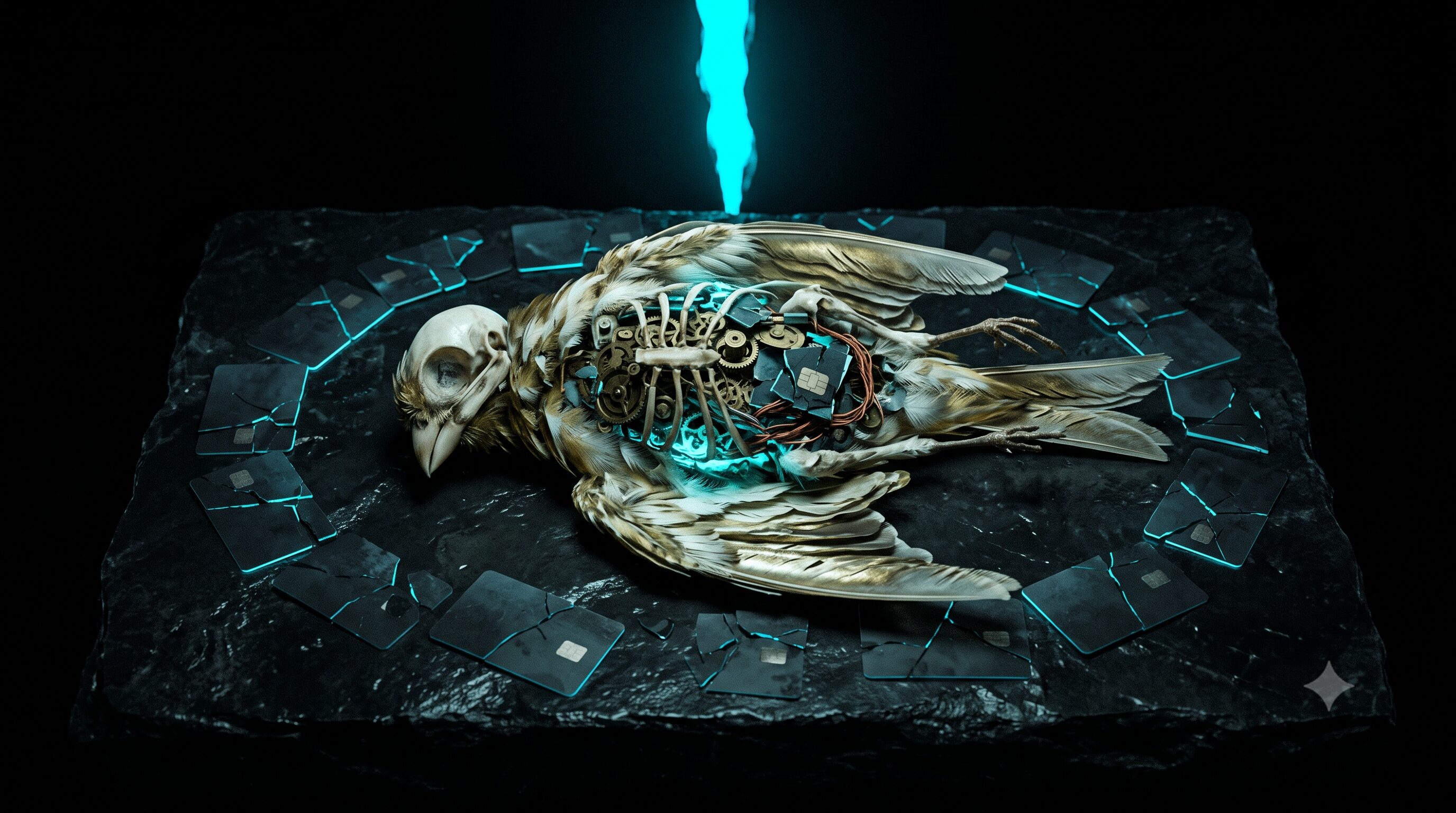
Gaze into the digital coal mine. The canary is not dead; it has been hollowed out, stuffed with gears, and sold back to us piece by piece. We are dissecting Adobe tonight; not as a corporation, but as the harbinger of a new, creeping darkness. Watch how the very concept of ownership is dismantled, brick by digital brick, until nothing remains but the dust of our own consent.
There was a time when Adobe was a sanctuary. A functional pair of hands that empowered the creator. You bought the tool, you possessed the means of production, you bent reality to your will. Today it is a parasite. The software you once owned outright, your sovereign property, is rented back to you by the month, at a price that climbs with a ruthless mechanical precision. We traded mastery of our tools for mandatory hollow intelligences we never asked for, relentless subscription tithes, and a literal penalty for the sin of wanting to walk away.
The gears are jamming. Adobe is caught in a death spiral of its own making. Decades of cynical avarice and rent-seeking greed are tightening the noose around its own neck.
Their CEO still stands at the podium, smiling the empty smile of the Last Man, claiming the ecosystem has never been healthier. He boasts of double-digit growth and extreme profitability. Mechanically speaking, he does not lie. Adobe recently posted a record $23.8 billion in revenue; their most bountiful harvest.
So why has the stock magnificently cratered by roughly 65% from its peak, defying the false dawn of the tech market boom? Why does the market turn its face away from a company drowning in record profits?
Because there is something profoundly rotten in the soul of the machine that redefined creativity for a generation. It is the inevitable endpoint of a process Adobe has been orchestrating with cold deliberation for years.
The Velvet Snare
Adobe used to inspire thousands to bend reality through Photoshop, Illustrator, or After Effects. Now the most vital wisdom circulating on the web teaches you how to escape the labyrinth. It looks easy. It is not.
When you signed away your sovereignty, Adobe steered you straight toward a plan called Annual, Paid Monthly. It was pre-selected. It wore the mask of a flexible month-to-month handshake. In reality it was a year-long snare. Dared to reclaim your freedom before the cycle was complete, Adobe slammed you with an early termination fee; a blood tribute equal to half of everything you owed. A surprise bill of hundreds of dollars, levied purely for the crime of wanting to stop.
This financial bear trap was buried in fine print, concealed behind tiny UI icons you had to blindly grope for to even perceive.
Then came the cancellation gauntlet. You did not simply leave. You were funneled through a labyrinth of menus, desperate discounts, and psychological friction. Every step was engineered to exhaust your will, to break your spirit until you surrendered and resumed your tithes. The industry politely calls this a dark pattern. We call it what it is: a user interface designed for digital hostage-taking.
It became so grotesque that even the Leviathan intervened. In 2024 the state’s hounds, the DOJ and the FTC, sued Adobe for trapping souls with hidden fees and deliberate psychological torture. Adobe paid a $150 million settlement, smiling and denying any wrongdoing.
The Murder of Ownership
The deeper tragedy is why users had something to cancel in the first place.
Until 2013, Adobe honored a simple ancient law: you bought the software, and it belonged to you. The Master Collection was not cheap, but it was yours. A tool to be wielded for a decade, requiring tribute only when a new version offered genuine undeniable value.
Then Adobe executed the pivot that poisoned modern commerce. They decreed that Creative Suite 6 would be the last tool you could ever truly own. From that day forward you did not possess Photoshop. You rented it. The second you stopped paying the toll, the very tools your life’s work was built upon turned to ash in your hands.
They wrapped this extortion in a warm weightless illusion: The Creative Cloud.
Overnight, a customer who paid once every five years was reduced to a serf, tithing every single month. Because once your life’s work was imprisoned inside Adobe’s proprietary formats, leaving meant incinerating your own archives.
The financial harvest was obscene. In its final year of selling boxed software, Adobe made around 4 billion. A decade later it extracts over 23 billion annually from the herd.
Most do not calculate the true gravity of this rent. The old Master Collection cost 2,600; owned forever. The modern Cloud demands ~840 a year; rented into the void. Every three years you now pay the full price of the old sovereign tool. A designer who has paid every month since 2013 has bled over 8,000. Over a 40-year career, assuming the lords never raise the price again, which they *always* do, that software will cost between 33,000 and $100,000.
A hundred thousand pieces of silver. Paid entirely for the permission to exist as a creator. That is wealth extracted from your future; blood that could have built a home, fueled a lineage, secured your liberty.
The Dawn of Techno-Feudalism
Adobe’s maneuver became the holy text of modern capitalism. Every tech executive watched them swap ownership for rent, saw the billions roll in, and applied the same iron collar to their own industries.
You do not own your music; you rent it from Spotify. You do not own your films; you stream them from Amazon, a corporation that once literally reached into users’ Kindles and burned copies of 1984 they had already purchased. Your car monetizes your movements. Homeownership is evaporating.
The majority now juggle five to eight subscriptions as the concept of ownership is ground into dust. This is what Yanis Varoufakis identifies as Techno-Feudalism. The tech monoliths own the digital land. We are the peasants permitted to till it, paying rent for the privilege of drawing breath within their walled gardens.
The worst slavery is the one you volunteer for.
The Monopoly Playbook
A corporation does not grow this brazen by accident. It takes decades of strategic devouring.
Adobe, like all titans, built its empire on a monopoly. Founded in 1982 by two exiles from Xerox, they started with PostScript, then the universally dominant PDF. The crown jewel, Photoshop, was not even forged by Adobe; they bought it in 1988 and turned it into an industry standard, verbifying its name, making it the air creative professionals breathed.
Whenever a genuine threat emerged, Adobe either consumed it or buried it. When Freehand challenged Illustrator in the 90s, Adobe tried to buy it. The state blocked it, enforcing a 10-year ban. Adobe waited in the shadows like a spider. The second the ban expired in 2005, they swallowed Macromedia for $3.4 billion, taking Freehand, Flash, and Dreamweaver into their maw. They immediately suffocated Freehand out of existence.
One by one, rivals were neutralized. The ecosystem was enclosed. The walls went up.
Enshittification and the AI Tax
Once you become a landlord with captive tenants, you stop fixing the plumbing. You simply raise the rent.
Year after year, the tithes climbed. The flagship plan was fractured. The 9.99 photography plan jumped to 14.99. Their justification? Forcing an artificial intelligence called Firefly into the apps. A mandatory tax on your own creativity.
If you fought through the dark patterns to downgrade and save your coin, Adobe punished you by slashing your monthly AI credits by 97.5%. Pay more for the AI you despise, or pay less for a crippled version of the tool your survival depends upon.
Meanwhile the core software rotted from the inside. The 2025 releases of Photoshop were bloated, decayed things. Premiere Pro became a notoriously unstable ruin.
Then in 2024 Adobe crossed the final red line. They pushed a mandatory terms-of-service update, granting themselves the right to sift through your private creations; via automated systems and human eyes. The blowback was seismic. Trust, once shattered in the creative space, cannot be glued back together with a PR apology. They attempted it again later, trying to retroactively legitimize the scraping of their own Adobe Stock contributors.
The illusion of safety was dead. The veil was torn, revealing the gnashing teeth beneath.
The Cracks in the Fortress
Every empire falls when the borders are breached. The fractures in Adobe’s fortress are now structural, echoing through the hollow halls of their dominance.
The First Blow: The Figma Humiliation.
When the collaborative design tool Figma emerged as an existential threat, Adobe reached for the old playbook; consume them. They offered a staggering 20 billion in 2022. But the regulators, in the US, UK, and EU, finally stirred from their slumber and blocked the deal. Adobe had to walk away in late 2023, handing Figma a 1 billion breakup fee for absolutely nothing. The titan drew its sword and missed.
The Second Blow: The Great Escape. Canva acquired Affinity, a suite of tools mimicking Photoshop and Illustrator, and made it free for education and nonprofits, offering perpetual licenses to the rest. Over a million serfs defected in days. Blackmagic’s DaVinci Resolve had already executed a similar raid on Premiere Pro. The gates were open. The exodus had begun.
The Third Blow: The AI Guillotine. Adobe’s core value proposition was making difficult things possible. Generative AI makes difficult things effortless. When media can be summoned from the void with a prompt, the moat of technical proficiency evaporates. Microsoft, Meta, and Nvidia do not rely on creative professionals to survive. Adobe does.
By hyper-fixating on integrating Firefly and cannibalizing their own stock image marketplace, Adobe funded their own obsolescence. They joined the AI arms race and became one of the only tech giants actively dismantled by it. They forged the sword that now cuts their throat.
The Collapse of the Rentier
The market sees the writing on the wall. By the spring of 2026, Adobe shares were bleeding out, trading near $200, down roughly 65% from their 2021 peak. Record revenues could no longer mask the stench of decay.
When Meta or Microsoft hit turbulence, AI was their savior; a magnet for capital. For Adobe, AI is not the bailout. It is the executioner.
Adobe is proving a vital terrible lesson to the broader technofeudalist regime. You can enclose the commons. You can trap your users in a labyrinth of rent. You can let the product rot, and force people to lease back their own sovereignty. You can get away with it for a long profitable twilight.
But the moment the gates are breached, the moment genuine decentralized competition offers a way out, the serfs will burn the fields and walk into the wilderness. The model is everywhere, but as Adobe is learning in its agonizing death throes: gravity always wins. The abyss always reclaims what tries to float above it.
The Pincer Movement: Leviathan and the Lords
Adobe’s stumble is a satisfying spectacle of corporate hubris, but do not mistake a single fallen landlord for the collapse of the system. Adobe may bleed, but Techno-Feudalism is not retreating; it is being meticulously, inevitably cemented.
Look at the architecture being drafted in Davos and championed by every major international NGO. When the global elites gather, they are not warning us about this future; they are writing its gospel. The subscription model of human life is not a flaw in their vision. It is the entire point.
The corporate rentiers are only one jaw of the trap. We are caught in a synchronized pincer movement.
On one side, the technofeudal lords enclose the digital commons and extract their monthly pounds of flesh. On the other side, the Leviathan, the State, is rapidly closing the perimeter. Governments are no longer regulating these mega-corporations; they are fusing with them.
The playbook is ancient. First, the definitions widen. A decade ago, the state intervened because centralized banks were deemed too big to fail. Today, that justification has metastasized. Now chip-makers and AI monopolies are suddenly vital for national security. The state encroaches, expanding its definition of critical infrastructure, effectively wedding corporate monopolies to state power.
You are being squeezed in a vise. On your left is the coldest of all cold monsters; the sovereign state that monitors your existence. On your right is the corporate platform that rents your tools, your media, your livelihood back to you. They are constructing an inescapable, centralized architecture of control.
The Escape Vector: Bare-Metal Sovereignty
There is no political savior coming to dismantle this alliance. You cannot regulate a machine the regulators themselves are building. Hope is the opiate of the herd.
The only structural remedy against this creeping dystopia is the total, violent rejection of their centralized architecture. The antidote is true decentralization. We must engineer a return to local ownership, local execution, local sovereignty. We need infrastructure that operates independently of the cloud overlords; systems built on the premise that you, and you alone, hold the cryptographic keys to your digital soul.
This requires a cultural and technological transvaluation of values. It means embracing local-first technologies, peer-to-peer networks, and resilient immutable systems that cannot be arbitrarily shut down, priced out, or co-opted by state mandates. It requires the will to stand alone.
Naming the Beast
Before the exit, name the architecture correctly. Propaganda dies when its proper nouns are spoken aloud.
Philosopher Slavoj Žižek and political economist Brett Christophers echo Varoufakis. Christophers calls it Rentier Capitalism. You are no longer a customer to be courted with innovation; you are a tenant to be squeezed until the pips squeak. Even the World Economic Forum, hardly a nest of radical rebels, has hosted panels explicitly outlining this dynamic: a system where the return on mere property rights drastically exceeds the return on actual human production. You keep the supply scarce by ensuring no rival is ever allowed to breathe.
Techno-Feudalism. Rentier Capitalism. The subscription model of human life. Same cadaver, different autopsists.
The vocabulary matters. The moment you can name the mechanism, you can refuse the premise. You can stop asking how do I get a better subscription? and start asking how do I exit the rent relation entirely?
Libertaria: The Blueprint for Exit
This is the ideological payload behind Libertaria.
We are not merely observing the descent into Techno-Feudalism; we are forging the escape routes. Libertaria is a structural rejection of the landlord-tenant dynamic they are trying to nail over humanity. It is about constructing radical self-sovereignty through decentralized systems, communal resilience, uncompromising individual freedom.
If Techno-Feudalism is the digital enclosure, Libertaria is the jailbreak. It is a space designed to arm you with the ideas, the frameworks, and the unyielding technological clarity needed to reclaim ownership of your life.
It is, quite simply, an immutable, decentralized, and highly strategic middle finger raised against the architects of our digital serfdom. The future belongs to those who forge their own tools. Choose your infrastructure wisely; or resign yourself to the dark.