Forty-Five Days and Counting
FISA gets another stopgap. Brussels can't water down its own law. The surveillance state runs on extensions now.

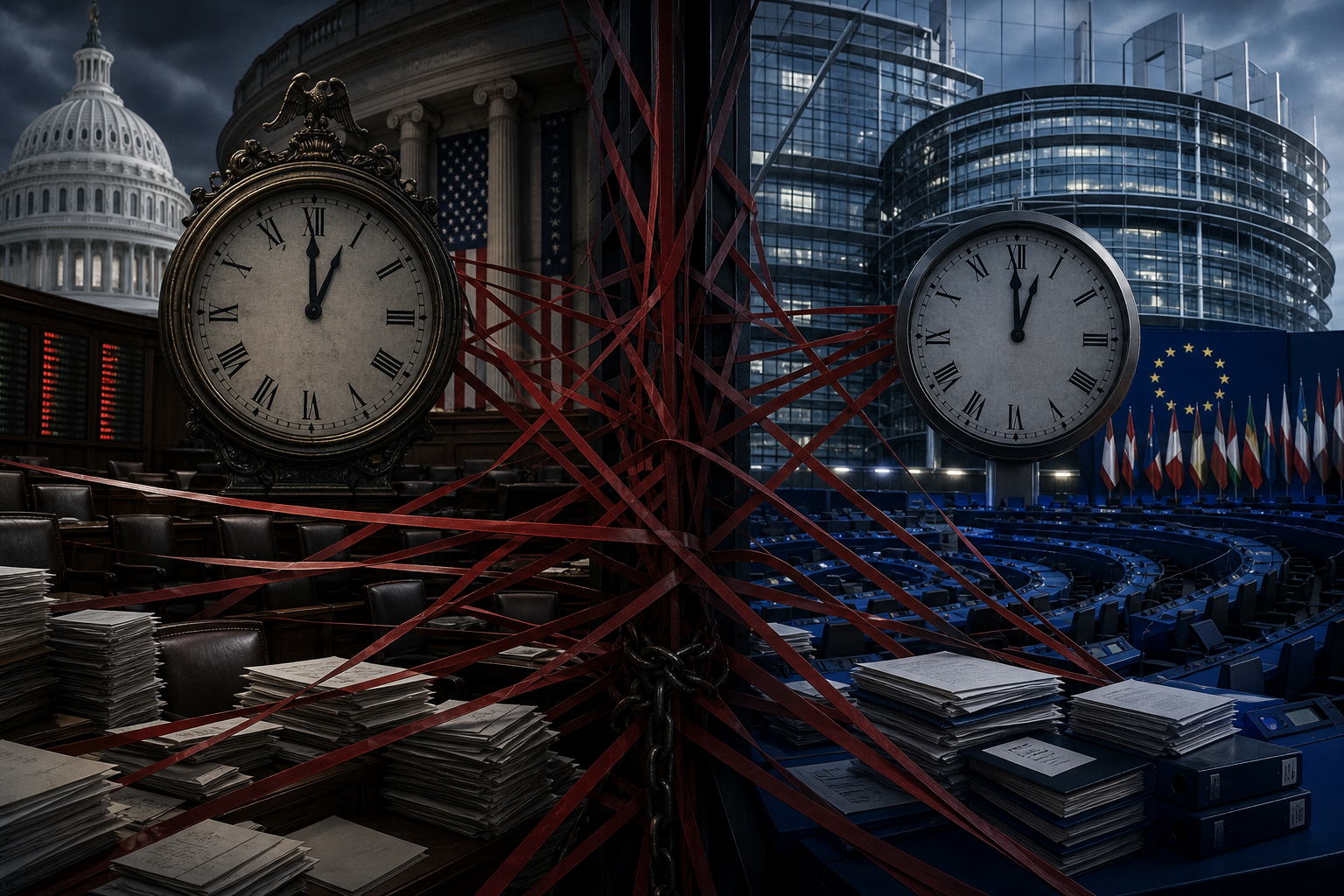
Forty-Five Days and Counting
Two things happened this week. Same pattern. Different continents.
Washington: Forty-Five Days, Again
Congress passed a 45-day extension of Section 702 of FISA on Thursday. That is the law that lets US intelligence agencies vacuum up communications of foreign targets abroad. It also sweeps in Americans’ texts, emails, and calls without a warrant. Incidental, they call it.
This is the second short-term extension this month. First came a 10-day patch in April. Now another 45 days. The House had passed a 3-year reauthorization bundled with a ban on Federal Reserve CBDC issuance. The Senate killed the package. Not because of the surveillance. Because of the CBDC language.
The surveillance state runs on stopgaps now.
Thomas Massie, Republican of Kentucky, tried to block the extension:
“FISA databases have been used to query political activists, members of Congress and their staff, random romantic interests of FBI agents, and we’re being told, ‘Oh, don’t worry, it’s not being abused any more.’ A short-term infringement of the constitution is still an infringement of the constitution.”
Jamie Raskin, Democrat of Maryland, took the floor with the same objection from the other side:
“We’re willing to give you 45 more days for us to negotiate this thing if the speaker will actually sit down with us.”
The vote was 261-111. Off to the president’s desk. The program that was supposed to sunset keeps getting resuscitated by procedural duct tape.
The signal is not the surveillance. Everyone knows that is happening. The signal is that the institution cannot close the deal. Not to end it. Not to reform it. Not even to permanently authorize it. Just enough momentum to keep the machine running for another six weeks. Then another vote. Then another extension.
This is not governance. It is a subscription model for constitutional infringement.
Brussels: Twelve Hours, No Deal
Twelve hours of trilogue negotiations in Brussels on April 28. Result: nothing.
The EU Council and European Parliament failed to agree on amendments to the AI Act, the landmark regulation that was supposed to make Europe the global standard-setter for artificial intelligence governance. The Digital Omnibus initiative was meant to streamline certain provisions. Depending on your angle, it was also meant to water them down to keep European companies competitive against US and Asian rivals.
It collapsed over carve-outs. Member states want exemptions for sectors already regulated under product safety rules. Parliament wants the AI Act’s risk framework to apply uniformly. Neither side blinked.
Dutch MEP Kim van Sparrentak:
“Big Tech is probably popping champagne. While European companies that care about safety and did their homework now face regulatory chaos.”
A Cypriot official speaking for the EU Council presidency:
“It was not possible to reach an agreement with the European Parliament.”
Talks resume in May. The August 2026 enforcement deadline for high-risk AI systems approaches. The standards bodies have not finalized the technical specifications companies would need to comply with even if the law were clear. It is not clear.
So the EU’s answer to American AI dominance is a regulatory framework that cannot agree on its own amendments. Cannot finalize its own standards. Cannot tell builders what the rules actually are with three months to go.
The Same Rot
A 261-111 vote. Twelve hours of deadlocked talks. The same week.
In Washington, the institution cannot agree on how to constrain its own surveillance power. So it extends by default. The machine keeps running because nobody can assemble the coalition to stop it, or to formalize it.
In Brussels, the institution cannot agree on how to regulate the most consequential technology since electricity. So it produces regulatory uncertainty by default. The machine keeps grinding because nobody can assemble the coalition to clarify it, or to simplify it.
Both are institutional paralysis. Both produce the same outcome: the status quo continues unexamined. Surveillance keeps collecting. Regulation keeps not regulating. The people in the path of both get neither protection nor clarity. Not the surveilled. Not the builders. Not the citizens.
This is the terrain Libertaria maps. Not because we have a reform proposal for FISA or a preferred amendment to the AI Act. We do not. The Dispatches are not policy recommendations.
The signal is simpler: the institutions that claim to govern these domains cannot, in fact, govern them. They can extend. They can delay. They can fail to agree. They cannot close.
Build accordingly.