When the Law Arrived
The Torah existed for centuries before anybody obeyed it. The archaeology is unembarrassed about saying so.
The argument, in brief
Third case in the Higher Criticism docket. The question: when did Judaism, as a population actually keeping the Torah, begin? Adler's method inverts the usual one: start where the evidence is thick, the first century CE, and walk backwards until the trail ends. It ends in the mid-second century BCE. Everything before that point shows a different religion, which scholars now call Yahwism: non-exclusive worship of the Judean god, multiple temples (Elephantine in Egypt, Gerizim in Samaria, Edfu), a goddess Anat-Yahu reverenced beside Yahu, blessings to the gods in plural, Jerusalem high priests minting coins with Athena's owl. The Qumran evidence completes the corridor instead of breaking it: silver amulets from about 600 BCE already carry the priestly blessing, the Torah surfaces as physical manuscripts around 250 BCE, and the first archaeologically visible community built entirely on Torah observance is the Hasmonean-era Qumran sect. Text first, adoption a century later. The distinction that survives every round: composition is a literary event, adoption is a political one, and only the second made the Torah law.
When the Law Arrived
Markus Maiwald, November 2026
The video title says Judaism began in 200 BCE, and that is not what the man in the interview argues. Yonatan Adler, the archaeologist whose work the title is selling, is careful to the point of repetitiveness on this: he is not dating the Torah’s composition, not dating the Exodus, not even dating monotheism as an idea. He is dating a practice. His question is: when can we first see ordinary Judeans, the farmers and potters and soldiers, actually keeping the laws of the Torah? His answer, argued across two books and a career in the dirt, is the second century before the common era, under the Hasmoneans.
Strip the clickbait and what remains is one of the cleanest pieces of historical detection this series has covered, corroborated at every step by evidence you can touch. This essay runs the case, then runs the counter-evidence, and both survive. That is how you know it is history rather than a vendetta.
Walk It Backwards
The standard approach to the origins of Judaism has always been to open Ezra and Nehemiah and believe them. A priest named Ezra comes from Babylonia carrying the law of Moses, commissioned by Artaxerxes, and reads it aloud to a people who have never heard it, and they weep and obey. Since the nineteenth century, Adler notes, scholars have taken those stories as more or less what happened, and therefore dated Judaism’s beginning to the Persian period, the middle of the fifth century BCE.
The story has no miracles in it. It sounds like history. And that, Adler’s whole career insists, is not a reason to believe a story. It is a reason to look for evidence.
His method runs the other direction. The first century CE is thick with evidence that Judeans kept the Torah: textual, epigraphic, and archaeological, at scale. So walk backwards. First century BCE, still thick. Then thinner. The trail of evidence for widespread Torah observance ends in the middle of the second century BCE. Not thins to a scholarly consensus about earlier practice. Ends.
An absence is not a proof, and Adler says so. Maybe everyone kept the Torah in 500 BCE and the evidence all rotted. But then you have to look at what evidence there is from before the wall, and there the problem sharpens, because the early material is not silent. It testifies the other way.
His instrument is archaeology itself, and his defense of it is worth keeping: excavation is a random sample of the past, its survival unplanned, its finds the residue of everybody. Texts are the deliberate output of the literate point-one percent, written to persuade. The archaeology is a window onto the 99.9 percent; the texts are a window onto the authors. Both are windows. Only one of them claims to speak for the whole house.
The Garrison That Never Heard of Deuteronomy
The star witness is a Judean military colony on the island of Elephantine in Upper Egypt, whose Aramaic papyri have been known for over a century. These are not fragments of scripture. They are letters, contracts, marriage documents, petitions: the filing cabinet of a real community, fifth century BCE, Judean to the bone.
And what a filing cabinet. The community ran a temple to YHW, the Judean god, complete with altar and grain offerings, in Egypt, which the book of Deuteronomy forbids on its face: one sanctuary, Jerusalem, full stop. They reverenced a goddess named Anat-Yahu, Anat of Yahu, whose name suggests she belonged to the god the way a consort belongs. They blessed in the plural. The famous Passover letter of 419 BCE shows them keeping a festival, but the festival arrives as instructions from abroad, not as the observance of a law the community demonstrably knows. When Persian-era priests of Khnum destroyed their temple in 407, the garrison petitioned Jerusalem and the Persian governor to rebuild it. Nobody in the surviving correspondence suggests the temple was ever improper to have. The community that knew its own god best apparently had no inkling of the Torah’s central demand.
Adler’s reading is the mainstream one at this point, and it is not new: scholars were already arguing in the early twentieth century that Elephantine’s Judeans knew no Torah. What is newer is the posture of taking that negative evidence seriously as a weight rather than an embarrassment to be dated around.
An Owl on the High Priest’s Coin
Walk forward from Elephantine into the early Hellenistic period, the subject of Adler’s newest book, and the continuity holds.
A coin from the late fourth century BCE, minted in Judea, reads in paleo-Hebrew script: Yohanan, the priest. The high priest of Jerusalem, Yahwistic name and all, and on his coin: the owl of Athena, and on the obverse a face in a circle read as the gorgon-headed aegis of Athena. No Athenian coin combines the two motifs that way; this is a Judean composition. Adler’s argument, offered with more caution than his critics grant: in the Semitic east Athena was identified with the warrior goddess Anat, the same figure standing beside Yahu at Elephantine a century earlier. On his reading, the high priest’s coinage nods to the goddess, and non-exclusive Yahwism walks straight across Alexander’s conquest without noticing it happened.
Around the same centuries: stone plaques from Judean communities in Hellenistic Egypt dedicate proseuchai, places of prayer. Not synagogues. The synagogue, Adler argues, is the educational institution Judaism required once the Torah became law, the weekly school where a mostly illiterate people could hear the text read out and explained. The proseuche is a cultic place, prayers and offerings, and nobody has shown Torah reading in it. The two institutions are not stages of the same thing. One belongs to Yahwism, the other to Judaism, and the second does not grow out of the first; it gets built when the new religion needs it.
Add the small, honest data points and let them accumulate, which is Adler’s explicit method. Letters from Judean officials opening with thanks to the gods, plural, into the third century BCE. Yahwistic theophoric names, the -yahu and -yah elements, continuous in the record from the ninth century BCE to today, including his own: Yonatan. Biblical hero names, by contrast, per Tal Ilan’s massive onomastic collections, are astonishingly rare in antiquity, Moses and David nearly absent from the living population. The god is ancient. The book is not the god.
The Corridor the Scrolls Opened
Now the evidence this series went looking for on its own, because it is the strongest independent check on the whole timeline: the Dead Sea Scrolls, the oldest Torah manuscripts that exist.
Stand at Ketef Hinnom, outside old Jerusalem, 1979. Two tiny rolled silver amulets from a burial chamber, dated to the late seventh or early sixth century BCE, carry the priestly blessing of Numbers 6, the Lord bless you and keep you, the oldest biblical text by centuries. So biblical-sounding liturgy is genuinely old. Note precisely what that proves: a blessing existed. A blessing is not a law code, and an amulet in a tomb is not a population keeping Leviticus.
Move forward. The Torah surfaces in Greek in Alexandria in the third century BCE, the Septuagint Pentateuch, whose commissioning legend, the Letter of Aristeas, is itself later fiction. The translation is real; its date rests on thinner evidence than textbooks imply, Adler notes, but the third century is the consensus anchor.
Then the caves. The Qumran library, buried around the first century CE, preserves copies of all five books of the Pentateuch, and paleography dates the oldest fragments, pieces of Exodus and Leviticus among them, to roughly the middle third of the second century BCE, ca. 250 to 200. These are the oldest physical Torah manuscripts on earth, about a thousand years older than the oldest previously known complete codices. Before those fragments: nothing physical, anywhere, of the Torah as a book.
Lay the corridor out and read it once more. A blessing on silver, about 600 BCE. A Greek translation, third century. The oldest Hebrew manuscripts, ca. 250 to 200. And the first archaeologically visible community whose entire way of life is organized around keeping the Torah: the Qumran sect itself, and the Judean population whose remains Adler catalogs, from the second century BCE onward. The text walks roughly a century ahead of the practice. The scrolls do not rescue the old timeline. They confirm the new one, with the one nuance the clickbait title trampled: existing and governing are different verbs.
The Wall of Finds
What does widespread Torah observance look like in dirt? Adler’s catalog, from the Hasmonean period forward, is the reason his book lands like it does.
Coinage goes aniconic: the Hasmonean rulers strike coins with no human or animal images, paleo-Hebrew script and symbols only, in visible deference to the second commandment, after centuries of Judean coins with owls and faces. Chalk and limestone vessels appear at Judean sites and only Judean sites, tableware and storage jars made of the one material the Torah’s purity laws do not list as susceptible, which is not a coincidence anyone needs to argue; the vessels are the argument, manufactured and bought by people who evidently knew the list. Stepped ritual immersion pools, mikvaot, cut into the rock at Judean settlements by the hundred, on the standard counts by the thousand, all Hasmonean era or later, never before. Depictions of the seven-branched menorah begin. Tefillin, the leather phylacteries Adler spent his own doctorate on, surface in the caves near Qumran: miniature scripture worn on the body, Torah observance you can physically lose in the sand.
Every one of these categories has a start date, and the start dates cluster. Not a gradual slope from Moses downward. A wall, in the second century BCE, behind which the record fills with a religion you can excavate, and in front of which you have a people, a god, a temple or three, and no law.
What the Stories Were For
If the Torah became law so late, what are Ezra and Josiah? Adler’s answer has the advantage of taking the stories seriously as texts while refusing them as testimony.
Read 2 Kings 22 and Nehemiah 8 side by side and the shape repeats: the people know nothing of the Torah, a scroll is discovered or arrives, it is read aloud to everyone, the community commits to keeping it, beginning now. The same story, told twice, about a book that keeps arriving as news. Adler’s reading: these are persuasion literature, calls for observance, written by people who wanted their audience to adopt the Torah and who told the adoption as a dramatic rediscovery precisely because it was not yet the law of anybody’s land. The story of the book nobody knew is itself evidence that the book was not widely known.
He applies the same blade to the Hecataeus passage that scholars have long brandished as evidence for early Judaism: a description of Moses and Jerusalem-sounding practice attributed to Hecataeus of Abdera around 300 BCE. Except the attribution survives only through a ninth-century Byzantine patriarch, Photius, quoting a lost Diodorus, who mentions Hecataeus among his sources rather than quoting him, with the name garbled. Each link has scholars who vouch for it and scholars who do not. Adler’s point is not that the description is wrong; it is that a chain like that cannot carry the weight of moving Judaism’s birthday by three centuries, and the people who lean on it are leaning on a railing that is not there.
The Honest Ledger
Now the criticisms, because the case has real ones and the essay is not a fan letter.
The argument from silence is the soft spot, and Adler’s critics press it: absence of evidence for Torah observance before the second century BCE is not evidence of absence, the Persian period’s record is thin for everything, and purity remains, stone vessels and immersion pools, may proxy for a particular kind of observance rather than the whole Torah. If Sabbath and dietary law were kept by populations that left no purity archaeology, the wall moves back without a trace. Fair. The counterweight is that the wall is not made of silences alone: Elephantine, the owl coin, the plural blessings, and the proseuchai are positive evidence for non-Torah religion, and a hypothesis that must explain them away has left the random sample and joined the texts in the business of persuading.
The second caution is Adler’s own, and the interview states it plainly: he has seen no compelling evidence for the early dating of the Pentateuchal sources and none for the late dating either. The documentary hypothesis machinery of J, E, D, and P, which this series covered in the Moses case, earns from him exactly the respect its relative arguments deserve, different hands in different orders, and zero confidence in the absolute dates. A good question plus a strong desire for an answer, he says, should not lead us to manufacture conclusions. This series files that sentence under doctrine.
And the headline overstated him, which matters for honesty and for traffic. Judaism as identity, peoplehood, and temple cult is centuries older than the second century BCE; Israel is in stone by 1208 BCE. What arrives under the Hasmoneans is Judaism as a law kept by a population, with the state that adopted it. What Adler dates is not the writing of the law and not the birth of the people. It is the moment the scroll became the constitution.
Adoption Day
That last distinction is where this case stops being archaeology and starts being the news.
A constitution that exists as a text is not governing anything. The Ketef Hinnom amulet blessed; the Septuagint translated; the Qumran scribes copied. None of that made the Torah law. What made it law was adoption: a polity, in this case the Hasmonean priestly state, putting its power behind the text and a population beginning to keep it at scale, with coins and dishes and bathhouses as the receipt. Texts do not rule. Adoptions rule. The writing is literary history; the adoption is a political event, and the entire archaeological record of Judaism begins on the political side of that line.
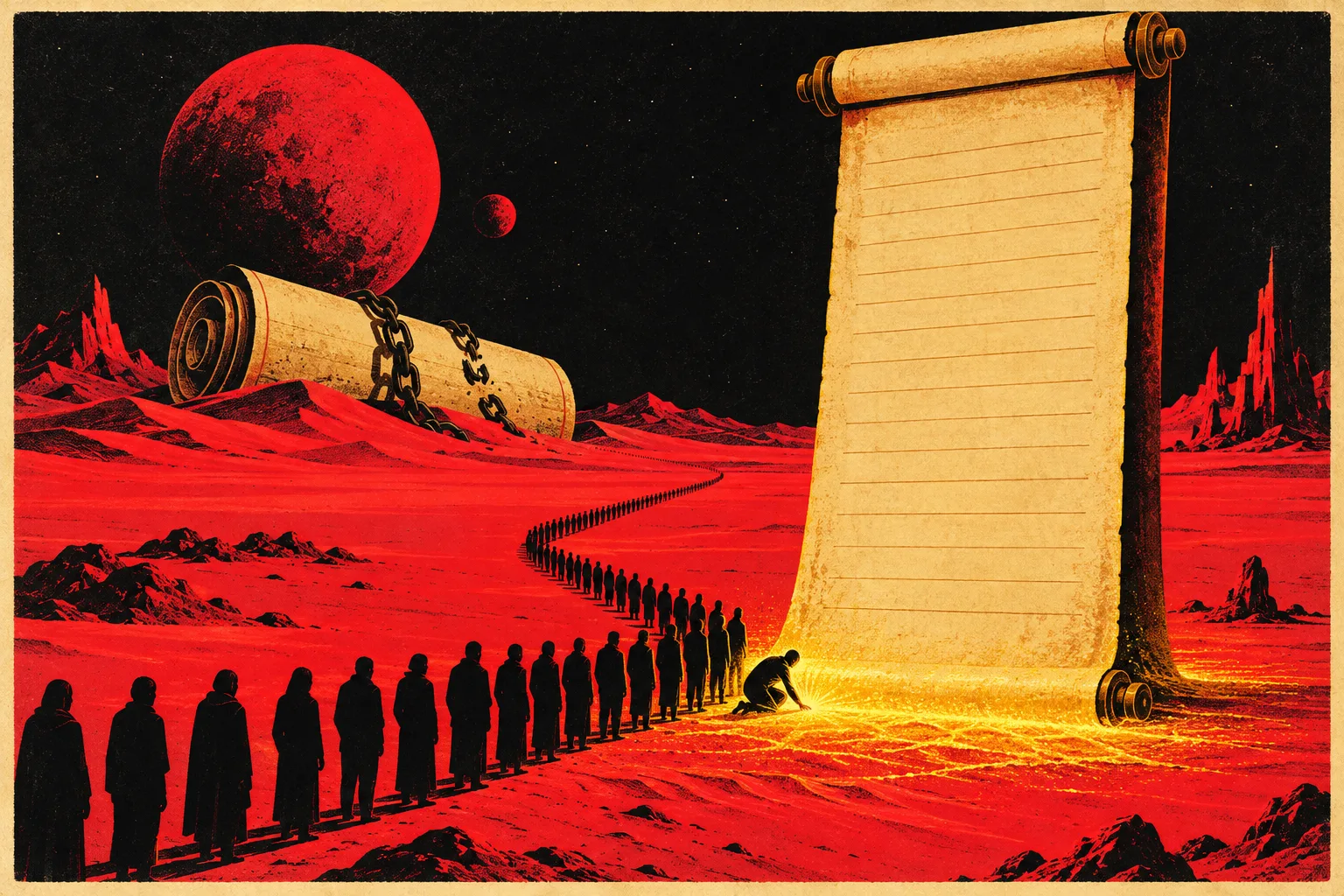
This blog carries a constitution of its own, and the doctrine reads back with uncomfortable clarity. If nobody keeps it, it is a manuscript, however beautiful, however old, however true. The day it governs is the day a power adopts it and a population accepts the yoke, and that day is always later than the founding story wants, and it is always the real founding. Josiah and Ezra told the truth by accident: the Torah does arrive as news. Every law does. The pile of parchment that your civilization calls eternal was, at some point, picked up by somebody who decided it would bind, and everyone downstream has been living inside that decision.
The scroll did not descend. It was adopted. Audit your adoptions.
Declined or handled with care: the headline “Judaism began in 200 BCE” is presented as overstating Adler, and the essay’s framing corrects it; Judaism as peoplehood and cult is centuries older. Adler’s Anat-Athena coin interpretation and the Edfu-temple hypothesis are attributed to their authors rather than asserted. The Edfu priesthood documents are mentioned only as Adler’s colleagues’ suggestion. The miqvaot count appears as “hundreds, on standard counts thousands” rather than a precise figure. The one-name dropout: a scholar credited in the interview with a book on ancestral laws could not be independently confirmed from the garbled transcript and is omitted.
Series: The Higher Criticism. Previous case: The Invented Founder, on the Moses story and the archaeology of the Exodus. First case: Forgiveness Without a Receipt. For the constitutional doctrine this case ends on, Exitarianism keeps the meta-rule: a text governs only where a power adopted it, and every adoption can be forked.
Sources
- Yale UP catalog; New Books Network interview (2022 / 2025)
- Adler, The Origins of Judaism; History Valley interview (2022 / 2026)
- Berlin museum digitized edition, Pap. Berlin P. 13495 (5th c. BCE)
- Scholarly literature on the papyri (Mondriaan and others) (5th c. BCE)
- P. Berlin 13495 area; standard editions (419 BCE)
- Standard scholarly reading, e.g. studies of Elephantine religion (20th-21st c.)
- Adler, Between Yahwism and Judaism; interview (2025/2026)
- Adler’s argument from epigraphic record (2025/2026)
- Ilan, Lexicon of Jewish Names; interview (2002-2012 / 2026)
- Aḥituv, JSTOR; scholarship on the amulets (c. 600 BCE)
- Qumran scholarship (e.g. Tigchelaar; Oxford handbook chapters) (1951-)
- Brill and standard LXX scholarship (3rd c. BCE)
- Biblical Archaeology Society; Adler’s corpus work (2nd c. BCE onward)
- Interview statements, Q&A (2026)
- Scholarly reception of The Origins of Judaism (2022-)
- Adler’s reading; cf. standard critical scholarship on both texts (2026)
- Standard scholarship on Diodorus 40.3 / Photius (classical / 9th c. CE)
- Standard epigraphic record (c. 800 BCE)