The Invented Founder
The strongest evidence for Moses is his Egyptian name. The strongest evidence against the Exodus is everything else.
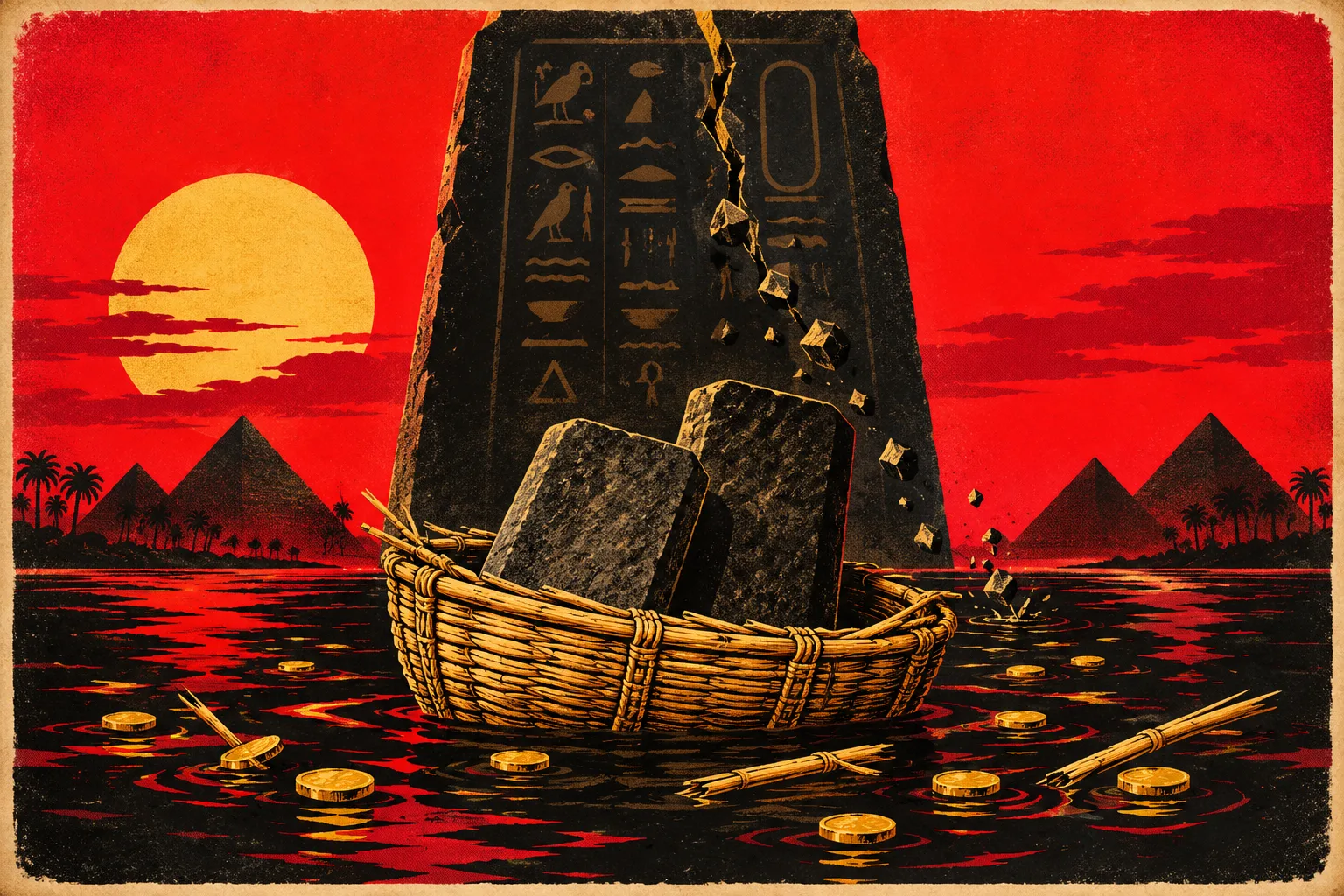
The argument, in brief
Second case in this blog's examination of the scriptures on historical-critical terms. Did Moses exist? The name is the one thing that points backward: Moses is an Egyptian name, the same element as in Tuthmose and Ramesses, born of such a god, possibly with the divine element stripped off later. Everything else points sideways or forward. The Pentateuch is multiple sources spliced across centuries, and its seams show: all of Egypt's livestock dies in the fifth plague and is on its feet again to die in the seventh. The infancy narrative has an older twin in the birth legend of Sargon of Akkad, reed basket and bitumen included. Egyptian records and material culture show no trace of the catastrophe, and the window where an Exodus could fit, roughly 1450 to 1200 BCE, is exactly where the silence is loudest. The discipline's honest output: overwhelming consensus that the Exodus as told did not happen, a plausible small historical core of escaped Semitic workers absorbed into the hill country, and a final text shaped by and for the Babylonian exiles it was written to comfort. The method note this blog keeps for itself: proving the data do not rule you out is not the same as being right.
The Invented Founder
Markus Maiwald, November 2026
Three religions stand on one reed basket. Judaism remembers the man who carried the law down the mountain. Christianity builds on the Exodus the way a second story builds on a first. Islam counts Musa as the most-mentioned prophet in the Quran. If the basket is literature rather than memory, the load does not shift evenly. It shifts all at once.
Two conversations frame the case. Bart Ehrman, the agnostic New Testament scholar from Chapel Hill, sat with MythVision to talk about the texts: who wrote them, when, and how you can tell. The Data Over Dogma podcast, Dan McClellan and Dan Beecher, took the same story to the dirt: Egyptian records, settlement archaeology, and what the physical remains will and will not carry. Textual criticism from one side, the spade from the other. They meet in the same place, and this essay walks both paths.
Start where Ehrman starts, because it is the only evidence in the whole file that points toward a historical Moses, and it is genuinely interesting.
The Name That Should Not Be There
Moses is not a Hebrew name. It is Egyptian. The element appears inside a roll call of pharaohs: Tuthmose, born of Thoth. Ramesses, born of Ra. The element means born of, and in Egyptian it never travels alone; it arrives bolted to a god’s name. Standalone Moses reads like a name with the deity sawn off.
Two readings are live. The first: there was a real man out of Egypt, and later copyists, embarrassed that the great lawgiver carried a pagan god in his name, sanded the god off and left the grammatical stump. The second, the one Ehrman leans toward: a smart Israelite author was building verisimilitude, the novelist’s trick of making fiction smell like history. If your hero is raised in Pharaoh’s household, give him an Egyptian name. The audience feels the authenticity without being able to say where the feeling comes from.
Notice what either reading concedes. The one hard trace of a historical Moses is a name, and a name proves authorship technique as easily as it proves a man. That is the recurring shape of this entire case. The evidence for the story is always also evidence for the storytelling.
Five Books, Many Hands
Did Moses write the Pentateuch, the five books that carry his name? The doubts are not a modern atheist invention. Medieval rabbis had already flagged passages that Moses could not plausibly have written, descriptions of his own death among them. The nineteenth century turned the puzzle into a discipline, and the answer that emerged was the documentary hypothesis: four sources, written at different times by different hands, spliced together by editors. The classic formulation labels them J, E, D, and P: the Yahwist around 950 BCE, the Elohist a century later, the Deuteronomist attached to Josiah’s reform, the Priestly source with the legal core and the great opening of Genesis.
The details have been fought over ever since, and Ehrman is careful about this: the neat four-source model has grown more complicated, some of his own colleagues dissolve sources instead of multiplying them, and the field’s best current work, the people doing it names like Schmid, Römer, Hendel, and Van Seters, argues for later dates than the textbooks gave a generation ago. But the load-bearing wall is consensus: whatever the count, the Pentateuch is not one author at one time. It is layers, and the layers were laid down centuries after the events they describe, with the final compilation in or after the Babylonian exile, six to seven hundred years downstream of the supposed setting.
The story assumes a thirteenth-century BCE stage. The earliest written strands, on traditional dating, come from around 900. On the newer dating, later still. Either way the memory had to survive four to seven centuries of oral transmission before the oldest surviving pen touched it, and oral tradition is a poet, not a court reporter.
Dead Livestock, Killed Twice
How do you see a seam in a spliced text? The same way you see a bad paint job: the layers disagree about what is underneath.
Take the plagues. In the fifth plague, all the livestock of Egypt dies. Every head. Two plagues later, hail destroys every field and the livestock in it. Wait. Which livestock? The ones that died two plagues ago are standing in the field waiting to be killed again. A single awake author does not do this. An editor splicing two sources, each with its own plague sequence, does this without noticing, because each source was internally coherent and nobody read the composite with a ledger.
Readers have noticed for millennia, and the harmonizations are their own genre. The Egyptians stole Israelite cattle after the fifth plague, one explanation runs, so those were the cattle in the field. The text does not say this. The explanation exists because the contradiction does, and it has to. This is the general law of apologetics you will meet again below: the harmonization is always more complicated than the seam it covers, and its only evidence is the need for it.
The same layering shows up at Genesis scale. The flood that wipes the world and saves one family in a great boat has an older Mesopotamian twin, Tablet XI of the Epic of Gilgamesh, centuries earlier, right down to the birds sent out to find land. The pattern is not one borrowing. It is a family of them.
A Basket With Pedigree
The birth legend of Sargon of Akkad survives in Neo-Assyrian copies and goes back, in its setting, to the twenty-third century BCE. Sargon’s mother, a priestess, bore him in secret, set him in a reed basket sealed with bitumen, and laid it on the Euphrates. A water-drawer named Akki pulled him out, raised him, and the foundling grew into the man who built the first empire in human memory. Humble secret birth, river exposure, rescue, greatness: the whole arc, in stone and clay, centuries before Exodus 2 tells it about a different baby on a different river.
Here the historian’s discipline matters, and Ehrman models it in a way worth keeping. The tempting move is to shout borrowing: the Israelite author copied Sargon. Ehrman declines to shout. Most ancient texts are simply lost, he points out; the survivals are a lottery ticket, and declaring that the one parallel that happened to survive is the one that was copied assumes the lottery was fair. The likelier engine is a shared story-grammar: this is simply how the ancient Near East narrated the origins of a great man, the way modern cinema narrates the origins of a superhero. The Moses birth story stands in that tradition. Sargon is the twin we happen to be able to see; there were probably others.
He applies the same discipline in reverse when the MythVision host offers a parallel between the golden calf and Odysseus’s men slaughtering the cattle of the sun god, both expeditions losing men over a sacred animal while the leader is off communing on a mountain. Ehrman takes it apart: Odysseus’s men eat the forbidden cattle and die almost at once; the Israelites make and worship an image, which is a different offense against a different taboo, and that generation dies across forty years. The parallels are real enough to notice and too loose to prove borrowing. Piling up possibilities is not the same as demonstrating a connection, in either direction, for either team.
That symmetry is the honest version of the method, and this blog files it as a rule: a parallel is a pointer to investigate, never a conclusion wearing a trench coat.
The Month Egypt Forgot
Now the other witness. The Data Over Dogma case rests on a question simple enough to hand to a child: if the plagues happened, who cleaned up?
Run the numbers as the text gives them. The livestock, the crops, the water. The firstborn of every household in Egypt. A slave workforce, on the text’s own census arithmetic, of well over a million people, gone in a month. Then the pursuit: the chariot arm of the era’s superpower, drowned to the last man in one sea. This is not one bad harvest. This is a civilization-scale amputation, economic amputation, demographic amputation, military coup de grâce, compressed into weeks.
Egypt kept records. Not humble ones. A bureaucratic state that inventoried granaries and carved its victories into stone would carry some scar of that year, in annals, in letters, in the collapse you can read in the ground: population estimates, city layers, the material culture of a society that just lost a seventh of its labor and its entire army. The archaeology shows no gash. Things carry on as usual, in every stratum, across the whole window.
The honest caveats get their day in court, and the podcast gives them more than most apologists would. Only a sliver of Egyptian records survives; papyrus rots, and the Nile Delta, where much of the story is set, is the worst preservation environment in the country. Absence of records is not automatically evidence of absence. Granted, all of it. But the argument never rested on missing papyri alone. It rests on the total silence of the material record against an event that could not have left the material record intact. A missing diary does not explain a missing crater.
The window itself is worth naming. The proposed dates for an Exodus run from roughly 1450 to 1200 BCE, two hundred years of fuzz, because the biblical chronologies do not agree with each other well enough to pin a year. The most defensible slot, if you insist on one, is around 1250. That is the window. The silence is loudest exactly there.
Workers, Not Slaves; Semites, Not Hebrews
What does Egyptian evidence show about labor and foreigners? Real things, just not these things.
The great building campaigns drew on corvée labor more than chattel slavery: locals with an annual obligation to work state projects for a season, fed, housed, and sent home. Foreign workers from the Levant appear in the record, and always have: Semitic caravans painted in color on the tomb walls at Beni Hasan, Semitic names in Middle Kingdom lists, Semitic miners in Sinai who bent Egyptian hieroglyphs into the ancestor of the Phoenician alphabet. The Egyptian texts have a whole vocabulary for these Asiatics, including the Habiru, a floating social category of outsiders and laborers whose sound has seduced a century of readers into hearing Hebrews in it. The scholarly debate over that sound is real, but the category is broader than any one people, and Moabites, Ammonites, Midianites, and Ugaritans fit the same door the Hebrews are supposed to have walked through.
So: Semitic people in Egypt, abundantly. A discrete, enslaved, nation-sized Israelite population, nowhere. The evidence does not absolutely preclude Israelite slaves in Egypt. Hold that phrase, it is about to do work.
Weighed, Not Precluded
Here the two conversations deliver the same lesson from two directions, and it is the part of this case that travels beyond scripture.
Historical method does not ask whether a conclusion can be made to fit the data. It asks which conclusion makes the most of the data probable with the least impossible ballast. A strong theory turns some things probable and many things plausible and nothing impossible. A weak theory buys a few plausibilities at the price of impossibilities. The Exodus as told is that weak theory: to keep it, you keep a set of events that are, under the discipline’s working rules, impossible, since miracles are by definition outside what the method can adjudicate, stacked on a silence in the record that itself needs explaining away.
Apologetics, in its candid moments, does not dispute this. It performs a different operation: it shows that the data do not preclude the conclusion. Semitic names in Egypt? Not precluded. Corvée labor? Not precluded. A delta that eats papyri? Not precluded. Every item is true, and every item is a shield rather than a witness. That is not lying; it is a different sport played in the same uniform. Showing you might be right is not showing you probably are, and the entire weight of the historical discipline rests on the difference.
The overwhelming majority of critical scholars, McClellan states it without ceremony, land where the weighing points: the Exodus as the book tells it is not historical. Some of those scholars are believers. The methods and the faiths are not at war here; the methods and a particular doctrine of inerrancy are.
The sober residue, and it is worth stating carefully because it is where the interesting history lives: a small group of enslaved or semi-enslaved Semitic workers who escaped Egypt, made their way to the Canaanite hill country, and were absorbed into the people who came to call themselves Israel, is plausible. A kernel, under the pearl. If it happened, it happened at a scale that leaves no more archaeological footprint than a family leaving town, and nothing about the escape of that band resembles the sea-opening, army-drowning, plague-bearing epic.
A Stele, Not a Prophet
The people called Israel do walk into external history, and the door is worth walking through precisely because of what is absent from it.
The Merneptah stele, carved around 1208 BCE for the pharaoh’s victory over the Libyans, closes with a victory hymn over his eastern campaigns, and in its final lines names, for the first time anywhere outside the Bible’s own pages, a people called Israel. Israel is laid waste, the poet boasts, its seed is not. Two details do heavy work. The name carries the hieroglyphic determinative for a people, not a city, not a state, not a land: Israel exists, as a highland population without a capital worth carving. And the stele knows nothing of Exodus, Moses, or slaves. Egypt’s own stone, three centuries after the supposed events, honors Israel with a boast of destruction and forgets the greatest humiliation in Egyptian memory entirely.
That is the pattern of every external witness in the file. Where the texts go silent, the stones go silent too, and the one stone that speaks names the people but not the story.
The Story That Exile Told Itself
If the epic is not memory, what is it? The most satisfying answer in the file, and the one with the deepest literary tact, reads the Exodus as a story shaped by the audience that needed it.
The final form of the Pentateuch, on the consensus and on the newer datings even more so, was assembled in and after the Babylonian exile: Judah’s elite shipped to Babylon, Jerusalem burned, a people wondering whether its god had lost or had simply left. Now hear the story again from inside that room. A people trapped in a foreign land, forced to build another empire’s projects, whose god remembers his promises and brings them home in a generation. The Exodus is the exile’s own mirror, held up at the correct distance, with the ending corrected. The exiles did not experience the story as fiction versus fact. They experienced it as theirs, which is a different axis entirely, and the text’s final compilers were building identity, not filing a police report.
The details that apologists offer as fingerprints of eyewitness memory dissolve into technique under this reading. The high concentration of Egyptian loanwords in the Exodus narrative is real; so is the fact that they entered Hebrew at different dates, early and late, which fits not a refugee scribe in 1250 BCE but a later author seasoning his story with Egypt for the smell of it, the same verisimilitude move as the hero’s name. Egypt and Judah were in constant contact through the whole period anyway; Hezekiah’s royal jar handles, stamped with Egyptian scarabs a generation before the exile, sit in the record as routine evidence of trade under vassalage. You do not need a sojourn in Egypt to know Egyptian words. You need neighbors.
And so the case closes where the Court’s cases always close, with the question of who benefits from the word. Israel as a people is real, attested in stone from 1208 BCE. Israel as a nation needed a founding epic, and epics are written by the living for the living. The founder came with an Egyptian name because the story needed one. The law came down a mountain because nations explain their law that way. The exile got a promise shaped like its own wound. None of this was fraud in the modern sense, any more than the Iliad was. It was literature doing literature’s oldest work: telling a people who they are so they can go on being it.
What the Audit Owes the Believer
Say the honest thing at the end, because this file tempts people to cruelty, and cruelty is bad history.
The historical case against the Exodus as told is about as strong as historical cases get, and it takes down exactly one doctrine: the claim that the text is a courtroom transcript of the past. It does not take down the neighbor who finds meaning in the story, and it does not touch the question of God, which sits outside the method’s jurisdiction by construction, exactly as miracles do. Ehrman, the agnostic, ends his course pitch by saying the material matters because it is the foundation of Judaism and Christianity and deserves to be read seriously, both for what happened and for what is being taught. That is the correct register. The believer who tells you the sea parted is wrong about the sea. The scholar who tells you the story is therefore worthless is wrong about stories, and the second error is lazier than the first.
This blog’s own doctrine says it cleanly: audit the claim, not the person. A civilization that cannot tell its founding story from its audit is a civilization that has decided not to know things. A people that burns its stories because an audit came back thin is poorer, not wiser. The sovereign move is the third one: keep the story, know its date, and never again confuse the two, in scripture or anywhere else. Your origin stories too. That includes the ones about your nation, your movement, and yourself. The reed basket floats in more rivers than the Nile.
Declined or handled with care: the Habiru-Hebrews linguistic link is presented as debated, not asserted. The claim that the plague sequence reflects specific J/P splicing is simplified from Ehrman’s framing to the contradiction itself, which the text supports directly. The exilic-shaping thesis is presented as the most satisfying scholarly reading, not the only one. The essay’s closing distinction between auditing claims and judging believers is editorial doctrine, not a sourced claim.
Series: The Higher Criticism. Read the first case, Forgiveness Without a Receipt, on what Jesus taught and what the churches did with it. For this blog’s method doctrine applied to words instead of scriptures, see You Are Not a Noun: every origin story is a chosen fiction, including the ones you tell about yourself.
Sources
- Ehrman on MythVision; McClellan on Data Over Dogma; standard Egyptological onomastics (2026 / standard)
- Ehrman on MythVision (e.g., the tradition of Ibn Ezra’s hesitations) (2026)
- Ehrman on MythVision; cf. Schmid, Römer, Van Seters (2026)
- Exodus 9:6, 9:19-25 (text)
- The Legend of Sargon, Fordham Sourcebook translation (copies c. 7th c. BCE)
- Epic of Gilgamesh, Tablet XI (c. 2100-1200 BCE)
- Ehrman on MythVision (2026)
- Ehrman on MythVision, responding to host (2026)
- McClellan and Beecher, Data Over Dogma; standard archaeology (Finkelstein and others for settlement records) (2026)
- Data Over Dogma (2026)
- Data Over Dogma; standard Egyptology (2026)
- Data Over Dogma; Beni Hasan tomb of Khnumhotep II (2026 / c. 1900 BCE)
- McClellen’s formulation on Data Over Dogma (2026)
- McClellen on Data Over Dogma; Ehrman’s course framing (2026)
- Merneptah Stele; Biblical Archaeology Society (c. 1208 BCE)
- Ehrman and Data Over Dogma; mainstream critical scholarship (2026)
- Data Over Dogma; standard archaeology of lmlk jars (2026 / c. 700 BCE)
- Exodus 12:37, Numbers 1:46 (text)