You Don't Understand Science Fiction. Yet.
A companion to Space Hippies with Guns and Agency: Damien Walter teaches the novum, the top comment teaches politics, and neither notices that it just answered the other.
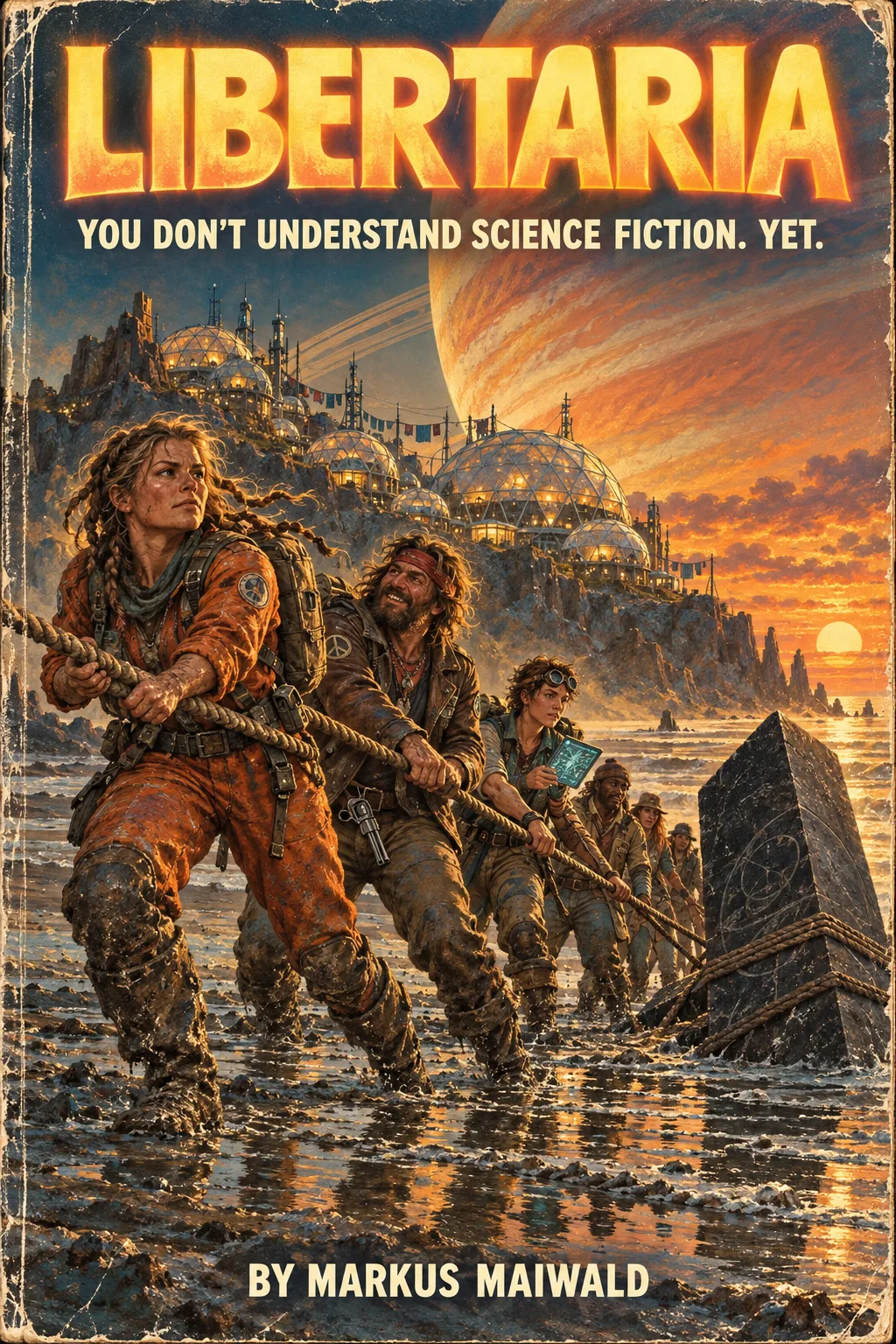
The argument, in brief
Walter's swap test separates the MacGuffin, which drives the plot, from the novum, which drives the world. Run it on politics: every tax and reform is a MacGuffin, because the plot never changes. The top comment under his video diagnoses rent extraction correctly and then prescribes one synthesis, one assessor and mandated workplace democracy. Fractalism refuses the monolith: one rule repeated at every scale, with the novum stated as a price – exit becomes cheap. Fantasy legitimises power by bloodline, science fiction by mechanism, and the nation-state is space fantasy with worse costumes. Somebody will write the novum of this century. If it is not a protocol you can leave, it will be a ministry you cannot.
The Slab in the Comment Section
It is two in the morning. In one tab, Damien Walter – a critic who runs one of the sharpest science fiction channels on YouTube – does what he does best: politicising science fiction in the service of the world state and socialism. I mean that as a compliment. I love it. Nobody makes me argue harder with a screen at this hour.
In the other tab, the comment section bleeds. On the thumbnail a black slab stands in a tidal flat, the word YET stamped across it in pulp yellow.
The video teaches writers how science fiction works. The top comment – a year old and still climbing – teaches politics. Neither notices that the other just answered it.
This is the companion piece to Space Hippies with Guns and Agency. Same frontier and the same dreamers; this time the weapon is an idea, the one new thing that rewrites the rules of a world.
The Hack
Walter’s argument is clean, and it deserves to be stated cleanly before we take his toys.
Every serious science fiction world runs on a novum, a term the critic Darko Suvin coined in the 1970s for the one new thing a society cannot absorb without rewiring itself. Jurassic Park has viable dinosaur DNA, Inception has shared dreaming, and the video game Fallout builds its whole retro-future on a transistor that arrived a century late.
His sharpest move is the swap test. A MacGuffin – Alfred Hitchcock’s word for the object everybody chases – is arbitrary: replace the glowing briefcase in Pulp Fiction with a bag of diamonds and the plot runs unchanged. A novum is structural: remove it and the world collapses. The MacGuffin drives the plot; the novum drives the world.
The purpose, per Suvin, is cognitive estrangement. The premise is rational, not magic, and it makes you a stranger in your own present. Science fiction, Walter says, is a mirror, not a crystal ball.
His ultimate example comes from Stanley Kubrick’s 2001: A Space Odyssey (1968). A black slab, the monolith, appears among a tribe of starving prehistoric apes. It does nothing and explains nothing. Then one ape picks up a bone, discovers it can kill with it, throws it into the air – and the film cuts to a satellite in orbit. Millions of years of technology in a single cut. Walter’s advice to writers: stop worldbuilding, start world changing.
He is right, and I want to take him literally.
Policy Is a MacGuffin
Run Walter’s swap test on politics.
Take a land value tax. Swap it for a wealth tax. Swap that for a carbon tax, a robot tax, a digital services levy. The plot stays the same:
- A ministry assesses.
- A parliament votes.
- A lobby forms around the assessment.
- A loophole opens for the lobby.
- The same people end up in the helicopter, staring at the shiny rock.
The plot did not change, and it never does. Every policy is a glowing briefcase: it gives the factions a reason to be in the same room, shooting at each other on schedule every four years.
A protocol works on a different layer. Change the cost of leaving and you do not change who wins the election; you change whether the election is the game at all.
A policy drives the plot. A protocol drives the world.
Reformers are screenwriters swapping MacGuffins and wondering why the third act always ends the same way.
Autopsy of the Top Comment
The comment opens with Martin Luther King Jr., speaking in 1967: communism forgets that life is individual, capitalism forgets that life is social, and the kingdom of brotherhood lies in a higher synthesis that combines the truths of both.
Two weeks ago I put a definition of Fractalism on record: left individualism, right communalism. King said it sixty years earlier and better.
Then the commenter prescribes a land value tax and workplace democracy.
The diagnosis is the best thing in the whole comment section. What was made by hands may be owned; what no hand made is owed back to everyone: land, spectrum, minerals, orbital slots. That line is cleaner than most party programmes.
Then the commenter reaches for three MacGuffins.
The synthesis. Hegel’s dialectic says an idea (the thesis) collides with its opposite (the antithesis), and the two merge into a higher third, the synthesis. It always ends in one synthesis. One synthesis means one table and one winner, and a single winner is a monolith with a flag on it.
The land value tax. In 1879 Henry George argued that land gains its value from the community around it – the city, the roads, the neighbours – so the rent on land should flow back to that community. He was right that unproduced commons owe rent. He was wrong about the collector. A national land tax needs a national assessor, and the assessor becomes the landlord of the landlords. You have not abolished the rentier; you have given him a pension.
Workplace democracy. As an option, fine. As a mandate, it is voice without exit: the majority votes, the minority is trapped, and capital stops arriving because nobody can price a firm that can be voted into a different firm.
And then the commenter writes the most important sentence in the thread, almost by accident: the failure of both systems is redistribution without an agreeable method of determining social vs. private ownership.
The commenter has just written a requirements document without noticing, and closed the laptop.
The Monolith Is the Anti-Fractal
Look at the monolith again. It falls from the sky as one object, it touches one tribe, and the ape who reaches it first holds the bone. Walter calls that scene the birth of technology and murder in the same frame, and he is right about that too.
A singular novum produces a singular sovereign. Whoever stands next to the slab owns the story. That is the political shape of every revolution that ever promised a synthesis: a new monolith, and a new ape holding the bone.
Fractalism refuses the slab. It does not drop one new thing at the top. It writes one rule and repeats it at every scale – the individual, the household, the Chapter (a self-governing community in Libertaria), the federation – with the same terms of entry and exit at each layer.
Every layer owes the layer below it the same exit it demands from the layer above.
Our novum is a price: exit gets cheap. Your identity, your reputation and your property become portable, held in cryptographic keys you control instead of in a registry somebody else can freeze. Exitarianism is the name for taking that seriously, and exit does not mean departure: most people will never leave. The point is that they could.
Now do what Walter does with Fallout. Change the one thing and follow what changes with it.
- Governance becomes a market. Chapters compete for members the way firms compete for customers. Bad rulers do not get voted out; they get emptied out.
- Land rent becomes a design choice. The commons is paid at the scale that actually holds it. One Chapter might run a Harberger tax, an idea from the economist Arnold Harberger: you declare what your plot is worth, you pay tax on your own number, and anyone may buy the plot from you at that price. Declare too low and someone buys it; declare too high and you overpay. Nobody needs an assessor. Another Chapter runs a community land trust. Neither needs a national ministry to bribe.
- Workplace democracy becomes a product. Some Chapters run co-ops, some run founder dictatorships. Members vote with their keys, and the scoreboard is retention.
- Unjustified taxation dies of natural causes. A levy you can leave is a price. A levy you cannot leave is tribute.
- Rent seeking starves. Capture a Chapter’s leadership and the members route around it. Capture stops being a business model and becomes a tax on your own shrinking population.
The commenter’s higher synthesis turns out to be a thousand tables running in parallel, each one honest because each one can be abandoned.
Think of the door of your house. It keeps out the people you did not invite, and it lets you walk out whenever you choose. A community needs both jobs done: protection for the people inside, and a way out for anyone who wants to go. Communism forgot the individual and capitalism forgot the community. The state forgot the door – it builds walls that keep you in as reliably as they keep others out.
Fantasy Is Bloodline, Science Fiction Is Mechanism
Walter’s most provocative line is that Star Wars is not science fiction. The Force is magic, it runs in bloodlines and prophecies, and a lightsaber is Excalibur with a battery.
He means it as genre taxonomy. Read it as political theory and it becomes a weapon.
Fantasy legitimises power by birth: the chosen bloodline, the prophecy, the ring that picks its bearer. Science fiction legitimises power by mechanism: it works because the rule works, and anyone who learns the rule can use it.
Now look at your passport. Citizenship by soil, citizenship by blood. Obligations inherited at birth, payable until death, with emigration taxed on the way out. You were tested for the Force at birth by a border guard, and we call the result a social contract.
The nation-state is space fantasy with worse costumes.
Walter also files some worlds under the ideological novum: Robert Heinlein rigging his futures for his politics, Isaac Asimov’s Foundation handing the future to a priesthood of mathematicians. Fair enough, but the category swallows everything. Walter himself reads Liu Cixin’s The Three-Body Problem as a metaphor for colonial capitalism. Every novum is ideological, because every novum decides who holds the rule.
Every world is rigged, so the useful question is whether you can leave it.
The tabletop universe of Warhammer 40,000 answers that question with brutal honesty: faster-than-light travel means flying through a dimension that is literally Hell. It is the most accurate depiction of emigration policy ever printed on a miniature box.
The Hard Part
Cheap exit still costs something.
Leaving does not cancel what you owe. The Federation Axioms are explicit: debts, damages and the care you promised a dependent travel with you, settled without turning your person into collateral. A door that also deletes your obligations is a getaway car.
A Harberger tax is elegant for a parking lot and cruel for a grandmother’s kitchen. A standing offer on your home is a standing threat to it, so it belongs to the Chapters that want it, not to a federation that imposes it.
Cheap exit also cuts the other way. In Space Hippies I wrote about the Glitterband, Alastair Reynolds’s ten thousand free habitats that each governed themselves and could not defend themselves when catastrophe arrived. A thousand tables that can each be abandoned can also be picked off one at a time. This is why I wrote in April that logic does not hold the line when the lights go out – the Bund does. Whether a federation carries bounded common funding and defence or none at all is the question Sovereign Society is testing right now: an Open Federation with no standing tax or police, against a Civic Federation with limited shared funding and enforcement. I have a preference and no proof.
Yet
Walter says science fiction is a mirror, not a crystal ball. I say it is a third thing: a specification.
The commenter wrote the requirements and Walter wrote the method; neither wrote the code. Stop worldbuilding, start world changing is advice he gives to novelists. We take it as a work order.
Stated as plainly as a slab in the dirt, the novum of this century is cheap exit. Everything else is ripple.
Walter, the commenter and half of that comment section would thrive in a Fractal federation. They just don’t know it yet.
Somebody will write the novum of this century. If it is not a protocol you can leave, it will be a ministry you cannot.
The monolith does not care whether you understand it. It drops anyway. The only open question is whether the ape who picks up the bone owns the bone — or the bone owns the ape, his children and their tax returns.
You don’t understand science fiction.
Yet.
Sources
- Damien Walter, You don’t understand science fiction, 26 April 2026, and the accompanying video on Science Fiction with Damien Walter.
- YouTube comment by @urnad12345 under that video, quoting Martin Luther King Jr.
- Martin Luther King Jr., “Where Do We Go From Here?”, address to the Southern Christian Leadership Conference, Atlanta, 16 August 1967.
- Darko Suvin, Metamorphoses of Science Fiction, Yale University Press, 1979.
- Stanley Kubrick and Arthur C. Clarke, 2001: A Space Odyssey, 1968.
- Henry George, Progress and Poverty, 1879.
- Eric A. Posner and E. Glen Weyl, Radical Markets, Princeton University Press, 2018, ch. 1 (self-assessed property taxation after Arnold Harberger).
- Markus Maiwald, “The Etymological Court #21: Fractalism”, 2026. libertaria.blog.
- Markus Maiwald, “The Etymological Court #20: Exitarianism”, 2026. libertaria.blog.
- Markus Maiwald, “Exit Is Not Departure”, 2026. libertaria.blog.
- Markus Maiwald, “Why Exitarianism Needed The Oath”, 2026. libertaria.blog.
- Markus Maiwald, The Federation Axioms, revised February 2026. libertaria.blog.
- Markus Maiwald, “Space Hippies with Guns and Agency”, 2026. libertaria.blog.