The Managed Estate: From Vancouver 1976 to Pontes 2026
You don't need the conspiracy theory. The paperwork is public.
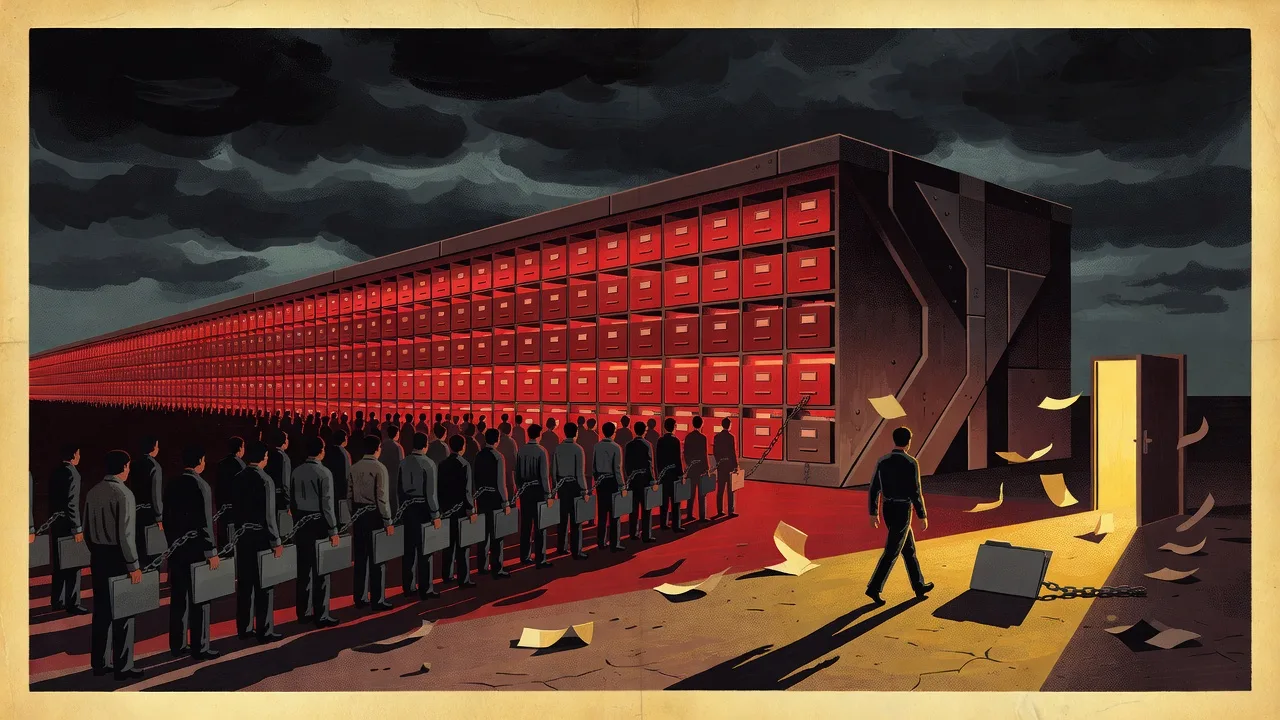
The argument, in brief
A finance YouTuber lays out the Agenda 21-to-2030 master plan and asks: conspiracy or accident? The honest answer: neither. The paper trail is public and verifiable, and it does not need a smoking gun to be alarming. 1976: the Vancouver Action Plan states land 'cannot be treated as an ordinary asset, controlled by individuals' and that 'public control of land use is therefore indispensable.' 1992: 178 governments adopt Agenda 21, a 40-chapter blueprint for how humanity should live, estimated at $600 billion a year, nonbinding. 2015: 193 states adopt 17 goals and 169 targets, including Target 16.9, 'legal identity for all' by 2030. 2019: the WEF signs a formal partnership with the UN to finance the 2030 Agenda; the same year Klaus Schwab writes that stakeholder capitalism 'positions private corporations as trustees of society.' 2026: the ECB switches on Pontes, tokenised settlement in central bank money, while the retail digital euro law is negotiated to a clock. Read as one corpus, the documents describe a single philosophy: whatever matters too much for you to hold, a system will administer. What the essay declines is the video's leap to engineered depopulation; what it keeps is worse, because it is documented. Full claims audit included.
The Managed Estate: From Vancouver 1976 to Pontes 2026
Markus Maiwald, October 2026
Two Documents
May 1976, Vancouver. The United Nations Conference on Human Settlements adopts an action plan. Section D deals with land, and it says this: land, “because of its unique nature and the crucial role it plays in human settlements, cannot be treated as an ordinary asset, controlled by individuals.” The section ends on a recommendation that governments treat “public control of land use” as “indispensable.” The sentence has a subject, an object, and a verb, and the verb is control.
September 2026, Frankfurt. The European Central Bank switches on Pontes, a settlement system that lets banks transact tokenised assets in central bank money, around the clock. The same week, the retail digital euro’s enabling legislation grinds through trilogue in Brussels, with the holding limit and the fee model still contested and political agreement targeted before year’s end. Money is learning to be programmable at the root.
Fifty years apart, across different institutions and continents, the grammar is the same: something individuals used to hold becomes something a system administers. Everything between those two documents is public. That is the part the conspiracy people keep getting wrong, and the part the fact-checkers keep refusing to look at.
The Paper Trail
The paper trail starts in 1976. The Vancouver conference responded to a real problem: the developing world’s cities were growing faster than governments could house them. The planners concluded that land was too important to leave to its owners. Building faster was not their answer. The Action Plan calls land ownership “a principal instrument of accumulation and concentration of wealth” that “contributes to social injustice,” and prescribes taxation, regulation, and public ownership as the tools. The conference also left behind a permanent agency, UN-Habitat, and a twenty-year cycle: Habitat II in Istanbul 1996, Habitat III in Quito 2016, each one advancing the same settlement doctrine under a new cover sheet.
1992, Rio de Janeiro. More than 178 governments adopt Agenda 21 at the Earth Summit: forty chapters across four sections, a blueprint for how humanity should live, produce, and consume in the twenty-first century. Poverty, health, population, consumption patterns, land use, agriculture, energy, water, forests; the UN secretariat priced implementing it at roughly $600 billion per year. It was never a treaty. No parliament ratified it; no signature bound anyone. Yet it moved through the machinery nobody watches: Chapter 28 asked local authorities to write their own Agenda 21s, and an outfit now called ICLEI, Local Governments for Sustainability, helped zoning boards and regional planners translate the chapters into code. The United States played along through exactly the channels the video cites: Nancy Pelosi sponsored H.Con.Res. 353 in 1992, which passed the House 232 to 189 on a pledge of “a comprehensive national strategy for sustainable development, in accordance with the principles of Agenda 21,” and in June 1993 President Clinton created the President’s Council on Sustainable Development by executive order.
2015, New York. All 193 UN member states adopt the 2030 Agenda for Sustainable Development: seventeen goals, 169 targets, and two upgrades from 1992: a deadline, 2030, and universality. Unlike the Millennium Goals before them, these apply to every country, rich ones included. Most of the goals sound unarguable; clean water, less hunger. Two targets do the architectural work. Target 16.9: “By 2030, provide legal identity for all, including birth registration.” Every person on earth, formally issued. Target 8.10: strengthen the capacity of domestic financial institutions to expand access to banking and financial services for all. Every person on earth, formally banked. Identity is the entry ticket; the account is where the ticket is spent.
June 2019, Geneva and New York. The World Economic Forum and the United Nations sign a Strategic Partnership Framework, with “financing the 2030 Agenda” first among six areas of cooperation. This formally merges the diplomatic track with the Davos track. The same November, Klaus Schwab publishes the sentence that names the resulting model: stakeholder capitalism, he writes, “positions private corporations as trustees of society.” A trustee manages an estate on behalf of beneficiaries. Note who appoints the trustee.
The money side of the merger had older paperwork. In 2004, at the request of the UN Secretary-General, twenty financial institutions signed a report under the Global Compact called Who Cares Wins, which introduced the acronym ESG and the thesis that the biggest investors could push companies toward social and environmental goals by making capital conditional on them. The biggest investor became BlackRock, which closed 2025 managing more than $14 trillion, with proxy votes in every boardroom its index funds touch. Larry Fink, its CEO, said the quiet part at a 2017 forum: “You have to force behaviors, and at BlackRock, we are forcing behaviors.” By 2023 he retired the word ESG, calling it “entirely weaponized,” without retiring the practice. By August 2025 he was Interim Co-Chair of the World Economic Forum’s Board of Trustees, the seat Klaus Schwab vacated. The revolving door now revolves between the enforcer and the club.
And 2026, Frankfurt again. On 21 September the ECB launched Pontes: tokenised financial assets settling in central bank money, the first piece of the Eurosystem’s plan for a tokenised future. The ECB is even parking some of its own funds in tokenised securities settled through it, the central bank eating its own cooking. Pontes is wholesale plumbing, banks only. The retail layer, the digital euro in your pocket, is one trilogue away, its legislation debated under an explicit clock: finalize before the end of the year. Programmable money is not a Bitcoiner’s nightmare anymore. It is a Gantt chart.
What the Trail Is Not
Before reading meaning into paperwork, cut what the paperwork does not say.
There is no world government here. Agenda 21 is nonbinding; the SDGs are nonbinding; the WEF is a membership organization with no legal authority over anything. No black helicopters are required, and none are dispatched.
The famous “you will own nothing and be happy” line deserves its own honesty. It comes from a 2016 essay by Ida Auken, a Danish MP, published on the WEF’s own platform under the title “Welcome to 2030. I own nothing, have no privacy, and life has never been better.” The WEF’s social channels promoted it, clipped it, and later discovered it was a grenade. Auken herself says it was a warning about a possible future, not a policy brief. Both facts stand: the WEF published and marketed it, and it is a scenario.
The “inventory and control of all land, all water, all plants, all animals, all human beings” litany that gives this discourse its fire is from Rosa Koire’s 2011 book Behind the Green Mask, and it is her characterization, not a sentence in any UN document. The UN’s own version sounds friendlier and aims at the same place: the natural-capital school wants every forest and aquifer accounted for on a balance sheet, and Davos panels discuss managing water as a global commons. Koire screams; the documents murmur. The murmur is the one you can quote.
The depopulation reading claims that falling fertility and coming hardship are engineered rather than emergent. That claim is unfalsifiable, and this essay declines it. What can be documented is posture: the planner’s instinct, fifty years consistent, that whatever matters too much for individuals to hold should be administered from the center. Where that instinct collides with human flourishing, outcomes can be catastrophic without anyone having willed them. Administrative evil needs no villain; it needs a form.
The Philosophy of the Paperwork
Now read the corpus as one document, because the institutions do.
Land, 1976: too important for individual title; public control indispensable. Consumption, 1992: patterns to be changed by policy, chapter and verse. Identity, 2015: every person on earth to be formally issued by 2030. Money, 2026: value that settles on state rails, with a holding limit written into the law and programmability waiting in the architecture. Corporate governance, continuously: companies as “trustees of society,” their conduct enforced not by legislatures but by index funds that own everyone’s proxy and score everyone’s conduct.
Different decades, different letterheads, one move repeated: the conversion of a holding into an administered relationship. You can still own land on paper; the use is administered. You can still hold money; the limit is legislated and the ledger is central. You will be issued an identity; the registry is the relationship. Nothing needs to be confiscated when everything can be administered. The estate keeps its owners the way a hotel keeps guests: welcome, everything is provided, please observe the rules, checkout is enforced.
The novelty lies in the mechanism. The old road to total administration ran through law: decrees, parliaments, police. This one runs through three softer channels. Soft law supplies the nonbinding goal that no legislature passed but every ministry benchmarks against. Capital supplies the ESG score and the proxy vote, delegating enforcement to investors who need no mandate. Infrastructure supplies the settlement system and the identity registry, building compliance into the pipes so that opting out becomes a technical error rather than a political act. The Transnational Institute, a left-wing think tank with no tea-party sympathies, campaigned to end the UN-WEF partnership for exactly this structural reason: it wires corporate actors into global agenda-setting with no democratic counterweight. When the far right and the far left read the same document and reach the same conclusion, the document is the problem.
The Mouse Mirror
The video that prompted this essay ends with two stories and no verdict. Story one: it is a plan. Story two: it is Universe 25.
In July 1968, the behavioral researcher John Calhoun built a mouse paradise at the National Institutes of Health: unlimited food and water, no predators, no disease, room for about three thousand animals. He seeded it with eight mice. The population doubled every fifty-five days, peaked around 2,200, and then the society came apart from the inside. Males who found no role withdrew or turned violent. Mothers abandoned litters. A cohort Calhoun named “the beautiful ones” stopped mating and fighting entirely and spent their days eating, sleeping, and grooming. The last birth came, and the colony died out with food still in the hoppers. Calhoun’s term for it was the behavioral sink, and his conclusion was that a society that meets every physical need while destroying every meaningful role destroys itself.
The mirror is uncomfortable because the reflection is current. Half the developed world is at or below replacement fertility. Purpose collapse is not a prediction; it is a diagnosis with waiting rooms. The choice between design and emergence changes nothing: if the trajectory is planned, the response is to exit the plan; if the trajectory is emergent, the response is to build the roles and institutions the trajectory destroys. Either way, we have to build. We lose nothing by remaining agnostic about the cause.
The Exit
The counter to the estate is holdings that need no administrator. This blog has been building that list for a year.
Own what does not require permission: real property, physical commodities, tools. Hold value nobody can freeze or haircut by legislation: self-custody keys, not exchange balances; the reason programmable money scares you is the same reason you should own the unprogrammable kind. Transact on rails you can run: the sovereign answer to Pontes is settlement you control, between parties who consent, on ledgers nobody administers. And build the parallel institutions with doors: identity you carry instead of identity you are issued, reputation that survives exit, the Chapter Zero discipline of running the counter-economy with the lights on. The tech oligarchs supplied the theology of the machine future; this paperwork is its liturgy; and the exit is identical in both cases. Ownership, opacity, a door in every room.
An estate is only total if everything is inside it. The paperwork assumes you will stay. Walk out of the inventory, and bring your ledger with you.
Claims Audit
Per this blog’s publishing doctrine: no audit, no heavy publish. Confidence: High = primary source verified directly; Medium = two or more independent secondary sources.
| Claim | Source | Date | Anchor | Confidence |
|---|---|---|---|---|
| Land “cannot be treated as an ordinary asset, controlled by individuals”; “public control of land use is therefore indispensable” | Vancouver Action Plan, Section D (A/CONF.70/15) | 1976 | Verbatim, Section D | High |
| Agenda 21 adopted by 178+ governments; 40 chapters; ~$600B/yr estimate; nonbinding | UN DESA; Ch. 33 | 1992 | 178 govts; 40 ch.; $125B intl. share | High |
| Pelosi H.Con.Res. 353, “in accordance with the principles of Agenda 21”; House 232-189 | congress.gov | 1992-03-04 | Passed House; Senate no action | High |
| Clinton PCSD created by EO 12852 | National Archives, EO 12852 | 1993-06-29 | Executive order text | High |
| 2030 Agenda: 193 states, 17 goals, 169 targets, universal | UN 2030 Agenda | 2015-09-25 | Resolution 70/1 | High |
| Target 16.9 verbatim “legal identity for all, including birth registration” | UN Statistics Division | 2015 | Verbatim target text | High |
| WEF-UN Strategic Partnership Framework; “financing the 2030 Agenda” | WEF press release | 2019-06-13 | Six cooperation areas | High |
| Schwab: stakeholder capitalism “positions private corporations as trustees of society” | Project Syndicate | 2019-11 | Verbatim essay | High |
| Who Cares Wins introduced ESG; 20 financial institutions; UN Global Compact | Report PDF | 2004 | Title page; signatories | High |
| Fink 2017 “we are forcing behaviors”; 2023 “entirely weaponized”; Interim Co-Chair WEF | Axios; WEF statement | 2017 / 2023-06 / 2025-08 | Quotes; appointment | High / High / High |
| BlackRock AUM > $14T | WSJ Q4 2025 earnings coverage | 2026-01 | $14.04T year-end 2025 | Medium |
| Auken essay title; published on WEF platform; author calls it a scenario | Medium/WEF | 2016-11-10 | Essay text; later clarifications | High |
| ”Inventory and control” litany is Koire’s characterization | Behind the Green Mask (2011) | 2011 | Book text; attribution hers | High |
| Pontes live 21 Sep 2026; tokenised assets in central bank money; ECB own-funds pilot | ECB press release | 2026-09-21 | Launch release | High |
| Digital euro regulation in trilogue; agreement targeted end-2026; holding limit contested | Ecommerce Europe | 2026-09-30 | Trilogue readout | Medium |
| Universe 25: July 1968, 8 mice, peak ~2,200 at day 560, “beautiful ones,” extinction | Science History Institute | 1968-1973 | Experiment record | High |
| TNI campaign against UN-WEF partnership | Transnational Institute | 2019-2021 | Campaign page | High |
Declined claims (unverifiable, excluded from the argument): engineered depopulation; wars/disease as deliberate instruments; “one world government” as a legal fact. The essay’s thesis does not need them.
Related: The Bootloader Theology supplies the theology of the machine future; Agorism supplies the practice of the exit.