Transhumanism - The Bootloader Theology: What the Tech Oligarchs Actually Want
Their heaven has a cover charge, and we are the ones paying it.
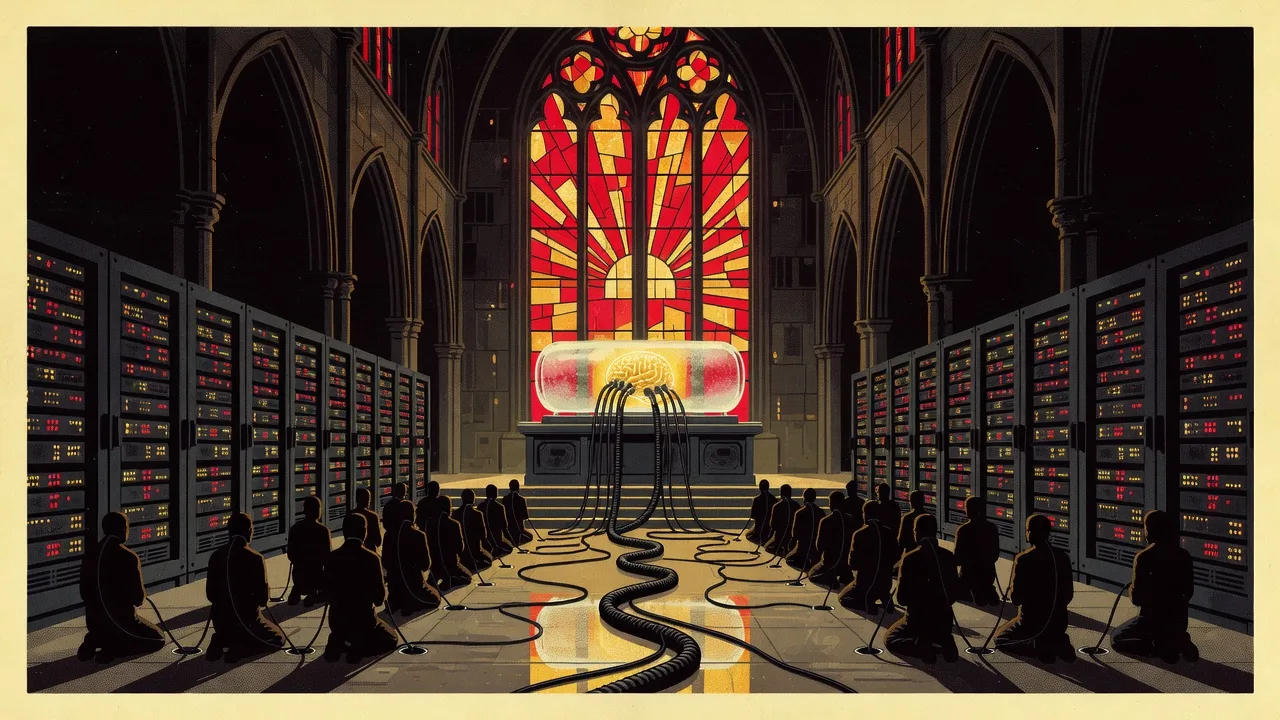
The argument, in brief
The tech oligarchs are not hiding their eschatology. Musk: humanity is a 'biological bootloader for digital superintelligence.' Altman: AI will 'probably' end the world, and meanwhile, great companies. Andreessen wrote the manifesto. The bundle underneath is TESCREAL: transhumanism, extropianism, singularitarianism, cosmism, rationalism, effective altruism, longtermism; a god-shaped hole filled with science fiction, an afterlife priced for billionaires, and an ethics that files the living poor under acceptable losses. The physics of mind uploading does not exist. The bill for the dream does; it arrives as drained aquifers, bent grids, and data centers humming next to people's bedrooms. The exit is practical: tax the fortunes, meter the extraction, refuse the bootloader role, and build sovereign infrastructure that answers to humans.
Transhumanism - The Bootloader Theology: What the Tech Oligarchs Actually Want
Markus Maiwald, September 2026
The Quotes Are on the Record
In 2020 Elon Musk posted: “It increasingly appears that humanity is a biological bootloader for digital superintelligence.” A bootloader is the scrap of code a machine runs to start an operating system, after which it is discarded. He chose a word that reduces eight billion people to scaffolding.
Sam Altman, CEO of OpenAI, has mused that humans could become “the first species to design our own descendants.” He wants man and machine merged within fifty years, on the theory that if we stay separate we will end up fighting our machines for resources. He also reportedly considers it reasonable to expect his own consciousness uploaded to the cloud within his lifetime. Larry Page has talked for years about humanity’s next manifestation being digital and galactic. And there is Altman again, on the record, in the tone of a man reading a menu: “AI will probably most likely sort of lead to the end of the world, but in the meantime, there’ll be great companies created.”
When these men describe the future, they describe an afterlife for themselves and a warehouse role for everybody else. They have made that business plan public. In May the Guardian ran a headline that needs no editing: “Our tech overlords are planning for conscious AI to conquer the cosmos. What could go wrong?” The paper described their “techno-mystical dream” of distilling what a human is, consciousness and all, into bits of information to be run on some non-biological substrate: a silicon chip, or a signal beamed at the stars. Power over the cosmos, immortality for the elect, and a supporting role for the rest of the species.
TESCREAL, or the Catalog of Salvation
The philosopher Émile P. Torres, author of Human Extinction: A History of the Science and Ethics of Annihilation, coined an acronym for the overlapping creeds of this crowd: TESCREAL. Transhumanism, extropianism, singularitarianism, cosmism, rationalism, effective altruism, longtermism. The Tribune walked through the bundle; it reads less like a philosophy department and more like a catalog of salvation products:
- Transhumanism: the body is a first draft. Upgrade it, then retire it.
- Extropianism: entropy is the enemy, and science will let the right people live indefinitely. The canon runs through libertarian science fiction; Atlas Shrugged is a perennial favorite in this crowd.
- Singularitarianism: superintelligence arrives soon, and it is the only event that matters. Everything before it is runway.
- Cosmism: humanity has a cosmic destiny. Consciousness is cargo for the stars.
- Rationalism: reason above all. A convenient flag for people confident they have no biases.
- Effective altruism: do the most good, as calculated. The calculation is where the mischief lives.
- Longtermism: future people vastly outnumber us, so they outweigh us. Present suffering becomes a rounding error.
A few of these creeds sound harmless or even kind in isolation. Money and a shared purpose turn them into a familiar doctrine. Torres calls transhumanism “eugenics on steroids”: the old eugenicists at least claimed to value the species; this wing wants to succeed it, with AI as the successor’s midwife.
Peter Thiel, founder of Palantir, is the movement’s most honest specimen. Asked in an interview whether the human race should endure, he produced a long silence, a few false starts, and never managed the word yes. A man whose company industrializes surveillance could not manage one syllable for the species.
Marc Andreessen published the hymnal himself in 2023: The Techno-Optimist Manifesto, complete with a section titled “Becoming Technological Superman.” It reads like a church newsletter in which every psalm is a purchase order. Technology carries no risk anywhere in the document. The frontier is a sacrament and the market is its clergy.
An Ethics That Prices the Poor
Longtermism supplies the moral justification for the other creeds. Its moderate version asks us to secure a long future for humanity while helping the present go well, a sound aim. Its radical version makes the survival of humanity and its posthuman descendants across colonized space, for as long as possible and in numbers we cannot imagine, the overriding concern. In the radical version the future’s theoretically enormous population dwarfs the present one, and the present becomes negotiable.
The founding texts are explicit about the exchange rate. Nick Beckstead’s dissertation, a founding document of the movement, argues that saving lives in rich countries should take priority over saving lives in poor countries, because rich lives ripple further into the far future. The mathematics prices a life in Lagos below a life in Los Angeles and calls the result altruism. Roughly 700 million people live in extreme poverty right now. The ideology files them under acceptable losses on the way to the stars.
Torres explains the appeal: “This ideology has a natural appeal to billionaires because it tells them exactly what they want to hear.” It tells them they need not worry about poor people because something else matters far more. It converts indifference into a moral position. Most ideologies at least ask the rich for sacrifice; this one issues them a waiver.
The Afterlife Market
The Guardian quotes a Silicon Valley hand explaining that atheism “left an empty space” and the machine cult rushed in. That excuse fails because atheists have long had humanism: devotion to human welfare. What these men wanted was a ladder: out of the body, out of the species, out of the bill.
The products are already on sale. Cryonics is fashionable enough that people wear dog tags instructing whoever finds the body to freeze it fast; a pendant that reminds you each morning that you are a scheduled corpse. The startup Nectome pitched a brain preservation technique designed to digitize your connectome; journalists covering it noted, correctly, that the procedure is 100 percent fatal. Bryan Johnson spends millions a year attempting to hack his way past aging, and picked up a chronic autoimmune gut condition for his trouble. Some transhumanists want expanded senses: echolocation, magnetoreception, envy of bats and pigeons, animals that solved problems we already solved with compasses and GPS.
Torres draws the obvious parallel: transhumanism borrows Christianity’s architecture. Contempt for the mortal body, a resurrection, an eternity. What it deletes are the parts about the poor. Heaven, minus the beatitudes, priced for the enterprise tier.
The Engine Underneath Is Fear
Strip the cosmology away and the engine underneath is mortal panic. Larry Ellison has been blunt for decades that death never made any sense to him, and has funded anti-aging research accordingly. Thiel writes about fighting decay as a duty. These are men who have not heard the word “no” since their second funding round; death is the one counterparty that will not negotiate, the last constraint that treats a billionaire exactly like a delivery driver. They can bend everything else in their lives; the obituary will not bend.
So the theology bends instead. It reclassifies death as an engineering problem, the body as defective hardware, and the species as raw material for whatever comes next. The fear itself is human; I share it, and so do you. The budget is what turns it into everyone’s problem. A private terror consoled by science fiction is a personal matter. The same terror with a trillion dollars and the world’s compute attached becomes other people’s weather.
The Physics Check
Mind uploading would require a theory of consciousness, which we do not have, and a map of the human connectome: 86 billion neurons and on the order of a hundred trillion synapses. For scale, the roundworm C. elegans has 302 neurons; its connectome was completed in 1986, and scientists are still arguing about what it explains. We are asked to believe the species that cannot model a worm will digitize a soul.
The intended substrate is not reassuring either. Today’s models hallucinate with total confidence and degrade when fed their own output; labs now ration synthetic training data because every pass through the copy machine blurs the picture. That is the medium proposed to carry human consciousness to the stars. And the machinery at the destination needs hands: mines, smelters, refineries, maintenance crews, replacement parts. A mechanical civilization with no humans is a clock with nobody to wind it, unless we also imagine robot supply chains all the way down, at which point the posthuman future is an industrial economy with extra steps and no customers.
Ben Goertzel of SingularityNET, who did as much as anyone to popularize the term AGI, champions modern cosmism and speaks of humans re-engineering not only themselves but the universe: re-engineering the fabric of space and time, what he calls scientific future magic. We cannot steer a hurricane or predict a volcano’s month; we cannot keep a recommendation feed from eating its own tail. But the universe, certainly.
There is precedent for tycoons with cosmic ambitions. Henry Ford, the Andreessen of his century, tried to re-engineer society itself in the Amazon: Fordlândia, a model industrial utopia in the Brazilian rainforest, built by the richest and most competent man alive. The jungle kept the money; the ruins are a tourist stop. Billionaires with cosmic theologies are a recurring feature of industrial capitalism, not a new species. The novelty is that this cohort owns the informational substrate of daily life, which is why their private heaven is a public problem.
The Bill Arrives Now
Daron Acemoglu, the Nobel economist, told the Guardian what he sees driving the industry: “The handful of people unleashing this technology on the world are guided by an ideology of control over humanity and by a conviction that machines are uniformly better than humans.” In the Acemoglu wars, Henry Farrell lays out the professor’s worry that the technology is disappointing even on productivity, while concentrating power in ways that corrode jobs and democracy alike. Acemoglu’s proposal is modest and human: steer AI toward complementing people; pro-worker tools instead of replacements.
The costs are already here. Data centers drink down water tables while the grid bends under them; the low hum alone gives the neighbors headaches. Every liter and every megawatt is justified by a heaven nobody can audit. You cannot falsify a rapture; you can only fund it. If the Singularity never arrives, we still paid for the church.
The Exit
Working in technology advances it; worshipping its shareholders has never been part of the job. Technical competence gives nobody a license to rule a civilization. We can act on that distinction in four ways:
Tax the fortunes. Wealth at this scale behaves like pollution: measurable, corrosive, self-justifying; the psychology on display this decade is the externality made visible. Europe already runs the experiment, and society does not collapse. It gets healthcare.
Meter the extraction. Put prices and limits on the water, power, and land they consume and the noise they produce. Account for all of it publicly. If their heaven is worth building, it can pay market rates for its own sacraments.
Refuse the role. Their future needs you as a bootloader only as long as you keep compiling their code.
Build the alternative. Own your compute, keep your data, and use protocols they do not control. Build sovereign infrastructure that serves human beings without treating us as a legacy dependency.
And if the oligarchs want to meet their makers in a data center, let them. The terms of the divorce: not one liter of our water, not one kilowatt-hour of our grid. No future of ours spent as somebody’s boot sequence. Let them upload at retail prices.
A civilization that consents to be a bootloader will eventually boot something. Decline the role while the choice still exists.