The Etymological Court #10: Anarchism
Not 'no rules.' No rulers.
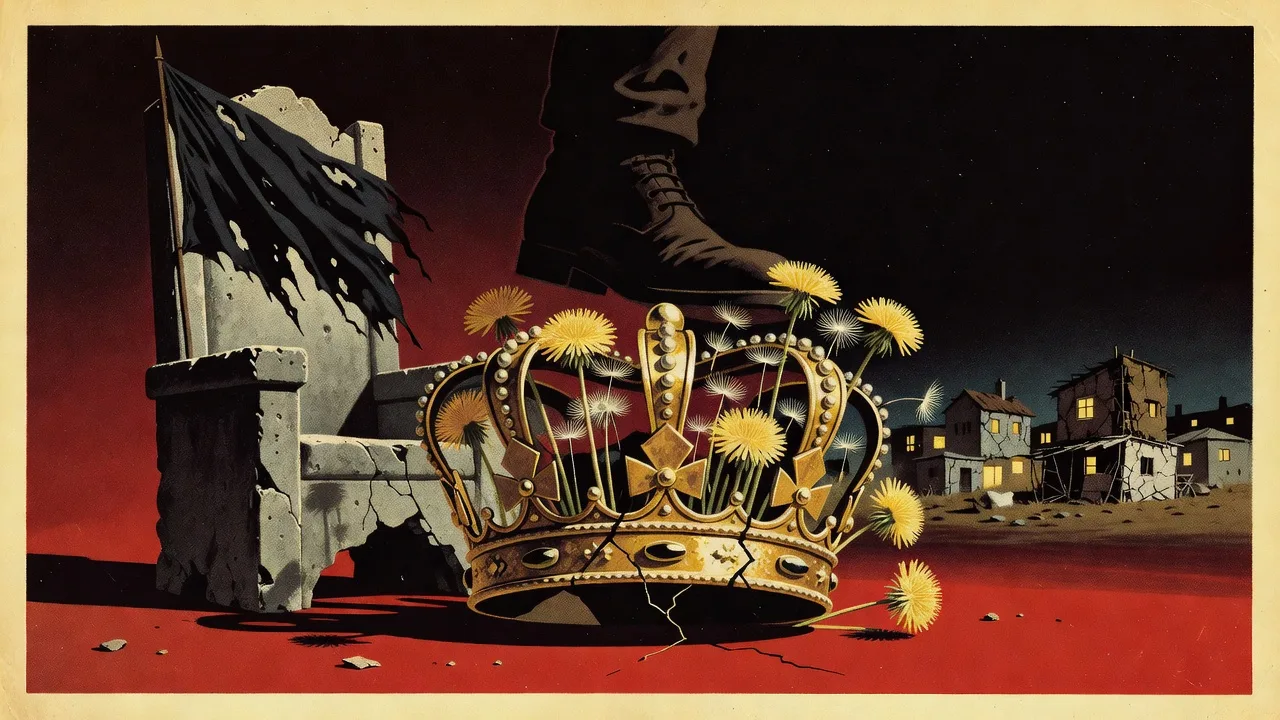
The word meant “no rulers.” It was sold to mean “no rules.” The difference is the whole history of anarchy.
The Word
arkhos. Greek for ruler: the one with the grip. an-. Greek for without. Weld them: anarkhia. Without a ruler. Notice what is missing: rules. Lawlessness. Anarchy is the only -archy that names its own absence.
The word was old, and mostly an insult: the Greeks used anarkhos for a leaderless army, their idea of disaster. Then Proudhon picked it up in 1840 and claimed it. In What is Property?, he called himself an anarchist; the first to wear the word as a banner. His enemies called it proof of madness. He called it the truth about order.
The name, before the theft, meant one thing: no rulers. Not no rules; no one who owns the right to make you obey.
What It Wanted
Charity first. Read at its best, anarchism is the most demanding doctrine ever written. Anyone can build a system that runs on fear; the anarchist proposed one that runs on consent, a much harder engineering problem.
The first school’s goal was orderly, not romantic: ordered self-management without coercion. People associating freely, building the institutions they need from the bottom up. Four convictions carried it:
1. No rulers. Not no rules. The distinction is the whole doctrine. A rule you can debate, amend, and leave is a tool; a ruler is someone with the authority to enforce his version of it on you.
2. Voluntary association. Every group you belong to should be one you chose, and could leave. The commune, the syndicate, the mutual-aid society: associations of equals, not subjects of a master.
3. Mutual aid. Kropotkin made it scientific: cooperation, not competition, carried the species. Build society to match the biology.
4. Federalism. From the free commune upward, by free agreement, not from the center downward by decree. Bakunin’s answer was the state stood on its head: power flowing up only as far as the people below consent to lend it.
Not a program for burning the world. A program for the world to stop having a master.
Why It Mattered
Because hierarchy is civilization’s default setting, and the state is the original monopolist. The pyramid is the cheapest coordination a primate brain knows; kings did not conquer by accident. Every nineteenth-century ideology argued over who should sit at the top. Anarchism asked the question nobody else would touch: must anyone sit at the top at all?
The state, in this view, was not a referee but the largest cartel on earth: a monopoly on force, financed by a monopoly on taxation, defended by a monopoly on legitimacy. It dressed the monopoly as order; question it and you were an enemy of order. The anarchist’s wager: order does not require a jailer, and a society where order justifies itself to every member is the more orderly, not the less. The wager kept alive the question every other ideology had abandoned: why is a ruler needed?
The First School
Proudhon published What is Property? in 1840. Its verdict, “property is theft,” made him infamous. Its quieter claim founded a school: he called himself an anarchist. Not a nihilist. Not a terrorist. A student of order who had concluded that the master is the unnecessary part.
Bakunin, who called himself Proudhon’s direct political heir, pushed the doctrine to its political form: collectivist anarchism, federalism, the free commune, the workers’ International. He joined the First International in 1868; Marx moved to expel him that same year and finally managed it at The Hague in 1872; the split never healed, and Bakunin was dead four years later. His collectivism was the departure from Proudhon: the land and the workshops to the workers’ collectives, remuneration by labor performed. Power that flows up, consent that can be withdrawn, hierarchy that must prove itself to the people under it. Kropotkin supplied the science: Mutual Aid (1902) showed cooperation is an evolutionary fact, the species survived by helping. The anarcho-syndicalists who fused Bakunin’s ideas with the unions came after his death, and their story has its own day in this court.
Proudhon is the hinge figure of the nineteenth-century anti-statist left, and the anarchist, the mutualist, and the syndicalist each claim him. What unites the three of them is the rejection of absentee property and the wage relation; what divides them is whether to abolish the state, abolish capital, or abolish exchange. Bakunin, who called himself Proudhon’s political heir at the International, inherited the use-criterion along with the no-rule word; the federation of free communes is just the possession principle applied to the polity. All three descend from Proudhon, and none of them has a monopoly on his name. He coined mutualism, claimed anarchism, and was claimed in turn by the syndicalist who came after. Give the man his due: the hinge is real, and the three sons are brothers, not rivals.
The doctrine was precise: no rulers, not no rules. Authority only where competence and consent intersect, and only as long as both last. The first school was not against order. It was against anyone who claimed to own it.
What Happened
The usurper arrived without a doctrine. It arrived as an image.
The bomb-thrower. The feral mob. The “Mad Max” collapse. A century of propaganda compressed an entire school of cooperative economists into a single silhouette: a man with a bomb.
There were bombs. The 1890s produced a scattered fringe of insurrectionists who gave the state its photographs, printed at full page. But watch the move: a marginal handful of nihilists became the essence of the school, while the cooperative bakeries, the self-managed factories, the mutual-aid societies, the whole working architecture, vanished from the frame. The word’s payload inverted. It no longer meant “people who can organize without rulers.” It meant “people who make order impossible.”
An ideology whose first principle is “no rulers” is the natural enemy of every ruler, who therefore needs the word neutered. State and capitalist propaganda worked in perfect symmetry: an orderly anarchy refutes the state’s necessity, so the state needed the word to mean chaos. Call a striker, a suffragist, a union organizer an anarchist; one gesture accuses them of wanting to burn the town and justifies your boot. The caricature was not a rival school but the school’s enemies, painting it so no one would look.
The Verdict
Anarchism = ordered self-management without coercion. No rulers; not no rules. The chaos stereotype is not the second school; it is the portrait painted by the rulers the doctrine threatened.
The first school wins. The bomb-thrower was a photograph. The federations, the mutual aid, the self-managed workshops: that was the doctrine. The state sold you the photograph and called it the word.
The Door
Can they leave?
Here is the deepest affinity in the whole docket; the first school of anarchism and the first school of Exitarianism are cousins. The exit instinct. Proudhon’s association was voluntary or it was nothing. Bakunin’s federation could be withdrawn or it was a state in costume. For a doctrine about no rulers, the door is not a feature; it is the premise. Forced to stay, you are ruled.
The series ancestor planted the compass: anarchy as the regulator against institutional rot, not a destination. The door test confirms it.
But the court adds the warning. Abolish the formal hierarchy and the informal one moves in: the commune tyrant without a title, the clique’s gossip as secret police, the leaderless space captured by the charismatic predator. The test runs both ways: an anarchy whose informal hierarchy you cannot leave is the same trap. If the group’s unwritten law is enforced by shunning and the door is a social execution, the ruler has merely taken off his crown. Exit must be real, walkable, with reputation intact, or “no rulers” is a slogan and “the group” is the throne.
The use-criterion does the same work here that it does to the absentee deed. The first school asks the same two questions of every group, formal or informal: who in this space is doing the actual work, and who is collecting from it? The commune baker who runs the ovens every dawn holds by use; his claim is inviolable. The charismatic who circulates, performs charisma, and is rewarded with deference he does not earn is a property owner in the Proudhon sense: extracting value from a thing he does not use, regardless of whether anyone signed him a deed. The doctrine that broke the absentee landlord breaks him too. Shunning, gossip, and the closed social circle are the same theft with a friendlier mask.
The word, at its root, an-, without; arkhos, ruler, still means what it meant: a world where no one can make you stay. Not a world without rules. A world without anyone who owns the right to force them on you.
Series: The Etymological Court · Previous: Nationalism · Next: Libertarianism