The Etymological Court #7: Syndicalism
Worker self-governance through the union; not a negotiator's seat at the boss's table.
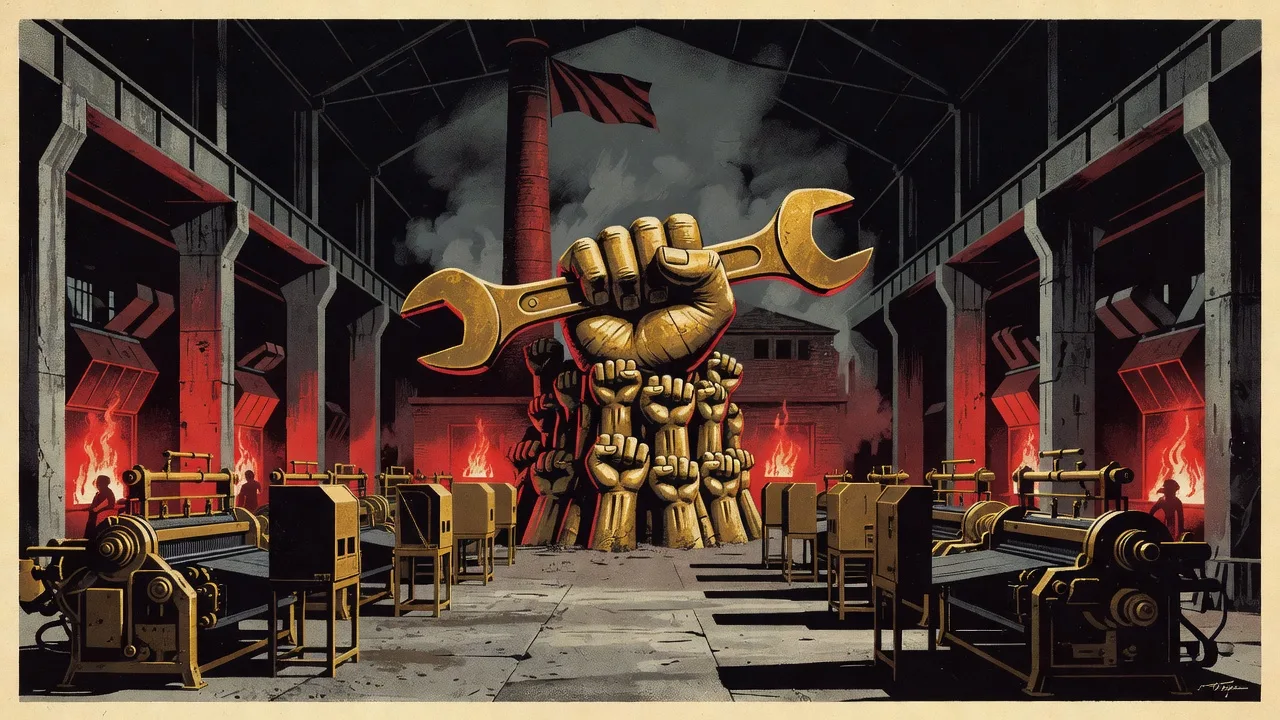
The union was to replace the state, not lobby it. The negotiators who stole the word never noticed the difference.
The Word
syndikos. Greek for advocate; the one who stands for another’s cause. In the courts of Athens the syndikos represented a group and argued its case. Latin borrowed the word as syndicus, French as syndic: a trustee, a delegate of a community. And from syndic came syndicat (the trade union) and then, in the France of the 1890s, syndicalisme, the doctrine that the union is not a lobby but a government in waiting.
The name, before the theft, meant one thing: the workers’ own institution, and the workers’ own rule.
What It Wanted
Charity first. Read at its best, revolutionary syndicalism is the most radical answer ever drafted to a question most ideologies never ask: who governs production? Not ownership, not regulation; who runs it, day to day. The answer: the workers, organized in their unions. No parties. No parliament. No state. Direct action over representation.
Four convictions carried the first school:
1. Direct action. Workers act for themselves; not through deputies, not through delegates who slowly forget who sent them, but directly, at the point of production, where their power is real.
2. The general strike. The revolution needs no army and no coup. The workers stop the economy (all at once, everywhere) and the masters discover they own nothing, because nothing runs without the workers.
3. The union as embryo. The syndicat is not merely the instrument of revolution; it is the new society growing inside the shell of the old. The union that organizes production today is the unit that will run it tomorrow.
4. No middlemen. The party is a detour. Parliament is a delay. Between the worker and the workshop, nothing. Between the union and production, nothing.
Not a program for seizing power. A program for making power obsolete.
Why It Mattered
Because parliamentary socialism had begun to rot before it had finished hardening. The workers’ parties sent representatives to parliament; the representatives discovered the parliament’s comforts; the revolution receded like a tide. Every election postponed it. Every seat in the chamber was a down payment on someone’s career.
Syndicalism answered a question the parties had stopped asking: if the state is abolished, who runs the economy? The answer was the one institution the worker actually controls; the union. Not the ballot box, which the worker shares with everyone and owns with no one. The union, where the worker votes on her own wages, her own hours, her own conditions, face to face with the people she works beside. That is where workers already govern themselves, and the first school proposed to trust it.
The First School
France, 1895: the Confédération Générale du Travail is founded at Limoges. Around it gather the Bourses du Travail (the labor exchanges that became self-governing workers’ institutions) and their animating spirit, Fernand Pelloutier, the anarchist who died young in 1901 after giving the movement its soul. Then Georges Sorel, the philosopher who wrote in 1908 that the general strike is the myth that carries a class to revolution; not a plan to be executed but an image to be believed: the map of a world in which the workers simply stop, and take what they have made.
In 1906 the CGT adopted the Charte d’Amiens: the union is independent of parties and of the state; the grouping of resistance that will become the grouping of production and repartition, the base of the reorganized society. The union does not negotiate with the system. The union replaces the system.
The doctrine was precise: the general strike as the revolution, the syndicat as the unit of the future economy, self-governance through the union. The three detours (party, parliament, state) removed, and the workers standing face to face with the means of their own emancipation.
The first school also inherited the hinge, late and by other hands. Proudhon is the figure all three anti-statist lefts claim: the mutualist for the use-criterion, the anarchist for the abolition of rule, the syndicalist for the federation of producers. The inheritance ran through Bakunin, who called himself Proudhon’s direct political heir; but mark the court’s precision: Bakunin was no syndicalist. His doctrine was collectivist anarchism, the land and the workshops to the collectives, pay by labor performed; and he led no syndicalist movement, because there was not yet one to lead. He joined the First International in 1868; Marx moved to expel him that same year and finally managed it at The Hague in 1872; he was dead by 1876. The weapon his ideas inspired, the syndicat as the instrument of revolution and the general strike as its myth, was forged in the 1890s by men working from his inheritance: Pelloutier, the Bourses du Travail, the CGT. What divides the three schools is the question of what to abolish: mutualism abolished absentee property without abolishing exchange; anarchism abolished rule; syndicalism abolished the state by way of the workshop. All three descend from Proudhon; none of them owns him.
And the court records the scorecard of the war that split the International, because the twentieth century graded it. Bakunin won the argument that mattered: his warning, that a dictatorship of the proletariat would be a dictatorship of a new official class, was verified by every state that flew the red flag. Marx was right that Bakunin’s secret Alliance, his invisible dictatorship of trusted conspirators, was poison inside a transparent workers’ movement. And Marx was ruthlessly right about the money: Bakunin had cashed the advance for the Russian translation of Capital, delivered no translation, returned no money, and Marx spent that receipt like a blade at The Hague. Both men won their point. The workers’ movement never recovered from either victory.
What Happened
The negotiators arrived, and the word quietly changed owners.
Bureaucratic reformist unionism took the scaffolding of syndicalism and built a service provider inside it. The union stopped being the embryo of the future society and became a negotiating agent in the present one: wages, hours, grievance procedures; the fine print of the wage system, endlessly renegotiated. Collective bargaining institutionalized the boss’s permission. The union became a lobby with a membership count and a strike fund; not a government in waiting, but a permanent plaintiff.
The dilution did the rest. In France, the CGT’s revolutionary wing lost to the reformers after the Great War, and “syndicalism” survived as a museum piece while “unionism” became its reformist heir; a card in the wallet, a line item in the cost of employment. In America it was worse: business unionism, Gompers’s AFL, which frankly defined the union as a seller of labor power seeking a better price; no embryo of anything, just a better rent within the wage system. The word kept its labor-flavored payload while its content (workers governing production) was emptied out and replaced with workers petitioning for a raise.
The Verdict
Syndicalism = worker self-governance through the union. The union was to replace the state, not lobby it. Everything after the negotiating table is a different doctrine wearing a stolen name.
The first school wins. The founders of the CGT and Pelloutier get their word back. If you want a name for organized labor as a service provider, use unionism; it is a fine thing, and it has its own meaning. Do not make it borrow syndicalism’s name and bury its corpse.
The Door
Can they leave?
A union that owns your job but not your exit is a lock.
Consider the closed shop; the union-security agreement that makes membership a condition of employment. Resign from the union, lose the job. The union claims to be your institution, and it holds your livelihood hostage. That is not self-governance; that is a tollbooth with a membership card. The worker who cannot leave the union is not a member; she is a tenant.
The first school’s union was different: a voluntary association of workers who governed production together, and its honesty was exactly the door. A syndicalist could resign and suffer nothing but the loss of the association, because the union’s power came from the workers’ own activity, not from a legal monopoly on their jobs. Exit is what makes self-governance real. A union that cannot be abandoned is a union in name only.
So here is the test this court hands to every syndicalist, the same test handed to every -ism in the docket: the worker must be able to walk out of the union with her reputation intact. If she can, the union is her government; freely joined, free to be quit. If she cannot, it is a lock with a slogan, and no etymology in the world will save it.
The first school understood this without naming it. Pelloutier’s workers could leave the Bourse. That is why their self-governance was real. And that is why the word, at its root (syndikos, the advocate who represents you), still means what it meant: representation you can resign from.
Series: The Etymological Court · Previous: Mutualism · Next: Social Democracy