The Etymological Court #3: Republicanism
The public affair cannot become somebody’s private estate.
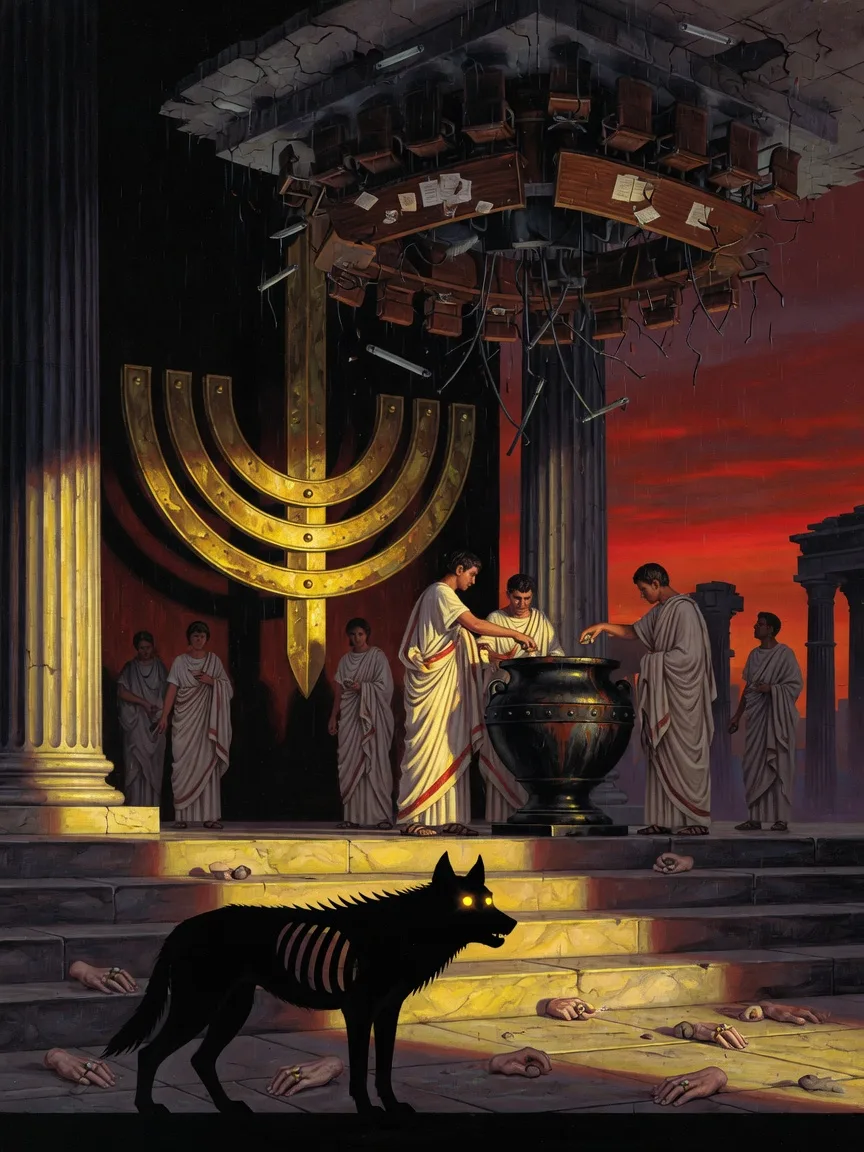
The argument, in brief
Republicanism denies that common government is a ruler’s private property. Rome’s mixed institutions evolved over centuries and included direct citizen assemblies as well as elected magistrates. Representation is not the definition of every republic, and democracy is not its opposite. Exitarianism adds a personal test: neither civic duty nor public ownership of institutions can establish ownership of the citizen.
The public affair is not the ruler’s inheritance. Nor is it the party’s.
The Word
The Latin res publica names the public affair. The political claim concerns possession of power: a ruler cannot treat common government as a household estate.
Roman tradition dates the expulsion of the last king to 509 BCE. That traditional date is not the birthday of a finished constitutional machine. The Republic’s offices and conflicts developed across centuries.
The question survives the chronology. Who controls the common power, and what prevents its administrators from making it their own?
What It Wanted
Republicanism’s strongest argument is against domination by a permanent proprietor. A dynasty cannot claim the public as an inheritance. An officeholder holds a responsibility with limits, rather than a title to the people governed.
The argument also applies to factions. Removing the king is no achievement if an oligarchy acquires the same undismissable control. Public power needs distribution, scrutiny and institutions capable of resisting its capture.
Civic responsibility belongs in that account. Maintaining common institutions requires work. The work cannot become an excuse for those institutions to possess the people who sustain them.
The First School
Polybius described the Roman Republic through the interaction of consuls, Senate and citizen assemblies. Command, deliberation and popular decisions had different institutional homes. Their dependence on one another constrained each component.
This was a mixed constitution, not simply modern representative democracy in a toga. Citizens voted directly in assemblies. Aristocratic power remained substantial. The machinery included exclusion and inequality alongside its checks.
Machiavelli’s Discourses later examined Roman conflict and republican liberty. He treated conflict between the people and the powerful as a source of institutions protecting freedom, rather than assuming that unanimity proved a healthy republic.
The lesson is sharper than a picture of virtuous men agreeing: an institution must make room for opposition and prevent public authority from becoming one faction’s permanent property.
Why It Mattered
A hereditary title settles who inherits an office; it does not establish competence, consent or restraint. An election changes the selection procedure; it also cannot establish those things by itself.
Republicanism directs attention to the arrangement around the office. Can its occupant be challenged? Can evidence of misconduct be examined? Can the office be limited without depending on its occupant’s generosity?
That is what a constitutional claim must answer. Admiring the incumbent supplies no protection against his successor.
What Happened
Republic became a title governments could print without practicing its strongest commitments. An institution can abolish a hereditary crown and still concentrate power in a dictator or ruling party.
But the word’s modern breadth does not make democracy its enemy. A polity can be republican in its form and democratic in its distribution of political control. The two claims need separate examination; neither can certify the other.
My objection is to a public name covering private command. When an office cannot be challenged, a governing party controls every route of review, or the administrators treat common funds as their own patronage, the public affair has changed hands while keeping its signboard.
The title republic then serves the same purpose as a crown: it explains why somebody else is permanently in charge.
The Verdict
Republicanism makes common government a public responsibility and subjects its holders to limits. A republic that cannot restrain its rulers has failed that argument.
A country without a king meets one classification. It does not automatically meet a philosophy of public liberty.
The test concerns what people can do when the ruler refuses to behave, not what the constitution calls him when he behaves well.
The Door
The Roman record supplies no ready-made Exitarian right. Cicero’s exile was a political disaster, not proof that Rome honored voluntary departure. Plutarch describes flight, punishment and the struggle for recall. We do not turn expulsion into consent because it took someone across a border.
Our additional demand is personal. A Chapter may choose republican institutions. Its members retain protection, expression, defense in proceedings and effective exit. Legitimate obligations survive within their scope; permanent allegiance does not follow from a birth certificate or a founding vote.
You can help sustain the common affair. You do not become part of its inventory.
Series: The Etymological Court · Previous: Democracy · Next: Liberalism
Sources
- Polybius, Histories, book VI, sections 11–18. His account of Rome’s mixed institutions.
- Niccolò Machiavelli, Discourses on the First Decade of Titus Livius (1531), book I, chapters 2–4. Constitutional forms and conflict in the Roman Republic.
- Plutarch, Life of Cicero, sections 30–34. Exile and recall, not a constitutional right of voluntary departure.
- Markus Maiwald, The Federation Axioms. The personal protections used in the Court’s contemporary test.