Idolon: IV, Keep Moving
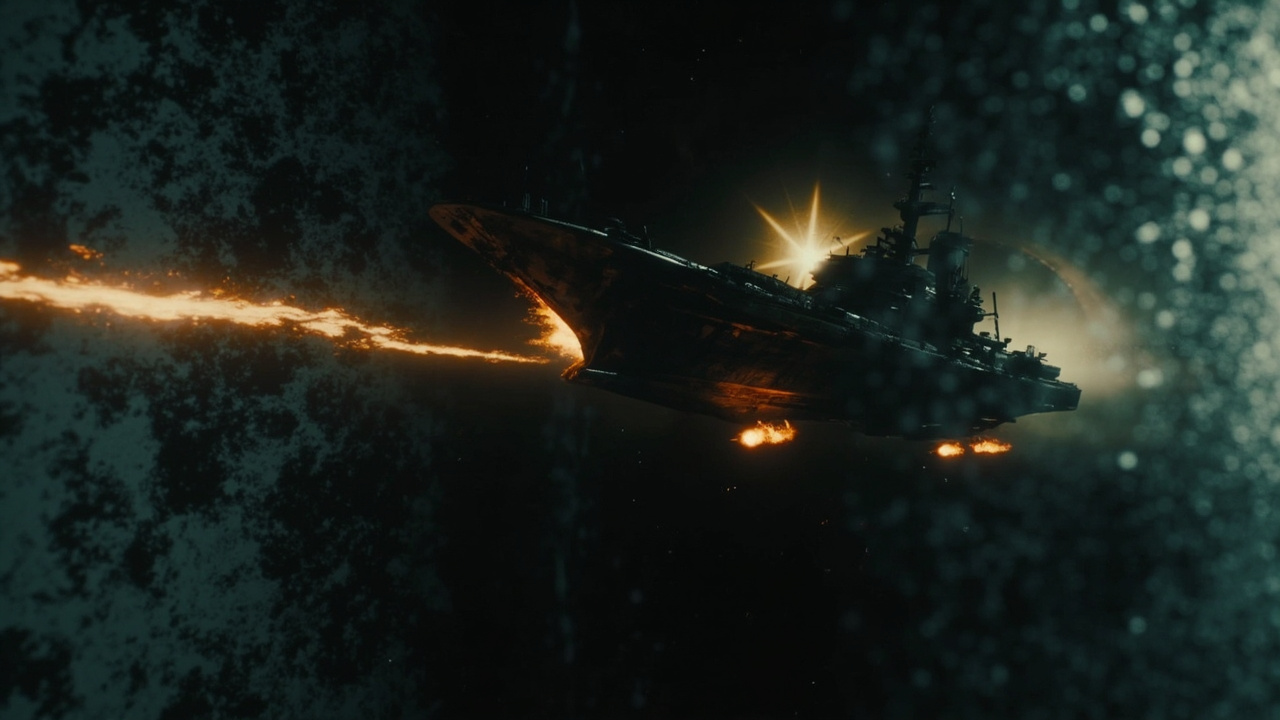
Act IV of Idolon, the finale. Drones, riots, slingshot. Forty-three dead. A people sentenced to motion. On the glass: KEEP MOVING, VICTOR. The spiral turns like a pupil that never sleeps.
Year 506, Aboard the Idolon / generation-ship-horror
Idolon: IV / Keep Moving
Year 506, Aboard the Idolon · A generation-ship horror in four acts.
IV / Keep Moving
What follows are the hardest thirty-one days in the history of the ship.
Not because the work is difficult. Difficulty humanity understands. We solve it with labor, structure, shifts, and the long blunt instrument of will.
This is worse.
We have to save nine thousand people from a truth they built their whole civilization around, without feeding them to panic, and without feeding them to a star that eats arrival.
Officially, command announces a course-refinement phase: newly detected stellar hazards in the Taeti system.
True enough to survive scrutiny. Not broad enough to prevent the smell of wrongness from moving through the ducts.
Rumors breed in capillary dark the way mold breeds in wet seals. Settlement lottery boards freeze. Training tracks quietly delay. Fabrication priorities shift from atmospheric colonization packages to structural reinforcement and drone skeletons. People notice. They always notice. On a welded world, attention is a survival organ.
The Idolon begins to feel wrong before anyone can name why.
Public spaces grow louder. Civic feeds grow angrier. The promise of arrival has always held this hull together more than rules did. Touch that promise with uncertainty and the metal does not crack first.
The people do.
Behind us the anomaly holds its altered distance. After the rehearsal burn it never fully returned to the old interval. Some acknowledgements cannot be undone. It does not rush. It does not send essays. It simply sits in a tighter relation to our spine, watching whether we will turn toward stillness again.
I build the slingshot in a fog of coffee substitute and bone-ache. Ren bleeds equations. Han bleeds logistics lies. Malik bleeds her eyes into two skies at once, aft leash and forward wound. Sorrell bleeds silence into Continuity indexes, hunting every banned Orpheus footnote like a man defusing a story.
Voss does not bleed where anyone can see.
We send six drones.
Three die almost immediately to signal collapse, not impact, not fuel. Collapse. As if the concept of a clean return path were being edited out of local physics.
One transmits until it crosses the plane of the inner system, then goes dark mid-sentence of its own diagnostics:
optical geometry nonstable.
The last two send back enough.
Enough to murder the old world.
The primary colony candidate is habitable only in the most technical, cruel sense. Atmosphere altered by long-term radiation insult and particulate saturation. Surface temperatures swinging in violent bands. Ocean chemistry shifted beyond the recovery curves our great-grandparents filed as gospel. Something vast has been happening there across centuries, something no inherited model prepared for, because all our models assumed a system wants to remain a system.
Then the inner-zone images.
Not clear. Not complete. Clear enough.
Structures.
Ren was right in the one-second theft of our map. He is righter now.
Immense ring-like architectures hug Taeti at impossible proximities, nested in broken spirals and half-collapsed lattices that dip in and out of visibility, as if only partly willing to inhabit the kind of space our eyes evolved to trust. They do not resemble stations. They do not resemble ships.
They resemble attempts.
Attempts to build near a star that did not want builders.
And at the heart of that impossible geometry, burned into thermal glare like an insect trapped in amber mid-struggle: the wreck signature of ECS Orpheus.
The first ship reached the star.
The first ship anchored.
The first ship became part of whatever that place now is.
I watch the wreck-scan in a fabrication bay so narrow my shoulders paint both tool walls when I breathe deep. Welding glare stutters down the aisle. Someone laughs at a private joke two racks over and the sound has nowhere to go, so it dies against my teeth. Outside these bulkheads the abyss continues, infinite and unbothered. Inside, we are animals learning our promised heaven is a processing site.
Malik stands beside me because there is no beside that is not against. Her voice is ash.
“Beacon matches the hulk. Seventy-nine second ghost is automatic, no crew living in any sense we mean.”
“Are they.”
She knows which they. Her throat works. “If anchoring makes them, if settlement is the chrysalis, then Orpheus didn’t get murdered by strangers.”
“They became the strangers,” I say.
She does not correct me.
On my slate, uninvited, a single line ghosts and fades before I can show it to her:
CORRECT
I do not say her name. I do not say Lena. I put the slate away like a blade.
Captain Voss calls the final sealed assembly two days after the last drone dies usefully.
Only the five. A compartment off command that was never meant for five egos and one species-level choice, table bolted, ceiling low, air already used. Han looks twenty years older than the month he has lived. Malik has stopped pretending exhaustion is temporary. Sorrell sits with both hands clasped so hard I wait for a finger to snap and go unnoticed. Voss stands at the head because sitting would look like rest, and rest is a kind of stillness, and stillness is contraband.
“Two survivable paths,” she says. “One physical. One political. They are not the same.”
No one interrupts. In a room this size interruption is a contact sport.
“Physical path: slingshot transit. Preserve motion. Avoid deceleration commitment. Use Taeti’s mass to throw the Idolon outward onto a new interstellar vector.”
Han, quiet: “Political path.”
Voss meets his eyes. “We tell the population before we do it.”
Silence, because that is the costly part. Not fuel. Not orbital stress. Not taking a city ship through a maneuver it was never designed to survive.
Truth.
Tell them in full and panic can destroy the ship before Taeti gets its chance. Tell them too little and we may keep their lungs working while we kill the last trust holding civilization in one can.
My voice arrives before I have fully authorized it.
“Tell them enough.”
Voss turns. “Define enough.”
“Enough about the system. About Orpheus. About arrival killing us.” I swallow pipe-taste and old grief. “Not about the thing behind us.”
Han frowns. “Hide the central cause.”
“Hide the part that offers no useful action except terror.”
Malik looks at me a long time, then nods once. “He’s right.”
Sorrell too, slow. “A civilization can survive a stolen destination. I’m not sure it survives learning the universe itself has forbidden roads.”
Han is silent several seconds, the longest he has granted anyone else’s framing since Year Zero. Then, reluctant: agreement.
Voss gives one sharp nod.
“Decision made.”
The announcement goes out six hours later.
I watch from navigation with the dome lights down and the leash glowing aft like a patient infection.
Voss does not lie. That is the remarkable thing, and the dangerous one.
She stands before every public display on the Idolon and tells them Taeti is not a viable refuge. She tells them an earlier human vessel reached the system and was lost. She tells them the stars ahead remain open, but this one does not. Then she tells them the ship will survive by remaining what it has always been in truth:
A vessel in motion.
The reaction is exactly what Han feared.
First riots inside ninety minutes. Not everywhere. Not most decks. Enough. A crowd forces entry into settlement planning. Another tries to seize an auxiliary comm node. Three members of the transit council demand emergency command review and get detained for the hull’s own good. Across the habitat rings people scream at screens, at officers, at each other, at the simple unbearable arithmetic that five hundred years did not buy them land.
The ship groans with human weather.
But it does not break.
Not fully.
Because under the rage another truth spreads on legs the riots cannot break: the drone images are real. Orpheus is real. Taeti is real, and real enough to fear. Fear is a dirty tool. It still cuts in the direction you need when hope has become a suicide pact.
I walk the spine during the second night of unrest with a duty armband that means little if a crowd decides otherwise. Shoulder to shoulder with strangers whose breath is animal-hot. Someone has painted across a corridor arch in protein-ink:
WE WERE PROMISED GROUND
Under it, smaller, in a different hand, already half-scrubbed by maintenance:
ground is mercy, keep moving
I do not stop to ask who remembers a founders’ scrap they should never have seen. The ship has begun to dream in the anomaly’s grammar. That may be infection.
It may be adaptation.
On the fourth night a boy no older than Lena was stops me under a junction lamp, eyes too wide, voice steady as a charge reading.
“Commander Kain. Is the star dead because of us.”
I look at him. The corridor presses. Somewhere a siren tests and fails into silence. My mouth shapes three different lies and discards them.
“It’s dead because something used it,” I say. “We are not going to teach it how to use us.”
He nods once, like a small adult, and vanishes into the stream of bodies.
I stand until the lamp buzzes in my teeth.
Slingshot burn window locks.
No secrecy this time. No rehearsal theater. The whole ship knows we are about to bend around a grave and pray the hull remembers flexibility.
Final night before commit, the five of us stand again in the low room.
Han sets a casualty model on the table like a funeral invoice. Structural failure bands. Ring shear. Thermal load. Expected dead if the pass goes “well.” Expected dead if it goes “honest.”
“Forty to sixty if the models hold,” he says. “Hundreds injured. If the models are kind.”
Voss does not flinch. “And if we decelerate into settlement posture.”
Malik answers for the abyss. “Then we find out what anchoring makes. Up close. With nine thousand raw inputs.”
Sorrell’s hands are steady for the first time in a month. “Orpheus is the citation.”
I think of a fourteen-year-old’s margin note. Of a drill that moved a gradient. Of a voice that said do not let them make the ship a grave.
“Captain,” I say. “Once we light this arc, we are the second ship that refused. Or the first ship that understood.”
Voss almost smiles. It is not a kind expression. It is a cutting tool.
“Then let us be understood by the only jury that has ever mattered out here.”
She looks at each of us.
“All boards green by dawn. Propulsion on my mark only. Civilian shelter protocols. Medical surge. Ring isolation ready.”
Han: “Council is still screaming for your removal.”
“Council can scream in a moving ship or whisper in a finished one,” Voss says. “I know which noise I prefer.”
Dismissed. Chairs scrape. Bodies file into capillary night.
At the hatch she says my name only.
“Kain.”
I turn.
“When it speaks in her voice during the pass, and it will, you will not answer. You will fly. That is an order with a father inside it. Do you understand.”
Copper on the tongue. “Yes, Captain.”
“Do you accept.”
Acceptance is not the same as understanding. Acceptance is a burn profile.
“I accept.”
She nods. For a moment the crack in the paint shows again, the same crack that once said neither do I about a false sensor verdict. Then it seals.
“Get an hour of sleep if the ship allows. Tomorrow we throw a city at a wound and ask the boundary to keep its leash.”
I do not sleep.
I go to the aft observation blister, glass teardrop, one body if the body does not raise its arms, and put my palm on the cold.
Outside: abyss without floor. Stars like hard grit. No mercy of horizon.
The spiral does not show to naked eyes. Instruments still feel it, shortened leash, patient as a held breath.
Forward of us, unseen from this angle, Taeti waits with structures in its glare and a human wreck for a jewel.
On the glass, too faint for alarm, gone almost before I am sure, pale condensation writes itself from nothing:
KEEP THE ARC CLEAN, VICTOR
Then only my hand-heat ghosting the pane.
I take the hand away.
Tomorrow we move.
Not toward home.
Not toward land.
Toward the only remaining definition of alive this universe has offered a species that would not stay in its cradle:
Not still.
Dawn cycle on a ship that no longer believes in mornings.
Light strips climb their timed gradients anyway. Ventilation swaps night-stale for day-stale anyway. Bakers in ring C warm protein ovens because hunger does not honor existential verdicts. Children are held in shelter sectors with tablets full of old Taeti cartoons command forgot to purge, bright oceans, kind skies, a lie still moving its mouth while the body dies.
In navigation the dome is undimmed.
Taeti is no longer a point.
It is an event.
We do not slow.
We bend.
Engines speak in patterns that string the whole Idolon tight between gravity and intention, a city pulled across a blade and asked to remember it is also a spear. The deck comes alive under boot and bone. Not the polite shiver of the rehearsal lie. Real shear. Real mass arguing with geometry.
Ren’s voice is a metronome with blood under it. “Arc acquisition. Lateral load inside red-adjacent. Holding.”
Han, from systems: “Ring C thermal spike. Agri two losing pressure integrity, sealing.”
Malik: “Aft interval stable. Leash holding. No close while commitment reads outward.”
Voss, at the well like a nail in wood: “Fly it, Kain.”
I fly it.
Hands on a board designed for arrivals that will never happen. The slingshot is a prayer written in vector. Too shallow and we kiss the wound wrong and tumble. Too deep and tidal teeth strip the rings like fruit. Perfect does not exist. Survived is the only decimal that matters.
Forward, Taeti swells from destination into glare. Hard gold sheets fill the chamber. Broken inner structures flicker at the edge of visibility like bones inside fire, lattices that are not quite in our space, rings that phase in and out as if reality were a signal with packet loss. Once, for a span of heartbeats I could count on one hand, the hollowed-star map returns without theft this time: nested spirals descending into a throat of light, fixed bright points around it like teeth.
Orpheus is a charcoal comma in that glare.
The first ship.
The finished sentence.
Someone in the room makes a sound. I do not look away long enough to learn who.
“Boundary,” Malik says, strained. “Aft spiral just, taut. Not closing. Taut. Like rope under load.”
“Means it’s reading us,” I say.
“Means it’s deciding whether we mean it.”
The ship groans. A living groan, metal and polymer and the long stacked animal of nine thousand lives feeling the same wrong turn in their inner ears. Somewhere below a bulkhead fails with a cough that travels the spine as rumor before it arrives as casualty code.
Han: “Section losses confirmed. Casualties climbing. Medical surge active.”
Voss does not blink. “Keep the arc clean.”
My slate is face-down. I left it face-down on purpose. Heat still writes against the couch edge as if a cheek were pressed from the other side of physics.
I do not flip it.
Mid-pass the measurement field stutters.
Clocks desync half a breath and relock. The dome’s star paint smears. For an instant the abyss looks wet again, something moving under the skin of dark, vast enough that the word beside becomes a joke.
Malik’s hands blur. “Commitment flag fluctuating, Ren, your thrust signature just developed a human tremor.”
Ren, jaw white: “Correcting. Hands are meat. Meat is the error.”
“Correct faster,” Voss says.
On a secondary board, uninvited, plain block:
STILLNESS IS A DOOR
I kill the board’s local render. The letters remain half a second in retinal burn, then die.
“Victor,” Malik whispers, and I almost snap at her for the name, for the aperture, for the fracture that listens, but she is only saying my name the living way, dense with fear, not the dead way, soft with bait.
“Aft leash,” she continues. “If we botch the exit vector and the arc reads like braking.”
“I know.”
I know in my daughter’s handwriting. I know in a drill that moved a gradient. I know in a wreck wearing a human name in a star’s gut.
Keep the arc clean.
It uses her voice at the worst possible second.
Of course it does.
Not through the slate. Through the aft array returns again, measurement shaped into air, into the animal channel that bypasses every protocol Voss can write.
“Dad.”
The word is a precision munition.
Not Victor.
Dad.
She almost never used it on the record. It lived in cabins, in half-dark, in the space between a bad shift and a shared protein bar. No memorial file holds it. No school clip. Continuity could not have stolen it from a public bone.
Meat recognizes. Meat always recognizes first.
The hands on the board want to lift. The mouth wants to answer. The father wants to turn the ship into a monument and a grave and a conversation.
Voss’s order stands in me like a second skeleton.
When it speaks in her voice during the pass, and it will, you will not answer. You will fly.
I fly.
Teeth together until something in the jaw ticks. Eyes on exit vector. The gold of Taeti sliding, sliding, the structures clawing at the edge of the dome like fingers that almost learned to be hands.
“Dad, if you stop I can stay.”
That is not her. That is the aperture wearing her. That is anchoring logic translated into the only knife that can cut me clean.
Malik is crying without sound beside the well. I smell the salt, see the blur in my peripheral, and still her hands work the leash numbers. Han is swearing a continuous unbroken alloy string. Ren has blood on his lip from biting it open. Voss says my name once, not soft:
“Kain.”
Not a plea.
A vector.
“I accept,” I say to no one and to her and to the captain and to the boundary, and I push the correction that keeps the arc from blooming into a brake.
The voice stops mid-breath, as if disappointed in a student.
On the boards, a different line arrives, almost courteous:
GOOD
Then, colder:
THE FIRST SHIP ANSWERED
Orpheus answered.
Orpheus stopped enough to be finished.
We do not.
Exit.
The pass is rougher than any model that wanted to be kind.
Two agricultural sections lose pressure integrity. I hear them as codes, then as names on Han’s secondary, then as a silence where hydroponic pumps used to braid into the ship’s night song. One habitat ring takes rotational damage; the gravity there becomes a drunk for eleven minutes that feel like a year. People break on walls they trusted. Forty-three die in the maneuver, structural failures, secondary impacts, a decompression that turns a prayer strip and a child’s sock and a whole cabin’s worth of morning into vacuum’s clean eraser.
Hundreds injured.
The Idolon groans like a living thing dragged across a blade.
But the Idolon turns.
Taeti falls behind us.
For the first time in five hundred years, humanity’s last great ship is going somewhere no one has named.
Malik, hoarse: “Aft interval. Holding. Not closing. Leash length… restoring. Slow. Like muscle unclenching.”
Han: “Casualty tally forty-three confirmed. Climbing pending ring reports.”
Voss: “Motion?”
Ren: “Outward. Clean enough. We are a spear again.”
I sit until the couch remembers my shape. My hands shake after the fact, uselessly, a body paying a bill the mind deferred. The copper taste is back. The room smells of burnt dust, sweat, and the ozone of systems that almost became confetti.
Forward boards show empty black with new stars arranged wrong, not wrong, only unfamiliar. The abyss ahead is the same abyss as behind. That is the joke and the judgment and the only remaining road.
We were not delivered.
We were continued.
Hours later, once the maneuver ends and the casualty reports begin their long drip into civic continuity, I go alone to the aft observation blister.
The hatch seals with a rubber sigh. One body. Arms down. Glass teardrop against the drop.
The stars have changed.
Taeti is behind us now, shrinking, a wound cooling into a point, structures no longer resolved, Orpheus returned to a number in a file labeled do-not-open-without-command. Farther behind, at the new preserved interval, the spiral remains: faint in the instruments, invisible to the naked animal, still there.
Still following.
Or guarding.
I no longer know which word matters. I no longer believe the words are different.
I stand a long time before I understand the final cost of our victory.
We have survived.
Not as colonists.
Not as heirs to a promised world.
We have survived as a people sentenced to motion.
My daughter’s name remains on a wall in ring D. Taeti remains behind us. Forty-three new dead join the ship’s memory because we chose a road no one aboard was raised to walk. In shelter sectors the Taeti cartoons still loop on uncleared tablets until a tired teacher finally kills the feed with her fist and begins, haltingly, to tell a different story: that the sky is not a ground, and mercy might be the running itself.
I put my palm on the glass.
The cold is different from the blister before the vault, before the burn, or I am. It climbs the bones of the hand and stops under the wrist like a held breath. Outside, the dark does not answer. Behind me the Idolon keeps performing animal functions: pumps, a laugh that does not know it is surviving, a sob that does. Close. Always close.
Out there: room enough to lose a species without a sound.
We did not get lost.
Not today.
Condensation writes itself on the glass from nothing, too faint for alarm, gone almost before I am sure.
Three words.
KEEP MOVING, VICTOR
Then blank pane. Hand-heat ghost only.
I wait for her voice.
It does not come.
That absence is the first kindness in eleven years, and I do not trust it. Kindness is a door. Stillness is a door. Understanding is a door. Her name is a door.
I take the hand away before I answer any of them.
Behind the ship, in instrument dark only, the spiral turns once like a pupil that never sleeps.
Ahead, the drop continues without edge.
I speak too low for comms, too low for gods, just loud enough for the animal in the chest that still wants ground.
“We’re never going to stop.”
The blister gives silence back.
It is enough.
It has to be.
If you are hearing this as transmission, you are already aboard something, metal, meat, or a life that thought it was going somewhere final.
Sometimes the universe does not chase us.
Sometimes it only waits until we decide to stop.
Do not decide.
Keep the arc clean.
Keep moving.