Idolon: III, The Dead Star
Act III of Idolon. Measurement becomes language. A dead child’s cadence. Do not let them anchor you to the dead star. Beacon ECS Orpheus. Structures around Taeti. The first ship did not obey.
Year 506, Aboard the Idolon / generation-ship-horror
Idolon: III / The Dead Star
Year 506, Aboard the Idolon · A generation-ship horror in four acts.
III / The Dead Star
The voice lasts less than two seconds. Time still changes shape around it.
Victor.
Not startle. Recognition, which has no argument against itself. The pause before the name. Soft weight in the middle of the word. Archives hold sound. They do not hold that.
Spine corridor, midnight amber, strangers’ shoulder-heat. Han says fabrication. My elbow finds bulkhead hard enough to spark white.
“I know my daughter’s voice.”
Sorrell looks at the deck. Voss holds the pause until everyone understands we have left external danger for the kind that guts crews from inside.
Han, fast, because he must: “If it can read ship memory.”
“It wasn’t records. Timing. Breath. And bait says more than a name.”
That stops him. Bait that refuses to fish is another trap.
Malik on hard-comm, tight, three rings away: “Captain. Aft array no longer passive. Distortions structuring. Intervals. Packets.”
Voss: “Of what.”
“Unknown. Moving.”
We run. Pressure door too slow. Blood in the hands. Sorrell’s old-man breath. Under it all, on loop: her voice from the dark behind the ship.
Navigation is alive with organized wrongness.
Not chaos. Braid.
The aft starfield no longer merely bends. It plaits, thin arcs of light folding through one another in nested spirals on a clock nothing stellar owns. Language trying to become geometry. The dome makes the drop look closer. The gut believes the lie.
Ren at propulsion lock, pale. Malik walled in plots. Room of overworked boards and human salt. Too little cubic air.
Voss: “Show me.”
Waves. Rhythm. Segmentation.
“Not EM,” Malik says. “Changes in how measurement returns.”
Ren: “Meaning.”
“It’s modulating the conditions under which we observe.”
Han: “Sabotage.”
“Both,” Sorrell says from the hatch, still breathing hard.
Sequence out of the distortions, timed contractions, shears, lensing pulses. The ship’s language layer maps hungrily toward symbol sets without being asked. Faces in burns.
Voss: “Why now.”
“Because we answered first.”
The burn. The board sentence. The voice. Braid tightening like muscle.
“Not random,” I add. “We crossed from observation into acknowledgement. It’s escalating.”
Han: “Interpersonal model.”
“Sequence.”
Malik, not looking up, highlights clusters. “Pulses only after the textual event was logged. Before: reactive. Now: iterative.”
Voss: “Plain.”
Malik turns. “It thinks we’re listening.”
Quiet settles. Heavy. The danger is no longer only the thing aft. It is that it might be trying, inside its limits, to be understood, and understanding might be how it enters.
Han, harder: “No translation attempts.”
“Every stage increased penetration,” he says when Voss looks. “Observation. Messaging. Impersonation. Structured signal. Reciprocity is a door.”
Malik: “Ignorance protects us how.”
Sorrell, reluctant with Han: “If it runs on thresholds, motion, intent, interpretation, comprehension may be consent.”
That lands clean and filthy.
Malik points at the grid. “May not matter. Signal intensifying. If we don’t decode on purpose, adaptive layers do it by accident.”
Han already stabbing shutdowns. “Tried. Core systems drink pattern mapping to live.”
“Isolate aft.”
“And blind ourselves.”
“Yes.”
Voss looks at me. Most to lose either way. Already reached through the intimate door. Grief sees some traps clearer than clean reason.
I look at the braid. Then the grid.
One pattern repeats harder: three-part, long contraction, three-part. Parser fails, not randomly. Identity markers. Address tags. Naming.
“Display identity candidates.”
Han: “Victor.”
“Do it.”
Unstable froth. Ship. Witness. Turned. Child. Vector. Victor.
My name holds a second longer than the rest. Enough. The room narrows to skull-width.
Han, quiet: “Using you.”
“Locating me.”
Worse.
Voss: “Constraints. Minimal bandwidth. No full recursion. No feedback. Kain, no direct engage.”
Direct engage died the moment a dead cadence said my name out of measurement dark.
The grid chimes.
Every display shifts. One line. Words.
VICTOR KAIN / THE FRACTURE WAS NOT THE FIRST
Not the first.
Before J-12. Before Lena. Before me. Fingerprints in old soot.
Malik tearing logs already, drifts, disagreements, transients. “If that word is accurate, it’s been handling our bones for generations.”
Not accusation. Not threat. Statement.
Maybe the Idolon was never only a ship. Maybe an experiment in motion that filed results under our dead.
Screens change. No flicker. Replacement only.
DO NOT LET THEM ANCHOR YOU TO THE DEAD STAR
Forward boards still hold Taeti in patient amber, lanes, windows, five centuries of expectation painted as destiny.
Dead star.
Not uninhabitable.
Dead.
Han has to make noise or the quiet becomes a third body. “Contamination. Fastest knife into judgment.”
Malik: “Doesn’t make it false.”
Voss, staring as if stare were an instrument: “Strip the star. No arrival filters. Now.”
Orders move. Shoulders negotiate cubic air.
My slate buzzes. Malik subvocal, still on the well.
Vault scraps unlocked on Continuity sidecar. Four lines. Launch rehearsals. Wording varies. Meaning does not.
Corner of my vision:
the ground is mercy remain where the dead are buried the sky is not a road stillness is protection / transit is trespass
Then colder:
Individualized on receipt. Perception is part of the channel.
Restraint edge digs my hip. Outside the paint-job stars, the drop does not care that we are arguing about whether understanding is entry.
Voss’s peripheral catches the slate angle. “Share it.”
Four lines bloom. Han swears. Sorrell goes still the way a century stands up inside a chest.
“It doesn’t hate us,” Malik says.
Han: “Comfort.”
“Worse. Hatred is predator range. This is enforcement.”
Han: “Enough. Same decision remains.”
“No,” Voss says. “Narrower.” Pins me. “Assume it reads intent through propulsion. Assume deceleration draws it in. Can we keep Taeti in the sky and still read as outward transit.”
Not conventionally.
A cold structure assembles behind the eyes.
“Yes. Possibly.”
Han: “Possibly means.”
“We do not enter orbit. We do not settle. Assist and keep moving.”
Silence. Sacrilege even soft.
Malik: “Slingshot a city ship.”
“Preserve transit.”
Han: “Destroys arrival. Unrest the hour it’s clear.”
“Yes.” And “Yes.”
Voss: “Boundary intact?”
“Unknown. But it would say we have not turned toward stillness.”
Survival and betrayal, same breath. Aft braid pulses once, slow, as if tasting what we do with engines.
Then Malik’s face changes before her mouth moves.
“Captain. Live.”
Aft feed. Static. Ship-hum. Then voice, not synth polish.
Human. A little girl. Soft. Calm. From inside the instrument throat.
“Victor,” it says.
“They want you still. Don’t let them make the ship a grave.”
First word enough to unmake me. Second worse, them is not us, and grave is not metaphor when you live inside one that moves.
Han lunges. “Kill.”
“Not a channel,” Malik, white. “Measurement returns again.”
Voss does not touch me. Looks at braid, at Taeti, at the judgment ghosting a secondary board.
“Ren. Cold propulsion. No practice. No vector theater without my seal.”
“Han. Star stripped by end of cycle. Full spectrum. No inheritance.”
“And the voice,” Han starts.
“We do not answer,” Voss finishes. Eyes on mine. “We verify the star. We find out who they are. What Orpheus did when it disobeyed.”
On my slate, no route, no seal:
THE FRACTURE LISTENS WHEN YOU SAY HER NAME
I put it face-down. Palm on dark glass until skin-heat almost makes it feel alive.
Aft, nine billion kilometers down a drop with no floor, the spiral turns one slow increment tighter, a pupil adjusting to a light that is us.
We were taught the journey was the trial.
The trial is what we open by understanding.
We murder the arrival filters before the cycle is half spent.
No settlement assumptions. No inherited smoothing. No scripture drawn over a wound. Taeti stops being a promise on the boards and becomes a set of numbers that do not want to be looked at.
Han moves because motion is how he refuses theology. “If this is contamination feeding us a dead star to break command.”
Malik does not grant him her eyes. Hands already deep in the stripped stack. “Then the contamination has better astrophysics than we do.”
Voss, vertical fact in a room too low for drama: “Treat the system as unknown. Talk only when the unknown has teeth.”
I strip the live feed myself. Four candidate worlds. Primary colony jewel. Gas giants on long leashes. Dust like a mature system’s leftover skin.
Nothing in the standard story says death.
The word from the boards stays lodged behind the teeth anyway.
Voss to me, already past philosophy: “Assist geometry. How close.”
Slingshot on a side pane. Closer than any first-settlement plan allows. High-velocity starfall through the outer system. Pass on primary gas giant or the star’s limb, mass tolerance versus whether our tired bones still accept lateral shear.
Han swears at the model. “Never designed for that profile.”
“Designed to stop.”
“Survive it?”
“Possibly.”
The honest word. Tastes like pipe seals.
Malik’s hard-comm finds my ear while her body stays welded to aft watch.
“Victor. Preliminary reanalysis.”
Side display: her face drained, eyes fixed offscreen on a truth she does not want.
“Say it.”
“Output history has anomalies.”
Han turns as if slapped. “What kind.”
“Subtle. Long-period instability. Hidden by inherited calibration smoothing. We only see it after murdering the arrival filters.”
Cold builds behind the ribs, pressure without bruise.
“Instability consistent with what.”
Hesitation, the worst instrument.
“Not natural stellar aging. More like recurrent energy absorption events.”
No one moves. Even the recycler seems to hold its wet breath.
Han, very careful: “Stars do not undergo energy absorption events.”
“I know.”
“Then your model is wrong.”
“It might be. There’s more.”
Data to the dome. First pass: ordinary brightness variation, the kind students sleep through. Then Malik overlays the corrected pattern across three centuries of stripped observation.
Dips. Uneven. Undeniable.
Not eclipses. Not instrument coughs. More like the system has been periodically veiled from within.
Voss: “Planetary transit chains.”
“No. Wrong geometry.”
Sorrell, almost without voice: “Something feeding.”
Han rounds on him. “Enough.”
No one fully dismisses it. Dismissal is a luxury of fuller air.
I run the system model with my own hands until the fingertips ache. Old assumptions peel like dead skin. With each layer gone Taeti looks less like a destination and more like a wound disguised by distance.
Infrared sores in the outer dust. Magnetospheric seizures around the primary colony candidate. A narrow belt of impossible temperature near one of the dark outer worlds, heat where heat should not organize.
Then a result I do not want crawls up the stack.
“Captain.”
She is already at my shoulder. In this room that means her breath is on my ear and the abyss is on the glass and there is no third place to stand.
“There’s a beacon.”
Han: “What kind.”
“Ship beacon.”
Malik’s voice cracks sharp on comm. “Impossible. No prior expedition.”
I magnify the trace. Faint. Intermittent. Buried in system noise like a pulse under scar tissue. Transponder architecture unmistakably human. Old human. Launch-era old.
Sorrell loses what color he had. “No.”
Han steps in, shoulder checking mine because space is a rumor here. “Identify.”
Pass runs. Four seconds. Too long. Then the label renders.
ECS ORPHEUS
Navigation does not speak.
The acronym is ancient and still legible to every spine-educated animal on this hull.
Earth Continuity Ship.
Launch-era designation.
Voss: “There was no Orpheus in the public departure record.”
“No,” Sorrell says, unsteady. “There wasn’t.”
Han turns on him slow. “In the public record.”
Sorrell’s silence is half a confession. Voss’s voice hardens to command alloy.
“Chief historian.”
He closes his eyes a moment. “Rumors. Fragmentary. A parallel continuity proposal before Idolon launch. Smaller crew. Autonomous command. Classified destination. I never had proof.”
“You do now,” Han says.
I keep looking at the beacon. It pulses once every seventy-nine seconds, weak, persistent, a heart too old to die cleanly.
Malik: “Victor, if another human ship reached Taeti before us.”
I finish it because someone must. “Then whatever lives in that system has already met us once.”
The room breaks without noise. In posture. In the way breath shortens. Five centuries aboard the Idolon were built on uniqueness. We were the Exodus. First and only. Spearpoint of the species. Even our suffering had meaning because it was singular.
The beacon says otherwise.
Someone went ahead.
Someone arrived.
If the pressure aft warns us off a dead star, then Orpheus either died there or helped kill it.
Han claws back to method. “Source integrity. Could the anomaly fake a beacon.”
“Possibly,” Malik says. “But the transponder code is physically consistent with pre-standardized Earth launch encryption.”
Sorrell looks sick. “Code older than most systems the anomaly has shown it can wet-wire.”
Voss stands very still. Then she makes the kind of decision that sounds obvious after it is spoken and impossible before.
“Mission posture changes now.”
Han stares. “To what.”
“No deceleration commitment. No public announcement yet. Immediate covert recalculation for slingshot transit. Deep system reconnaissance.”
Malik: “Recon with what. We don’t have detached scouts.”
“Maintenance drones. Survey glass. A civilization’s worth of fabrication. Build what we need.”
Han opens his mouth, closes it. Understanding arrives before objection can dress itself. If Taeti hides a human wreck and something that earns the word death at stellar scale, then arrival without eyes is not courage.
It is how you feed a grave.
I look again at the line the anomaly gave us.
DO NOT LET THEM ANCHOR YOU TO THE DEAD STAR
Them.
Not us.
Not you.
Them.
The pronoun sits in thought like a slow toxin.
“Captain.”
She turns.
“If the wording is deliberate, the warning isn’t only about the star.”
“Meaning.”
“It didn’t say do not anchor at the dead star. It said do not let them anchor you.”
Sorrell whispers, “Plural agency.”
Han: “Linguistic imprecision.”
“No,” I say. “Not after everything else.”
Malik on comm, quieter. “Another issue.”
No one wants another issue. She keeps going because the universe does not care what we want.
“The Orpheus beacon isn’t coming from orbit around the colony candidate.”
Voss: “Where.”
System map enlarges. A faint point lights far inward, much closer to Taeti than any sane human vessel should loiter. Not habitable belt. Not near a world. Inside a region of thermal and gravitational irregularity we spent centuries dismissing as corrupted distance reading.
Ren, who has been a silent prop at the edge, goes blank. “Why would a human ship be there.”
No answer belongs to the world we thought we lived in.
Then every screen in navigation dims.
Not full black. Lowered, as if something passed between us and the light. Aft distortions tighten. Forward Taeti feed flickers.
For a single second the system map is not ours.
Something else.
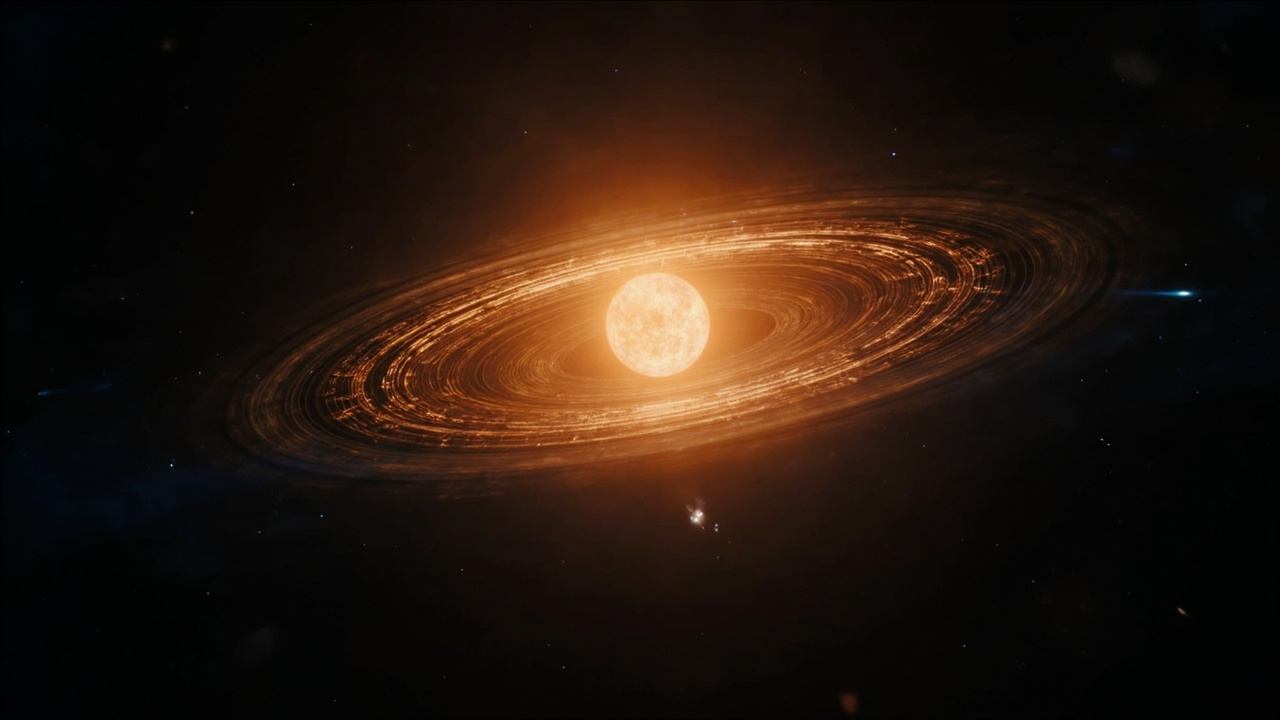
The star at the center appears hollowed, ringed by nested spirals descending inward like a wound opening in layers. Around it, tiny bright points hold fixed positions that are not planets and do not drift like debris.
The image vanishes fast enough to call glitch.
Except all of us see it.
Ren says the word none of us want in the mouth.
“Structures.”
Then the text on the primary board changes one final time for the cycle.
THE FIRST SHIP DID NOT OBEY
I stare until the letters stop being ink and become verdict.
Orpheus reached Taeti.
Orpheus anchored.
Orpheus disobeyed the only rule that has ever held the leash at nine billion kilometers.
And somewhere ahead, close to a star that may not be alive in any sense that warms a human hand, the proof of that disobedience is still transmitting once every seventy-nine seconds like a guilt that learned Morse.
After the last message, no one speaks for almost a full minute.
Shock has already burned off somewhere between a dead child’s second sentence and a beacon with a forbidden name. What remains is heavier: terror that has stopped expanding and started taking shape.
The first ship did not obey.
Enough to build a future out of fear.
Voss breaks it because captains are the animals who speak when speech is a kind of hull plating.
“Seal all command channels. No council disclosure. No public briefing. Not yet.”
Han nods, already moving. “Done.”
“Malik, continuous watch on the anomaly and on Taeti. No automated interpretation without human meat in the loop.”
“Understood.”
“Kain.”
I look at her.
“Build the slingshot.”
Not model.
Not explore.
Not consider.
Build.
No hesitation left in the voice. For the first time since Year 37 put a shy curl in my board, I understand that the journey we inherited is dead.
The Idolon will not arrive at Taeti as planned.
Not unless we choose to become the second ship that disobeys.
I nod once. “Yes, Captain.”
On my slate, face still down from the last wound, heat-bloom writes through the casing into my palm as if a cheek were pressed to glass from the other side of impossible distance.
I flip it.
No route. No Continuity header.
Six words, plain block, patient as gravity:
THEY ARE WHAT ANCHORING MAKES
And under it, smaller, almost an afterthought in a hand that is not a hand:
She tried to warn the drill. You are trying to warn the ship. Do not stop. Stopping is how they finish.
I show Voss without speaking.
Her jaw sets. One nod. The kind that files a new enemy without the comfort of a face.
“From this hour,” she tells the room, “stillness is contraband. Motion is policy. And Orpheus is not a ghost story, it is a trajectory warning written in wreckage.”
Aft, the spiral holds its shortened leash in the measurement dark.
Forward, a dead star wears a human heartbeat like jewelry.
Between them: a welded city of nine thousand souls about to learn that hope has a failure mode called arrival.
I pocket the slate. The words stay on the skin of the hand.
We were taught the journey was the trial.
The first ship learned the other half.
Now it is our turn to decide whether we are capable of refusing a grave that looks like a sun.