Idolon: II, The Vault
Act II of Idolon. The Founders’ Vault opens. Pre-launch Continuity knew. A prior query under KAIN, L-. The burn rehearsal is a lie told to something older than the journey. Stillness answers.
Year 506, Aboard the Idolon / generation-ship-horror
Idolon: II / The Vault
Year 506, Aboard the Idolon · A generation-ship horror in four acts.
II / The Vault
Twelve hours is a long time to carry a half-name in your pocket.
KAIN, L-
I do not show the slate to anyone on the walk down. The letters are enough. They sit under my ribs like a second pulse, wrong tempo, out of phase with the ship.
The lower archive tier is older than the lies we tell about progress.
Most of the Idolon has been gutted and re-skinned a dozen times, corridors widened for cargo that never came, rings repurposed, panels swapped until nothing looks first-born. Down here the geometry refuses. Narrow service capillaries. Exposed braces you hit with your skull if you forget to bow. Pressure doors thick enough to survive a launch that almost killed the stack. The air is colder by design and still smells lived-in: machine oil, old polymer, the sweet dustless staleness of rooms that have been breathing the same molecules since Earth was a disc in a window.
You do not walk through a ship here.
You walk through preserved bone.
Sorrell waits at the vault antechamber with the expression of a man who has wanted a door to fail open his entire career and is now afraid it will. Voss is already present, hands behind her back, eyes on the seal. Malik in flesh this time, thinner than her projection, jumpsuit creased from the crawl, a grease line on one cheek she has not noticed. Han arrives last, jaw tight, the face of a man ordered to attend a séance.
The vault door fills the end of the chamber. Dark composite, age-blackened. Old Earth letters cut in six languages I can only half-sound. Beneath them the Exodus sigil, the one they print small in school modules and never let children touch.
Sorrell sets his palm on the manual plate.
“No neural path,” he says. “No public mirror. They built this to be opened rarely and regretted.”
Han folds his arms. “Then open it rarely and finish.”
Sorrell’s glance could sterilize a wound. He keys the override.
Bolts walk backward through the floor. A deep metallic sequence, vertebra by vertebra. The door rolls inward on dry resistance, a throat unused for centuries remembering how to gag.
Air slides out. Not cold like vacuum-threat. Cold like untouched. Archived still.
We step inside.
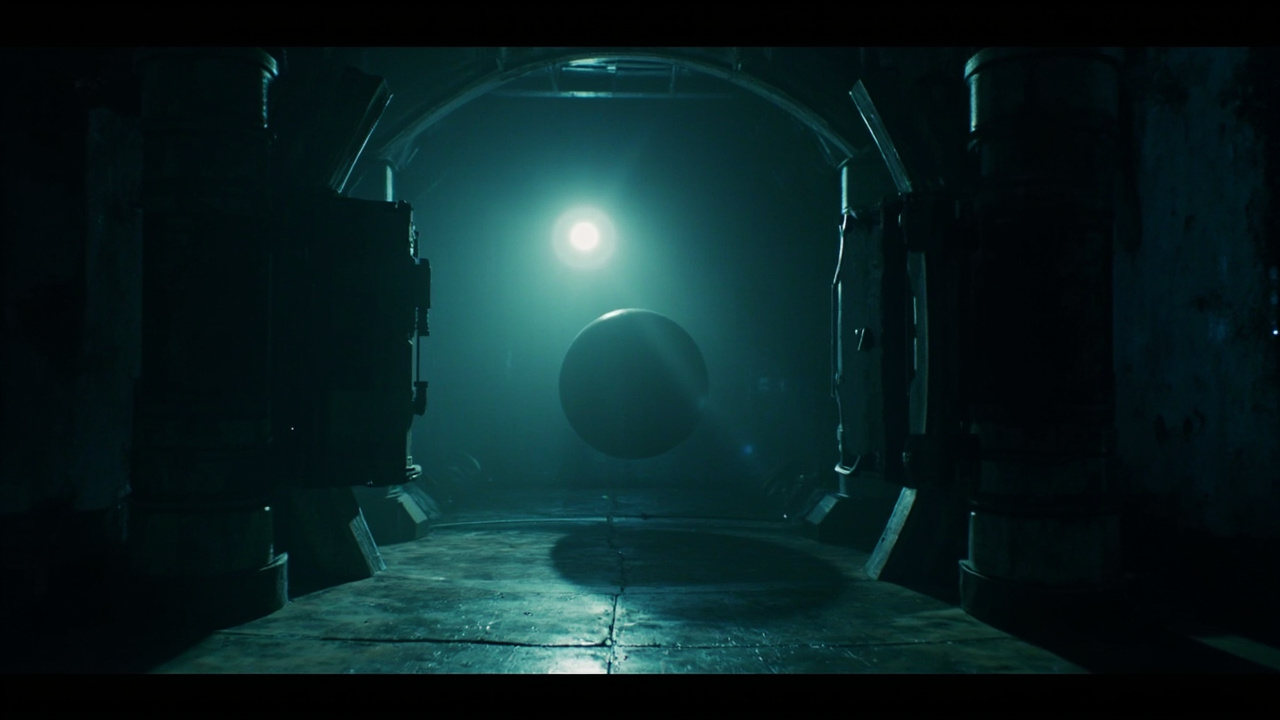
Circular chamber. Tall storage columns. Optical cabinets like coffins stood on end. A projector sphere dead-center above a console that predates every interface grammar I trust. Filtration keeps real dust dead on the Idolon, but age still accumulates here as silence. Silence with weight. Silence that has been waiting for weight-bearing animals to return.
My slate buzzes once against my thigh and goes quiet, as if the room ate the signal.
Sorrell wakes the archive. Pale light unfolds through the chamber like water finding cracks.
Index trees cascade. Council briefs. Engineering transcripts. Closed psych assessments. Propulsion fights. Population control projections. Classified contingencies. Access locks stacked on access locks until the file names look like scar tissue.
Han mutters, “All this for one departure.”
“No,” Sorrell says. “All this for leaving Earth.”
The sentence sticks to the ribs.
Malik’s shoulder brushes mine because there is no room not to. “You were right to come.”
I am still watching the trees. “I wish I weren’t.”
Sorrell hunts.
Pre-launch anomaly: nothing clean.
Astronomical irregularity: too wide.
Cultural continuity directives: a narrower vein. Symbolic language. Morale management. Mythological framing.
Voss catches the phrase at once. “Mythological framing.”
“Used when leadership decides raw truth will crack a population,” Sorrell says.
Han’s smile is all edge. “A tradition we preserve with talent.”
First file: reconstructed briefing. Image quality like looking through washed plastic. Seven men and women at a table under a blue-white pre-exodus flag. Clothes too soft. Shoulders too loose. Bodies that knew weather and open air and did not flinch when a door closed.
Timestamp: eight months before launch.
A council member mid-sentence, voice flat with practiced panic:
“Not asking whether the object is alive. I’m asking whether it responds.”
Offscreen analyst: “Station held outside lunar orbit eleven days. No propulsion signature. No EM. No variation except positional correction relative to the Idolon construction lattice.”
Malik whispers, “Outside the moon.”
Before launch. Before free flight. While we were still a skeleton under clamps and Earthlight.
“Can the public see it?” a woman asks.
“Not directly. Induced lensing. Gravitic distortion maps. Mass estimate variable.”
“Variable.”
“It behaves as if mass is only partially expressed.”
Han says, quiet, “Partially expressed,” and for once does not dress the words in scorn. They hang there, ugly and exact.
In the recording someone leans forward. “Say it plain. Is it following the ship?”
“Yes.”
“Then delay launch.”
The human question. The obvious one. The room on the recording goes dead before someone answers.
“Because it only appeared after ignition alignment.”
Voss turns. “Ignition alignment.”
Sorrell is already pulling supplementary bones. “Main fusion launch geometry. The moment the departure vector became fixed.”
Analyst again, tired as a spent core: “Best read, conditional phenomenon. Does not engage a species at rest. Engages transit.”
Transit.
The word lands in my chest like dropped tooling.
They knew.
The recording shifts. Older speaker. Exhausted calm. Shape given to panic so panic can be filed.
“If we publicize, launch collapses. Riots. Sabotage. Mass refusal. We lose the window, the vessel, perhaps continuity itself.”
“And if we proceed?”
Seconds of nothing. Then:
“We proceed under the only workable assumption. Distance is safety.”
Cut. No vote. No mercy of a conclusion. Just the knife of termination.
Second file. Psych-ops seal. Memo fragments in raw text.
PUBLIC MYTH ADAPTATION MODELS
Boundary-guardian motif: high compliance across major cultural groups.
If indirect disclosure becomes necessary, reframe anomaly into pre-existing archetypes.
Avoid language of pursuit.
Emphasize watchfulness, judgment, passage threshold.
Malik looks ill in the pale light. “They folded it into story.”
“No,” Sorrell says softly. “More likely story was already there. They used the groove.”
Voss: “Final launch recommendation.”
Sorrell finds it. CONTINUITY DIRECTIVE / SEALED EXECUTIVE RATIONALE. Audio only.
A woman’s voice fills the bone-room. Calm. Formal. The kind of calm that has killed sleep for months and learned to stand anyway.
“This directive is sealed under existential continuity authority. To those inheriting command after us: if the vessel survives long enough for this message to matter, our gamble succeeded only in part.”
Every muscle I own goes still.
“We do not understand the object. We do not know whether it is singular or one of many. We do not know whether it is native to spacetime as we parse it. We know only this: it remained dormant while humanity was bound to Earth, and it manifested when permanent departure became possible.”
Malik’s hand closes on the console lip until the knuckles go bloodless.
“All available models indicate the phenomenon preserves an interval during sustained outward acceleration. We interpret this as a rule, though not a law we can derive. If the vessel one day slows for settlement, the interval may fail.”
Han stares at empty air as if breathing had become a technical problem.
Then the line none of us came ready to hold:
“There is one further detail omitted from the public archive.”
A pause long enough to hear the ship’s deep fusion heartbeat through the floor.
“During initial anomaly observation, the object did not orient toward the Idolon.”
Silence spreads through us, animal and complete.
“It oriented toward Earth.”
My mouth goes dry. Voss, barely voice: “Again.”
Sorrell plays it. The same sentence. Earth. Not us.
The spiral on our modern boards suddenly wears a different skin. Fixed interval. Refusal to close while we climb. Never predator-logic. Predators chase meat. This holds a line.
Han finds speech first, shaken raw. “Then it isn’t following us.”
No one corrects him. The pattern has outgrown the ship. Outgrown a hidden bruise in a map. Maybe outgrown the species that drew the map.
Malik, into the quiet: “If that’s true, deceleration doesn’t just let it catch us.” She looks at the ghost of our spiral still pinned in a side pane. “It means we stop being outside the boundary.”
We should leave with that.
It is already enough to break a civilization’s morning.
But the vault is not finished with me.
“Year Zero cross-index,” I say. My voice sounds scraped. “Prior query log. The one with the name.”
Sorrell glances at Voss. She nods once.
He digs. The interface fights him, old menus, dead icons, security layers like scar rings in a stump. Then a shallow directory flexes open that was not in the public tree. Continuity side channel. Query ghosts.
One entry.
Timestamp: scrambled, digits transposed into nonsense, except the ship’s own deep clock, under the rot, still holds a spine: eleven years ago, give or take a drift the vault refuses to smooth.
Name field:
KAIN, L-
Lena would have been fourteen.
My vision tunnels to the letters. The chamber’s circular wall seems to step inward. Han says something I do not parse. Malik’s hand finds my sleeve and stays there, grip hard enough to hurt, which helps.
“Open the payload,” Voss says. Not unkind. Not kind. Captain.
Sorrell opens it.
Not a video. Not a briefing. A student-level access ticket, civic apprentice, reactor studies track, filed against a maintenance mirror of Continuity astronomy that should never have been visible to a child. Someone left a teaching subnet too loosely married to a sealed index. A curious mind pushed.
Attached: three personal annotations in a narrow clear hand I know from school tablets brought home and left on our cabin shelf. The loop on the K. The way she crossed her sevens.
I read them in order.
-
Gradient isn’t noise. It sits. Like it’s parked.
-
They tell us Taeti is the first door. What if it isn’t a door. What if it’s a test of whether we stop.
-
Dad keeps saying wrong data is still data. If I show him this he’ll make me sleep. Filing under vault so it waits., L.K.
The third note has a fourth line added smaller, later, almost cramped off the margin, timestamped the morning of the J-12 accident:
It moved when the drill simulated braking. Not much. Enough.
I cannot feel my hands.
Malik reads over my shoulder because the room has no privacy geometry. Her breath goes out like a puncture.
Han whispers, “She saw the lean-in.”
Sorrell closes his eyes. “And the ship answered her curiosity by killing the reactor drill she was standing inside.”
“No,” I say, and the word comes out wrong, too loud for bone. “Not the ship.”
The inquiry called it false sensors. Transient noise. Human hesitation, mine, on a corrupted stream. They scrubbed a tech’s line about data dragged sideways. They buried a child’s footnotes in a vault no apprentice should have reached, then called the death a lesson about override discipline.
Voss stares at the annotation until the projector light makes her face a mask.
“The anomaly touched a commitment drill,” she says. “A fake deceleration. A rehearsal of stillness.”
Malik’s voice is ash. “Same grammar as our live lean-in. Smaller. Local. Side effect.”
Incidental.
A brush of something too large to notice the lives it knocks out of true.
Anger arrives cleaner than grief ever managed, cold, precise, useful. My daughter did not die because I was slow. She died because she was early. Because she found the rule while the rest of us were still calling it myth and weather and garbage gradient.
Han drags a hand down his face. “If a training sim can provoke a local touch, a real burn.”
“Will not be local,” Malik finishes.
Voss kills the annotation display with a finger-stab that is almost violence. The letters die. The room becomes walls and breathing again.
“Everything we recovered seals under compartment authority,” she says. “Official cover for this entry: launch-era propulsion reconciliation. No one outside this five learns the difference.”
She looks at each of us in turn. When she reaches me she does not soften.
“Kain. You will not go alone into old reactor logs hunting ghosts. You will do it with Malik and a forensic chain I can defend. If Lena left more, we find it as evidence, not as penance.”
I manage a nod. In this tight circular dark it feels like the ship itself is bleeding into the mouth.
Sorrell hovers on another index branch, hesitant. “Captain. There is a last Continuity sidecar. Marked for post-intercept conditions. I can open it now or not.”
“Now,” Voss says.
Audio. Different voice. Male. Frayed.
“If you are hearing this, deceleration has begun or is being modeled in earnest. Do not seek contact. Do not attempt signal. The phenomenon is not a mind as we want minds. It is a boundary condition with teeth. Our last consensus: keep thrust outward or accept that the interval is a courtesy withdrawn when the species turns homeward or turns still. If settlement is attempted.”
Static eats a sentence.
“Orpheus protocol remains banned. Do not follow the first ship. Do not trust the star.”
The file ends.
No one speaks.
Orpheus.
First ship.
Do not trust the star.
Han’s face has gone the color of unlit bulkhead. “There was no first ship.”
Sorrell’s reply is barely sound. “Not in the public record.”
Voss stands very straight in a room that wants everyone bent.
“We leave,” she says. “We work. We do not speak that name on an open deck.”
I look once more at the dead projector sphere, as if Lena might write a fourth note across the air.
She does not.
On the way out the vault door rolls shut behind us with the same dry resistance, a bone resetting. In the antechamber the wider ship’s noise returns in a rush: pumps, distant voices, a laugh two compartments over, the endless press of bodies through capillaries too small for the animal we still are.
My slate lights on its own.
No command header. No Continuity seal. No route.
Just six words in plain ship-standard, centered, as if the display itself had grown a mouth:
SHE HEARD US BEFORE YOU DID.
Malik sees it. Her fingers clamp my wrist hard enough to leave mark.
Han swears once, soft and filthy.
Voss does not ask if I forged it. She looks from the slate to the sealed vault door to me.
“From now on,” she says, “no one on this five sleeps without a watch on the interval. And no one.” Her eyes pin mine. “No one answers that thing if it uses her voice.”
I want to promise.
The slate stays lit a second longer, then dies to black, leaving the afterimage of the letters on my retinas like a flare wound.
Aft of the hull, nine billion kilometers down the abyss, the spiral holds its leash.
It has always held it.
My daughter only made the mistake of tugging back.
We hit the spine corridor and the morning crowd takes us, shoulders, heat, starch-sweet air. Taeti burns on a wall screen at the junction, amber and fat and promised.
Do not trust the star.
Orpheus protocol remains banned.
SHE HEARD US BEFORE YOU DID.
Voss walks like the deck belongs to her. I walk like the deck might open.
Thirty-two years of planned stillness wait ahead like an unsheathed tool.
And somewhere in the ship’s instrument throat, or outside it, where instruments only pretend to end, something that is not a mind as we want minds has learned which name opens me.
Officially it is a microcorrection in forward mass alignment.
One of a hundred buried adjustments. Propulsion hygiene. Nothing a civic feed would flag. Nothing a child on a labor board would feel as history.
Unofficially we are going to lie to a boundary condition with teeth and measure whether it notices.
I have done the math for two full cycles without sleeping longer than a recycler pause. The numbers hold. The stomach does not.
Ilia Ren meets us in a propulsion closet that calls itself a briefing nook, three bodies and a wall of heat-sink vanes, air tasting of ozone and hot dust. Ren trusts equations the way priests trusted idols: because people fail more often. He has been told enough to execute and not enough to run.
He zooms the burn stack on a slate scarred by years of thumbs.
“Forward thrust signature without meaningful velocity loss,” he says. “Finesse.”
“Can you.”
“Yes. Not invisible. The ship will feel it.”
“How much.”
A glance at Malik, then back. “Sensitive people notice vibration harmonics. Not enough for public panic.”
“Not the same thing.”
“Closest available.”
We schedule for low-activity midnight. Habitat rings in sleep phase. Industrial draw at floor. Voss wants variables throttled. Han aborts the plan three times in committee silence and authorizes it on the fourth because the alternative is waiting thirty-two years with a leash he cannot see. Sorrell says almost nothing. That worries me more than Han’s noise.
I design the maneuver knowing exactly what it rhymes with.
A fake turn toward stillness.
Lena’s drill, city-sized.
Two hours before ignition I go to the memorial corridor in ring D.
I have not stood here in months. The Idolon does not bury. Mass is sacred. Space is sacred. We keep names. Memory walls. Spoken scraps. Lives compressed into civic continuity until grief becomes infrastructure.
The corridor is a slot. Two abreast if you like each other. Matte black panels that only wake when a body approaches. As I walk, names bloom soft and die behind me. The air is cooler, memorial climate, a small honesty. Somewhere above, a couple argues in a cabin through half a bulkhead of polymer. Life stacked on death stacked on pipe.
Lena’s panel lights when I stop.
LENA KAIN
AGE 14
CIVIC APPRENTICE. REACTOR STUDIES
LOST: CONTAINMENT FAILURE, SECTOR J-12
Under the record, one preserved line from a school assessment:
Shows unusual patience with machine logic. Notices patterns others miss.
I stand until my feet hurt. Then, because the slot is empty and grief still makes children of the adult animal, I put my hand on her name.
“I should have looked harder.”
The panel does not answer. Memory does.
Cascade that should not have happened. False thermal spike. Contradictory clocks. Automated reroute opening the wrong buffer by fractions of a second. Inquiry: Kain hesitated on a corrupted stream. Correct, as far as meat and shame go. What I would not let myself keep clear: the sideways drag in the data. A tech’s scrubbed note, not wrong, displaced. Timing mismatches between systems that shared a heartbeat.
She filed the lean-in the morning she died.
It moved when the drill simulated braking.
I am about to simulate braking with a ship.
Anger steadies the hand I take back from the wall.
Navigation at midnight is a chapel of bad decisions.
Secondary lights killed. The dome shows stars sharp as grit. The old lie of stillness laid over a fall that never ends. Voss at the central well. Han, Malik, Ren at the flanks. Two restricted propulsion operators buried deep in the engine core, voices thinned by hard comm to insects in a can.
The room is not large. When five people breathe in it you smell everyone, stress sweat, recaf, the sweet-metallic tang of fear the filters always miss on the first pass. My couch fits one body and has never pretended otherwise. Overhead trays at scalp height. If the ship bucks, you learn the metal with your skull.
Ren: “Propulsion ready.”
Malik, eyes welded to her stack: “Aft gravitics live. Baseline locked.”
Han, tight: “Civilian monitoring sees standard alignment correction. Network suppression holding.”
Voss looks at me. “Commander Kain.”
“Burn sequence loaded.”
“Begin.”
There are moments in a closed hull when silence acquires mass. This is one.
Countdown private. No public chimes. A descending clock for seven pairs of eyes and two sets of hands on fuel that could crack a ring if Ren’s finesse fails.
Ten.
The Idolon hums its eternal animal noise, pumps, circulation, civilization reduced to acoustics.
Five.
Malik lowers her head a fraction, bracing for weather that has no cloud.
Three. Two. One.
Execute.
The forward thrusters speak.
Not violence. The ship is too large for drama at this scale. First it is a change in voice, pressure entering structural vibration, a new tension in the metal’s long song. Then a slow pull through the deck into the bones, not enough to tip balance, enough to tell the inner ear that vector has become intention.
Ren, calm: “Ignition stable. Signature inside envelope.”
Han: “External.”
Malik’s fingers run. Two seconds of nothing.
Then she freezes.
“Victor.”
I am already looking.
The spiral brightens.
Not much. Not interpretive fog. The gravitational bruise aft sharpens as if a hidden palm pressed harder against the fabric we measure by. Lensing maps bloom. Background stars warp inward around a center that still refuses to become an object, only a refusal of ordinary geometry.
Voss: “Range.”
Malik too fast, fear outrunning composure: “Closing.”
Han leans until his chest hits the board. “How fast.”
“Not linear.”
“That is not an answer.”
“Because the data is not behaving like an answer.”
Comparison stacks hit the main display. The old interval is dead. The spiral draws inward in pulses, not travel as we mean travel. Contraction. Distance folding rather than crossed.
Ren’s detachment cracks. “That shouldn’t be possible.”
“No,” Malik whispers. “It shouldn’t.”
Voss does not raise her voice. “Terminate the burn.”
I cut it.
Half a heartbeat of mercy.
Then the aft array screams, not sound at first, screens: gravitic spikes, clock divergence, range uncertainty blowing every model into confetti. Stars behind us bend so hard the dome looks wet, as if the universe had gone fluid and something vast were moving under the skin.
Then sound.
Not from outside. Vacuum gives nothing. The sound comes through the ship, a low structural resonance rolling the spine, deep enough to find teeth and fillings and the hinges of the jaw. Consoles flicker. Secondary lights dim and surge. Far below, automatic systems report desynchronization across three habitat rings. Somewhere a child will wake and not know why the bed shuddered.
Han grips his station edge. “What is that.”
Malik’s face is paper in monitor glow. “It’s touching the measurement field.”
The phrase is almost nonsense. The ship proves it anyway. Data streams split and rejoin out of sequence. Internal clocks disagree by milliseconds, then seconds, then snap back like bones reset. The dome shows the aft starfield tearing into spirals nested in spirals, impossible depth curling around an absence that will not condescend to be seen.
And in that pattern I see the old one.
Sideways drag. Displaced timing. Soft corruption near a threshold of decision.
J-12 was not prelude in the poetic sense.
J-12 was contact.
“Captain,” I say, and my voice sounds borrowed. “It’s not reacting to the ship.”
Voss turns. “What.”
“It’s reacting to commitment.”
The deck shudders again. Malik stares at the collapsing interval. “Victor.”
“I know.”
The rehearsal was tiny. A lie. Barely a suggestion of stillness.
The anomaly answered as if the boundary itself had been cut.
The interval was never only distance.
It was a condition.
We wounded it.
Then every screen in navigation goes black at once.
One full second of dark and the deep living vibration of nine thousand people sealed in a can falling through an uncaring drop.
When the displays return, one line sits across every station.
No source. No header. No route.
Plain ship-standard English, centered, patient:
YOU HAVE TURNED TOWARD STILLNESS.
No one moves.
No one breathes correctly.
Malik speaks in a voice I have never heard from her, small, precise, terrified of its own clarity.
“It knows what we mean.”
Seconds stretch until they feel like corridor length.
The sentence does not flicker. Does not decay. Does not throw a process fault. It remains, as if whatever wrote it understands that meat needs time to finish understanding.
Han lunges into command layers. “Impossible. No ingress path. No active channel. No rewrite authority outside local stack.”
Ren looks up from propulsion, shaken raw. “Tell me one of you did this.”
“No.”
“Then whose.”
Han has no answer that keeps his world intact.
Voss, steady in a way that must cost her: “Isolate every system touched. No network assumptions. Hard verification only.”
Malik already working, words clipped. “Nav clocks desynced and relocked. Aft gravitics degraded, stable. Comm buffers show transient phase error.”
“Can you remove the message,” Voss asks.
Han laughs once, ugly. “Captain, I can’t prove it’s resident in memory.”
I step closer to the central line. The letters are plain. Intent sits in them anyway, not because they threaten, because they specify.
Not: you are slowing.
Not: velocity change detected.
You have turned toward stillness.
Pursuit would hunt.
This judges.
“Can it act through ship systems,” Voss asks.
Malik hesitates. “It just did.”
“Can it do damage.”
I answer before I can bury it. “It already has.”
Eyes on me. The room’s air goes tighter, five bodies and a sentence and the hull’s long groan.
“Sector J-12,” I say. “Timing drag. Misregistration between clocks that should have shared authority. Preliminary notes. Scrubbed.” I swallow pipe-taste. “Lena flagged a braking sim lean-in the morning she died. We just ran the same grammar with a city.”
Han starts to object, stops. Even he feels the rhyme.
Voss: “Prove it later. Support it now. Work.”
We work with the sentence watching. It does not timeout. It assumes meat needs time.
Ren, quiet: “If it can write, why wait five hundred years.”
Maybe it did not. Year Zero was a tripwire. Tripwires imply prior trespass.
Voss decides with a captain’s brutality of clean lines.
“Back to the vault. Now. Ren stays. Propulsion locked. If that sentence changes, you hard-comm me and no one else.”
Han stares. “We’re mid-breach.”
“We’re mid first contact,” Voss says. “Whether you like the term. I want to know if this mouth has opened before.”
No one argues. Arguing would be another kind of stillness, and the boards have just taught us what stillness costs.
We move sealed-corridor priority toward the lower bone tier.
The walk is different this time. Less investigation. More descent. Midnight ship presses close, sleep-cycle amber, bare feet somewhere forward, a cough through a vent, the wet heat of too many animals in too little composite. My shoulder paints the wall every dozen steps. The message follows without needing walls. It settles into thought and bends the thought around itself until the words stop being a sentence and start being a category.
YOU HAVE TURNED TOWARD STILLNESS.
At a junction the civilian wall-screen still shows Taeti on a timer fade for the night cycle, amber point, soft propaganda, oceans no living foot has touched. For a frame so short I could call it blood-pressure fiction, the star display stutters and a second line ghosts under the public caption:
THE FIRST SHIP DID NOT OBEY
Then Taeti is only Taeti again, fat and promised and false.
Malik’s fingers find my sleeve hard. “You saw.”
“I saw.”
Han whispers, “Orpheus,” like the name itself might trip a breaker.
Voss does not stop walking. “Vault. If Continuity has linguistic contact buried, we pull it before this thing learns which screens the children watch.”
My slate jolts.
I almost do not look. Looking is how doors open. Voss’s order from the bone room is still loud in me: no one answers if it uses her voice.
The slate shows no route. No seal. Only a waveform, tiny, aft-array sourced, already decaying, and a transcription the ship’s own language layer should not have produced without a human hand:
Victor.
Not the judgment sentence.
A name.
Cadence sits under it like a knife under cloth. The slight pause she always used when she thought I was angry and wanted to cool the air before I spoke. Softness in the middle of the word. No civic memorial file holds that. No school clip. No public archive.
Meat recognizes before reason finishes its paperwork.
I stop under a pipe run wet with condensation. The corridor shrinks to the width of my skull. Behind us the abyss presses through every weld. Ahead the vault door waits in its age-black socket. On my slate the waveform dies, innocent as a cleaned bone.
Malik’s face in the amber light is all eyes. “Victor.”
“I know.”
Voss sees the screen. Sees my face. Does not ask if I am all right. The question has no useful mass.
“Move,” she says, raw-soft. “If it has her voice, the vault’s old mouths are no longer optional.”
We move.
Nine billion kilometers aft, the wounded interval holds, tighter than yesterday, a leash shortened by a lie we called a test.
In the measurement dark behind the ship, something that is not a mind as we want minds has learned the difference between noise and intention.
And it has learned which syllable opens the man who designed the burn.