The Last Atmosphere Tax - Act II
Act II of a Libertaria science fiction novella about trust, mercy, resource governance, and the first private crime aboard the generation ship Archimedes.
Interstellar Transit / resource-governance
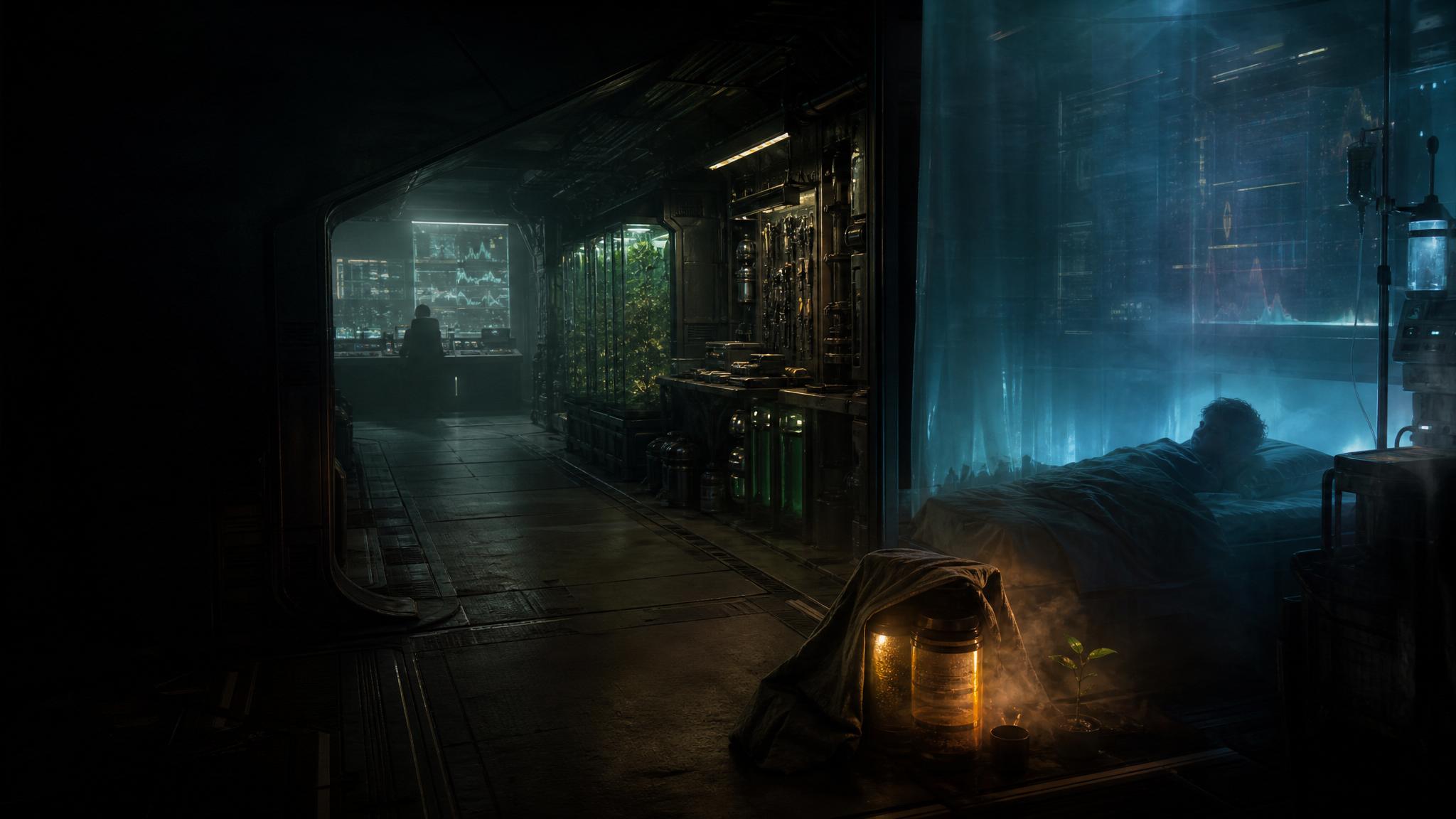
The Last Atmosphere Tax
Act II: The Price of Trust
The adjustment ended on schedule.
That mattered to people. On the twentieth morning, the ration boards returned our missing fraction as if returning a borrowed tool. The green light brightened by one degree. The household ledgers corrected themselves. A few adults laughed in the corridors with the loose relief of citizens whose government had kept its promise.
TEMPORARY COMMUNITY ADJUSTMENT: COMPLETE
ATMOSPHERE STATUS: STABLE
MISSION CONFIDENCE: HIGH
The ship had taken a little from everyone. The ship had balanced the loss. The ship had proven that hard correction worked.
For most people, Tomas Rhee became a completed lesson. For me, he became a unit of measure. After Tomas, every corridor fan had a price. Every open vent became a question. Every time someone laughed too loudly after a public meal, I wondered how many liters their joy moved through the room.
Our household felt Satisfactory first in small logistics. My mother’s maintenance requests moved later in the queue. Her sleep cycle shifted by seventeen minutes, enough to put her out of rhythm with my father. My education apprenticeship review was deferred for one quarter pending civic normalization. The garden-air rotation we had earned under Exemplary status disappeared from the calendar without explanation.
My father continued teaching with the same paper slates and careful hands. My mother became more exact. She measured soap film by fingertip width. She folded gasket cloth into perfect rectangles. She checked the sleep mask seals twice, then once more after lying down. Precision gave her somewhere to put rage. It also gave the ship less surface to grip.
On the fourth, I went to Medical Observation.
Not for rebellion. Not for inquiry. Nothing noble enough to survive being named. The nursery ring had organized a condolence slate for Mira Rhee. Children who had known her were allowed to add drawings and recorded messages under supervision. Older students could volunteer as carriers, because grief, like everything else aboard the Archimedes, had a workflow.
I signed up before I understood why.
Medical Observation sat between Ring Two and the central spine, close enough to the main life-support trunks that no one inside ever felt a pressure delay. The corridor smelled cleaner than the rest of the ship. Less human. More mineral. The walls were white panels with blue seams and soft corners. Every surface suggested that pain could be rounded down if addressed early.
Mira was in Bay Seven.
She was smaller than I expected. That was my first stupid thought. I had made her large in my mind because she had carried the weight of an execution. But she was eight years old, narrow-shouldered, dark-haired, and propped against a medical incline with two vapor lines taped beneath her nose. A monitoring cuff hugged her wrist. Her eyes were open.
The attendant checked my slate, checked my name, checked my household rating, and almost sent me away.
Then Mira said, “He can come in.”
Her voice was rough and too old for her face.
The attendant made a note and opened the privacy field halfway. Not fully. A grief visit with a Satisfactory household was permitted but observed.
I stepped inside with the condolence slate pressed against my chest.
“I’m Venn,” I said.
“I know.”
I did not know what to do with that.
She looked at the slate. “Are those for me?”
“Yes. From nursery ring.”
“They made stars again, didn’t they?”
I opened the folder. Every third drawing had stars. Children who had never seen an unmapped sky still drew stars when they wanted to comfort the bereaved. It was one of the ship’s failures of imagination.
Mira made a small sound that might have been a laugh if her lungs had been less busy.
“My father hated stars,” she said.
I stared at her.
“Not hated,” she corrected. “He said people drew them because they didn’t know how empty space was. He said if children drew vacuum correctly, everyone would cry.”
She said this as if it were a joke he had told at meals.
I tried to smile.
The vapor machine clicked. A green light blinked. Mira watched me watching it.
“It helps,” she said.
“Good.”
“Not enough.”
The words came without drama. That made them worse.
I glanced at the privacy field. The attendant stood outside Bay Seven with her back turned in the official manner of someone still listening.
Mira lowered her voice.
“They write ‘adequate’ when I sleep sitting up. Did you know that?”
I shook my head.
“Adequate means not dead by morning.”
I should have said something adult. I should have said the doctors knew their work, or that adjustments took time, or that her father’s petition had been reviewed according to medical sustainability protocols. The sentences were available. We had all been taught them.
Instead I said, “That’s wrong.”
Mira looked at me then, not with gratitude. Gratitude would have been easier. She looked at me with interest.
“You’re not supposed to say that.”
“No.”
“Do you say things you’re not supposed to say?”
“Not usually.”
“My father did. Quietly.”
“Mine too.”
That was the first time she smiled.
Not much. A small crease at one corner of her mouth, quickly hidden because the vapor line pulled at her skin. But I saw it and felt a ridiculous heat move through me, immediate and embarrassing. It was not romance. It was worse: pure allegiance, instant and foolish, the sudden belief that one person’s opinion could change the mass of the ship.
I wanted her to smile again.
That was the first unclean motive.
The next was mercy.
The report on her bed rail read:
PATIENT: MIRA RHEE
RESPIRATORY STABILISATION: ADEQUATE
DISTRESS EVENTS: WITHIN ACCEPTABLE RANGE
ALLOCATION CHANGE: DENIED
OBSERVATION STATUS: CONTINUING
I copied the words into my head because I did not yet know how to steal anything else.
When the visit ended, Mira touched the edge of the condolence slate.
“Thank you for bringing the bad stars.”
“I’ll come again,” I said.
The attendant looked at me sharply.
Mira did not. She looked down at the drawings, but the hidden corner of her mouth moved again.
That was enough to ruin me.
The Toolshop Reserve was not romantic.
It lived in Ring Two behind a gray hatch between Machine Calibration and Sealant Storage. Toolshop was where apprentices learned to respect objects that could kill everyone if mistreated: pressure keys, ceramic cutters, torque collars, pipe snakes, membrane patchers, thermal clamps, vacuum-safe adhesives. It smelled of oil, dust, rubber, and old hands.
My education cohort rotated through Toolshop once per quarter. The official purpose was vocational exposure. The real purpose was civic humility. Every child on the Archimedes had to hold a failed gasket and understand that extinction could be smaller than a fingernail.
I had liked Toolshop before Tomas.
After Tomas, I liked it more because Toolshop did not pretend. A cracked clamp was a cracked clamp. A dull cutter did not become sharp because Chairwoman Sayeed found better words for it. Maintenance objects were honest in a way people were not.
Elias Cor ran Reserve 4B.
He was nineteen, which made him almost adult and therefore unreachable. He had a thin face, careful fingers, and a habit of humming through his teeth while checking inventory. His hair was always tied too tight. He treated apprentices with the bored kindness of someone who remembered being us last year and had decided not to be cruel about it.
Reserve 4B held microclimate pockets for precision tools and sealant compounds. Not breathing tanks. That distinction mattered on paper. The pockets held warmed, humidified, filtered air at stable pressure so certain polymers would not harden early and fine instruments would not drift. Each canister was small enough to carry with one hand. Each had a sealed coupling, a keyed valve, and an audit chip.
Not for lungs.
For tools.
The first time I noticed them, Elias saw me looking.
“Don’t get ideas,” he said.
I went cold.
Then he grinned.
“Everyone gets ideas when they see canisters. You think it’s emergency air. It isn’t. Wrong mix for long breathing. Too humid. Too warm. You’ll cough yourself stupid.”
“Could it hurt someone?”
“Everything here can hurt someone.” He lifted a clamp from the bench. “This can open a seam in your palm. That cutter can take your finger. That patcher can blind you if you trigger it against glare. Toolshop is civilization because every object is dangerous and labeled.”
He said it lightly. I remembered it anyway.
The canisters sat in a rack near the back wall, each with a green status light.
4B-01
4B-02
4B-03
4B-04
Their labels were boring. That made them possible.
I did not steal one that day.
I wish I had. A first crime committed in panic might have remained small in my memory. Instead I planned. Badly, like a child, but planning still makes a person less innocent.
I watched three Toolshop shifts. I learned Elias checked the physical rack at the start and end of his cycle, but the audit chip only synchronized with Atmosphere once every two ship-hours unless manually pinged. I learned apprentices were allowed to move waste trays past the reserve hatch if a technician had logged corridor clearance. I learned the privacy field outside Medical Bay Seven had a service gap during vapor-line replacement because Medical disliked interrupting patient sleep with static.
None of this was secret.
That was another thing the ship taught me. Most forbidden paths are built from permitted steps placed in the wrong order.
My father’s lesson slate helped.
He had assigned us a history module on ration economies before the Launch Accords. I requested archive access for primary-source comparison. The terminal granted it automatically because my father had not been demoted; only trusted less. Trust, like air, moved through valves. Sometimes old pressure remained in a line after the main flow was cut.
I used the archive terminal to print a maintenance-route diagram.
I told myself I only wanted to understand.
Then Mira had a bad night.
Medical did not announce it publicly. I heard from a nursery attendant who spoke too freely while collecting meal trays. Mira had triggered three distress events in one sleep cycle. Still within acceptable range. Still adequate. Still alive by morning.
I went to Toolshop after second study.
Elias was calibrating a pressure key at the bench. He looked tired. Everyone in Maintenance looked tired that week because a condensation bloom had formed behind the laundry exchangers and half the ring smelled faintly of rot.
“Venn,” he said. “You’re not on rotation.”
“My father sent me for archive clamps. Teaching set.”
This was almost true. My father did use old clamps in class. He had not sent me.
Elias wiped his hands on a cloth and checked the request slate.
“No order.”
“He said the system was slow because of Satisfactory review.”
I hated myself while saying it. Not enough to stop.
Elias made a face. “That’s not how requisitions work.”
But he looked at the back shelf where the teaching clamps were kept. He also looked toward the corridor, where someone had called his name from Sealant Storage.
“Wait there. Touch nothing.”
He left the bench.
I waited until his footfalls moved past the storage threshold.
My body became simple then. Terrible acts are not always dramatic from inside. Sometimes they are clean sequences. Three steps to the rack. Hand around 4B-03. Thumb over the manual release. Canister into waste tray. Seal cloth over it. Walk, not run.
The rack light stayed green.
I had expected an alarm. I had wanted one, maybe. An alarm would have returned the decision to the ship.
No alarm came.
At Medical, the service gap opened exactly when the schedule said it would. The vapor-line technician moved from Bay Six to Bay Eight. Bay Seven’s privacy field flickered down to maintenance blue.
Mira was awake.
She saw the waste tray. Then she saw my face.
Children who are treated as patients learn to read adults early. Mira had learned more than that. She had learned to read danger in kindness.
“What is it?” she whispered.
“Air.”
The word sounded enormous.
I opened the seal cloth and showed her the canister. Warm condensation beaded along its side.
Mira’s eyes widened. Not fear first. Hope first. That was the worst part.
“From where?”
I should have lied. I should have said emergency surplus, or Medical discard, or nothing that could touch another name. But I had not prepared a lie for her.
“Toolshop.”
The hope stayed. The fear arrived beside it.
“Is it allowed?”
“No.”
The vapor machine clicked behind us. Somewhere down the corridor, the technician laughed at something an attendant said.
Mira looked at the canister, then at me.
“Will it help?”
“Maybe. Not for long. It’s warm and humid. Elias said it isn’t for lungs.”
“Who’s Elias?”
“A technician.”
She heard the name. I watched her hear it.
That was the moment she could have saved us both.
She could have said no. She could have called the attendant. She could have made the ship return to its proper shape. Instead she looked at the vapor lines under her nose, then at the closed drawings beside her bed, then at the canister again.
“Only a little,” she said.
It took me too long to connect the coupling. My hands shook. The canister did not fit Medical hardware, because civilization labels dangerous objects and children ignore labels when they are desperate. I had to strip the vapor intake sleeve and hold the toolshop valve against it by hand. Warm wet air leaked around my fingers.
Mira breathed.
Once.
Twice.
Then she coughed so hard I nearly dropped the canister.
“Stop,” I said.
She waved me off with one furious little hand.
“Again.”
The second time was easier. Her shoulders loosened. The wheeze did not vanish, but it moved farther away, like a machine behind a thicker wall. Color came into her face. Not much. Enough.
She closed her eyes.
For twenty-seven minutes, I held stolen tool air against a medical line while Mira Rhee breathed without fighting every breath.
No one came.
When it was done, I resealed the canister with less than half its charge remaining and hid it under the waste cloth. Mira watched me as if I had changed shape.
“You shouldn’t have,” she said.
“I know.”
“Thank you.”
Those two sentences should not be able to live next to each other. They did.
I carried 4B-03 back through the corridor with the calm of the guilty. Toolshop was empty when I returned. Elias had left the rack hatch open while sorting sealant packs on the far bench. I slid the canister back into place. The green light blinked once, then steadied.
4B-03No alarm.
No witness.
No consequence.
Mira improved the next morning.
Not officially. Officially, nothing had happened. But her distress count dropped. She sat up without bracing both hands against the bed rail. She sent a message through the condolence slate because Medical still had not cleared visitors.
It contained one drawing.
No stars.
A small green leaf.
I stared at it until my father asked what I was reading.
“Nursery reply,” I said.
He nodded, and I discovered that lying becomes easier after the first time if the first lie protects something beautiful.
By midday, the ship found the loss.
It began as a yellow notice on the maintenance channel, not public boards.
TOOLSHOP RESERVE 4B
CANISTER 4B-03 MICROCLIMATE DEPLETION
ESTIMATED LOSS: 312 LITERS CONDITIONED AIR EQUIVALENT
STATUS: AUDIT REQUIRED
Three hundred twelve liters.
I had expected a smaller number. The ship converted warmth, humidity, pressure, filtration, and replacement labor into conditioned air equivalent. The number looked absurd and precise. That was how the ship made guilt mathematical.
I waited for my name.
It did not appear.
At evening meal, the notice moved to Civic Maintenance.
TOOLSHOP RESERVE 4B INCIDENT
RESPONSIBLE HANDLER: ELIAS COR, MAINTENANCE APPRENTICE SECOND CLASS
PRELIMINARY FINDING: IMPROPER SEAL VERIFICATION
MISSION IMPACT: CONTAINED
CIVIC REVIEW: PENDING
My mother saw it first.
Her spoon stopped halfway to her mouth.
My father read the board, then looked at me.
Not because he knew. Because fathers sometimes look toward the wound without knowing where the knife is.
I kept my face still.
“Three hundred liters,” my mother said.
No one answered.
“A bad seal can do that,” she said.
Still no one answered.
She put the spoon down carefully.
“A careless apprentice can do that.”
My father said, “He’s a person, not a category.”
“Do not start.”
“I only said his name is missing from your sentence.”
“His name is on the board.”
There it was again. The board as witness. The board as judge. The board as the thing that allowed people to stop seeing one another.
I wanted to confess then.
Not enough.
After meal, I went to Medical.
Mira’s privacy field was half lowered. She sat upright with a blanket around her knees. The green leaf drawing lay beside her hand.
She knew before I spoke.
“It was from him,” she said.
I looked toward the attendant station.
“Don’t,” I whispered.
“Elias.”
The name sounded different in her mouth. Accused names do.
“It wasn’t his fault.”
“I know.”
She looked at me with a face too controlled for eight years old.
“Are they going to hurt him?”
“It’s Civic Review.”
“That’s not an answer.”
No. It wasn’t.
I sat on the edge of the visitor stool. My hands were useless in my lap.
“I can fix it,” I said.
Mira looked at the vapor line, then back at me.
“Can you?”
I hated the question because it had no accusation in it. Accusation would have given me something to resist.
“I think so.”
“How?”
“I don’t know yet.”
A child would have asked why I did it. A witness would have asked why I stayed silent. Mira did neither. She had already chosen the answer she could survive.
“I didn’t ask,” she said.
“I know.”
“I wanted to.”
“I know.”
Her fingers tightened on the blanket.
“No. I mean I didn’t ask because I wanted it to be true.”
That broke something in me more cleanly than any confession could have.
The attendant glanced over. I lowered my voice.
“Mira.”
“Don’t say my name like that.”
“Like what?”
“Like I’m the reason.”
I had no answer. She was the reason. She was also not the reason. Mercy had become a corridor with too many doors and a body behind each one.
The ship saved me from speaking.
A tone sounded through Medical, low and civic, not emergency. The public boards brightened.
CIVIC NOTICE
TOOLSHOP RESERVE 4B INCIDENT
FORMAL REVIEW SCHEDULED: NEXT ATRIUM ASSEMBLY
RESPONSIBLE PARTY: ELIAS COR
ATTENDANCE: VOLUNTARY
MISSION CONFIDENCE: HIGH
Mira read it from her bed.
Her face did not change.
That was worse than crying.
“Tomas had Review too,” she said.
I stood.
“I said I’ll fix it.”
“You said you think.”
“Then I will.”
It sounded like courage because no one had tested it yet.
That night, my mother received a private notice.
She thought I was asleep. I was behind the curtain, listening to the ship breathe through the walls. My father was at the table, sorting lesson slates he had already sorted twice.
The notice came with a soft chime. My mother opened it on her wrist screen. The blue light crossed her face.
She did not move for a long time.
My father looked up.
“Atmosphere?”
“Civic Continuity.”
He set down the slate.
“What do they want?”
She closed her hand over the screen.
“Nothing.”
“That is rarely what Civic wants.”
“Leave it.”
“What do they want?”
My mother stood. For a moment I thought she would delete it. Instead she turned the screen toward him.
I could not see the words from behind the curtain, but I heard my father’s breath change.
“A concern statement,” he said.
“Voluntary,” she said.
“About me.”
“About household rhetoric affecting civic stability.”
“About me.”
She shut the screen off.
“If I sign, our review accelerates. If I don’t, it doesn’t. That’s all.”
“That’s not all.”
“No,” she said. “It is never all.”
My father rubbed his face with both hands. He looked older than he had in the atrium.
“Are you going to sign it?”
My mother stared at him.
The silence lasted too long.
Then she said, “I don’t know.”
Honesty can wound more deeply than betrayal because it arrives without armor.
My father nodded once.
“Thank you for not lying.”
“Don’t make that noble.”
“I’m not.”
“You think everything becomes cleaner if we name it. It doesn’t. Sometimes naming a thing just gives the ship a better handle.”
He had no answer.
For the first time since Tomas, I felt almost angry at him. Not because he was wrong. Because being right had not protected any of us.
I waited until both sleep masks had sealed.
Then I took my father’s curriculum key.
It hung beside the table on a cord marked EDUCATION USE ONLY. He trusted me not to touch it because I had never touched it. That was how trust worked before it became a resource.
I slid it into my sleeve and left the compartment.
The education deck was dim during third sleep. The ceiling sky had been lowered to starlight. I hated the stars now because Mira’s father had been right. Drawn correctly, they would have made everyone cry.
Archive Terminal Three accepted the curriculum key.
WELCOME, INSTRUCTOR VENN
CIVILIZATIONAL CONTEXT ARCHIVE
QUERY:
My hands hovered over the slate.
I did not know what to ask. The truth was not a document waiting under the word truth. The ship did not call its hidden things hidden. It called them operational, deferred, contextual, restricted, supervisory, continuity-sensitive.
I started with Toolshop Reserve 4B.
The archive returned public training modules, maintenance safety notes, and one incident summary already stripped of useful detail.
I tried Elias Cor.
PERSONNEL FILE RESTRICTED
CIVIC REVIEW ACTIVE
I tried conditioned air equivalent.
That opened more than it should have.
Tables appeared. Conversion factors. Heat-to-air equivalence. Humidity penalties. Filter debt. Pressure correction. A century of small losses transformed into standardized civic meaning. The ship did not merely count air. It translated every deviation into a moral language people could understand.
Three hundred twelve liters.
Not because Mira breathed three hundred twelve liters.
Because I had taken one canister from one category and forced the system to heal the category around it.
I searched backward.
RHEE, TOMAS. ATMOSPHERE INCIDENT A-771.
The terminal hesitated.
Then it asked for secondary authorization.
I should have stopped.
Instead I used my mother’s maintenance mnemonic.
I had known it since I was twelve, from watching her exhausted fingers enter it at our table while pretending I was not looking. Children harvest secrets from repetition before they know what secrets cost.
The terminal accepted it.
For one second, I felt triumph.
Then the screen filled with ledgers beneath the ledger.
Not the public notice. Not Sayeed’s speech. Audit streams. Recovery estimates. Behavioral risk annotations. Atmospheric replacement curves. Civic precedent modeling. Household compliance projections. The ship had counted Tomas before, during, and after his death. It had counted us watching him. It had counted the likelihood that another parent would try mercy if Tomas lived.
At the bottom of the first file was the number my father had seen without seeing the file.
PHYSICAL MISSION IMPACT: CONTAINABLE
CIVIC PRECEDENT RISK: SEVERE
RECOMMENDED CORRECTION: TERMINAL
RATION RECOVERY VALUE: SECONDARY
RITUAL COMPLIANCE VALUE: PRIMARY
I read it three times.
The ship had not hidden the murder.
It had filed it correctly.
A movement behind me made every muscle lock.
“You shouldn’t be in that archive.”
Elias Cor stood at the end of the terminal row.
His face was gray with sleeplessness. His apprentice badge had been turned inward, as if hiding the name could protect him from the board.
I pulled the screen blank.
Too late.
He had seen enough. Not all. Enough.
“Instructor Venn,” he said, reading the login header.
My father’s name glowed in the corner.
Elias looked at me, then at the dark screen, then at my sleeve where the borrowed key cord disappeared.
Understanding did not arrive dramatically. It arrived like pressure loss. Quiet, invisible, total.
“It was you,” he said.
I opened my mouth.
No sound came.
He stepped closer.
“Reserve 4B.”
“Elias.”
“Was it you?”
I thought of Mira sleeping. I thought of Tomas folding at the threshold. I thought of my mother’s private notice. I thought of my father thanking her for not lying.
Then I did the worst thing I had done so far.
I said nothing.
Elias’s wrist lifted toward the terminal. The report field was still open behind the blank screen. One touch would have put my name beside his before the next audit pulse. His thumb hovered there, close enough that the glass woke under it.
He looked at the login header again.
Instructor Venn.
My father’s name.
Then he lowered his hand.
Elias’s face changed.
Not anger first.
Disappointment.
He looked younger with it.
“Review is tomorrow,” he said.
“I can fix it.”
The same sentence. Worse now.
“Can you?”
I hated him for asking it in Mira’s voice.
He looked at the terminal again.
“What did you find?”
I should have shown him.
I should have confessed.
I should have handed him the key and let the ship finally count me correctly.
Instead I said, “Enough.”
“Enough for what?”
The archive lights hummed. Somewhere far below us, the central fans moved all our breath through shared metal.
I had no answer.
A civic tone sounded through the deck. Elias flinched before I did. His wrist screen brightened.
FORMAL REVIEW REMINDER
ELIAS COR, MAINTENANCE APPRENTICE SECOND CLASS
REPORT TO ATRIUM HOLDING: CYCLE 07
NONCOMPLIANCE WILL BE RECORDED
He read it without moving.
Then he turned the screen off.
“My mother thinks I forgot a seal,” he said. “She keeps telling people that. She thinks if I am careless, they can correct careless.”
“Elias.”
“But if someone stole it, that is different.”
I could not look at him.
“Look at me,” he said.
I did.
He was not Tomas. That was the unbearable part. He was not noble or doomed or already folded into public myth. He was nineteen, tired, frightened, and still more honest than I was.
“If you did it for her,” he said, “say that.”
I said nothing.
His eyes hardened then.
“Coward.”
He walked away before I could deserve the word by answering it.
I stood alone in the archive with my father’s key in my sleeve and my mother’s mnemonic in the terminal cache. On the blank screen, my reflection floated over the hidden ledger like a ghost assigned to the wrong body.
The ship had counted Tomas.
The ship had counted Elias.
Now it had counted me.
It simply did not know my name yet.