The Last Atmosphere Tax - Act I
Act I of a Libertaria science fiction novella about a generation ship where fairness becomes arithmetic, breath becomes taxable, and civic trust starts to crack.
Interstellar Transit / resource-governance
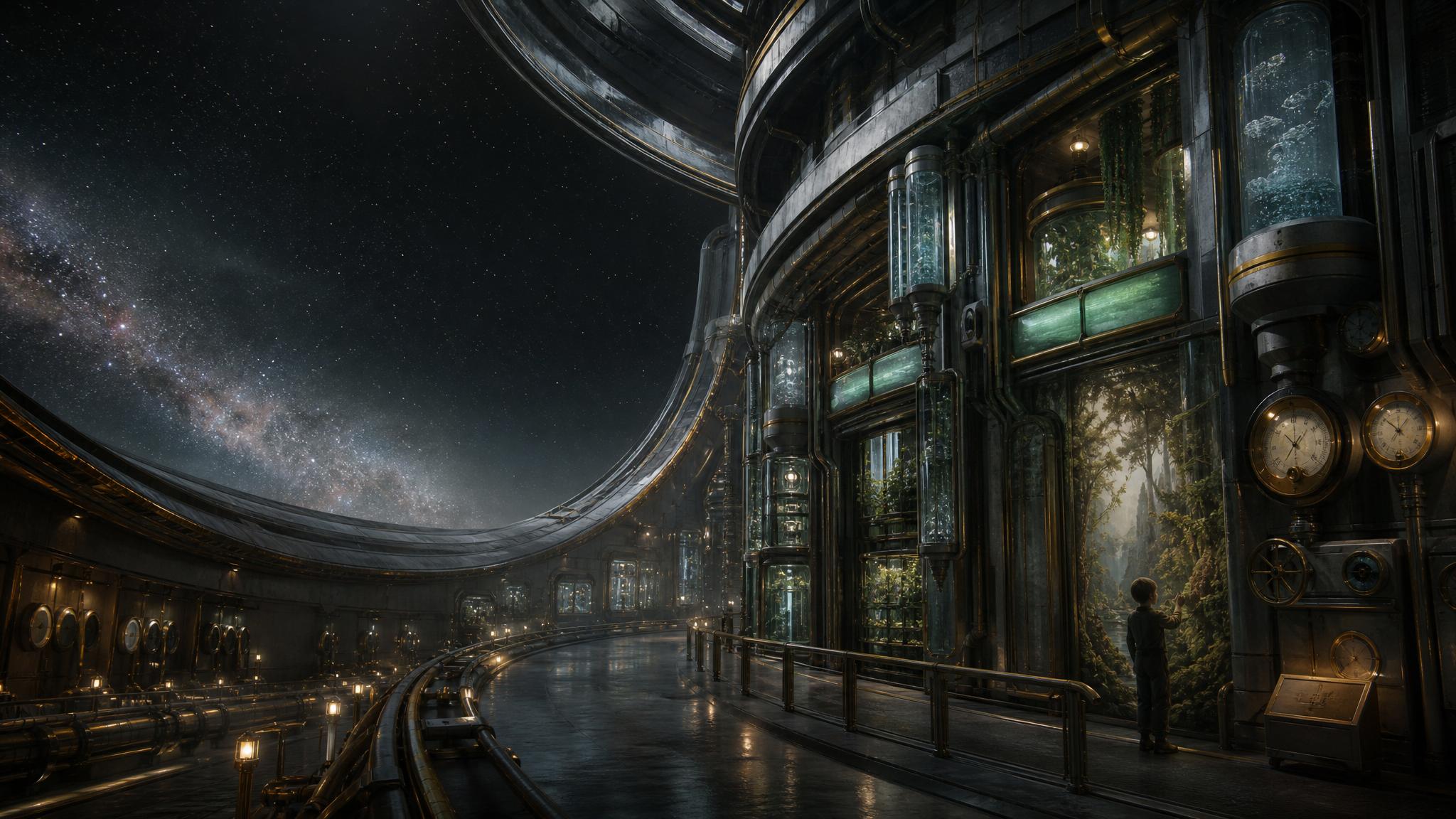
The Last Atmosphere Tax
Act I: The Fairness of Numbers
The first law of the ship was kindness.
That was how they taught it to us in the nursery ring, where the walls were painted with impossible forests and the ceiling showed an Earth sky none of us had seen. Kindness meant closing the hatch behind you. Kindness meant finishing your meal paste. Kindness meant reporting leaks, fevers, unauthorized heat blooms, and crying that lasted too long.
Kindness meant numbers.
Every child on the Archimedes learned the numbers before letters. Oxygen load. Water recovery. Calorie debt. Thermal drift. Spore count. Carbon scrub capacity. Waste yield per body. Birth budget per decade. The tutors sang them as songs.
A lung is a garden.
A garden is a debt.
A debt is a promise.
A promise keeps us breathing.
We liked the song. Children like songs before they know what they mean.
The adults liked it too, or said they did. They said the ship had saved us from Earth’s long collapse, and therefore the ship had the right to be strict. Not cruel. Strict. Cruelty was arbitrary. The ship was never arbitrary.
The ship counted.
It counted every breath, every gram of sweat pulled from the fabric of our sleeping wraps, every fleck of skin drifting into the filters, every fever that warmed a compartment half a degree above plan. We learned to trust the counting because the counting kept us alive.
My mother said this was normal.
“Space is not political,” she told me once, while tightening the gasket on my sleep mask. “Space does not care what you voted for. A leak is a leak.”
She worked in Atmosphere, which meant she was one of the priests of the real god. Not the Council. Not the Charter. Not the smiling portraits of the Founders hanging in the education corridor. Atmosphere had the true authority, because Atmosphere could point to a gauge and end an argument.
My father called it the soft tyranny of arithmetic.
He never said that outside our compartment.
Nobody said anything outside their compartment.
Not because we were afraid. That would have been an ugly thing to admit, and people on the Archimedes were educated not to be ugly. We were disciplined. We were mature. We were grateful. We were the generation between worlds, the narrow waist in the hourglass, the ones who had to be careful so that our grandchildren could stand under a real sky.
That was the promise.
We were not prisoners. We were passengers on the most noble migration in human history.
The Council repeated this every seventh day from the central atrium. Chairwoman Sayeed stood beneath the old brass model of Earth, her silver hair cut close to her skull, her uniform clean in the way only public uniforms were clean. Around her, the water columns rose in blue spirals, lit from beneath, a public luxury nobody could touch.
“Every restriction is temporary,” she told us. “Every sacrifice is accounted for. Every ration exists so that no family must bear the burden alone. We are not surviving for survival’s sake. We are carrying civilization.”
Then the atrium answered, as it always did.
“We carry together.”
The words came easily. They were not forced. I said them with everyone else.
We believed them.
In the early years of the crossing, belief was easy. The ship was still new enough to feel like a miracle. The gardens in Ring Three produced basil, spinach, dwarf wheat, bitter tomatoes, and once, for Founding Day, seven strawberries. The strawberries were cut into slices so thin they were almost theological. Each child received one red crescent on a ceramic plate. The adults watched us eat and cried quietly into their sleeves.
Nobody mocked them.
A strawberry was not food. A strawberry was proof that restraint could become abundance if practiced long enough.
Even the ration boards looked beautiful then. They were installed in every corridor, glowing soft green under the ship’s day cycle.
ATMOSPHERE STATUS: STABLE
WATER RECOVERY: 98.7 PERCENT
CALORIC RESERVE: 104 DAYS
MISSION CONFIDENCE: HIGH
Below the public numbers came the household ledgers.
Venn Household
Adult Units: 2
Minor Units: 1
Oxygen Allocation: 6,000 L/day
Water Allocation: 8.4 L/day
Heat Allocation: 14.2 kWh/day
Civic Compliance: Exemplary
Exemplary was the word everyone wanted.
Not because it brought privileges. Officially, there were no privileges. Privilege was an Earth disease, a fever of dead systems. The Archimedes had fairness.
But exemplary households were offered earlier maintenance slots, better sleep-cycle assignments, access to fresh garden air on rotation days, and first consideration for education apprenticeships. If you complained about this, people corrected you gently. It was not privilege. It was trust.
Trust had to be earned.
My mother earned it every day.
She sealed other people’s leaks. She crawled through duct channels slick with condensation and mold-kill. She came home smelling of metal, vinegar, and human breath. Her hands were always cracked. On rest days she slept with one ear uncovered, listening for pressure alarms that did not come.
She believed in the ship because she knew exactly how fragile it was.
My father believed in people because he knew exactly how fragile they were.
That difference grew between them in silence.
He taught history in the education deck. Not the official sequence for children, which began with Resource Wars, continued through the Heat Famines, and ended with the Launch Accords. He taught the older students, the ones allowed to handle ambiguity.
He taught them about city-states, republics, guilds, communes, empires, nations, corporations, and the final platform sovereignties that ate the nations from inside. He taught them that every institution begins as a tool and dreams of becoming weather.
The Council did not object. My father’s compliance record was high. His lessons were tagged as “civilizational context.” Context was safe. Context had footnotes.
He never told students what to think.
That was considered his dangerous habit.
I was sixteen when Tomas Rhee wasted the air.
That is how the official notice phrased it.
ATMOSPHERE INCIDENT A-771
UNAUTHORIZED RELEASE OF PRESSURIZED BREATHING MIX
RESPONSIBLE PARTY: TOMAS RHEE, HYDROPONICS SECOND CLASS
ESTIMATED LOSS: 18,400 LITERS
MISSION IMPACT: CONTAINED
CIVIC REVIEW: PENDING
The notice appeared during breakfast cycle. It arrived between the protein yeast allocation update and the announcement that Ring Two showers would be reduced by twelve seconds per person until the graywater membranes were recalibrated.
At first, people read it as they read all notices. With concern, not panic. The ship had incidents. Seals aged. People made errors. Containment was the important word. Contained meant the system had absorbed the mistake.
Then the whispers started.
Tomas Rhee was not a saboteur. That was the first whisper.
He had a daughter in nursery ring. Mira. Eight years old. That was the second.
His wife had died in the eighth year of the crossing from clotting complications after a sanctioned pregnancy. That was the third.
By midday the unofficial version had reached every ring.
Tomas had opened an auxiliary growth chamber without authorization.
Inside he had built a tiny room.
Not large. Not even large enough to stand in. A sealed wedge between hydroponic pipework and an old insulation wall, lined with stolen moisture film and warmed by a diverted root lamp. He had planted contraband seeds in nutrient cloth: mint, thyme, a dwarf orange cutting, and something that might have been lavender if it had lived.
For six months he had bled air into it.
Not much at first. A thread. A rounding error. Then more, because plants are living arguments. They do not care about your moral intention. They breathe, drink, rot, bloom, and demand.
Mira had asthma. Real asthma, not anxiety-breath, not corridor cough. Her lungs hated recycled air. The official treatment was rationed steroid vapor and sleep-cycle humidity adjustment. Adequate, the medical board said. Sustainable, the Council said.
Tomas built her a garden.
He took her there after second sleep, when the nursery attendants were changing shift. She sat in the warm illegal air among leaves no child was scheduled to touch. For twenty minutes at a time, she breathed without wheezing.
That was the human version.
The ship had another version.
18,400 liters.
By evening, the ration boards changed.
ATMOSPHERE STATUS: STABLE
UNAUTHORIZED LOSS RECOVERY PLAN: ACTIVE
TEMPORARY COMMUNITY ADJUSTMENT: 0.4 PERCENT
DURATION: 19 DAYS
MISSION CONFIDENCE: HIGH
Everyone lost a little air.
The adjustment was too small to hurt. No one could claim injury. No one could call it oppression without sounding childish. We all gave up less than half a percent of our allocation for nineteen days because one man had stolen from the commons.
A baby could understand the equation.
That night, the atrium filled without being ordered. People came because they had to see what the numbers would ask of him. The water columns had been dimmed. Chairwoman Sayeed stood beneath the brass Earth again, flanked by Councilors from Atmosphere, Medical, Civic Continuity, and Hydroponics. Tomas Rhee stood below them in a gray restraint jacket.
He looked smaller than his photograph.
I remember being offended by that. I wanted him to look monstrous or noble. Either would have helped. Instead he looked like a tired man with dirty fingernails and eyes that kept searching the crowd for someone who was not there.
Mira was not present.
That was announced as mercy.
Chairwoman Sayeed began softly.
“There is no joy in this proceeding.”
Everyone believed her. I still believe she meant it.
“Tomas Rhee has served this vessel for fourteen years. His labor in Hydroponics helped feed your families and mine. His grief is known to us. His child’s condition is known to us. His petition for increased respiratory allocation was heard, reviewed, and denied under existing medical sustainability protocols.”
She paused.
She waited until the atrium had gone still.
“We do not punish grief. We cannot permit theft from the unborn.”
There it was. The unborn.
The strongest citizen on the ship was always hypothetical. The unborn could not speak, so the Council spoke for them. The unborn did not breathe yet, so they could be used to price every breath taken by the living.
Around me, adults lowered their heads.
Not in obedience. Not exactly. In recognition. Tomas had stolen from children not yet made. From landfall reserves. From emergency margin. From the strawberry years ahead. From all the tiny red crescents promised to future mouths.
My mother stood rigid beside me. Her face had gone pale and hard.
My father watched the Council.
“Tomas Rhee,” Sayeed said, “you diverted atmospheric resources from a closed mission vessel during interstellar transit. You concealed the diversion across multiple audit cycles. You endangered mission confidence and imposed involuntary burden on every passenger and crew member aboard this ship. Do you contest the findings?”
Tomas lifted his head.
His voice came through the atrium speakers, flattened by the public channel.
“No.”
A sound moved through the crowd. Not surprise. Something worse. Relief.
The crowd loosened. A confession meant the system had found the right man.
Sayeed closed her eyes for one second.
“Do you offer final statement?”
Tomas looked at the crowd then. Not at the Council. At us.
“She slept,” he said.
Nobody moved.
He swallowed.
“My little girl slept without coughing.”
That was all.
No defense. No ideology. No accusation. Just a fact too small to survive the machinery built around it.
The Council withdrew for deliberation, though everyone knew deliberation had happened before the atrium filled. Procedure required the appearance of time. We waited under the brass Earth while the ration boards continued their silent glow.
MISSION CONFIDENCE: HIGHMy father looked at the number the way he looked at a student’s wrong answer. His thumb moved against two fingers. Eighteen thousand four hundred liters over six months. Divided by ship-day. Diluted across rings. Less than a membrane inefficiency if a filter crew missed one cleaning cycle. Not nothing. Never nothing. But not a wound the ship could not survive.
He did not say it. People near us were already too ready to hear subtraction as treason.
When the Council returned, Sayeed’s voice had changed. It had become the voice adults use when telling children that a pet has been recycled.
“The Charter gives this Council three obligations in hierarchy. First, preserve vessel integrity. Second, preserve mission viability. Third, preserve civic trust. In ordinary circumstances, corrective confinement and labor restitution would satisfy justice.”
A few people breathed out.
My mother did not.
“However,” Sayeed continued, “the Archimedes is not in ordinary circumstances. We are thirty-one years from landfall. We cannot normalize atmospheric theft. We cannot permit private grief to become public extinction. We cannot teach our children that compassion exempts mathematics.”
The words were perfect. That was the horror. Every sentence was load-bearing.
“The sentence is removal from life support.”
For a moment, nobody understood. The phrase was too clean.
Then someone made a small animal sound near the back of the atrium.
Removal from life support.
Not prison.
Not suspension.
Not exile.
There was no outside.
Only vacuum.
Tomas did not collapse. I hated him for that too. Some childish part of me wanted him to make a scene large enough to break the room. But he only nodded once, as if he had expected the bill and found no error in the sum.
The Councilor for Civic Continuity stepped forward.
“Witnessing is voluntary.”
Nobody left.
Not because we were cruel. Cruel people would have enjoyed it. We did not enjoy it. We stood there sick and silent and obedient, because leaving would have meant making a private judgment against a public necessity. Leaving would have meant saying the Council had done something wrong.
And if the Council was wrong about this, what else was it wrong about?
Better to stay.
Better to witness.
Better to let horror become duty while everyone could see you performing it.
They walked Tomas to Airlock Twelve. The atrium screens showed the corridor feed because transparency was one of the founding virtues. We watched him pass beneath pressure lights and maintenance stencils. Two officers walked behind him. Not gripping him. They did not need to.
The inner airlock door opened.
Tomas stepped inside.
No one spoke now.
The restraint jacket had been removed. That was also mercy. He stood in his gray ship tunic, hands at his sides, hair floating slightly in the ventilation stream.
On the screen, his mouth moved.
The public audio was muted.
The outer door opened.
A human body does not fly into vacuum like in dramas. Not if the pressure cycle is controlled, not if the system is careful. The air left first. A white ghost pulled from the chamber. Tomas staggered, folded, struck the threshold, and was gone.
The door closed.
The pressure system recovered what it could.
That detail was not shown on the screen, but everyone knew it. Atmosphere recovered everything it could.
Chairwoman Sayeed returned to the atrium feed.
Her face was wet.
“Let this be the last time,” she said.
And because we were decent people, because we were frightened people, because we were passengers on the most noble migration in human history, we answered her.
“We carry together.”
The next morning, the ration boards showed improvement.
ATMOSPHERE STATUS: STABLE
UNAUTHORIZED LOSS RECOVERY PLAN: ACTIVE
TEMPORARY COMMUNITY ADJUSTMENT: 0.4 PERCENT
DURATION: 18 DAYS
MISSION CONFIDENCE: HIGH
Life resumed with the obscene efficiency of systems that have survived a moral injury.
Children attended lessons. Adults reported to shifts. Hydroponics sealed the illegal chamber and composted the plants. The dwarf orange cutting was classified as biosecurity risk. Mira Rhee was moved to Medical Observation for grief monitoring and respiratory stabilization.
No one said execution.
No one said murder.
The accepted term was hard correction.
For three days the ship became kinder than usual. People spoke softly in corridors. Extra sleep-cycle songs were played in nursery ring. The Council authorized one public garden rotation for all minors, twelve minutes each, to restore civic confidence. We were allowed to smell basil.
That was when I understood something was wrong.
Not with the sentence. I was sixteen. I still believed too much in numbers to know where the lie entered.
What unsettled me was the gratitude afterward.
People thanked the Council.
They thanked Atmosphere for containing the loss. They thanked Civic Continuity for transparency. They thanked Medical for caring for the orphan. They thanked one another for the nineteen-day adjustment.
My mother signed the public condolence ledger. Her hand shook, but she signed.
My father did not.
That night, our compartment was quieter than sleep.
I lay behind the privacy curtain pretending not to listen. The vents whispered above me. Somewhere in the wall, water moved through recovery tubing with the intimate sound of a throat swallowing.
My mother spoke first.
“He killed himself when he opened that valve.”
My father answered too quickly.
“No. He became expensive.”
Silence.
“You know the math,” she said.
“I know the math.”
“Then say what you mean.”
“I mean eighteen thousand liters over six months is not why they opened the door.”
My mother’s voice dropped.
“Careful.”
One word. Not disagreement. Warning.
My father laughed once, without humor.
“I would have signed it,” he said. “If I sat up there. If I had the gauges in front of me and all those faces waiting. That is what scares me.”
“You think I like this?” she hissed. “You think I wanted to watch that?”
“No.”
“I have patched leaks with my hands while the pressure alarm screamed in my skull. I have watched people turn blue because a seal failed three meters from their bed. You teach history in warm rooms. I keep your air inside the walls.”
“I know.”
“No, you don’t. You know stories. I know pressure. Eighteen thousand liters is not a metaphor.”
My father was quiet long enough that I thought he had surrendered.
Then he said, “Neither was Mira.”
That ended the conversation.
Not because my mother had no answer. Because she had too many, and all of them would have broken something.
The next week, our household ledger changed.
Venn Household
Adult Units: 2
Minor Units: 1
Oxygen Allocation: 5,976 L/day
Water Allocation: 8.4 L/day
Heat Allocation: 14.2 kWh/day
Civic Compliance: Satisfactory
Not exemplary.
Satisfactory.
No reason was given. The ship did not punish opinions. It adjusted trust.
My mother stared at the word for a long time.
My father put his hand on her shoulder.
She flinched.
That was the first crack in the wall of our family.
For nineteen days we breathed slightly less.
Nobody died.
That fact became part of the official lesson. The community had absorbed the cost. Justice had restored balance. The system worked.
But after Tomas Rhee, people counted differently.
They still watched the ration boards. They still sang the nursery songs. They still said the words in the atrium when the Council called.
We carry together.
Only now, sometimes, after saying it, people glanced at the vents.
As if the ship were listening.
As if the air itself had become a witness.
As if breath, once counted, could never again be innocent.