Woke Movies: Narrative Obedience and the Collapse of Storytelling
Katniss passes. Rey doesn't. The Butler Test measures the gap between a character who earned her place and one assigned it by the marketing department.
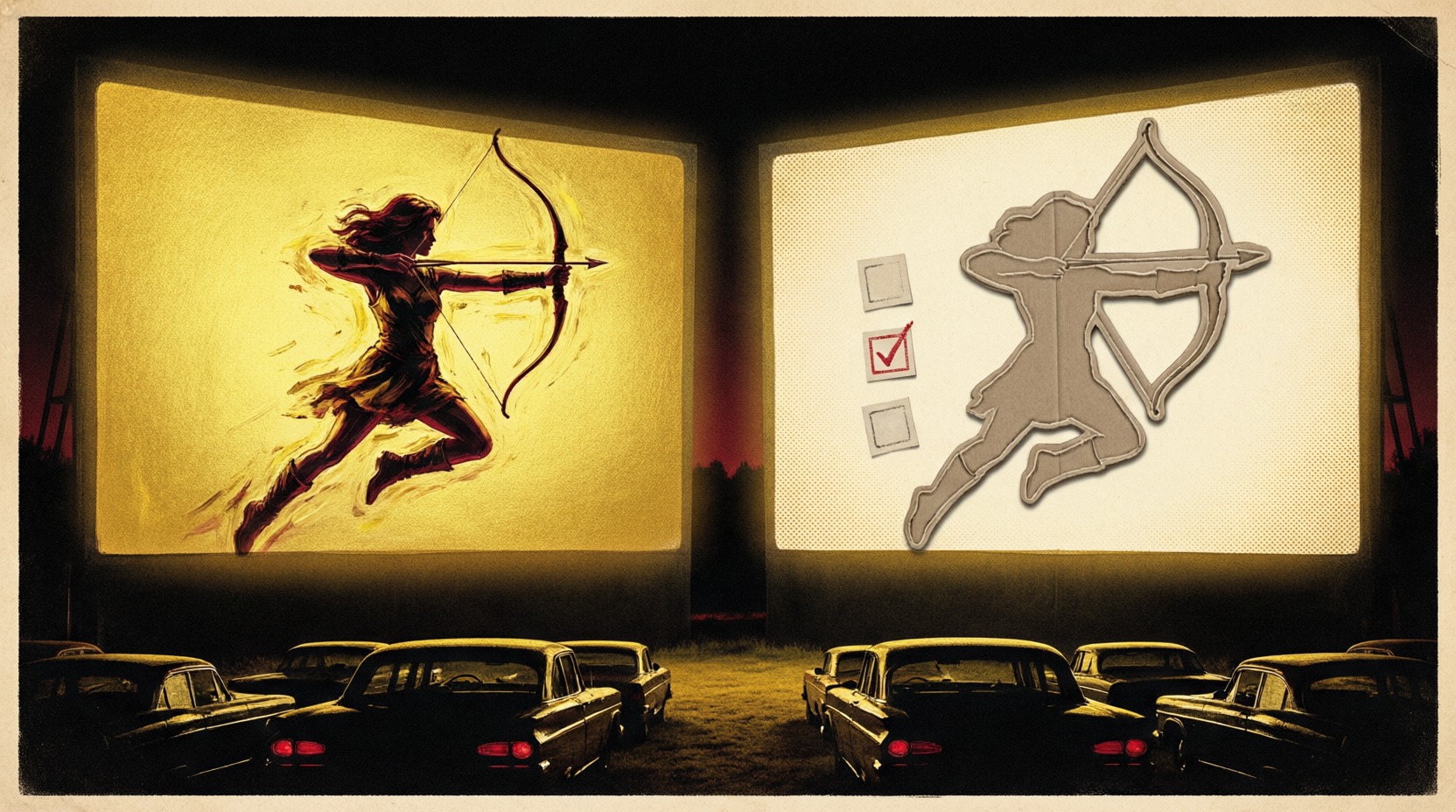
“A teenage girl leads a revolution, overthrows a dictatorship, and becomes a war hero. The audience loved her. Another teenage girl leads a revolution against a galactic empire and becomes a war hero. The audience rejected her. The difference is not the gender. The difference is that one of them was written.”
The Instrument, Not the Argument
There is an ideology loose in the writers’ rooms. It treats society as a hierarchy of privilege that doubles as a moral barometer, and it demands that every story obey the barometer before it obeys its own characters. The result is ideology-first storytelling: the question is never what would this character realistically do, always what does the theme require. Characters stop behaving like people and start behaving like press releases.
I am not going to re-litigate the ideology here. The mechanism by which it captures a profession, the compliance department that enforces it, the franchises it has hollowed out, and the exit available to anyone who wants to build outside it, that is the companion piece: The Force Was Female.
This piece gives you the instrument: the thing that detects what the ideology breaks, in a paragraph, on any character you name. Call it the Butler Test.
The Boundaries
This is not an argument against stories that confront real social issues. To Kill a Mockingbird is not woke. Game of Thrones is not woke. Power dynamics, abusive leadership, systemic corruption: these are the raw material of drama. There is a difference between a story that explores an issue and a story that forces an ideology into places it does not belong; reversing or exaggerating injustice to score a point rather than to tell the truth about people.
Nor is this an argument against strong female leads. Which brings us to the proof.
Exhibit A: The Hunger Games
The Hunger Games is set in Panem, a post-revolution North American dictatorship where a decadent Capitol rules twelve impoverished districts. As punishment for a failed uprising, each district sends two children every year to fight to the death in a televised arena. Katniss Everdeen, a sixteen-year-old from the poorest coal-mining district, volunteers to take her little sister’s place. She has fed her family by illegal bow-hunting since her father died in a mining accident; her skill, her guardedness, and her entire don’t die worldview grow from that soil. She survives the Games, becomes the face of a revolution against President Snow, and discovers the rebellion’s own leader is nearly as monstrous as him.
On paper, the franchise reads like a woke narrative. A strong female protagonist leads a revolution, overthrows a white male dictator, kills people, becomes a war hero. Every surface box is checked.
The Hunger Games is not woke storytelling, for two reasons.
There is no identity-based virtue. President Coin, the woman who replaces Snow, turns out to be as bad as Snow, or worse. The story never asserts that a female revolutionary is inherently better just because.
There is no narrative obedience. Katniss is not a girlboss presented as proof that women are inherently superior to men. She is a specific human being with specific abilities, burdens, and weaknesses; the men around her are never diminished to elevate her.
Peeta has better emotional intelligence than Katniss, better communication skills, better instincts for the Capitol’s political games. He is, at times, the actual moral center when Katniss does not know how to proceed. Haymitch is a cynical alcoholic who also happens to be brilliant at strategy, and Katniss has to learn to trust his judgment because he has something to offer that she lacks. Nobody talks down to anybody. Everybody contributes something the others are missing.
That is not just good for the characters. That is how real life works. Nobody wants to be around someone who knows everything all the time. We seek out relationships precisely because other people have things we do not.
The Butler Test
To make this less vibes-based, a diagnostic. Call it the Butler Test. It measures character depth; it is especially useful for female characters in the current climate, because it clarifies why a character is being criticized. Is it bigotry, or is it bad writing?
Rule 1: Specificity. The character must have a specific skill, trait, worldview, or psychology that is uniquely theirs; not generic competence.
Rule 2: Earned. The story must adequately explain how the character became that way. Skills and psychology come from somewhere.
Rule 3: Flawed. The character must be wrong about something significant and have to reckon with being wrong.
Corollary: No character may be elevated by diminishing another. If a heroine can only look competent next to men written as idiots, losers, or emotional cripples, that is not depth. That is the theme stacking the deck.
One honest caveat: the Butler Test does not detect wokeness directly. It detects what wokeness destroys. A propagandistic story could theoretically pass it; plenty of non-ideological characters fail it. The claim was never that representation is bad. The claim is that narrative obedience produces shallow characters, and the test measures exactly the shallowness.
Katniss Takes the Test
Specificity: She passes. She is good with a bow; more importantly, she has a unique psychology. Fiercely protective of her family. Crushed by the burden of providing for them after her father’s death. Mistrustful of strangers, naive about politics, uninterested in being liked. Her stance on not wanting children is not a quirk; it is completely believable for someone who watched a government randomly take children and murder them. There is not a single line of Katniss dialogue you could hand to another character without it feeling wrong.
Earned: The world builds her. A failed revolution. Generations of North Korean-style oppression. Districts that get poorer the further out you go. A father dead in a mining accident. An oldest child who becomes the provider. You understand exactly why Katniss is poor, why she hunts, why she is guarded, why her entire mindset is don’t die.
Flawed: She is wrong constantly. Her trauma wrecks her judgment. She miscalculates the Capitol’s politics, crashes out, has to be rescued. She is not the architect of the revolution; she is its symbol, held up by the people actually plotting it. She is proven wrong, and she has to reconcile with it, apologize for it, grow from it.
Three for three.
Exhibit B: Disney’s Star Wars
Rey is the protagonist of Disney’s sequel trilogy. An orphan scavenging wrecked ships on the desert planet Jakku, waiting for parents who never come back, until she is swept into the war between the Resistance and the First Order alongside legacy heroes Han Solo and Luke Skywalker.
Run Rey through the same test.
Specificity: What is Rey’s specific skill? Whatever the scene calls for. She can fly like Han Solo, fight like Luke Skywalker, use Jedi mind tricks, speak Wookiee, repair anything. She has many skills and none of them are hers. Katniss’s competence was specific, limited, and earned. Rey’s is generic and boundless.
Earned: Rey was abandoned on Jakku as a small child and spent her life scavenging. That backstory explains a mechanically gifted, bitter, cynical loner who trusts no one. It does not explain a cheerful polyglot ace pilot with the emotional disposition of someone raised in a loving two-parent household. Nothing in her story explains what she can do or why she is the way she is.
Flawed: Rey almost never makes meaningful mistakes. Her instincts are validated. She is placed at the moral center of the entire franchise for no earned reason; she is the one who brings Luke Skywalker back to reality, the one who serves as Kylo Ren’s moral guidepost. Why her? Because the theme said so.
The corollary, the deck-stacking, is where Disney Star Wars is most damning. Look at what was done to the men to lift Rey up.
Han Solo, who had the street smarts and skills to help reestablish order across the galaxy, is written as a loser: separated from Leia, estranged from his son, back to smuggling and bad at it; he even lost the Falcon. Don’t worry, though. Rey found it, and Rey knows exactly how to fly it.
Luke Skywalker, whose first on-screen mention made every audience member think he’s been captured, we’re going to rescue him, it’s going to be awesome; turns out he is hiding on an island because he is sad. All of Han’s growth, all of Luke’s growth, undone. Because the hierarchy must be inverted: the people at the top got there through unearned privilege, so the story must show they never really knew anything at all.
Even Finn, a character kidnapped as a child and trafficked by a murderous military regime to be used as expendable cannon fodder, gets exploitation explained to him by Rose on a casino planet side quest. The sequence ends with the triumphant liberation of racing animals while the child slaves are still standing right there. The theme called for it. The character’s actual history be damned.
The Tragedy Is the Missed Story
Rey the scavenger should have been mechanically brilliant and socially feral. Rude, cynical, unhappy; because no one has loved her since she was six. She should have had zero interest in the rebellion. Her only objective: get off Jakku, find her parents. And then she gets pulled into the fight because she discovers her parents were part of it, or betrayed it. That is a story. That serves the franchise.
Instead we got a slogan.
Katniss Everdeen proves audiences never hated strong women. They hated being lectured. They hated watching characters stop behaving like people and start behaving like marketing departments.
Write People, Not Points
The Butler Test does not care what you believe. It cares whether your characters are real.
The studios know this. They have the data. The audience has been telling them for a decade, with wallets and with words, and the studios have responded by calling the audience bigots and doubling down on the ideology. That is not a business strategy. That is a cult; and cults do not make art. They make propaganda. And propaganda is what the audience smelled the moment Rey spoke Wookiee, with no writer able to explain how a scavenger from a desert planet learned a language that had never been near it.
The fix is not less diversity. The fix is characters who pass the test: specific, earned, flawed. Write people, not points. The audience can tell the difference. They always could.
Part 10 of the Feminism Series. Companion: The Force Was Female.