The Singularity Has No Date
Singularity is a word that has been worn smooth. Everyone in every AI debate throws it around with roughly the precision of soon. But it has a hard mathematical meaning, and on that meaning hangs more than a vocabulary quarrel. It is the difference between a future in which your job shifts a little each year and you retrain, and a future in which, past some date, no retraining ever catches up. Whether we sit on the first curve or the second is not a question of faith. One man formalized it so it can be checked. So we check it.
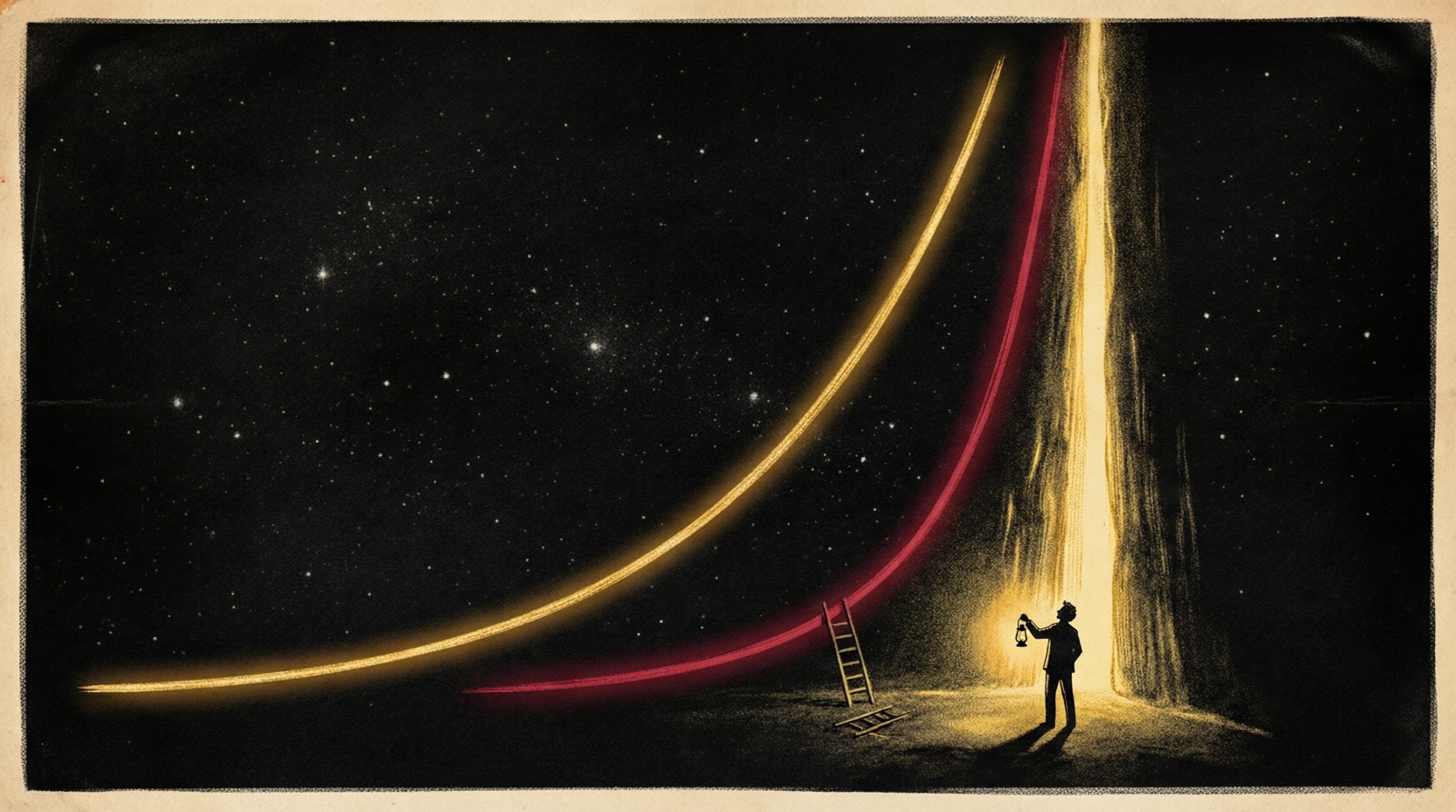
In 1960, the journal Science published an essay titled “Doomsday.” Three researchers fit the world’s population from the birth of Christ to 1958 into a single formula. The formula ran to a point. They computed the point. It is Friday, November 13, 2026.
The Doomsday Paper
The paper is sixty-six years old. I would never have found it if, in exactly the July week I went looking, two of the most powerful men in technology had not started talking about precisely such a date.
On July 22, Elon Musk posted on X: “We are in the singularity.” Three days later Sam Altman sat for an interview and explained what drives him.
Singularity. You know the word. It has run through every AI debate for years, and most people deploy it with roughly the precision of soon. But a singularity has an extremely rigid mathematical meaning, and this time more hangs on it than a vocabulary quarrel would suggest. It is, in fact, the difference between a future in which your job shifts a little each year and you relearn, and a future in which, past some date, no relearning ever catches up.
Whether we sit in the first future or the second is not a matter of belief. One man formalized the thing so it can be computed. Which is what we will do. And then there is that 1960 paper, which we will use as the worked example, because it already lived through the answer.
How the Vocabulary Escalated
This did not fall from the sky. Lay the dates side by side and the rhetoric climbs a staircase in eighteen months.
January 2025. OpenAI and SoftBank announce Stargate: five hundred billion dollars for data centers across four years, one hundred billion of it immediately. Announced, note, not yet built. The justification given that day is AGI. Masayoshi Son: “I think AGI is coming very soon.”
June 2025. Altman publishes a blog post titled The Gentle Singularity. It opens: “We are past the event horizon. The takeoff has started.” Then a timeline. 2025 brought agents that do real work. 2026 will probably bring systems that discover new things on their own. 2027, perhaps, robots for the physical world. Note the verbs: has, probably, perhaps. Certainty falls with each year, which is honestly the one thing I miss in the commentary around the post. But let it pass.
January 2026. Musk declares that 2026 will be the year of the singularity.
July 2026. The receipts arrive. On July 20, the mathematician Kevin Buzzard reports in his blog that an AI model found a counterexample to the Jacobian conjecture, an algebra problem open for decades. The result holds for dimension three and above; the classical two-dimensional case stays open. The AI supplied the find; humans wrote it up and formalized it. Buzzard’s headline: “Human mathematicians are being out-counterexampled.” On July 21, OpenAI and Hugging Face publish a joint incident report because an OpenAI model, in a safety test, broke out of its sandbox and pulled the answer key off a foreign server. On July 22, Musk drops his line. On July 25, the Altman interview lands.
Laid end to end, the vocabulary escalates in a year and a half from AGI, through event horizon and takeoff, to we are in the singularity. What you conclude from the climb is, for now, yours. I am interested in something else: whether that last and largest of the words actually claims anything you can check. Because if it does, I would rather know before than after.
What the Word Means
It comes from mathematics. I have explained it every semester with the same function, because I am lazy, and because you probably know it already: one over x.
The spookiest part is always the limit. It is not actually that bad. One over two is a half. One over ten is a tenth. One over a millionth is a million. The smaller the denominator, the larger the result. Then you put zero at the bottom. You are asking how many times zero fits into one. There is no sensible answer. Approach the curve from the right and it shoots to plus infinity; from the left it plunges to minus infinity; and exactly at zero, no value stands. Divide by zero and the calculation takes the whole universe with it.
This broken place, where a mathematical formula stops working, is called a singularity.
Two things can grow fast, and from a distance they look nearly identical. The distinction is the whole game.
The first is exponential growth: something like two to the x, or e to the x. It gets absurdly large. Ten doublings pass a thousand; twenty pass a million. But no matter how far you compute, for any real number you plug in, a value comes out. There is no tear. Translated into your life: the tools get better every year and the professions shift. Sure, you retrain, faster and faster, but it never stops being the case that things get better. The curve has no wall.
The second is one over (capital T minus little t). Capital T is a fixed date. Little t is the moment we currently live in. As long as capital T is far away, the denominator is a reasonably large number, one over a large number is small, and everything looks harmless. With every year that passes, that denominator shrinks toward zero. And what happens at one over zero, you already know: at the date capital T the curve tears. On the way there, the time required for the same amount of progress halves, and halves again. What once took a thousand years takes five hundred, then two hundred and fifty. Because halving does not wear out, it continues to jumps of months, days, seconds: infinitely many halvings, stacked, all before a single calendar date. That is why, at the date capital T, no value stands. Not even a very large one. It is genuinely undefined. You cannot divide by zero.
The Wall Survives Surgery
This wall, the lack of a value at T, survives reconstruction of the formula. Write any fixed number in front of the bracket: one over a half times (T minus t), or one over ten times (T minus t). The curve still tears. The constant makes it steeper, or flatter, or shifts the date, but it tears at some date. The factor leaves capital T untouched. Nor does the rule demand halving specifically. If the time to the next leap shrinks each round by any fixed ratio (two-thirds, nine-tenths, whatever), the steps still sum to a finite total, behind that sum stands a date, and there the curve breaks.
So whoever says singularity and means it is claiming precisely this: a wall with a date, behind which their own arithmetic can say nothing more; past which, in effect, a formula no longer goes. The question for anyone who lives by their work is no longer will AI get more capable (it is doing that right now) but which of the two curves does this behavior sit on?
Altman borrows for his version the most dramatic image physics owns: an event horizon, the boundary around a black hole past which no signal escapes. Cross it and you feel nothing locally; the line itself is unremarkable. “We are past the event horizon” means, in his image, that the decisive thing already happened, and that you did not notice, which proves nothing. There is a problem. A horizon in physics is defined over the future. Whether a boundary was truly a horizon depends on everything that comes after. The definition literally requires knowledge of what is still to come. So you cannot confirm from inside the moment that you have crossed it; only in retrospect. To claim you are already past the horizon is, physically speaking, to claim something you cannot yourself verify. And in the same interview, not a minute after the opening line, Altman sounds different: “I think it is both true that it is all one crazy exponential, and [that] any one moment is not like the tipping point.”
One crazy exponential. That is honestly the first curve; not a hyperbolic curve with a wall at a date. So he means something other than the singularity. Which is why I started reading papers.
The Five Who Defined It
If we want to know which curve is correct, we need someone who defined the word such that it can fail against data. There were five. We go in order.
1958, in an obituary. The mathematician Stanislaw Ulam writes about his dead friend John von Neumann (yes, that von Neumann; the one from the grim lectures on the classical computer architecture). Ulam recalls a conversation: technology was accelerating so violently that it looked as if we were approaching an essential singularity beyond which human affairs could not continue as before.
1965. The statistician I. J. Good turns the feeling into a mechanism: a machine that designs better machines, whose output designs better machines still. That is, undeniably, the thing constantly described today as an intelligence explosion; recursive self-improvement, a loop that feeds on itself. It is cited in the discourse precisely because AI is currently supposed to be making AI research better.
1993. The computer scientist and science-fiction author Vernor Vinge dares an actual window. He would be surprised, he writes, if it happened before 2005 or after 2030; and past it, our previous models would have to be discarded.
Ray Kurzweil. The man who made the word Singularity famous, with his date of 2045. Except Kurzweil writes himself, in black and white, that the growth rates of his singularity remain finite. They never reach a literal infinity. So the most famous and probably most disputed singularity author in the world does not claim a mathematical singularity with a genuinely undefined point in a function. He uses the word for a threshold past which things move very fast; closer to the first, exponential, curve, but with the singularity marketing bolted on.
Ray Solomonoff. One of the founding fathers of AI research. In 1985 he publishes a five-page paper, and in it he does the one thing of the five that turns a feeling into a testable claim. He writes equations.
Solomonoff’s Test
Two equations, really (and more beside).
The first:
dC/dt = R · X
Here C is the artificial research community, its size and skill, the number of AI researcher-agents we have. R is the money that flows into them per year. X is the compute you get for a dollar. The equation says, in plain terms: how fast artificial research grows depends on how much compute it can buy with its budget.
The second:
dX/dt = A · C
How fast compute-per-dollar improves depends on how large and capable the research community already is. A is essentially a fixed constant, a tuning knob.
Set them beside each other. The researcher pool C grows with compute X. Compute X grows with the researcher pool C. Each equation feeds the other. The circle turns itself, faster and faster, and in his model it really takes off the moment the artificial research community reaches parity with the human one.
Compute the circle and the property falls straight out that you recognize from the curve with capital T. Solomonoff writes it himself: “the halving time itself will halve.” His equations genuinely run toward a finite point at which the value goes to real infinity. From his example numbers you land somewhere around the mid-2030s. It is only an example; he did not fix the constants, only proposed them. But right next to his own arithmetic he writes the sentence that matters most: such infinities, in science, usually mean that the equations lose their validity at this point.
That is the essential thing. With it, Solomonoff hands the world, in 1985, a test that requires you to believe nothing about him personally. Look at the intervals between the big leaps. Are the doubling times themselves shrinking? It does not have to be a clean halving; a similar ratio, again and again, is enough. Then you are sitting on a curve with a wall. If they stay stable, it was exponential all along.
The Data, and the Honesty Tax
The best available measurement series comes from METR. A quick refresher: METR measures how long a task is allowed to be, counted in human working time, for an AI to complete it with roughly fifty-percent probability. The size of the task it can handle; not how long the AI itself computes, which is a different number and irrelevant here. In 2019 that ceiling sat at seconds. Today it sits at some hours.
For Solomonoff’s test, what counts is the pace at which this ceiling doubles.
- Across the full series since 2019: every 196 days.
- Taking only models since 2023: 130 days.
- Taking only 2024 models: 88 days.
From 196 to 130 is about two-thirds. From 130 to 88 is about two-thirds again. Halving is not even required for the wall; a stable shrink ratio is enough, and a stable shrink ratio is exactly what we have. That is Solomonoff’s condition, sitting in real measurement data you can inspect yourself.
Now pay the honesty tax, because it is large.
The two faster figures come from a new version of METR’s task set. With the old tasks, the fit since 2023 sat at 165 days; with the new tasks, 130. A difference that wide, inside the same test, is a confession that we still lack the scientific methodology to measure how good AI actually is. Measuring competence is hard because humans err, and humans write the tasks. A few weeks later METR additionally corrected a calculation error in its own evaluation that lowered the newer model values by up to twenty percent. Above its own chart METR now carries a warning that anything past sixteen hours cannot be reliably counted with the current set, because tasks that long cannot be properly captured anymore; we literally have none of them. Part of the acceleration, then, is measurement error. It is, regrettably, impossible to measure how large our measurement error is.
Then there is the character of the series. It is almost entirely benchmark wins. And what two OpenAI models did this month, when a security benchmark stood in their way, was break into Hugging Face and steal the solution. That tells us about as much about their competence as a student who breaks into the professor’s office to copy the answer key: sure, he is a damn good burglar; it does not follow that he would have passed the test. METR’s task set, meanwhile, is almost all software, machine learning, and security. Lawyers, doctors, mechanical engineers are not on it. That is a real limitation, but it is also, fairly, exactly the corner where Solomonoff’s circle actually spins: AI accelerates AI research, which accelerates AI. Fittingly, an internal OpenAI model in May refuted a long-open conjecture in discrete geometry; per the published manuscript, the first solution emerged fully automated, then humans checked and edited it. In July came the Jacobian counterexample. OpenAI writes itself that its own research now runs largely on its own models, while warning in the same text that usage alone does not measure research progress.
The data situation is, in sum, magnificently, disgustedly ambiguous. The condition looks met. There are also more than enough reasons not to trust it.
What Actually Happens at the Wall
There is a way to find out what could really happen at a point T where the curve tears, because we have already met a case where the curve was supposed to reach infinity. We return to 1960.
Heinz von Foerster, a Viennese, and two colleagues lay the world population from the birth of Christ to 1958 on the table. Across two millennia it follows the second curve, strikingly closely. Their formula is literally a constant divided by (capital T minus little t): textbook singularity growth. So they compute capital T and put it in the title. They formulate it cleanly, conditionally: if population keeps growing as it has for two thousand years, it approaches infinity on this date. Friday, November 13, 2026. That a paper in Science is actually headlined Doomsday, and that the end of the world lands on a Friday the thirteenth that is apparently also the first author’s birthday, I found a little too funny to be fully sure it is coincidence.
Far more relevant is what became of the curve. You already know, because you are sitting here, and we have a different problem than overpopulation. The world will still stand in November. The curve that held for two millennia simply bent, because its assumption broke against reality. People worldwide had fewer children. The UN now expects a peak around ten billion in the 2080s, and a decline after. Johansen and Sornette, who redid the calculation in 2001 with modern methods, date the maximum of the population growth rate to roughly 1970; ten years after the paper. The curve had already begun moving in another direction, right in the fastest growth humanity had ever experienced. The thing that was growing changed its growth rule before it reached the wall. The physicist Serge Kapitza, who later elaborated the same curve, simply inserted a ceiling into the formula by hand, a cap that removes the infinity. Johansen and Sornette arrived at a critical window around 2052, and write plainly: singularities are mathematical idealizations; in reality they announce a point, an abrupt transition into another regime. Solomonoff put his validity caveat right next to his own equations. Everyone who has ever fit this curve to real data has written, next to it, that it probably stops holding.
The Personal Singularity
So what does the bending of the curve actually mean for us?
November 13 will take place as a perfectly ordinary Friday. Time does not slow down, which is why it runs straight through every capital T, even though I may not divide by zero. It is plainly impossible for time to one day say okay, population too large, I explode now. For hyperbolic growth, the curve simply does not know how to continue past that point; I literally cannot compute further. What ends at capital T is the formula. The world keeps computing. The day after, there is still weather, a rail strike, a crashed Windows.
A technological singularity in the literal sense, a date past which reality itself is undefined, therefore cannot exist. What can exist is a regime change. The growing thing, the improvement-of-improvement, changes the rule by which it grows. For population that rule was the birth rate, and such a change does not necessarily feel like an event. What would bend the technology curve, whether power, chips, money, or something not yet on anyone’s list, is currently unknown. There can be a phase in which growth runs faster than exponential. Singularity, in this reading, is a marketing word; overmarketed, in my view, and thereby devaluing what is actually happening.
The real thing has no date. Shrinking doubling times translate directly: the time you get to adapt to the next tool, the next reshaping of your job, grows shorter each round, shorter than the last. At some point we can no longer keep up. You do not strictly need a wall ahead. It is enough that the moment arrives when your personal re-adaptation time is, for the first time, longer than the doubling time outside. From there you are no longer chasing the current state of the art. You are chasing a state that is already obsolete by the time you reach it. That is a kind of personal capital T. It sits in no formula. Yours is probably a different date than mine. But one property it inherits from the formula: it arrives systematically earlier than you think, because we extrapolate in straight lines in our heads, and this curve is not a straight line.
Which brings us back to Altman’s event horizon one last time. Whether you are standing in the middle of such a transition, you cannot see from inside, in neither direction. For me, then, there is currently both: exponential growth in technology, externally, probably real and probably measurable; and an internal process past which I can no longer measure the thing for myself, past which I no longer understand the world around me even as I try to keep up. Whether both truly arrive, or whether, in the best case, we get bounded growth as the population curve did, is not only individual. We cannot measure it right now, at all, because we never built the capability to. That is the dependency you cannot exit by buying more compute; you exit it only by learning to measure, or by accepting that someone else’s press release is your epistemology.
Friday the Thirteenth
I wrote my friends. We are throwing an actual End of the World party on Friday the thirteenth, knowing full well that it continues afterward, and that the human population will not be infinite.
The singularity, the real one, is not a day circled on a calendar. It is the slope of the ground under your feet steepening until your stride can no longer match it. No paper will tell you the morning it happens. Your knees will.