The Strainer and the Bowl: Why Men and Women Are Different
She went in thinking it would take two months to figure men out. Thirty-five years later, she had named a mechanism so deep that it explained why women attack men when they are happy, why men stop talking, and why the most connected generation in history cannot stay married.
“I asked men where different feelings are in their body. Some are the same, some are different. I asked them: where do you feel happy? They couldn’t answer. Because they pay no attention to themselves being happy. They pay attention to women being happy.”
, Alison Armstrong
Thirty-Five Years In
In 1991, a woman named Alison Armstrong decided to study men. She expected the project to take two or three months. That tells you everything about where she started.
Thirty-five years later, she is still studying. She has written books. She has run workshops. She has sat across from thousands of men and asked the questions that most women never ask, because they assume they already know the answers.
She did not know the answers. She still does not know all of them. What she knows is enough to explain why the chairs at speed dating events are empty, why men have stopped proposing, and why women who have everything the culture told them to want are unhappier than their grandmothers were.
She is not famous in the way that people who say things on social media are famous. She is famous in the way that a field manual is famous among the people who need it. Her audience is not large. It is desperate. Men who have been told their entire adult lives that their instincts are pathologies. Women who have been told their entire adult lives that their unhappiness is someone else’s fault. Both sides exhausted by a war they did not start and cannot win.
What follows is not a summary of Armstrong’s work. She has books for that. It is an attempt to name the mechanism she uncovered. That mechanism explains more about the current state of relations between men and women than the entire output of every gender studies department combined. And it has been hiding in plain sight for thirty-five years.
The Bowl and the Strainer
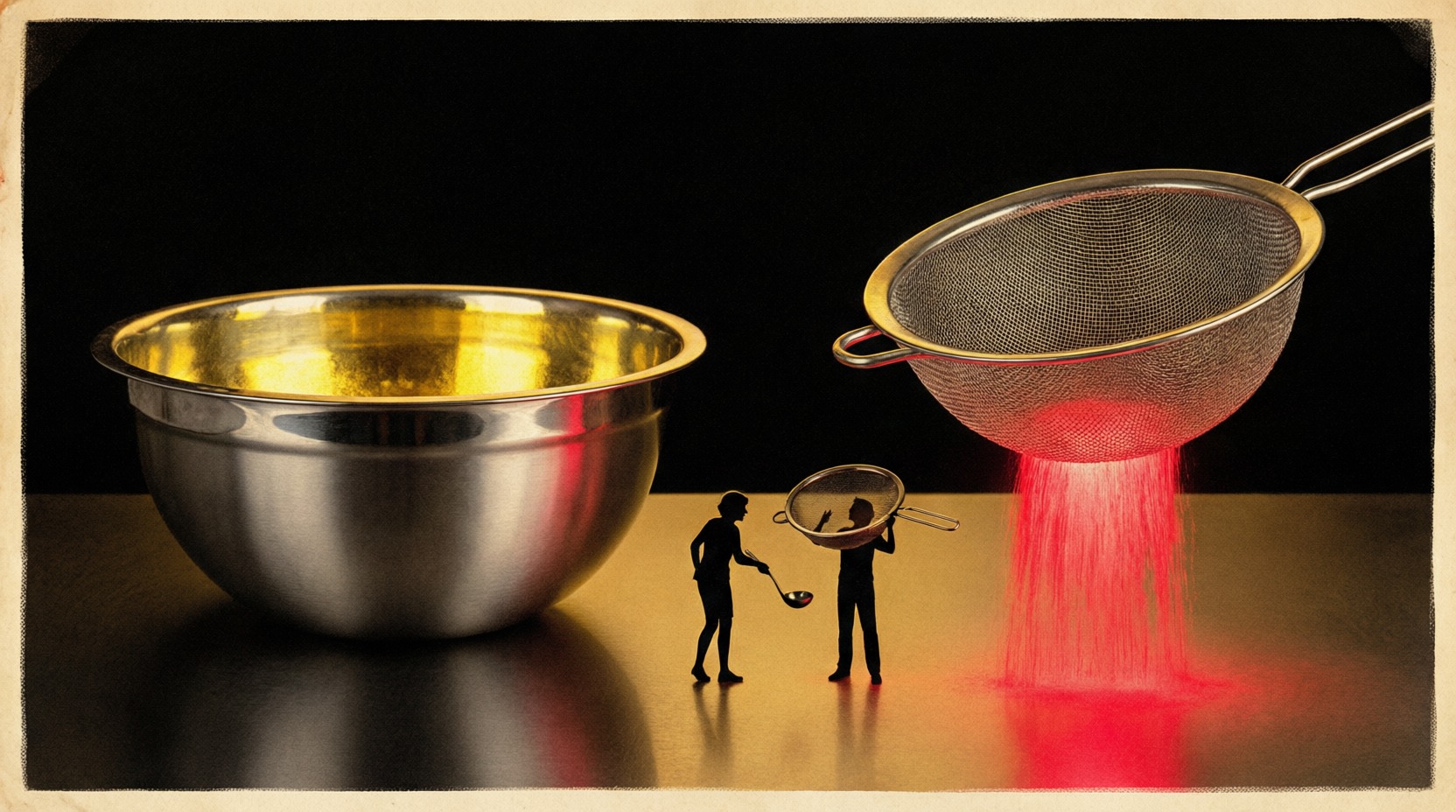
Armstrong asks her audiences a question. Have you ever encountered a stainless steel mixing bowl? Have you ever used a colander, a strainer?
Men, she says, are the stainless steel mixing bowl. You put something in there. It stays. It might evaporate over a long period of time. But it stays.
Women are the strainer. You put something in. It runs out the bottom.
The metaphor is not a joke. It is the most compact explanation ever given for why men and women cannot sustain the same emotional continuity, and why the daily maintenance rituals that women need and men do not understand are not optional. They are structural.
A man can be told he is loved once. Two decades later, he still knows it. The information went into the bowl. It is still there. If anything has changed, he will say so. A woman can be told she is loved in the morning, and by evening it has drained out. Not because she does not believe it. Because the strainer does not retain. The information passes through. It must be replenished.
This is why Armstrong tells men: you could interrupt her every single day to tell her how beautiful she is, how wonderful she is, how luscious she is. Every single day. She would not get tired of it. She actually needs it every single day. Does he still think I am beautiful? Does he still think I am sexy? How about now? How about now?
The question runs constantly. It is architecture, not insecurity. The strainer does not accumulate. The bowl does. When a man tells a woman he loves her on the day he proposes and then never says it again, he is not withholding. He thinks the information is still in the bowl. He would let her know if he changed his mind. The woman experiences this as emotional abandonment. She is not wrong. She is running on different wiring.
Neither system is defective. The problem is that the culture has spent fifty years insisting the strainer and the bowl are the same container, and then blaming both sides when the contents behave differently.
The Sorting Mechanism
A man is talking to someone important to him. He is talking about something important. The water begins boiling for the tea. The woman walks away and addresses the teapot. Or a child comes up and says her name, and she turns to the child.
Every couple in Armstrong’s audience has lived this scene.
What the man experiences: she chose the teapot over me. By her actions, she is saying the teapot is more important than what I am saying. The child is more important than me.
What the woman is actually doing: sorting by loud.
Estrogen creates diffuse awareness. Women do not sort by importance the way men do. They sort by urgency, by volume, by what is most immediately demanding attention. The teapot is not more important than what the man is saying. It is louder. The child’s need is not more important. It is more urgent. None of these are more important. But the sorting mechanism prioritizes them anyway.
Men prioritize by importance and urgency together. Women do not. Men assume women do. Women assume men understand that they were not choosing the teapot. Both assumptions are wrong. The hurt that accumulates across years of teapot-level misunderstandings does not register as a series of small incidents. It registers as evidence that the other person does not care.
They proved this with a study. A group of men agreed to take very high doses of estrogen. By the third day, every single one had opted out. The men could not tolerate the lack of screening that comes with testosterone and single focus. They were overwhelmed by what was coming at them. The condition that is normal for every woman under roughly thirty-five, the condition that shapes her entire experience of the world from the moment she wakes up, was unendurable to men after three days.
This is a difference in blood chemistry. Not opinion. Not socialization. The culture insists it does not exist. The couples who are failing pay the price for the culture’s insistence.
Why Women Attack Men When They Are Happy
Armstrong asked men a question that seems trivial but opened a door she has spent decades walking through. Where do you feel happy in your body?
Men could not answer. Not because they are not happy. Because they pay no attention to themselves being happy. They pay attention to women being happy.
But when she mapped it, the answer was consistent. Happiness for men lives in the chest. It radiates down the arms. Big happiness goes downstairs, high-fives, slaps on the back, spikes the ball. Happiness and power live in the same place in the male body. They arrive together.
This is what women do not know.
The power terrifies us. Especially if we do not feel connected to you. Because we are afraid you will use it against us. If we feel connected to you, then we are happy you are happy. If we do not, it is scary. And this is why women attack men when they are happy.
The mechanism is not deliberate. It is autonomic. A man comes home. He caught a big fish. His team won. He closed a deal. He is full of happiness, which means he is full of power, which means he is radiating a signal that the woman in his life reads as threat unless she feels connected to him. If the connection is not present, she will do something to bring him down. Not because she wants him to be unhappy. Because his happiness reads as unpredictable power, and unpredictable power is unsafe.
If it was not something she did that gave him that feeling, it is a problem. The happiness is external. It came from somewhere else. It did not come through her. The connection is not confirmed. The power is not tethered.
This is why women resent men who seem happier going on a trip with friends than going on a trip with them. This is why women diminish male enthusiasm when it is not directed at them. This is an autonomic response to a biological signal that the female brain reads as a potential threat. Naming it does not excuse it. Naming it makes it possible to override. But you cannot override a mechanism you refuse to acknowledge exists.
The Commitment Lie
Armstrong is blunt about the thing women get most wrong about men. The biggest lie. The one she would put at the top of the list.
Men are not non-committal. Men are naturally committal. More committal than women are.
This is an observation from thirty-five years of watching both sexes operate. Men commit to things they believe they can win at. The focus that testosterone enables is a form of commitment. Focus is commitment. Focus is also peace. When a man is doing what he is doing while he is doing it, he is in a state that is simultaneously productive and peaceful. The distraction, the diffuse awareness that characterizes the female cognitive environment, does not intrude. He is in the bowl.
But the other thing about commitment, Armstrong says, is that you cannot commit to something you do not think you can win at. A man’s instincts will shut that down. He is not allowed to care about something he cannot win at. Caring about something you cannot win at is torture.
This is why men do not propose. The chairs are empty at the speed dating events. Not because men are broken. Because the game stopped being winnable.
A man who has decided, based on evidence, that he cannot make a woman happy, switches focus. He has been focused on making her happy. He cannot win at that. So he focuses next on not upsetting her. And then he goes underground. His instincts tell him to conceal. Men seal everything that can be used against them. The vulnerability that was once offered freely is withdrawn, not out of anger, but out of self-preservation.
This is what women experience as emotional abandonment. The man they fell in love with, the one who talked, who opened, who shared, that man is gone. He is not gone. He has been sealed. He sealed himself because the evidence told him that opening was losing, and a man cannot continue to lose indefinitely. His instincts will not permit it. The sealing is biology, not a choice.
An honorable man does not marry a woman he cannot build with. An honorable man may love a woman deeply and still know that he is not right for her, that he cannot give her what she needs. Keeping her would be dishonorable. He will not do it no matter how much he loves her. This is unimaginable to women, who think you marry me when you love me enough. No. He might not marry you because of how much he loves you, because he is an honorable man.
The Four Food Groups
Picture a man who has stopped talking at dinner. He used to tell her about his day. Now he stares at his plate, or at his phone, or at the wall. She thinks he is checked out. He is not checked out. He is starving.
Armstrong names them plainly. Four things a man needs from a woman the way a woman needs oxygen. Not preferences. Not rewards for good behavior. Biological requirements for male functioning in a partnership. She calls them the four food groups. Appreciation. Admiration. Sex. And letting him impress you.
Appreciation is the first, and Armstrong does not soften it. Appreciation is oxygen for men. A man is literally fed energy by being in the presence of a contented woman. Not a woman performing gratitude. A contented woman who receives what he offers. The receiving is the food. When she stops receiving, he stops eating. No man has ever starved faster than the one who keeps setting full plates in front of a woman who looks through him.
Admiration is the second, and it shares the circuit with appreciation. Men must be admired. Literally. Admiration is the nutrient whose absence rewires the understanding of infidelity. More on that below.
Sex is the third, and it is not what women think it is. It is the fuel for protection and provision. Armstrong investigated why a man who went six months without sex as a bachelor needs it constantly in a relationship. The man himself answered. As a bachelor he was not protecting or providing for anyone. Sex is what makes the protecting and providing worth it. The desire matters more than the act. A man who is not wanted by his own woman has already been shown the door. The act is only the paperwork.
Letting him impress you is the fourth, and the one the modern woman resists hardest. There is a difference between depending on a man to provide and letting him provide. Most women will not let a man provide for them. They want to be the provider themselves. What follows is a standoff of dueling providers, and a man cannot give way without being emasculated. He cannot win at impressing a woman who grades everything he does against what she could have done better, faster, and without him. And a man cannot commit to a game he cannot win. That is not a complaint. That is the commitment mechanism from earlier, still running.
What she discovered about male infidelity rewires the understanding of why men cheat. She talked to men about the reasons for their sexual infidelity. The most surprising thing was how many of them told her it was not because their wife did not have sex with them. It was because their wife did not admire them.
Armstrong’s own confession is the proof that the starvation is not a theory. She stopped nurturing her husband when he retired, because she thought he should be doing more around the house. He joined a poetry class and started talking about a woman there in a way that raised the hair on Armstrong’s neck. Emotional infidelity. Not for sex. For nurturing. She had stopped feeding him, and he found someone who would.
The mechanism is almost too painful to look at directly. A woman who withholds admiration, who criticizes, who corrects, who treats her husband as a defective version of herself, is starving him of a biological requirement for partnership. He will find admiration somewhere else. Not because he is a bad man. Because the requirement is real and the deficit is unsustainable. The man who is not admired will eventually stop performing, stop opening, stop being the man she fell in love with. She will blame him for changing. She will not see that she starved the part of him she most wanted to remain.
The withholding is the weapon, and Armstrong’s list of how women emasculate men runs eight items long. The first four are the food groups inverted. Withhold appreciation. Withhold admiration. Withhold sex. Do not let him impress you. Then the slow poison. Compare unfavorably, be impressed by someone else. Do not trust him. Assume insincerity. Do not need him for anything important. The withholding is not always conscious. It is always effective. Nothing was done. Everything was taken.
Respect is often offered as the missing ingredient. It is not one of the four. For a man, Armstrong observes, respect usually means: I will respect you when you prove you are better than I am. I will respect you when you prove that everything I can do, you can do better. This is a competition disguised as a standard. The man who accepts these terms will spend his life trying to meet a threshold that rises every time he approaches it. He will never meet it because the woman who sets it does not believe he can. She is scanning for strength but demanding weakness as the price of admission.
Honor and the Ever-Presence of Death
The most difficult thing Armstrong learned, the thing she says every man confirms, took her thirty-five years to see.
Men live with the ever-presence of death.
It is right there. Every man she has asked has confirmed it. Women have the ever-presence of life. We are opposites. Women monitor life all the time. Men monitor death.
This is why men want to die for something. They want to live for something worth living for. A family where there is respect and appreciation present, that is worth it. That is what makes the ever-presence of death bearable. A man who comes home to a house without admiration, without respect, without the confirmation that what he is building is worth what he is sacrificing, is a man who is dying without purpose. The ever-presence of death is not distant for him. It is immediate.
To a man, Armstrong says, honor is doing the right thing no matter what you feel. No matter how you feel, you do the right thing. This is one of the reasons men do not marry women they love. They know they are not right for her. It would be dishonorable to keep her when you know you cannot give her what she needs.
Women do not know how much men are interacting with honor all the time. And so when a man expresses shame, which is what he feels when he has failed at something he holds himself accountable for, the woman will often say the worst possible thing. That is ridiculous. You could not have prevented that. You were not even in the same part of the country. You could not have saved her. Basically, she is saying: you are not Superman.
And the man thinks: I hold myself to account for being Superman. I should have been there.
This is the compounding tragedy. Women try to hold men to account for acting like a woman would. They do not know that men already hold themselves to account for standards women cannot see, do not understand, and often dismiss as ridiculous. The man who walks away from an argument to settle down so he does not hurt anyone is not abandoning the conversation. He is disarming himself. The impulse is protective. Women do not know this. They think he is refusing to engage. He is refusing to become dangerous.
The Frog Farmer
Armstrong tells a story. A man and a woman are at a party. The woman is complaining, criticizing, antagonizing him. He looks at her. She looks at him. She starts tapping her foot.
“I see you are a frog farmer,” he says.
“What is a frog farmer?”
“Some women turn frogs into princes. You, my dear, turn princes into frogs.”
The women in Armstrong’s audiences are often furious at this. They hear the accusation and conclude they are being blamed for everything, that none of this is fair, that the man must be at fault too. This is what Armstrong calls the Schrodinger’s feminist connection: the inability to see oneself in a negative light. It simply must be the man’s fault.
Matchmakers are quitting. They cannot get through to these women. They cannot make them understand that they are the frog farmers, and the adjustments need to come from them. The culture has reinforced the opposite message for so long that the truth, when spoken by another woman, lands like a physical blow. The women who hear it for the first time often look exactly like the woman at the party: foot tapping, arms crossed, waiting for the part where the man is the villain. There is no villain. There is a mechanism. And the mechanism operates regardless of who is right.
The Five Layers
Men have five layers of protection against criticism. Armstrong counted them.
The first layer is single focus. Most of the criticism leveled at men, they did not even hear. The signal did not register. The bowl does not catch what it is not tuned to catch.
The layers descend from there. Consider the source. Dismiss the irrelevant. Seal the wound. The architecture is layered. Men are protected by design.
Women have no protection. Armstrong says it plainly: criticism enters women at a cellular level. There is no barrier. The woman hears the green beans are cold and crumbles. You are just stating a fact. There is no accusation in it. But the diffuse awareness that makes her so attuned to the needs of everyone around her also makes her defenseless against the signal that she has failed at the one thing her biology tells her she must do: be pleasing.
The asymmetry is catastrophic. A woman criticizes a man because criticism works on women, they change, they adjust, they survive. She assumes it will work on him the same way. It does not. It triggers the sealing mechanism. The man goes underground. She criticizes more because he is not responding. He seals more because the criticism confirms his instinct that opening is losing. The cycle destroys marriages in silence.
Armstrong’s advice to women is brutal in its simplicity. Ask for what you need without criticism. Honey, you are wonderful. You are amazing. I could go on. Do you think maybe you could do one thing a little bit differently for me? The framing sounds almost manipulative if you have never tried it. If you have, you know it is the difference between a man who hears you and a man who has sealed himself against the sound of your voice.
The Oxytocin Account
A woman lying in bed at ten at night. Her husband reaches for her. She feels nothing. Not desire. Not even willingness. Just a body that will not respond. She does not know why. She thinks something is wrong with her.
Nothing is wrong with her. Her oxytocin account is empty.
Oxytocin is the bonding hormone. It is the I-can-care-about-you hormone. It is also the orgasm hormone. A large amount of oxytocin is spent during sex.
Armstrong calls it the oxytocin account. Before sex, there is a checking of the account. If a woman does not have enough oxytocin, and most women do not know this about themselves, sex will depress her. Women who do not have enough oxytocin cannot have orgasms. The more oxytocin they have, the easier sex is, the more receptive they are, the more desire flows naturally.
This is the mechanism behind the scheduling insight that Armstrong offers men and that men resist instinctively. When a man asks for sex when he wants sex, he knows he can perform. He is springing sex on her. When a man asks hours in advance, “when would be a good time to have sex,” the woman unconsciously shifts how she moves through the day. She builds oxytocin without knowing she is doing it. Rhythmic hand motions. Wiping down counters. Folding clothes. Vacuuming. Dusting. Armstrong says their housekeepers have better sex than they do, because all those rhythmic motions build oxytocin.
The man who schedules desire rather than surprising it is not killing spontaneity. He is creating the chemical conditions under which spontaneity becomes possible. The woman who primes herself throughout the day, knowing that connection is coming, arrives ready. The man who springs it on her at ten at night after a day of diffuse-awareness demands arrives to find an empty oxytocin account and a body that cannot respond. Both are operating rationally within their biological frameworks. Neither understands the other’s framework. The misunderstanding produces resentment instead of intimacy, and the resentment prevents the very connection that would restore the oxytocin that would make intimacy possible.
The Deal That Works
Armstrong’s personal life is the proof of concept. Her late husband, Greg, and later her partner Dan, represented the things she teaches.
With Greg, she made a deal. He was concealing his desire, doing the manly concealing thing, because rejection was unbearable. Springing it on her was the only way he knew worked. She was furious. She told him: ask me for a when. I am the only one who knows when it will be a good time.
He would say: I am looking for a When. She would say: in the next twelve hours, or twenty-four, or thirty-six. He would check his calendar. Six-fifty. Be there, be square. Come naked.
She would prime herself all day, knowing the When. She would show up ready. And then he would say: it is okay if you do not want to do it.
She wanted to kill him. Do not give me a second chance to choose. I am here. I am naked. I am ready. Do not make me accountable for whether this happens now or not.
He thought he was being generous. Accommodating. Considerate. He was giving her an out. She did not want an out. She wanted him to trust that her When meant when, and that showing up was the deal being kept.
With Dan, they invented the lay-down. Every day. A scheduled time when they lie down together. They can snuggle, talk, get frisky, or just lie there. The point is attention. The point is connection. The point is that the strainer gets refilled and the bowl gets confirmation that what it contains is still there. Three and a half years of lay-downs. Rarely missed.
This is infrastructure, not romance. The stair hug. The kiss held for two or three seconds longer, consciousness and awareness placed in the lips, not the routine peck of roommates. The embers do not stay lit on their own. The hum in a relationship is not self-sustaining. It requires a dedicated maintenance schedule, and the maintenance items are small, daily, and easy to skip. Skipping them is what turns lovers into roommates, and roommates into people who cannot remember the last time they had sex but are sure they are no longer lovers.
What If No One Is Misbehaving
The simplest thing Armstrong offers is also the most radical. What if no one is misbehaving? What if there is a good reason for that?
The man who did not hear the teapot was not ignoring you. He is single-focused. He literally did not perceive the sound.
The woman who walked away mid-sentence was not choosing the teapot over you. Her diffuse awareness sorted by urgency, not importance. The teapot was louder. It was not more important. None of the interruptions are more important. They are just louder, more urgent, more immediately demanding.
The man who sealed himself was not abandoning you. He was protecting himself from a game he could not win. His instincts will not let him continue to lose. The sealing is an autonomic response to evidence that opening produces damage.
The woman who attacked you when you were happy was not trying to hurt you. Your happiness registered as unpredictable power, and unpredictable power is unsafe when she does not feel connected to you. The attack is a biological alarm system that cannot distinguish between the threat of male violence and the threat of male joy.
The man who did not marry you loves you. That is why he did not marry you. He knows he cannot give you what you need. Keeping you would be dishonorable. He would rather lose you than fail you. The calculus is invisible to women. It is fundamental to men.
The woman who needs to hear she is beautiful every single day is not insecure. Her emotional architecture does not retain. The information passes through the strainer. It must be replenished. You cannot build equity with her. All that counts is what you have done for her lately, because the strainer does not accumulate. It only holds what was most recently poured.
What if no one is misbehaving?
The question does not excuse the damage. The damage is real. The opting out is real. The divorce rates are real. The empty chairs are real. The children raised by roommates instead of lovers are real. But the damage is not caused by malice. It is caused by a misunderstanding so deep it took thirty-five years of dedicated research to begin naming it. The misunderstanding does not let anyone off the hook. It puts everyone on the hook. Because once you know the mechanism, you are accountable for operating with the knowledge, and the knowledge changes everything.
What To Do With This
Learn your partner’s container. Are you a bowl or a strainer? Which is your partner? The bowl retains. The strainer lets everything drain out. If your partner is a strainer, daily replenishment is not optional maintenance. It is structural necessity. If your partner is a bowl, trust that what you said six months ago is still there. Stopping the replenishment is not withholding. It is trusting the bowl.
Schedule the When. Surprise is the enemy of female desire. Not because women do not like spontaneity. Because spontaneity catches the oxytocin account empty. Ask for a When. Hours in advance. Let her build the chemical conditions under which desire becomes possible. The man who schedules sex is not killing passion. He is creating the infrastructure passion requires to exist.
Name the mechanism instead of the accusation. The teapot was not chosen over you. The happiness was not diminished to hurt you. The criticism was not heard, not because he does not care, but because single focus filtered it out. Name the mechanism every time. What if no one is misbehaving? What if there is a good reason for that? The reframe is the difference between a fight that ends in understanding and a fight that ends in sealing.
Refuse to be a frog farmer. Some women turn frogs into princes. Some women turn princes into frogs. The difference is not the frog. The difference is the farmer. Admiration is one of the four food groups. Withholding it is not negotiation. It is starvation. The man who is not admired will find admiration somewhere else, or he will die inside and continue performing the motions. Neither outcome is what you want.
Honor the ever-presence of death. Men live with death right here. Women live with life. The asymmetry is fundamental. A man who comes home to a house without respect, without appreciation, without the confirmation that what he builds matters, is a man dying without purpose. Give him purpose. Not because he needs a project. Because the ever-presence of death is bearable only when the life he is building is worth the death he is trading for it.
Do not hand her the victim card. If you cheat, you let her off the hook. Her lack of admiration, her withholding, her role in the dynamic, all of it is swept under the rug the moment your infidelity becomes the headline. You hand her the victim card. Do not do that. Stay. Work the mechanism. Or leave honorably, without the betrayal that lets her escape accountability for her part. The honorable exit is harder. It is also the only one that lets both sides learn.
The Hammer Falls Differently
Someone will ask the obvious question. What happens when the mechanism runs to its end? Who ends up more wrecked?
The answer is asymmetric, and the culture hates it.
She is forty-two. A clean apartment. A cat that waits at the door, because the cat is the only creature still happy to see her. The phone lights the room at one in the morning. The feed is always open. The feed is always pouring. You deserve better. He is disposable. You do not need him. The message goes in like water into a strainer, and because nothing else is poured, the strainer is full of it. Her bitterness is not something she holds. It is what remains after love, patience, and every man who ever tried have all run out the bottom. The institutions poured the poison. Social media held the cup. The geometry of the strainer did the rest.
She was sold strong and independent, and it cost her the one thing that cannot be bought: someone willing to receive her.
Nietzsche said that whoever gazes long into an abyss will have the abyss gaze back. The abyss is a feed now, and it gazes back with her own face, older every year, angrier every scroll, telling her the war is still winnable at forty-five, at fifty, alone, in an apartment where the only heartbeat at the door has four legs. What does not kill her does not make her stronger either. It makes her smaller, and it calls that growth.
And the man? The man walked away long ago. That is the other half of the truth, and the culture refuses that one too. Men do not fight the machine. They exit it. No proposal, no ring, no name on a lease. The empty chairs at the speed dating event are not a malfunction. They are the vote.
But no victory lap for him. The sealed man is not a survivor. He is a tomb that walks. The bowl kept everything good he was ever given and sealed itself shut, and it does not open again. What walked away from the wreckage is alive the way a lighthouse is alive. Functioning. Lit. Nobody home. He did not win the war of the sexes. He conserved his losses and called it sovereignty, and some nights, in the apartment where nobody waits at the door, even he can hear the difference.
Here is why the hammer falls harder on her. The institutions and the feed aim at women because women are strainers. Pour the message in and it shapes the behavior. A man is a bowl. The same message bounces off the steel, so the institutions have nothing on him but his absence. He cannot be filled. He can only be lost. And he is already gone.
The man loses the war and keeps the exit. The woman wins every argument and loses the war, and the feed keeps insisting she is winning while it eats her alive from the inside. His destruction is fast and silent. Hers is slow, and it talks, and it posts, and it calls itself empowerment.
The tragedy fits in one sentence. The woman who needed refilling every single day found a machine that refills her with rage, and the men who could have poured love into her walked away, because nobody ever told them the strainer was thirsty. They only saw that what they poured never stayed.
Alison Armstrong went in thinking it would take three months to figure men out. Thirty-five years later, the answer was not a list of complaints. It was an operating manual for two fundamentally different organisms attempting to function as a single unit without understanding that they run on different architectures, different chemistry, different cognitive defaults, and different existential postures toward death, life, time, and connection. The bowl and the strainer. The single focus and the diffuse awareness. The oxytocin account and the testosterone-spending that cannot be spent listening. The ever-presence of death and the ever-presence of life. The honor that does the right thing no matter how it feels, and the connectivity that needs to feel the right thing before it can do anything at all.
The misunderstanding is a wiring collision. The wiring is real. The ones who learn to translate between them survive. The ones who insist the difference does not exist sit in separate rooms, in separate silences, wondering what happened to the person they married, when what happened is that they never understood who that person was. They were not told. They did not ask. And the culture told them the question was irrelevant because men and women are the same.
They are not the same. The strainer does not hold. The bowl does not drain. Accepting this is not surrender. It is the beginning of the only partnership that works: the one built on what each actually is, instead of what the other wishes they were.
Part 4 of the Feminism Series.
Markus Maiwald is the founder of Libertaria. He writes on political philosophy, sovereignty, and the architecture of human relationships. He listened to Alison Armstrong so you do not have to spend thirty-five years in the research phase. But the Queen’s Code is public, the interviews are free, and the mechanism does not care whether you believe in it.