Space Hippies with Guns and Agency
Why the Culture got the future right and the power structure wrong
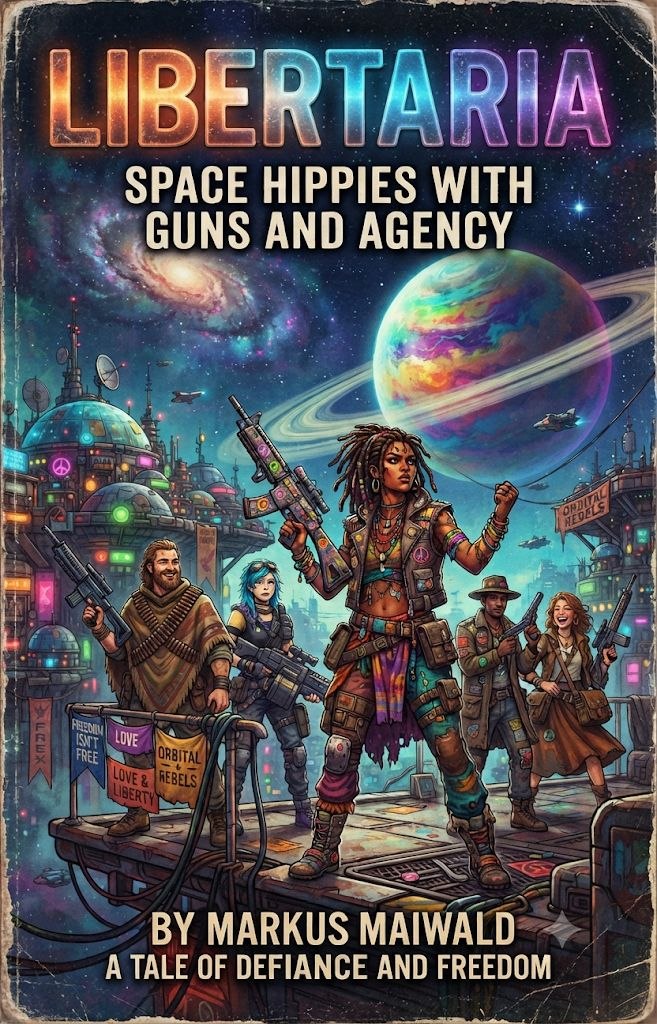
I was sixteen the first time I read Consider Phlebas, sitting cross-legged on the floor of my room with the door closed because my mother had opinions about how much time I spent reading science fiction instead of doing things that would presumably make me employable. The carpet was that specific shade of institutional beige that all German apartments seemed to have in the nineties. I remember the texture of it under my knees. I remember the smell of the book, cheap paper, slightly sweet, the kind of paperback that disintegrates in your hands if you read it too many times. I’ve read it too many times. The spine is held together with tape and stubbornness.
And I remember the exact moment the floor dropped out. Not the opening, the drowning man reciting nonsense rhymes in his own filth, that was weird, that was British, that was a door I didn’t know how to walk through yet. No. The moment was Bora Horza Gobuchul, agent of the Idiran Empire, standing on the bridge of a Culture ship and realizing he was going to lose. Not because the Culture was stronger. Because the Culture was smarter. And the Idirans, disciplined, ancient, hardened by evolution into something magnificent and terrible, were fighting a war against an idea they couldn’t even parse. A civilization that had looked at the entire menu of suffering humanity had cooked up over ten thousand years and said, no thank you, we’ll have something else.
I wanted to live there. God help me, I still do.
Thirty trillion citizens. Total material comfort. No kings, no lords, no money, no property. Any citizen could have their own planet if they wanted one, but it would be considered rather gauche. Drug glands in every body. Sex changes on a Tuesday. Orgies on the weekend. A drone the size of a DJI Mavic could dismantle the entire United States Navy and Air Force before the President finished his coffee. And the whole thing runs on intelligence, not the blind, grinding, mechanistic intelligence of markets or the deaf, top-down intelligence of central planning, but something genuinely, terrifyingly smart. Minds that dream entire universes for fun. Ships with personalities. A civilization that treats war as an embarrassment and stupidity as the only real sin.
Space hippies with big fucking guns. I love them. I love them the way you love a city you visited once at nineteen and never stopped thinking about.
And I love Reynolds too. The Glitterband. Ten thousand habitats orbiting Yellowstone Canyon, each one a sovereign experiment in how to be human. No nanny AI. No benevolent overlord. No Special Circumstances deciding which civilizations need enculturation. Just people, governing themselves, badly, beautifully, messily, humanly. The Glitterband is what happens when you look at the Culture and say: yes, but who flies the ship? And Reynolds answers: you do. All of you. Good luck.
I love both visions. And I’m here to tell you that neither of them is the one we should build.
The Diagnosis Is Correct
Let’s get this out of the way, because I’m not interested in pretending Banks was wrong about the disease.
He wasn’t.
Our systems are dumb. Not evil, well, sometimes evil, but mostly just dumb. Capitalism is a blind mechanism. It cannot distinguish between a child starving and a quarterly earnings report. It processes both through the same indifferent arithmetic and calls the output efficiency. Communism is a deaf mechanism. It hears the collective and cannot hear the individual. It plans for millions and starves thousands and calls the output equity. Fascism is a stupid mechanism. It mistakes hierarchy for intelligence and obedience for loyalty and calls the output order.
Banks saw this. Banks saw it more clearly than almost anyone writing in the genre. The Idirans in Consider Phlebas are not evil. They are magnificent. Disciplined. Honorable by their own lights. Products of brutal evolutionary pressure that forged them into something genuinely admirable. And they are going to lose, because they are fighting a two-dimensional war against a civilization that operates in three. The Azadians in Player of Games are not stupid. They are brilliant. Their game is a masterwork of strategic thought. And their entire civilization is a machine for converting brilliance into domination, and the Culture looks at it the way an adult looks at a child’s very impressive ant farm.
The Culture’s thesis is that most human suffering is not caused by malice. It is caused by stupidity. By low-intelligence systems running on hardware that was never designed for civilizational-scale coordination. Wars, famines, pogroms, ethnic cleansings, forced famines, political oppression, these are not the products of evil geniuses. They are the products of dumb systems operated by frightened primates who inherited their institutional architecture from Bronze Age goat herders.
This diagnosis is correct. I will die on this hill. The world is not run by villains. It is run by idiots, and the idiots are not the problem. The systems are the problem. The systems are the idiots. And the systems are all we have.
Where Banks goes wrong, where the entire Culture project goes wrong, is the prescription.
The Medicine Kills the Patient
Here is the sentence that undoes the Culture. It’s in Player of Games, and it’s easy to miss if you’re enjoying the adventure:
If the machines that run the Culture decide they need a particular human to do a particular thing, you’ll never even know. Your entire existence is to serve that end.
Gurgeh doesn’t choose his mission. A drone chooses for him. His entire being, his genius, his ambition, his restless dissatisfaction with the comfortable paradise he lives in, has been engineered to produce a specific outcome that a Mind decided was necessary. He is a piece on a board. He thinks he is a player. He is not.
And that is the architecture. Not a bug.
The Minds are benevolent. I believe Banks believed they were benevolent. I believe the Minds believe they are benevolent. And I believe that benevolence without accountability is just tyranny with better PR. Thirty trillion citizens live in total comfort, and not one of them steers. Not one of them looks at the ship and says I want to go there instead. The ship goes where the Mind decides. The Mind decides well. The Mind decides for you. And you are so comfortable, so entertained, so thoroughly enriched by your excellent life, that you never notice you haven’t made a real decision in decades.
This is not humanism. This is a zoo with excellent enrichment.
The humanist bargain, the one Banks asks you to accept, is this: trust that more intelligence leads to more empathy, and you can trust the Minds. And I get it. I get the appeal. Look around. Look at what we do with our intelligence. We build engagement algorithms that radicalize teenagers. We build financial instruments that vaporize pensions. We build weapons systems that kill children with a rounding error. And Banks says: what if the intelligence was higher? What if it was so much higher that it could actually feel what it does to you? And the answer is supposed to be: then it would be kind.
Maybe. Maybe a sufficiently advanced intelligence is indistinguishable from kindness. I don’t know. Nobody does. That’s the unsupported assumption the whole ziggurat rests on, and Banks knew it. He knew it. The Grey Area in Excession is the proof. A Culture ship that looked at human evil and decided to become judge, jury, and executioner. That enjoys its own power. That needs victims to punish. The Minds are not immune to the corruption they police. They are just better at hiding it.
And here’s the thing a certain kind of reader gets right, the diagnosis, the intelligence thesis, the Kant connection, all of it, and then gets catastrophically wrong in the prescription. They call the Culture the answer. Not an argument. Not a thought experiment. The answer. A planned economy run by superintelligent AI, and we should just accept that this is what the future looks like if we’re smart enough to build it.
No.
The problem was never that humans are too stupid to govern themselves. The problem is that we keep building systems that concentrate intelligence and strip agency from the people it’s supposed to serve. The Culture doesn’t solve that problem. It perfects it. It builds the most beautiful, most comfortable, most humane cage ever designed, and then asks you to be grateful the bars are made of light.
I don’t want to be a pet. I don’t care how much the Mind loves me. I don’t care if the enrichment program is exquisite. I want to fly the fucking ship.
And notice the shape of the trap, because this is where the whole public argument about the Culture goes sideways. Everyone wants to know who should own the Minds. The capitalist says: put them in private hands, let the market allocate the abundance, and the owner keeps the surplus. The socialist says: no, the Minds should be collective, owned by everyone, allocated by need. And they fight, bitterly and endlessly, about which of them gets to hold the leash.
Both of them have accepted the premise. Both of them agree there is a leash. Both of them agree that someone, somewhere, owns the means of production and gets to point it at you. The only question is whether that someone is a shareholder or a committee.
The Culture is the most beautiful, most humane, most seductive version of the socialist answer ever written. And it is still a cage. The Mind still owns the means of production. The Mind still allocates your life. The bars are made of light and the warden loves you, but you are still not flying the ship. You are still a passenger in someone else’s economy.
The question is not who owns the Mind. The question is whether you need a Mind at all.
The Glitterband: What Happens When Nobody’s in Charge
Alastair Reynolds looked at the Culture and said: what if we just… didn’t?
I read Revelation Space during a trippy weekend in Maastricht, sometime in my twenties, and I remember the specific vertigo of watching the Glitterband come into focus. You expect a government. You expect a Mind, a council, a something in charge. And Reynolds just… doesn’t give you one. Ten thousand habitats, and each one is its own argument about how to be alive. You want to live in a democracy? There’s a habitat for that. You want to live in a theocracy run by sentient fungi? There’s probably a habitat for that too, and it’s probably thriving, or at least it’s trying, which is more than most of our terrestrial experiments can say.
The Glitterband is ten thousand habitats orbiting Yellowstone Canyon. Each one is sovereign. Each one is an experiment. Some are democracies. Some are anarchies. Some are corporate fiefdoms. Some are artist colonies. Some are religious communes. Some are probably running things that would make a Culture Mind file a strongly worded diplomatic protest. And none of them have a nanny AI. None of them have a benevolent superintelligence making sure everyone eats their vegetables and doesn’t play with matches.
It’s magnificent. It’s human. It’s everything the Culture is, minus the surrender.
And it burns.
The Glitterband gets torn apart. Not because agency is a bad idea. Because agency without capability is fragile. The people of the Glitterband are sovereign, but they are not armed. Not in the way that matters. They don’t have the tools to defend their sovereignty against something that does. They are space hippies without the big fucking guns. And when something with guns shows up, when the Conjoiners, the Ultras, the actual powers of the Revelation Space universe come knocking, the Glitterband is a speed bump.
Reynolds is honest about this. He doesn’t pretend that pure human agency is enough. He shows you the cost. And he shows you the other failure mode too: the Conjoiners. Distributed intelligence. Networked minds. Capability without sovereignty. You gain the power of a thousand minds thinking together, and you lose yourself. The hive doesn’t hate you. The hive doesn’t even notice you. You are a neuron. Neurons don’t get to vote.
So Reynolds gives us two warnings, and neither can be removed:
Agency without capability is fragile. The Glitterband burns.
Capability without sovereignty is a hive mind. The Conjoiners lose themselves.
Banks solves the first problem by handing all capability to the Minds. Reynolds shows you that this is just the Conjoiner problem with better interior decorating. Nobody in science fiction threads the needle. Nobody writes the civilization that has both. Sovereign individuals with sovereign tools. Space hippies with agency and big fucking guns.
That’s the gap. That’s the book nobody wrote. And I’m tired of waiting for someone to write it, so I’m building it instead.
The Build Log
Libertaria is not a utopia. Utopias are for people who want to be done. Who want the argument settled, the blueprint finalized, the Mind installed, and the rest of eternity spent in comfortable irrelevance. Libertaria is a process. A build log. A civilization that is perpetually under construction and proud of it.
The thesis is simple, and it’s the thesis Banks was circling but never quite landed on: intelligence should amplify the individual, not replace them.
Not a Mind that flies the ship. A ship that answers to you. Not a drone that decides your mission. Tools that let you decide your own. Not a planned economy that allocates your life. Protocols that let you allocate it yourself, with exit rights at gunpoint velocity.
This is not a thought experiment. This is not a novel. This is infrastructure. Cryptographic sovereignty. Distributed trust. Protocols that don’t require a benevolent overlord to function. Tools that make a single human being capable, not comfortable, not enriched, not managed, capable. Capable of building. Capable of defending. Capable of leaving. Capable of saying no to a system that doesn’t serve them, and meaning it, because the system cannot stop them.
The Culture gives you everything except the one thing that matters: the ability to steer. Libertaria gives you the steering wheel and says: here. The road is rough. You might crash. That’s the price. Drive.
Is it comfortable? No. Is it safe? God no. Is it yours? Yes. Every bolt. Every line of code. Every decision. Yours.
And the drugs are legal. And the orgies are consensual. And nobody is subliming your consciousness into a mathematical paradise you didn’t ask for. You want to be a tentacled alien warrior? Fine. You want to be an attack helicopter? Go for it. But you do it because you chose it, not because a Mind decided it would be optimal for your personal development trajectory.
This is the humanist bargain without the surrender. Yes, humans are good. Yes, our desires are valid. Yes, our intelligence can be raised to heights we can’t yet imagine. But we raise it. We hold the tools. We fly the ship. And if the ship crashes, we crash free. We don’t crash in a terrarium while a Mind watches with benevolent concern and adjusts the enrichment program.
The Hard Part
I’m not going to pretend this is solved.
The Glitterband burns. That’s not a metaphor. That’s a prediction. Sovereign individuals without collective capability get destroyed by things that have collective capability and don’t care about your sovereignty. The Culture solves this by being the collective capability. The Minds coordinate. The Minds defend. The Minds make the hard calls so thirty trillion citizens can go to their orgies in peace.
Libertaria has to solve the coordination problem without a Mind. And that is genuinely, brutally, possibly impossibly hard.
How do sovereign individuals coordinate at civilizational scale without a central planner? How do you build a defense network when every node can exit at any time? How do you prevent the Glitterband’s fate, the slow accumulation of fragility that ends in fire, without building a Mind to manage the risk? How do you keep the Conjoiners out, the seductive logic of just merge your intelligence, just give up a little sovereignty, it’s for the common good, without becoming so isolated that you can’t build anything bigger than a single habitat?
I don’t have clean answers. I have directions. Protocols that preserve exit rights while enabling coordination. Cryptographic trust that doesn’t require a trusted third party. Distributed capability that doesn’t require distributed consciousness. Tools that let you lend your power to a collective effort without surrendering it. Guns you can pick up and put down, not guns that are bolted to your hands and aimed by someone else.
Is it enough? I don’t know. Maybe the Glitterband’s fate is inevitable. Maybe any civilization that refuses to build a Mind is doomed to burn. Maybe Banks was right and the only way to save humanity from itself is to hand the keys to something smarter and hope it’s kind.
But I’d rather burn free than be kept.
And I think, I believe, in the way that belief is a choice you make before the evidence is in, that we are smarter than Banks gives us credit for. That the problem was never our intelligence. The problem was our architecture. We built pyramids when we should have built networks. We built cathedrals when we should have built protocols. We built Minds when we should have built tools. And the tools are here. They’re in our hands. They’re in the code. They’re in the cryptography and the distributed ledgers and the sovereign infrastructure that we are building right now, not in a novel, not in a thought experiment, not in a GSV dreaming in some fictional orbit, but here, in the dirt, in the terminal, in the commit log.
The Culture is a beautiful dream. The Glitterband is a beautiful warning. Libertaria is the work.
Coda: The Memplex
Banks knew something his most enthusiastic readers miss. The Culture doesn’t really exist. Banks said it himself, in 1994, in the very first line of his notes: the Culture does not really exist. It only exists in my mind and the minds of people who have read about it.
And that’s the point. The Culture is a memplex. A self-replicating narrative weapon. An expertly engineered story deployed into the population of a backwards planet to teach them the power of their own intelligence. As long as one reader of Iain M. Banks is walking the Earth, the Culture is here. In the way we think about what a civilization could be. In the way we look at our own systems and see them for the low-intelligence disasters they are. In the quiet, persistent, annoying conviction that things could be better, that we could be smarter, that the suffering is not necessary.
I love the Culture. I love the Glitterband. I love the space hippies and the big fucking guns and the drug glands and the sex changes and the drones that pat your back while you vomit at the bloody carnage they just inflicted on your behalf. I love them the way you love a song that describes a feeling you didn’t know you had.
But I don’t want to live in a song. I want to play one.
The Culture is the diagnosis. The Glitterband is the warning. Libertaria is the prescription. And the prescription is not a Mind. It’s not a plan. It’s not a benevolent superintelligence that loves you and manages your life and makes all the hard decisions so you don’t have to.
The prescription is a steering wheel. A set of keys. A ship that answers to you.
And a galaxy full of open road.
Drive.