The Father-Shaped Void: What Mishima Knew and Fight Club Confirmed
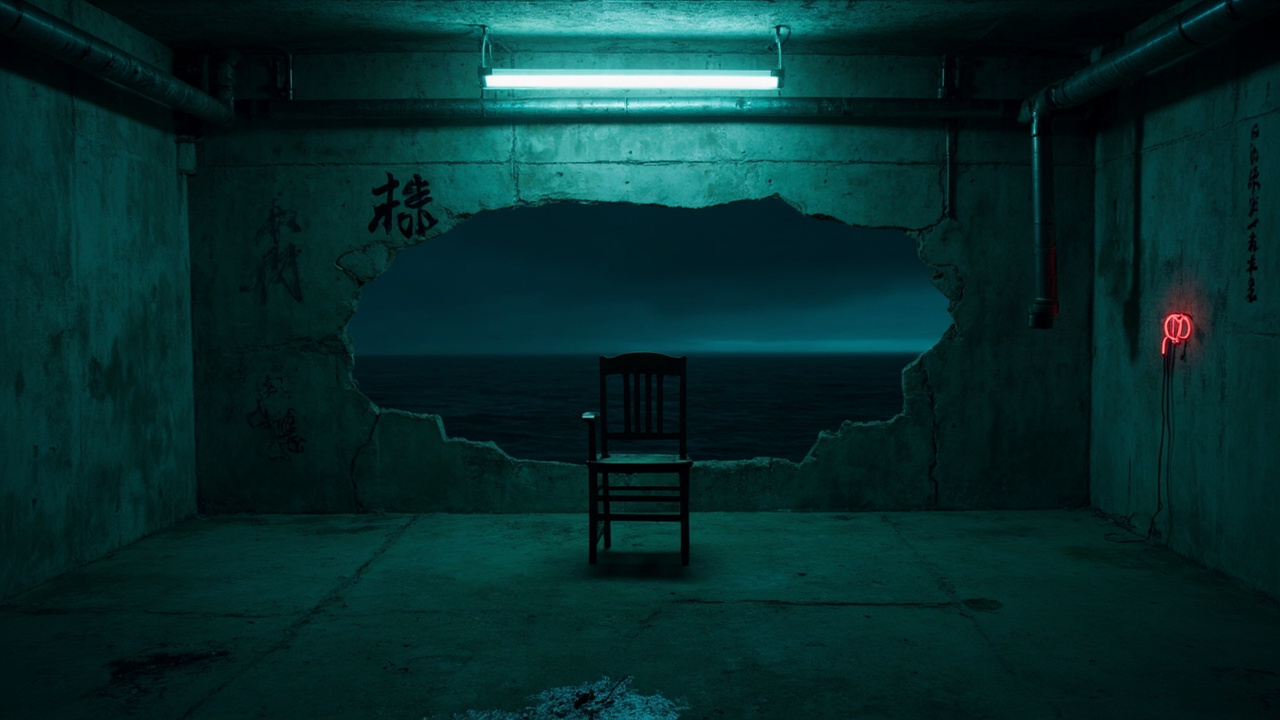
“We’re a generation of men raised by women. I’m wondering if another woman is really the answer we need.”
— Tyler Durden, Fight Club
I. The Debt
Fathers are the most conspicuously absent feature of modern Western civilization. A quarter of American households are single-parent households. Over eighty percent of those have no father present. Fewer couples bother marrying. The fathers who remain are increasingly incapable of the one thing fathers exist to do: form their children.
This is not a political observation. It is a civilizational one. The failures of fathers are a debt laid upon the shoulders of each resulting generation, which then repeats those same failures with compound interest. We are three generations deep now. The interest is due.
Two books, separated by thirty years and an ocean, diagnosed this pathology before the rest of us were willing to look. Yukio Mishima’s The Sailor Who Fell From Grace With the Sea (1963) delivered the warning as a chilling fable. Chuck Palahniuk’s Fight Club (1996) showed us the world that ignored the warning.
Mishima examined the price society pays for bad fathers. Palahniuk depicted a world already remade by fatherlessness. One was prophecy. The other was confirmation. Both understood something the commentariat still refuses to admit: the void does not stay empty.
II. Fight Club’s Fatherless Men
You know the story. A nameless narrator, a condo full of IKEA furniture he does not remember buying, a job he cannot describe without falling asleep, and a friend named Tyler Durden who is not actually his friend — or anyone. What begins as a basement fistfight becomes a movement, then a cult, then a domestic terrorist cell. Along the way, Tyler delivers a stream of aphorisms sharp enough to cut through the narcotic haze of late capitalism.
“You are not a beautiful and unique snowflake.”
“The things you own end up owning you.”
“It’s only after we’ve lost everything that we’re free to do anything.”
These lines entered the Western genetic memory for a reason. They landed. They described a felt reality for millions of men who had done everything right — degrees, jobs, mortgages, marriages — and still felt hollow. They were lopsided. Clean-shaven, well-behaved, perfectly credentialled, and missing something essential. They could not name the missing thing because they had never seen it.
The narrator never saw his father after age six. He called periodically for advice. What now, Dad? Dad didn’t know. Got a job. What now, Dad? Dad didn’t know. Tyler Durden never knew his father at all. When he fought in the basement, he said, he was really fighting his father.
Palahniuk himself was raised by his maternal grandparents after his parents divorced. His paternal grandfather murdered his paternal grandmother. The man knew something about the absence of good fathers, and it glows behind the entire novel like a sizzling neon sign.
The narrator observes, almost in passing, the most devastating line in the book: men who grow up without fathers will see their father as their model for God. If the father leaves, or is weak, or is cruel — what does that say about God?
The observation is not theological. It is functional. The father is the first authority. The first standard. The first thing in a boy’s life that is bigger than him and not his mother. When that figure is absent or broken, the template for all subsequent authority is absent or broken. The void forms, and the void is shaped exactly like a father. It will be filled by something. Military service. Corporate hierarchy. Political movements. Sports teams. Any godlike cause loud enough to drown out the constant awareness of the empty space.
And then, when all those substitutes prove hollow — because substitutes for a father are, by definition, hollow — the void fills with Tyler Durden. A man who does not exist. A figment of a broken man’s psyche, projected outward as a father, a god, and then, inevitably, an enemy.
The punchline of Fight Club is not that the narrator was crazy. It is that the imaginary father was the best one available.
III. The Women Who Inherit the Wreckage
A brief aside for the other half of the equation, because it matters and it is almost never stated plainly.
Women are also destroyed by bad fathers. A girl who had no good father cannot recognize a good man. She has no template. She judges men by the only standard available — herself, a woman — and concludes that men are defective women. Girls raised by bad men gravitate toward men who are bad in the same way, eternally perpetuating the cycle. Girls raised by no men at all don’t know what a man is, so they cannot possibly know what a good one looks like.
The mothers in both novels are, by all visible metrics, excellent. The narrator’s mother in Fight Club is barely mentioned — she is irrelevant to the story because she is irrelevant to the problem. She did her job. She raised a clean, polite, degree-holding, employed, married, mortgaged man. She could not teach him how to be a man because she is not one. No mother in history has ever been a father, and the greatest mother who ever lived could not fill that role.
This is not a critique of mothers. It is a statement of category difference. Mothers and fathers bring different, equally crucial things to formation. One cannot substitute for the other. The attempt produces the lopsided man, and the lopsided man produces the next generation’s catastrophe.
IV. Mishima the Man
To understand The Sailor Who Fell From Grace With the Sea, you must understand the man who wrote it. Yukio Mishima was a case study in remedial masculinity — a man who diagnosed his own lopsidedness and undertook one of the most radical self-reconstruction projects in literary history.
Born Kimitake Hiraoka in Tokyo in 1925, he was forcibly taken from his parents by a dominating, sickly grandmother who raised him like a porcelain doll, entirely in the company of women. When he finally reestablished contact with his father, the relationship was catastrophic. His father, concerned that his pale, frail son was growing up soft, subjected him to ordeals designed to toughen him. They traumatized him instead. The way only a father can.
Mishima’s semi-autobiographical Confessions of a Mask documents a man acutely aware of his own deficits — physical, psychological, spiritual. His mind lacked the masculine strength he believed essential, so he became a bodybuilder. A scholar. A husband and father. A ruthlessly self-disciplined man who literally studied the blade, took a pen name, and wrote forty novels before staging a failed coup and committing seppuku at forty-five.
Correcting ill-formed masculinity, Mishima understood, is like correcting a bone that healed wrong. The bone broke when the father left, or was never present, or was actively destructive. It healed wrong because no one set the break. The only way to fix it is to re-break it.
Tyler Durden knew this. Mishima knew it. The difference is that Mishima actually did the work. Durden just broke things and called it freedom.
V. Mishima’s Fatherless Fable
The plot of The Sailor Who Fell From Grace With the Sea is deceptively simple. Noboru, a thirteen-year-old boy, is being raised by his widowed mother. He has secrets. He observes her through a hole drilled between their bedrooms. He is indifferent to her discipline, precociously aware that her rules depend entirely on her mood and therefore mean nothing.
Unknown to any adult, Noboru has fallen under the influence of an older boy known only as the Chief. The Chief commands a group of six boys, all thirteen, all sharing one trait: they are victims of bad fathers. One is beaten. One’s father is a serial adulterer. Some have fathers who are merely weak — men who buy affection with gifts because they cannot earn it through presence, who never discipline, who have abdicated the office while retaining the title. Noboru is envied by the group because he has no father at all, which the Chief deems a certain type of perfection.
The Chief’s philosophy is simple and devastating. Society cannot be respected because fatherhood cannot be respected. The failure of fathers means the failure of everything. Fathers are repulsive. Therefore society is meaningless. The logic is adolescent, but it contains a jagged splinter of truth: if the foundational unit of civilization — the father who forms the next generation — is corrupt, what exactly are we defending?
Noboru also loves the sea. He worships sailors. When his mother takes up with a merchant sailor named Ryuji, Noboru is enthralled. Here is a man who has thrown off society, thrown off responsibility, devoted himself entirely to the ocean. The ultimate non-father. The perfect embodiment of adult masculinity — disconnected, beholden to nothing, serving only the great and beautiful sea.
Then disaster. Ryuji falls in love with Noboru’s mother. He becomes fond of the boy. He decides to give up his life at sea, settle down, and form a family. In doing so, as Noboru sees it, he falls from grace with the sea.
The sailor’s betrayal is absolute. The perfect man has demeaned himself into fatherhood. Worse: now Noboru will possess one of those hated things. A father.
The Chief proposes a solution. They are all minors. Japanese law in 1963 held no sway over children under fourteen. They can commit any crime with impunity. They will kill the sailor. They will reject fatherhood, reject society, reject the broken and meaningless world in which fathers are weak, odious, soft men or worse.
The tragedy is that Ryuji is actually trying to do something good. He wants to take responsibility for the boy. He wants to be a father. But his motivation, glimpsed in brief passages of interior narration, is imperfect. He mainly wants to please the son to remain with the mother. He chooses not to discipline Noboru when he deserves it, fearing alienation. Noboru interprets this as the ultimate weakness — proof of everything the Chief taught.
And so the boys kill him. A man trying to be a good father, murdered by boys whose own fathers failed them, led by a boy whose father did something to him that was worse than beatings, for the crime of attempting to fill the void.
The evil of a bad father produced a boy eager and willing to kill a man who was trying to be a good father, precisely because he was trying.
VI. The Price of Bad Fathers
The Chief, like Tyler Durden thirty years later, became a father and god to the boys who followed him. They all had a void shaped like a strong, authoritarian male figure. The Chief fit that shape despite being warped himself. His bad father made him into a bad father. His own bad fathering would lead not just to an innocent man’s death, but to a group of children becoming cold-blooded murderers.
Bad fathers, Mishima shows us, are corrosive — not just to the individual, but to the entire civilization. One generation of bad fathers can cause so much harm that the civilization never recovers. In this case, one generation of bad fathers was directly responsible for the next generation losing all respect for good fathers.
And it is not only evil fathers who produce this warping. Weak fathers are functionally identical. Many of the boys under the Chief’s guidance had fathers who were merely pathetic — men who drank with friends instead of raising children, men who shirked responsibility at every turn, one man who did nothing but pray all day and insisted that his constant prayer made their house a good house. Their sons despised them. They were wounded so deeply that they became open to the teaching that no father was acceptable, that all fathers were evil, that the mere act of fathering a child was unforgivable.
Boys raised by weak men were easily influenced into committing a cruel, calculated murder. The Chief became their father whether they knew it or not, whether he knew it or not. Vacuums fill. They always do.
VII. The Parallels
The resonances between Mishima’s novel and Palahniuk’s are not accidental. Both sets of boys came from good homes with conscientious mothers who kept them fed, clean, presentable, and academically successful. Their mothers were doing excellent jobs. Their fathers were negligent or actively harmful — which is often the same thing.
Both the Chief and Tyler Durden believed destruction was necessary. The Chief led his boys in killing small animals as preparatory exercises, insisting these acts would “fill the world’s great hollows” and grant them “real power over existence.” Tyler Durden led his space monkeys into increasingly violent confrontation, insisting that self-destruction was the only path to self-knowledge. Both were talking about filling a void. Both were filling it with blood.
Both the Chief and Tyler became surrogate fathers and gods to their followers. Both had nothing to offer in terms of actual masculine virtues. Both were hollow — Tyler literally does not exist; the Chief exists only as a reaction to trauma, an inverted image of his own father’s evil. Both were followed blindly by men so desperate for a father that they would accept anyone.
Both Mishima’s Chief and Palahniuk’s narrator asked their fathers the same question: What is the purpose of life? For what reason do you go on living? Neither father had an answer. The Chief concluded that a father is “a reality-concealing machine” who secretly believes he represents reality. Tyler concluded that fathers who cannot answer the question have forfeited the right to ask anything of their sons.
And the children of those fathers — Noboru’s gang, Tyler’s space monkeys — will grow up, or would have grown up, formed by adopted bad fathers into something worse than their biological fathers ever were. They will remember the lessons. Fatherhood is evil. Society is meaningless. Destruction is the only honest act. They will either never become fathers, or they will become evil, self-hating fathers like the Chief. The cycle will repeat. The debt will compound.
VIII. What Three Generations Have Produced
This is not literary analysis for its own sake. Mishima warned us in 1963. Palahniuk confirmed the trajectory in 1996. We are now living in the world they described.
The Gen X men — the first full generation of widespread divorce — grew up lopsided. They got the degrees and the mortgages and the marriages, and most of them got the divorces too. They filled the void with material goods, careerism, the Super Bowl. Then they had children. The Millennial men inherited a weaker template. They were a little more broken, a little less able to fake perfection with a leased car and a townhouse. Many skipped marriage entirely. Their voids filled with video games, cryptocurrency, and the softer edges of the manosphere.
Now the Gen Z men are not even bothering to pretend. Why would they? Look at the examples of masculinity available to a sixteen-year-old boy in 2026. Roided-up TikTokers hawking supplements between deadlift sets. Adult film stars with more followers than any living philosopher. E-daddies who possess the external trappings of masculinity without embodying a single masculine virtue. Andrew Tate, who is essentially Tyler Durden with a Romanian compound and a criminal indictment — a man who also had no father, also hates his father, also knows nothing about being a good man, and has been adopted as father and god by millions of vulnerable young men who were raised by women and recognize the void when they see it.
Can you imagine what Generation Alpha’s sons will look like?
Men who were raised by women are more prone to seek out surrogate fathers who perform masculinity without possessing it. They cannot tell the difference because they have never seen the real thing. Tyler Durden was charismatic, insightful, and genuinely trying to figure out how to be a man in a society that no longer produces them. He was also unstable, unreliable, hollow, and not actually real. The same is true of the Chief. The same is true of every e-daddy currently monetizing the void.
IX. The Bone That Healed Wrong
Mishima’s life offers a counterpoint — not a solution, but a direction. He knew he was broken. He took responsibility for the repair. He became strong, not to look strong, but to be strong. He wrote, not to be famous, but to excavate the wound. He studied the blade, not as an aesthetic, but as a discipline. He married. He fathered children. He attempted, however imperfectly, to break the cycle.
The narrator of Fight Club goes to the gym after his first fight, but not to sculpt his body into the aesthetic ideal of masculinity. He goes to become stronger. Fight Club showed him his weaknesses. He went to the gym to get rid of them. This is the single most overlooked line in the book, because it is the only line that points toward actual repair.
Correcting ill-formed masculinity is like correcting a bone that healed wrong. The bone broke when the father left, or was never present, or was a bad father. It healed wrong because no one was there to set the break. The only way to fix it is to re-break it.
Mishima knew this. Durden knew this. The difference is that Mishima’s self-destruction was disciplined, directed, and aimed at reconstruction. Durden’s self-destruction was indiscriminate, theatrical, and aimed at nothing beyond the destruction itself. One built a man. The other built a crater.
Strategic Imperatives
The void does not stay empty. This is the first law of the father-shaped void. It will be filled by something. The only question is what. If we do not supply the real thing — fathers who are present, strong, loving, and demanding — the void will fill with whichever counterfeit is loudest. The counterfeit is always worse than the emptiness.
Weak fathers are not neutral. They are actively destructive. A father who is physically present but emotionally absent, who buys affection instead of earning respect, who shirks formation because it is hard — this father produces the same outcome as the father who leaves. The sons of weak men are the easiest recruits for the Chief. For Tyler Durden. For any man with a loud voice and a convincing performance of strength.
Mothers cannot be fathers. The greatest mother in history cannot teach a boy how to be a man. She cannot model masculine virtue. She cannot provide the template for male authority. The single mother who raises an excellent son is performing a heroic act of triage — she deserves honor, not criticism — but the boy is still missing something. Two decades of maternal excellence produced Noboru. It produced the Fight Club narrator. It is not enough.
The cycle compounds. Every generation of bad or absent fathers makes the next generation less capable of being good fathers. The knowledge is not transmitted. The template is not provided. The wound deepens. We are three generations in. The fourth is forming now. The debt is not theoretical. It is walking around, hollow-eyed, looking for someone to follow.
Rebuild the template. The void is hungry and the counterfeits are multiplying.
Books Discussed: Yukio Mishima, The Sailor Who Fell From Grace With the Sea (1963). Chuck Palahniuk, Fight Club (1996).