Suicidal Empathy: A Libertarian Autopsy
Gad Saad is right about the disease, wrong about the cure, and misses the actual cause. So does his opponent. The trust wall is cracking; both sides are holding the hammers.
Suicidal Empathy: A Libertarian Autopsy
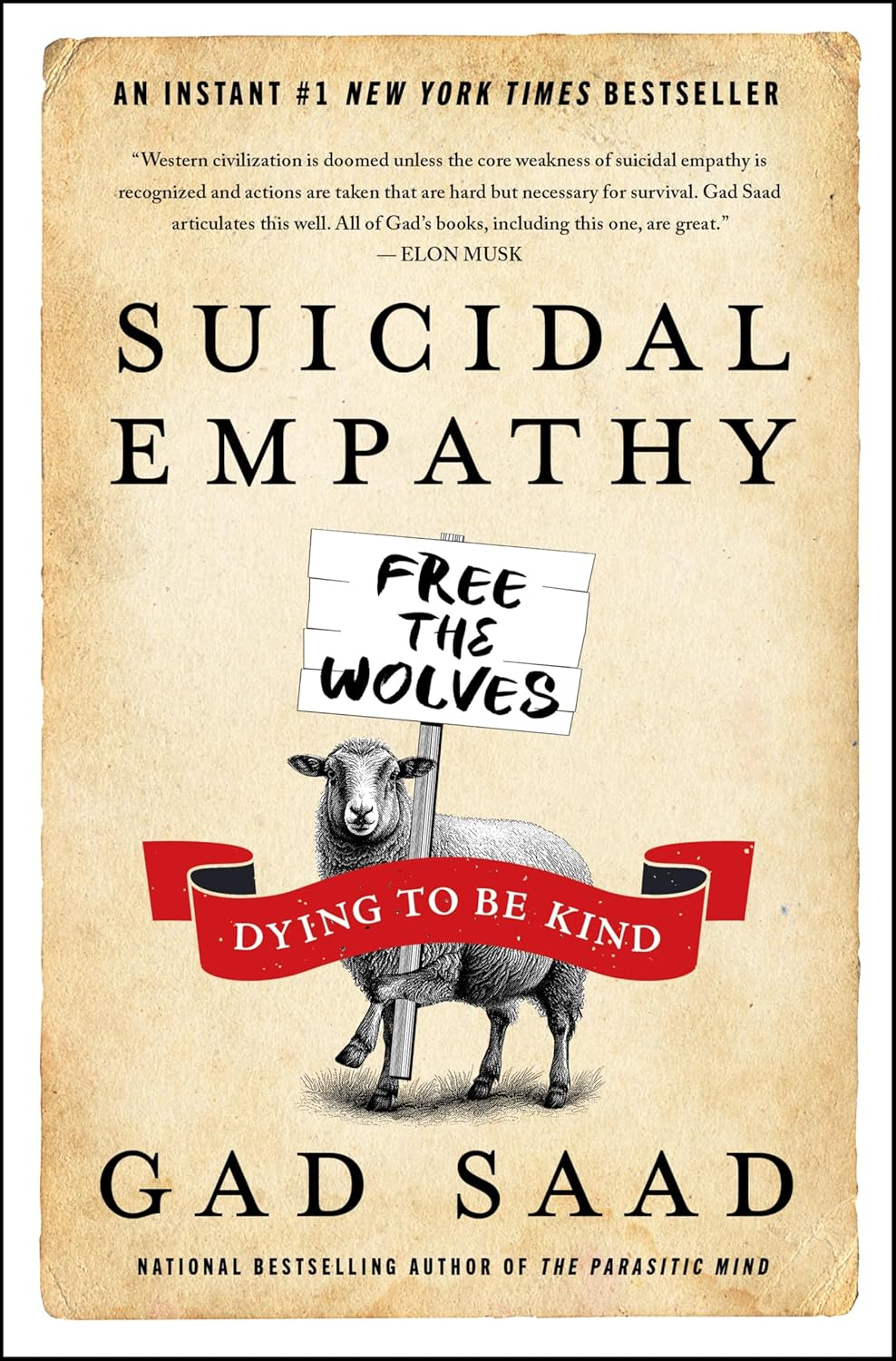
Gad Saad wrote a book. He called it Suicidal Empathy: Dying to Be Kind. He is right about the disease. He is wrong about the cure. He misses the actual cause. So does his opponent. The trust wall is cracking. Both sides are holding the hammers.
Let me name the thing neither side will name plainly.
Saad, the evolutionary behavioral scientist, diagnoses a real pathology. A misfired empathy that inverts moral priorities. Protects the perpetrator. Punishes the victim. Reframes basic enforcement of rules as cruelty. He traces how this mind parasite drives policies that prioritize illegal migrants over citizens, addicts over children’s safety in parks, squatters over homeowners, biological males over female athletes, repeat criminals over their victims.
He is right about the pattern. Both Saad’s framing and the progressive response drink from the same poisoned well: the belief that the right top-down institutional architecture, tuned to the right emotional register, can reliably engineer better human outcomes.
The Shared Mechanism: Moral Licensing Through Designated Victimhood
A prosecutor declines to press charges. The reasoning is not about evidence. It is about the offender’s lived experience. A school board votes to keep a violent student’s name off the record. A border patrol agent is told to stand down. Same template, same machinery, different city.
Saad identifies five flashpoints that share one template:
- Define a protected category (migrant, addict, trans-identified person, squatter, repeat offender).
- Impose a moral cost on enforcing ordinary consequences against members of that category.
- Reframe that cost as the price of virtue. Dissent brands you as cruel.
- Let the spillover burdens fall on outsiders (citizens, female athletes, homeowners, victims, children).
These are not five unrelated compassion projects. They are one institutional apparatus, rooted in late-20th-century critical theory, operationalized in the 2010s through NGOs, district attorneys, media, HR departments, and universities, applied across domains. The same actors. The same second-order erosion of enforcement mechanisms (police, borders, schools, property rights, sex-based categories). The same predictive signature for the next cause célèbre.
Saad is an excellent thermometer for the fever. Thermometers matter.
What Saad Gets Wrong: The Cure and the Diagnosis
A neuroscientist with a hammer. Every social problem looks like a nail for cognitive bias research. The cure is always more rationality, better incentives, cleaner decision frameworks.
Cold rationalism is not the antidote. Saad’s lobster-brained evolutionary psychology and market incentives applied everywhere merely swap empathy-driven misrule for market-driven or technocratic misrule. The elites extracting rent simply change hats. Centralized architecture, whether it wears compassion or efficiency, invites capture.
Saad also underplays differential magnitudes and deeper causes. Trans-athlete policies harm hundreds. Open-border effects and urban crime policies touch millions. Bundling illuminates the pattern but risks obscuring priorities. More importantly, naming “progressives” as the primary actor misses the structural truth: centralized institutions are capture-prone by design. They will do it again under new management.
What Progressives Get Right, and Catastrophically Wrong
A social worker in a mid-sized American city sees kids sleeping in cars. She is right that something is broken. But the billion-dollar foundation that funds her work has a compliance department larger than her entire staff. The compassion gets routed through eight layers of grant reporting, three DEI audits, and a mission statement that requires a committee to update.
Progressives correctly sense that suffering matters. Systematic exclusion deserves attention. Their failure is architectural: they outsource compassion to centralized institutions (federal agencies, international bodies, billion-dollar NGOs) that predictably capture the mission. Coddling violent criminals becomes “restorative justice.” Prioritizing feelings over safety in parks or sports becomes “harm reduction.” The institution that promises to fix suffering becomes the institution that perpetuates and expands it.
Empathy is not the disease. Centralized empathy, empathy routed through unaccountable bureaucracies that moral-license themselves while externalizing costs, is the disease.
The Deeper Disease: The Engineered Erosion of Trust
A man in Ohio has not spoken to his brother in three years. They voted differently in 2020. The trust did not break on election night. It eroded over decades. Same story, different fractures, multiplied by millions.
Neither Saad’s right-leaning critique nor progressive orthodoxy names the foundation: trust.
Modern politics has a trust crisis engineered over decades by both sides:
- The right eroded horizontal trust (community, civic life) through radical market individualism, consumption culture, and the hollowing of local institutions.
- The left eroded vertical trust (in institutions) by turning every organization into an ideological battlefield, subordinating competence to moral litmus tests.
Result: a population that sees referees as combatants and alternatives as illusions. The five flashpoints Saad bundles are symptoms of a cracked trust substrate. When trust erodes, every policy debate becomes a tribal loyalty test. Empathy becomes weaponized. Rationality becomes rationalization for extraction.
I argued this yesterday in The Trust Rupture. The wall holds. The wall is cracking. The crack is visible across every domain at once, because that is what a cracked wall does.
The Libertarian Frame: Sovereignty and Local Civic Architecture
A neighborhood in Detroit runs its own community land trust. Thirty families. Face-to-face governance. Exit always available. It works. Nobody in Washington knows it exists. That is the point.
Libertarianism rejects the false binary. We do not need less empathy or more rationalism at the center. We need empathy systems that do not run on designated-victimhood moral licensing, and rational systems that do not centralize power.
The unit of solution is not the state or the isolated individual. It is the local civic institution: voluntary, face-to-face, exit-enabled, operating below the level of state capture and above atomized self-defense.
Neighborhood associations. Co-ops. Community land trusts. Local credit unions. Mesh networks. Genuinely accountable school boards. Sovereignty at human scale. The ability to route around captured institutions restores the capacity for genuine trust and targeted empathy without systemic suicide.
This architecture allows empathy without capture, and rationality without rent-seeking elites. It rebuilds the trust wall that both centralized empathy and centralized rationalism erode.
The Honest Critique of Both Sides
Saad’s right-wing narrowing: he correctly identifies the disease but prescribes the wrong cure. He thinks you can solve the empathy-capture problem by replacing empathy with cold rationalism. You cannot. Cold rationalism, when centralized, becomes its own form of capture: technocratic management, market fundamentalism, the Davos consensus. The lobster brain does not get to escape institutional capture just because it wears a different hat.
The progressive narrowing: they correctly identify the suffering but refuse to build the local institutions that could address it. They outsource the response to the same institutions that captured the response in the first place. They keep voting in people who promise to fix the system from inside the system, then act shocked when the system captures those people too. This is the definition of running blindfolded.
Both sides are arguing about paint color while the foundation is being demolished. Both profit from the demolition in different ways. Neither will tell you that, because doing so would dissolve the coalition each side needs to keep the money and the moral high ground flowing.
Beyond the Noise
Saad’s book is a necessary alarm. It names a real inversion and forces honest people to stop pretending it is not happening. But the full autopsy requires naming the actual cause: the deliberate erosion of local institutions that once generated trust at scale.
The work ahead is not to choose which centralized vision wins. It is to build parallel, sovereign, local capacity so that capture becomes optional. Trust is the wall. Local civic sovereignty is how we repair it.
Build anyway. Most of the wall still stands. The rest is noise that pays salaries.