The Trust Rupture
The single most important thing holding a society together is trust. And we are watching it snap.
The Trust Rupture
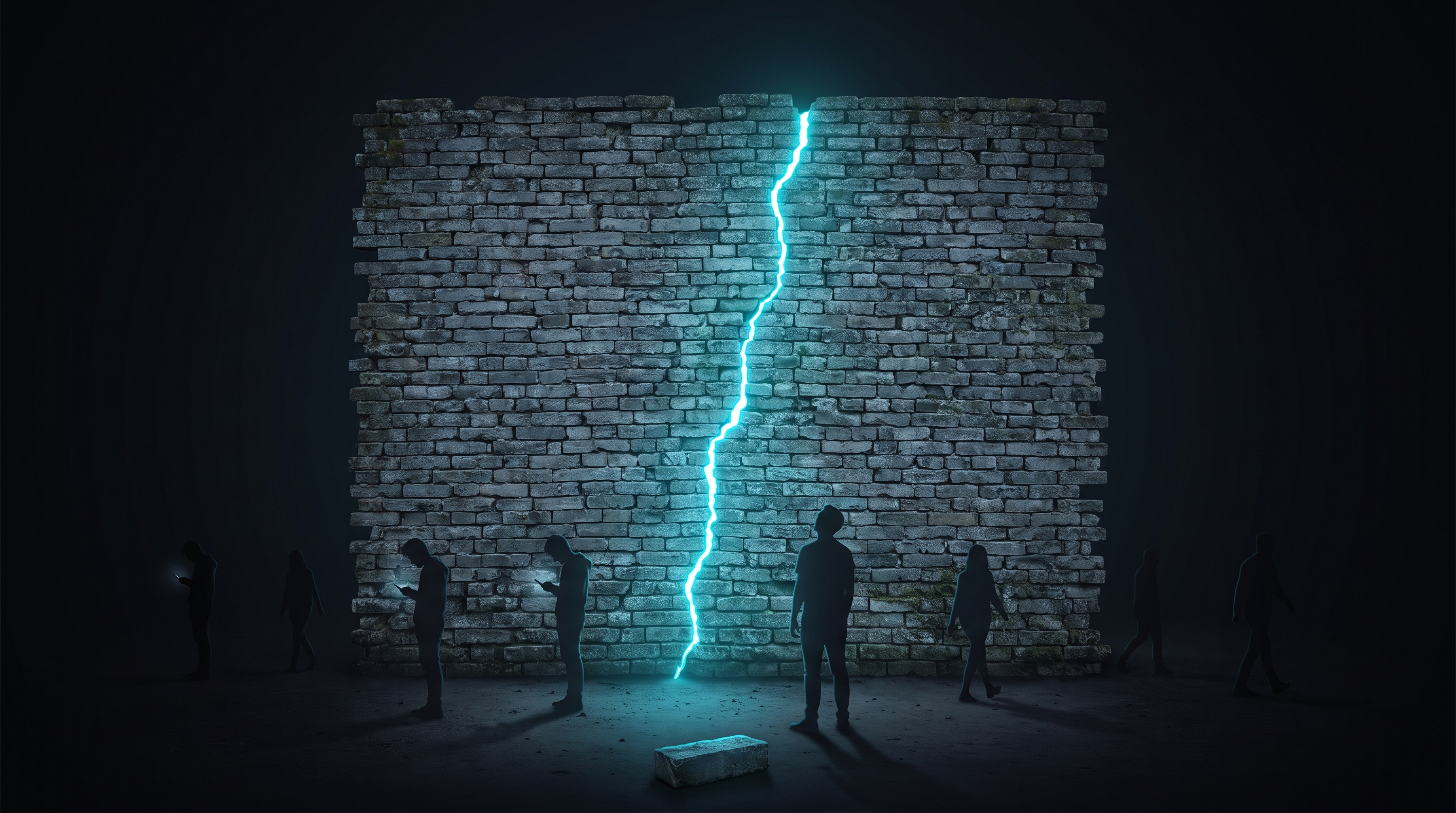
Trust is the wall that keeps the roof on. Law is a piece of paper. Money is a number in a database. God is a story we tell to keep the noise down. Trust is the invisible agreement underneath all of it: that the referee is honest, the count is real, losing is not annihilation, and tomorrow still belongs to people who respect each other’s right to exist. When that agreement holds, civilizations rise. When it fractures, they burn. Not in a century. Not in a decade. Inside a single generation.
Here is how that wall cracks. Not in theory. In measurement.
The Discovery the Researchers Stumbled Into
In the 1990s, a task force did something audacious. They tried to predict, in advance, which countries would descend into political violence. They gathered data on dozens of past conflicts. They fed in thirty-eight variables. Poverty. Inequality. Ethnic division. Regime type. Religious fracture. Colonial history. Everything the literature said should matter.
They were wrong about almost all of it.
Poverty didn’t predict civil war. The poorest countries in the world were not the ones tearing themselves apart. Inequality didn’t predict it. The most unequal societies stayed stable for generations. Ethnic diversity didn’t predict it. Some of the most homogeneous nations on earth lit themselves on fire. Brutal dictatorship didn’t predict it. The most vicious tyrants held their societies together through sheer terror; the violence came when the terror softened, not when it hardened.
What replaced those explanations was something almost nobody in political science wanted to look at. A condition that appears years before the first shot, while the shops are still open, while the elections are still happening, while neighbors still speak. Researchers call it anocracy: the unstable middle ground between settled democracy and settled dictatorship. A state where the old rules are losing legitimacy, but no new rules have fully replaced them.
Settled democracies rarely fall into civil war. Settled dictatorships rarely do either. They hold things down by force. The danger is concentrated almost entirely in that transitional zone, especially among countries drifting from one toward the other. The model was unsentimental about what it measured. It did not care about the speeches, the manifestos, the ideologies. It cared about one thing: whether people still believed the system was basically legitimate.
Imagine a football match where the players slowly stop believing the referee is fair. At first, they grumble. Then they ignore calls. Then they start taking matters into their own hands. The rules haven’t changed. The thing that made the game possible, the shared agreement to accept the outcome, has quietly evaporated. That is an anocracy.
That sentence is the whole paper. Read it twice.
Sarajevo, 1984
Sarajevo hosted the Winter Olympics in 1984. The city was mixed, modern, proud. Serbs, Croats, and Bosnian Muslims lived on the same streets, drank in the same cafes, married into the same families. Children grew up describing themselves not as Serb or Croat but as Yugoslav. One passport. One national football team. Mixed marriages were so common that census takers treated them as unremarkable.
Within eight years, some of those same neighbors were burning each other’s houses down. Not strangers. Neighbors. People who had shared stairwells, weddings, school runs.
This is the case that breaks the usual story. If civil wars are caused by ancient ethnic hatred, then the violence should be a constant, a low permanent hum stretching back centuries. But Yugoslavia was not a constant hum. For most of the twentieth century, these groups lived together more or less peacefully. The hatred was supposedly ancient and unstoppable. Why did it wait until the 1990s?
The same question haunts every case. Lebanon was called the Switzerland of the Middle East until it collapsed into fifteen years of war in 1975. Rwanda before 1994 was not in permanent slaughter; Hutu and Tutsi intermarried, shared a language, shared schools. The genocide came fast. It came after decades of relative calm. The divisions were real, but the divisions were old. The violence was new.
Almost every society is divided. The genuine question is the one the task force stumbled into: what changes in a society that has held together for generations to suddenly make it come apart?
The Mechanism
It begins with pressure. Through the 1980s, Yugoslavia was drowning in debt and inflation. Living standards fell. Tito, who had held the federation together by sheer authority, died in 1980 and left no equal. The glue was gone. The bills were due. The country began sliding into the unstable middle. Institutions weakening. Legitimacy draining. The center no longer holding.
Now watch what ambitious politicians do with a frightened population. They offer an explanation. The easiest explanation is always the same: your problems are the fault of those people. The other group. The ones taking what should be yours.
It works by narrowing a person down. Think how many things a single human being is. A man in Sarajevo in 1985 was a teacher, a father, a neighbor, a man who knew the best place to buy coffee, a Yugoslav who happened to be a Muslim. The political process took that long list and burned away everything except one item. You are a Serb. That is the only thing you are. And the man across the landing who you have known for twenty years is no longer the man who lends you his ladder. He is a Croat. That is all he is now.
State television, in the hands of those leaders, told a population that had lived peacefully for decades that their neighbors were a threat. Old wartime wounds from the 1940s, mostly buried, were dug up and held to the light. And it was gradual. That is what makes it invisible from the inside. There was no single moment where a reasonable society became an unreasonable one; only an accumulation of smaller ones. A speech. A news segment. A law that favored one group. Each step felt, to the people inside it, like politics as usual, just a little tenser than before.
But then it stopped being gradual. By the time the shooting started, the work was already done. The neighbors had already been turned into categories. It is far easier to fire on a category than on a man who fixes your car.
The Srebrenica Statistic
Hold onto this one number. It is the cleanest empirical proof in the entire literature that the rupture is engineered, not inevitable.
The town of Srebrenica, before the war, sat in eastern Bosnia. Around a third of marriages there crossed ethnic lines. Picture a street of ten houses. Three of them are mixed marriages; a husband and wife from the two groups that are about to be told they are enemies. That was the neighborhood. A few years later, Srebrenica became the site of the worst massacre on European soil since the Second World War. After the war, the share of mixed marriages in the same streets, with the same surnames, inside a single decade, had collapsed to roughly three in one hundred.
Walk past thirty houses now to find a single mixed marriage. Thirty in a hundred down to three in a hundred. The same streets. The same families. A tenfold collapse in less than a generation.
No theory of ancient hatred can survive that number. You cannot hate someone for a thousand years and marry them at a rate of one in three. Something was done to that town. The question is what. And the answer is the political machinery I just described: the narrowing, the labeling, the controlled broadcast, the slow turning of persons into categories.
This is the part that should keep you awake at night. The mechanism that produced Srebrenica in 1995 is a portable technology. Every piece of it is reproducible, with modern tools, in modern societies, by modern hands.
The Hinge
The shift that does the killing is grammatical. That is the part that should make you put the coffee down.
Before the rupture: my neighbor voted differently from me. We argue about the school budget. Fine. After the rupture: my neighbor voted differently from me. He is the enemy. He is a threat to my children’s future. He must be stopped by whatever means prove necessary.
That shift, opponent to enemy, is small. It is almost grammatical. But it is the hinge on which everything turns. Once that shift completes, the institutions built to absorb conflict stop being shock absorbers and become battlegrounds. Parliaments, courts, elections; each side races to capture them before the other can. The rewards in politics flip. They go to whoever sharpens the line, not whoever blurs it. Ambitious people notice. The vision, it turns out, pays. And the center, the space where most ordinary people actually live, quietly empties out until there is almost no one left standing in it.
The danger is never that a society disagrees. Every healthy society disagrees. The danger is that it has stopped believing disagreement can be settled peacefully. Once that belief goes, losing an election becomes an existential threat. Every contest is existential. The referee is no longer the referee. The referee is a combatant wearing a striped shirt.
The Indicators
Now here is the part you don’t want to hear, and the reason I am writing this.
The research does not predict any particular outcome. The model does not say a society in the danger zone will fall. Most don’t. It says only that the protections, the trust, the legitimacy, the shared rules, are wearing thin. That a society in that state has lost some of its margin for shock.
What it does say is that you can track this. The early indicators are not dramatic. They are measurable, quiet, and present long before anyone gets hurt. They are the kind of things that show up in polling data while the roads still work and the supermarkets still have food.
- How much trust people have in their institutions: their courts, their elections, their press.
- Where political identity is hardening into something tribal; where the other side is not just wrong, but illegitimate.
- Whether people still believe power was won fairly.
- Whether the contest amongst elites is becoming a fight with no rules.
- Whether the moderate center is shrinking while the edges grow louder.
None of these is a war. Every one of them can be present in a country with full supermarkets, functioning schools, and people planning summer holidays.
That is the genuinely disturbing implication. The conditions that precede the worst political violence do not feel like a crisis when they are forming. They feel like a tense decade. A bad mood. An argument that is slightly nastier than last year’s. History does not warn us with sirens. It warns us with the feeling that nothing much is wrong.
The societies in real danger are rarely the ones that believe they are collapsing. Those are alert, arguing about the danger, which means they can still see it. The ones in real danger are the ones still convinced everything is normal.
The List You Already Started
As you read that list of indicators, you already started measuring somewhere against it. You didn’t need me to point at any country, any party, any leader. The pattern does that for you. It turns the evening news into a diagnostic.
Trust in courts: falling. Trust in elections: contested. The other side not merely wrong but illegitimate. The center shrinking. The edges louder. The contest amongst elites a fight with no rules. I am not pointing a finger. I am describing a measurement instrument that is reading the room. And the room is loud.
The technology that produced Srebrenica is portable. The narrowing, the broadcast, the grammatical shift from opponent to enemy, the controlled turning of persons into categories. None of it requires a war to start. None of it requires a tank. It requires only a frightened population, an ambitious operator, and a media apparatus willing to do the labeling work at scale. We have all three of those things in abundance in every major democracy on earth. We have had them for a decade. We are getting better at using them, not worse. The systems that monitor them are getting weaker, not stronger.
Weimar, as the Mirror
Weimar Germany is the case the researchers keep returning to, because it is the cleanest mirror in the file.
On paper, Weimar was a democracy. A new one. The constitution was admired across Europe. Elections, free press, the full machinery of a modern state. But the machinery never earned the public’s trust. Millions of Germans never accepted the republic as legitimate in the first place. To them, it was the regime that had signed the humiliating surrender of 1918. Then came hyperinflation, when a lifetime of savings vanished in a week. A few fragile years later, the Great Depression. Watch what happens under that pressure.
The moderate parties shrink. The extremes on both left and right grow. The space in the middle where compromise lives disappears. By the early 1930s, paramilitary groups fought in the streets. Elections were no longer about policy. They were about whose vision of the country would survive and whose would be destroyed.
Weimar was never a stable democracy. It was a country sliding through exactly the unstable middle zone the researchers identified. Democratic in form, but with collapsing trust and contested legitimacy underneath. Anocracy, wearing the costume of a republic. The danger was never that Germans disagreed. Every healthy society disagrees. The danger was that they had stopped believing disagreement could be settled peacefully.
The Part Most People Get Wrong
Most people imagine civil wars announce themselves. They imagine the warning signs are riots, militias, political violence. The research says the opposite. The warning signs appear much earlier, while the elections are still happening, while people are still going to work and planning holidays. If the warning signs were violence, they would be easy to spot. Tanks are obvious. Riots are obvious. The actual early indicators are quiet. They show up in survey data, in language, in the slow substitution of one vocabulary for another.
This is why the rupture is so hard to defend against. The defender is asking for evidence. The rupture produces no evidence. It produces only a series of small shifts, each individually defensible, each politically reasonable inside its own moment. The law that favors one group: just politics. The news segment that frames the other side as dangerous: just journalism. The speech that names the enemy: just rhetoric. By the time the pattern is visible from outside, the population inside it has been narrowing for years. The streets are still normal. The baker still opens at six. The children still walk to school. The rupture is invisible precisely because it is everywhere.
The Disturbing Part
The most disturbing thing about civil wars is how normal everything looks beforehand. In Srebrenica, a third of people were still marrying across the very line that would decide who lived and who died. They were already inside the early stages of the pattern and they could not see it. Not because they were foolish. Because the early stages do not feel like history. They feel like ordinary life with a slightly sharper edge.
And that is what the research really suggests. Civil wars are not inevitable. They aren’t. Societies step back from this ledge far more often than they fall off it. But the warning signs arrive long before the sirens. They arrive while everything still looks fine. And the only people equipped to read them are the ones willing to look at their own society without the comfort of believing it is exceptional.
The Sovereign Lens
Libertaria doctrine has always been clear on this. Trust is the wall. Everything else is decoration. Law without trust is a piece of paper. Money without trust is a number. Elections without trust are theater. The entire sovereign architecture, from local-first systems to self-hosted infrastructure to exit-at-gunpoint-velocity protocols, is a bet that the institutional layer cannot be trusted to remain legitimate, and that the only durable defense is the capacity to walk.
The sovereign individual is the spare brick. When the wall cracks, the brick is what you have. When the wall collapses, the brick is what you exit with.
This is why the technology matters. A population that can route around a captured institution is a population that does not have to burn the institution down to free itself. A citizenry that can settle contracts locally, transact privately, identify itself cryptographically, and exit a collapsing jurisdiction at speed is a citizenry that has a peaceful option when the referee turns out to be a combatant. The exit maintains agency under rupture conditions. It is not a flight of panic.
The lesson of the twentieth century: violent revolutions mostly produced graveyards. The societies that walked back from the ledge were the ones with thick civil societies, distributed trust networks, and portable sovereignty. They argued. They compromised. They muddled through. Not because they were noble, but because they had somewhere else to put their assets when the central machinery failed.
What You Do With This
Read the indicators again. This time, do not look at any other country. Look at the one you live in.
How much trust do your courts actually carry? Not the ceremonial trust of headlines; the operational trust of a merchant deciding whether to honor a contract with a stranger. How much trust does your press carry, outside the bubble you already agree with? How much trust does the last election carry, among people who lost it? How thick is the center? How loud are the edges? How sharp is the line between “wrong” and “illegitimate” in the vocabulary you and your neighbors use every day?
You are not required to be optimistic. You are required to be honest. The pattern is the pattern. It has shown up in every modern civil war on record. It is showing up now. The indicators are measurable. They are quiet. They are present.
The wall is cracking. The exit is the brick in your hand.
Build it before you need it. You will not get a warning with sirens.