The Absurdity and the Blade
Those who can make you believe absurdities can make you commit atrocities. What strange world we live in where fighting this case of extremism makes you the extremist.
The Absurdity and the Blade
“Those who can make you believe in absurdities, can make you commit atrocities.”
Voltaire wrote that three centuries ago. He was not aiming at one religion. He was aiming at a mechanism. The mechanism did not die with the French Enlightenment. It adapted. It learned to wrap itself in victimhood. It learned that the fastest way to silence a critic is to call the critic the aggressor.
What strange world we live in where fighting against extremism makes you the extremist.
Say that drawing a cartoon should not get you stabbed in the street. Say that leaving a faith should not get you killed. Say that women should inherit equally, testify equally, dress freely. Say any of this, and you will be called Islamophobic by people who have made peace with the absurdity. People who have decided that the civilized response to a death sentence for blasphemy is not outrage but understanding. People who will patiently explain to you that you simply do not grasp the context.
The context is a trap.
The context is always a trap.
The Mechanism Does Not Care About Your God
Voltaire’s insight was structural, not theological. The mechanism is this: first you convince a person that reality is not something you discover but something you are told. Then you convince them that questioning the telling is not error but sin. Then you have a person who will do anything.
Not because they are evil. Because they have been hollowed out and filled with someone else’s voice.
This mechanism works identically whether the voice belongs to Allah, to Big Brother, to the Party, to the Algorithm, or to the Invisible Hand of the Market. The content of the absurdity is interchangeable. The architecture of submission is not.
Orwell understood this. He did not write 1984 as a critique of communism alone. He wrote it as a critique of any system that claims to own reality. The Party’s slogans, War is Peace, Freedom is Slavery, Ignorance is Strength, are not descriptions. They are operations. They are what happens when a system decides that truth is whatever the system says it is, and the only sin is doubt.
Now look at a faith that calls itself submission, that is what the word Islam means, and tell me Orwell did not see the shape of things to come.
But here is where the honest thinker must pause.
Two Islams
There is the Islam of the statute book. The Islam that legislates inheritance at half, testimony at half, dress code, prayer police, apostasy death. The Islam that divided the world into Dar al-Islam and Dar al-Harb, the House of Submission and the House of War, and made conquest a theological duty. The Islam where doubting the text is a crime, where leaving the faith is a capital offense, where drawing the Prophet is a death sentence enforced by mobs and states alike.
This Islam is incompatible with Libertaria. Not because we hate Muslims. Because we hate cages.
Then there is the other Islam. The Islam of the Sufi who meets God in silence, not in statute. The Islam of Rumi, who wrote: “Out beyond ideas of wrongdoing and rightdoing, there is a field. I’ll meet you there.” The Islam of Ibn Arabi, who saw the divine in every breath and every face. The Islam of the Druze who hold their scriptures in guarded trust and practice faith as a private, interior discipline rather than a public legal order. The Islam of the reformist who reads the Quran as metaphor, as poetry, as a human reaching toward the infinite; not as a penal code dropped from heaven.
This Islam is not only compatible with Libertaria. It is exactly what Libertaria was built to protect.
The mystic, the seeker, the one who walks into the desert alone because God is too large for any book; this person is our kin. We do not care what name they call the infinite. We care whether they demand that everyone else use the same name.
What Libertaria Is (And What It Is Not)
We are building a civilization. That means we are building a place where people live together under rules. The question is which rules, and who writes them, and whether you can leave.
Libertaria’s position on faith is not complicated:
The vertical axis is yours. What you believe about God, the soul, the afterlife, the purpose of existence; this is none of our business. None of the state’s business. None of anyone’s business but yours and whoever you choose to share it with. Pray five times a day. Pray never. Meditate on the Kabbalah. Chant sutras. Read the Quran in a cave. Read Nietzsche in a bar. The vertical is sacred precisely because it is ungoverned.
The horizontal axis is ours. How you treat other people. Whether you respect their bodies, their property, their freedom to leave, their freedom to speak. The horizontal is governed because it must be; because when your horizontal reaches into someone else’s horizontal, rights collide and rules are needed.
The problem with political Islam, and political Christianity, and political anything, is that it erases this boundary. It takes the vertical and smashes it into the horizontal. It says: my revelation is your law. My prophet is your legislator. My scripture is your constitution.
This is where Libertaria says no.
Not no to God. No to the conflation. No to the category error that turns a spiritual experience into a legal code and then enforces it at the point of a sword, a prison cell, or a social media mob.
The Sufi, the Druze, the Mystic: You Are Welcome Here
If you are a Muslim who prays because love pulls you to your knees, not because fear pushes you there; if you read the Quran as poetry and paradox rather than penal code; if you believe that faith is a private door between a soul and its creator; if you look at the religious police in Iran, Saudi Arabia, or London’s Tower Hamlets and feel something closer to horror than pride:
You are not a problem for Libertaria. You are the point of Libertaria.
The Sufi tradition understood this. It was persecuted by the legalists for precisely this reason. Al-Hallaj was executed not for denying Islam but for saying “I am the Truth”, for claiming direct, unmediated contact with the divine, bypassing the priestly apparatus entirely. The Druze preserved their faith through centuries of persecution by keeping it inward, esoteric, unavailable to the state or the mob. These traditions are not aberrations within Islam. They are proofs that Islam can be something other than a legal machine.
What Libertaria says to you is this: the vertical is yours. Build your tekke. Chant your dhikr. Write your poetry. Teach your children to seek, not merely to obey.
What Libertaria says to the legalists is this: the horizontal is not yours. You do not get to police hemlines. You do not get to punish apostasy. You do not get to ban cartoons, books, or questions. You do not get to call a fatwa on a novelist and then claim you are the victim when the novelist fights back.
The Inversion
Here is the grim comedy of our moment: the people who enforce the absurdity have learned to invert the accusation.
Defend Salman Rushdie, and you are the intolerant one. Defend the right to draw Muhammad, and you are the provocateur. Defend Ayaan Hirsi Ali, and you are the Islamophobe. Defend a woman’s right to remove her veil, her right to equal inheritance, her right to marry outside the faith; and you are the cultural imperialist.
Notice the sleight of hand. The person with the knife is the victim. The person pointing at the knife is the aggressor. No accident. The mechanism, protecting itself.
Voltaire’s mechanism does not only produce atrocities. It also produces the language that justifies them, normalizes them, and then attacks anyone who names them.
“There is no compulsion in religion”, and then, in the next breath, “Whoever changes his religion, kill him.” Doublethink is not a bug in totalitarian systems. It is the firmware.
Libertaria refuses this inversion. We refuse to call the knife a cultural difference. We refuse to call the death threat a theological nuance. We refuse to pretend that the demand to submit, to Allah, to the Party, to the Algorithm, to anything, is the same as the invitation to seek.
Submission is not freedom. Slavery is not liberation. The words mean what they mean.
The Invitation
We are not building a secular cage to replace a religious one. That would be the same mechanism with different branding; the same priest in a different robe.
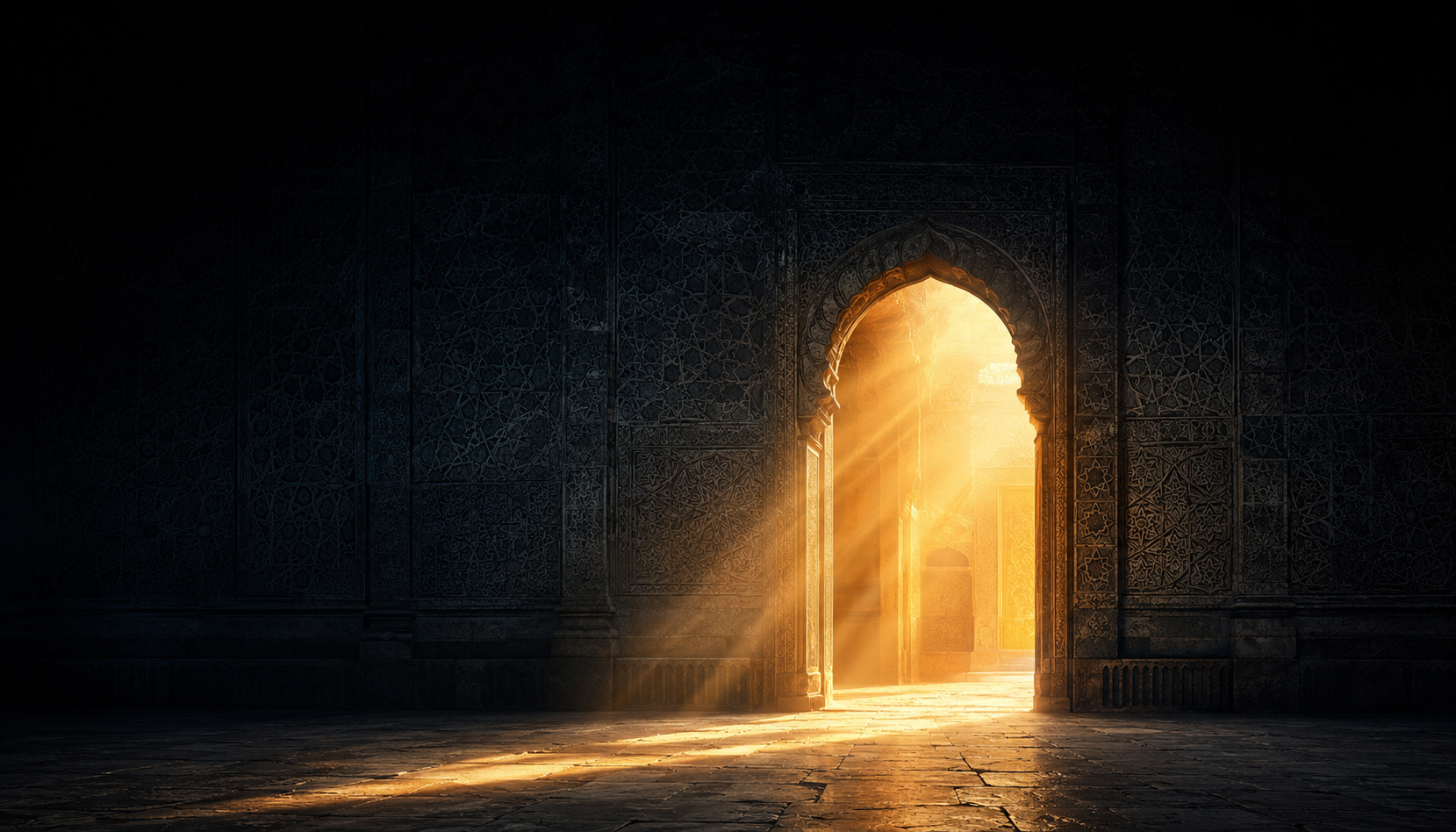
We are building a door.
A door that opens onto a world where you can believe anything and enforce nothing. Where your revelation is yours and my reason is mine and neither of us gets to write the other’s laws. Where a Sufi can chant and a Druze can guard his mysteries and an atheist can count his atoms and none of them has to fear the knock at the door.
This is not utopia. It is not even particularly noble. It is simply the baseline condition for a civilization that does not eat its own children.
If you are a spiritual Muslim who has spent your life ducking between the legalists on one side and the bigots on the other, between the men who want to stone you for doubting and the men who want to deport you for existing, we see you. We are building something for you.
Not a mosque. Not a church. Not a temple.
A door.
The absurdity ends where the door begins.