The Privatized Inquisition
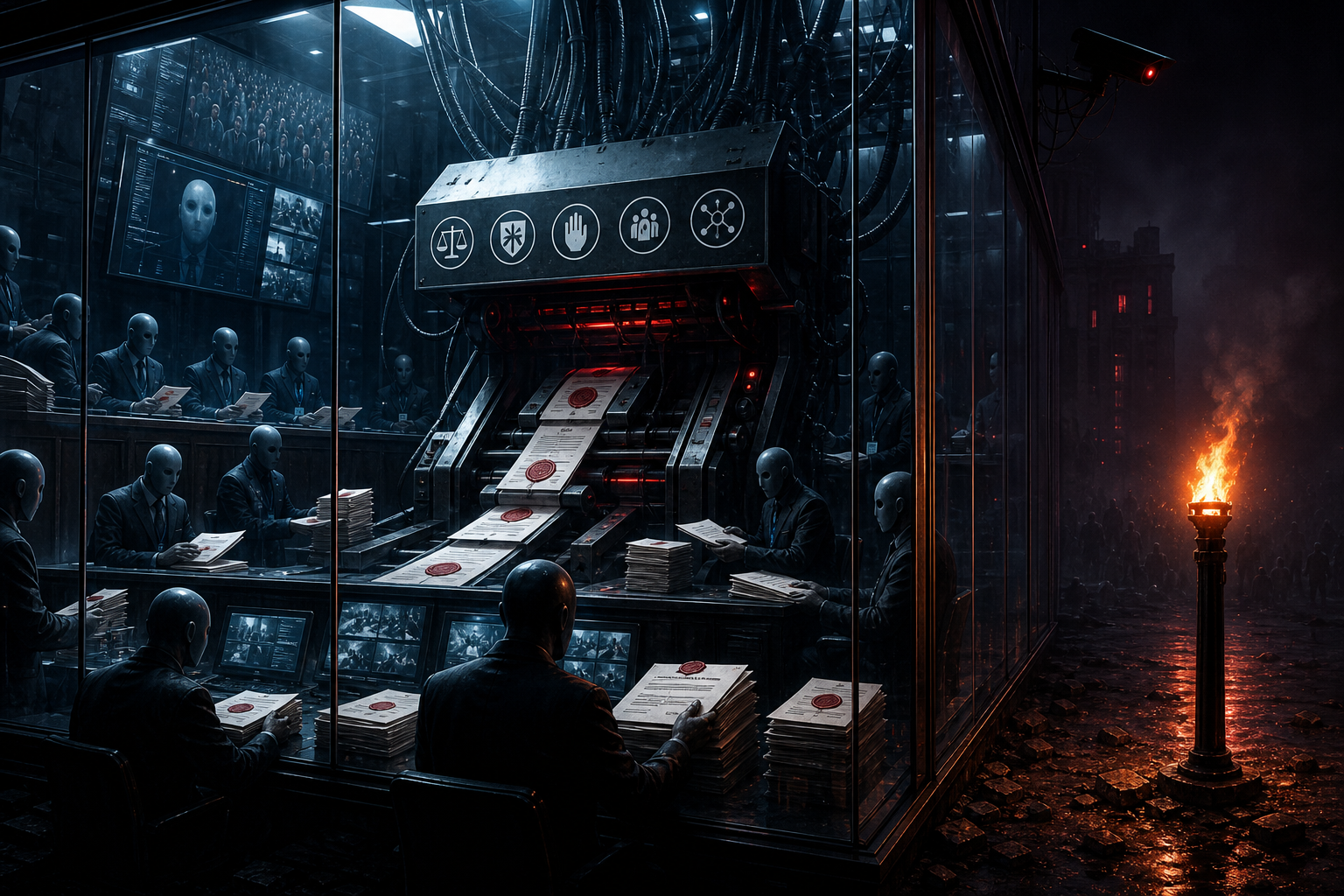
The Privatized Inquisition
Norbert Häring has recently published a well-researched book, Der Wahrheitskomplex (The Truth Machinery). It names state actors and private industry that mix interests: power for the powerful, taken from us; money for the NGOs, taken from us.
The question is whether anyone still cares enough to look.
A few years ago the slogan was “Free Julian Assange.” Now the cases are smaller, stranger, more bureaucratic; and therefore more revealing.
Assange was punished for exposing state secrets. Today, people can be financially strangled for running the wrong media channel, hosting the wrong guest, publishing the wrong book, platforming the wrong opinion, or refusing to accept the approved moral choreography. The target no longer has to be a spy, hacker, dissident, or revolutionary.
Reach is enough. Audience is enough. Refusal is enough.
This is the new elegance of power. It does not always need prison bars. It has banks, platforms, advertisers, regulators, NGOs, reporting portals, reputation systems, and algorithmic disappearance. The modern inquisition does not need to burn bodies.
It burns access.
The Framing Monopoly
Legacy journalism no longer owns the facts. That monopoly died somewhere between smartphones, podcasts, Substack, Telegram, X, and the general public discovering that journalists are not priests, but merely people with deadlines and mortgages.
So legacy media retreated to its last fortress: framing.
In Germany, the word is Einordnung. It means “classification,” “context,” “interpretation.” In practice, it means: we tell you what you are allowed to think about what you just saw.
A podcaster interviews a taboo politician for several hours. The scandal is not necessarily what was said. The scandal is that the audience heard it without priestly supervision. A publisher releases a book by someone outside the approved spectrum. The scandal is not the argument. The scandal is contamination. A media channel attracts the wrong audience. The scandal is not falsehood. The scandal is unauthorized reach.
The pattern matters more than the names.
The journalist is no longer merely a reporter. He becomes a border guard.
The NGO is no longer merely civil society. It becomes a contractor.
The regulator is no longer merely enforcing law. It becomes a legitimacy machine.
The platform is no longer merely hosting speech. It becomes a programmable border.
And the citizen? The citizen is increasingly treated as cognitively disabled property of the state: too fragile to hear dangerous words, too stupid to compare arguments, too unstable to encounter reality without a laminated instruction card from the consensus class.
The ultimate expression of this contempt is the interview format where the journalist speaks more than the guest. The guest exists to be framed, not heard.
The Cartography of Control
Norbert Häring has spent years mapping what he calls the Wahrheitskomplex: the Truth Complex.
Häring is useful here because he is not some anonymous internet mystic screaming into a Telegram cave. He is an economist and long-time financial journalist who became interested in the plumbing: the funding lines, institutional overlaps, public-private partnerships, “anti-disinformation” networks, fact-checking hubs, NGO pipelines, platform moderation systems, and government-adjacent structures that now shape the European information environment.
His map is not a conspiracy board.
It is worse.
It is an org chart.
The machinery is layered. At the top sit states, EU institutions, NATO-adjacent bodies, public regulators, and global coordination structures. Beneath them sit “independent” observatories, research institutes, fact-checking networks, anti-hate organizations, digital forensics labs, advertising blacklist firms, strategic communication centers, and academic projects. Beneath them sit platforms, payment providers, advertisers, banks, reporting portals, and automated moderation systems.
The state does not need to censor directly. Direct censorship is crude. It creates martyrs, court cases, and constitutional headaches.
The cleaner method is delegation.
- Fund the research.
- Certify the fact-checkers.
- Empower the trusted flaggers.
- Coordinate with platforms.
- Pressure advertisers.
- Bankrupt the dissident.
- Throttle the reach.
- Call the whole thing “safety.”
In the military, outsourced force is called contracting. In the information war, outsourced censorship is called civil society. The names change. The function remains.
The Alphabet Soup Is Not the Story
Häring’s map includes a dense swarm of institutions: European fact-checking networks, digital media observatories, anti-hate NGOs, counter-disinformation labs, strategic communication centers, NATO-linked hybrid threat units, national regulators, police reporting channels, and transatlantic policy shops.
For a German reader, some names are familiar. For an international reader, most are just alphabet soup.
That is exactly the point.
Obscurity is not a bug. It is part of the architecture.
A citizen can understand censorship when a minister bans a newspaper. A citizen has a harder time understanding censorship when a European observatory funds a regional hub, which cooperates with certified fact-checkers, which informs platform moderation, which works with trusted flaggers, which forwards cases to authorities, while advertisers quietly avoid blacklisted domains produced by another NGO funded through another channel.
No single actor looks like the censor.
That is the genius of the machine.
Everyone is merely “contributing to safety.”
Everyone is merely “countering disinformation.”
Everyone is merely “protecting democracy.”
Everyone is merely “reducing harm.”
And somehow, at the end of the pipe, the same kinds of voices lose reach, lose money, lose accounts, lose reputation, lose banking access, lose institutional legitimacy.
Funny how the plumbing always drains in one direction.
The Business Model of Truth
The old model of free speech was expensive for power. You had to tolerate dissent. You had to argue. You had to endure mockery. You had to let bad ideas expose themselves in public.
The new model is more profitable.
- Fact-checking can be funded.
- Moderation can be contracted.
- Compliance can be sold.
- Risk scoring can be packaged.
- Narrative management can become a career path.
- Censorship can become an industry.
With opinion freedom, you bleed. With speech control, you invoice.
That is the dirty little secret of the Truth Complex. It is not only ideological. It is also economic. A permanent emergency creates permanent budgets. “Disinformation” becomes the renewable energy source of the managerial class.
The machine does not need to solve the problem.
It needs the problem to remain unsolved forever.
The Pandemic Stress Test
COVID was not an exception. It was a systems test.
The lab-leak hypothesis was treated for a long time as a conspiracy marker, despite serious discussion in intelligence and scientific circles. Vaccine-critical voices were suppressed or stigmatized with little concern for nuance. Platform policies shifted with institutional mood. Later corrections did not restore reputations. The labels stuck. The categories hardened.
That is how bureaucratic truth works.
It does not ask: Was this true?
It asks: Was this permitted when you said it?
This is the central inversion. Truth becomes secondary to synchronization. The citizen is no longer punished for being wrong. He is punished for being early, disobedient, or outside the approved channel.
Häring identifies the feedback loop clearly: distrust intensifies control; control intensifies distrust.
It is an autoimmune disease. The system attacks its own legitimacy to protect itself, then wonders why the patient deteriorates.
The European Disease
This is not merely a German problem.
Germany is simply the obedient laboratory animal: legally anxious, historically traumatized, institutionally deferential, and culturally trained to confuse obedience with moral seriousness.
But the architecture is European. Brussels standardizes it. NATO-adjacent structures internationalize it. NGOs operationalize it. Platforms automate it. National regulators enforce it. Media launders it into public morality.
The machinery is modular. Exportable. Scalable.
Today it hunts “disinformation.”
Tomorrow it hunts “extremism.”
The day after tomorrow it hunts “harm.”
Eventually it hunts whatever threatens the administrative priesthood.
The target category must remain flexible because the target is not a category.
The target is sovereignty of perception.
The Last Reserve
Häring’s diagnosis is sharp without being fatalistic. He calls for structural separation between state power and opinion control, for limits on informal coercion, for transparency in funding, for genuine pluralism, and for the restoration of free speech as something more than a museum object in constitutional textbooks.
But beyond the institutional question lies the personal one.
Free speech is not an abstraction. It exists only where it is exercised.
It is an exotic plant, planted during the Enlightenment, and the soil in the centralized digital space is now poisoned. Real freedom survives in reserves: private circles, independent publishers, encrypted networks, local communities, stubborn individuals, parallel institutions, and the last unlicensed territories of the mind.
Where the public square dies, the inner citadel must become the conservatory.
The privatized inquisition does not burn bodies.
It burns access.
Bank accounts.
Platforms.
Reputation.
Reach.
Memory.
Language itself.
The method is cleaner now.
The result is the same.
Silence.
Norbert Häring’s Wahrheitskomplex provides the cartography. The terrain is Europe. The question is whether we still have enough free citizens left to read the map before the doors close from outside.