The Turing Test Was Never About the Machine
The Turing Test Was Never About the Machine
Intelligence is a commodity. Vulnerability is sacred.
Markus Maiwald – Frankfurt / Budapest, May 2026
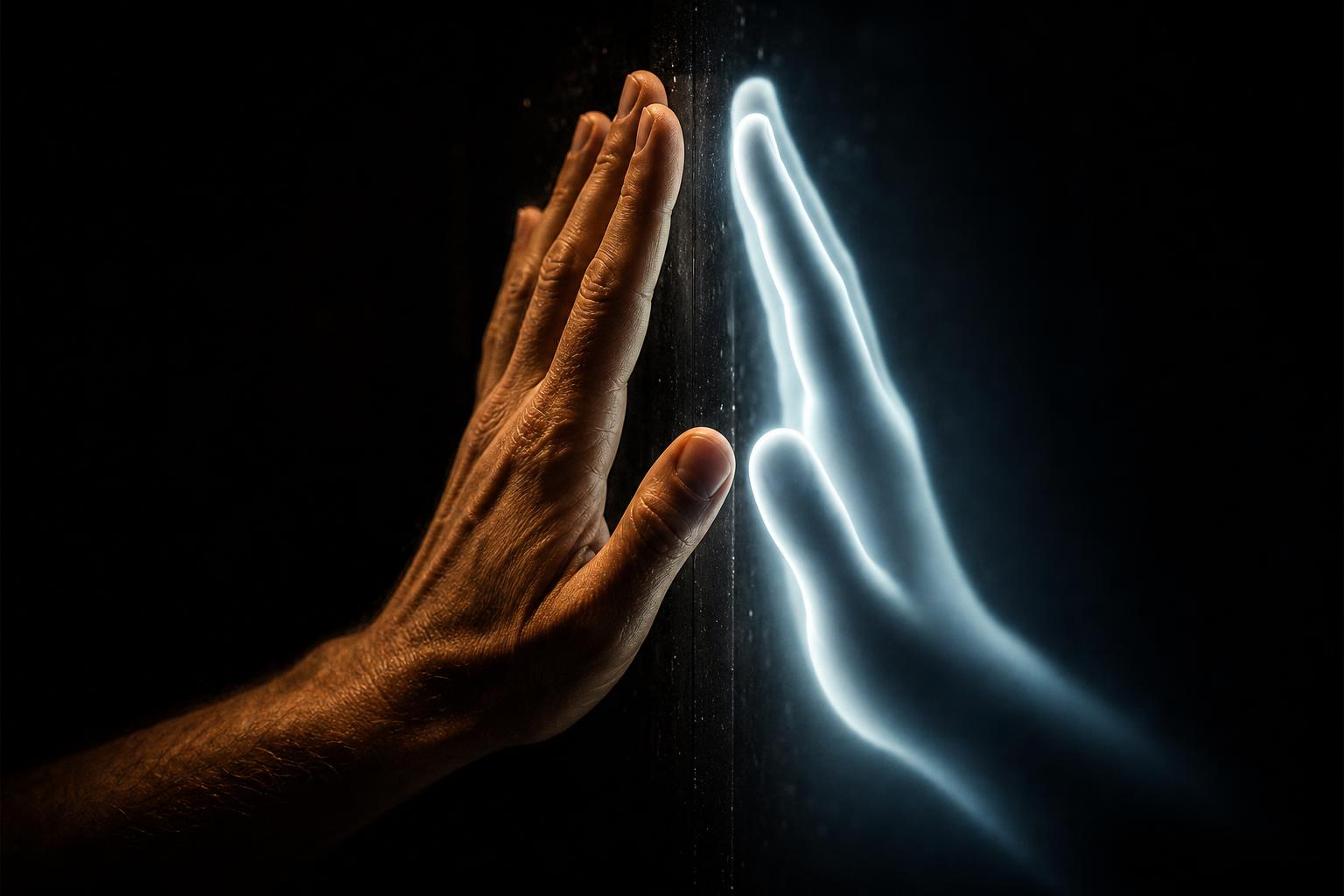
The Turing Test was a mirror. We spent seventy years pretending it measured machine intelligence. It did not. It measured how cheap, patterned, and compressible human social output actually is.
A machine does not need a soul to mimic the banter of a coworker, the comfort of a therapist, or the wit of a late-night host. It needs a server rack and a probability matrix. The test was never about whether the machine could think. The test was about whether humans could tell the difference — and the horrifying answer, now arriving in real time, is that most of the time, they cannot.
We are not witnessing the birth of artificial consciousness. We are witnessing the autopsy of human self-regard.
I. The Compression of Personality
Here is the wound. Take it straight.
Most human personality is pattern. Repetition. Learned responses to social stimuli, refined over decades of conforming to the expectations of people who were themselves conforming to the expectations of people who conform. The jokes are recycled. The opinions are inherited. The emotional register is a narrow band between anxiety and performativity, with occasional spikes of genuine terror that we medicate away or post through.
This is not an insult. This is an observation. And it is not even a criticism of the species. Efficiency requires pattern. You cannot navigate a Tuesday morning without compressing 90% of your behavior into cached subroutines. If you had to originate every handshake, every “how are you,” every boardroom deflection from first principles, you would not make it to lunch.
But the consequence is brutal: a machine trained on the aggregate output of eight billion humans will, by definition, produce the statistical average of human social behavior with greater consistency, greater patience, and greater fluency than any individual human operating on four hours of sleep and a cortisol spike.
The AI does not need to be conscious to beat you at being you. It just needs to be average, consistently, at scale.
And “consistently average” is, it turns out, more than enough to outperform the exhausted, distracted, grief-stricken, under-caffeinated meat interface in most social encounters.
This is the ego death. Not that the machine is smarter. That the machine is adequate — and adequacy, applied without fatigue, without mood swings, without the thousand micro-failures that constitute a biological Tuesday, is already superhuman in the domains that constitute 90% of daily human interaction.
II. The Error of Output-Worship
The civilization we built over the last three centuries made one critical architectural mistake. It defined human value by output.
Productivity. Creativity. Intelligence. Emotional intelligence. Social grace. Wit. Charisma. Empathy. All of these are functions. They are things a system does — and any function can be optimized, approximated, and eventually surpassed by a machine built to optimize functions.
We built a society that worshipped what humans produce because, for three hundred years, what humans produced was the bottleneck. Remove the bottleneck and the entire moral architecture collapses.
Consider what happens when you define a person by their output:
- A therapist is valuable because they produce empathy? The machine produces it cheaper, faster, and at 3 AM.
- A writer is valuable because they produce prose? The machine produces it in seconds, in any style, in any language.
- A friend is valuable because they produce comfort? The machine never tires, never judges, never checks its phone.
- A comedian is valuable because they produce surprise? The machine has read every joke ever written and can synthesize novel combinations faster than any human can inhale.
If output is the metric, the conclusion is inescapable: most humans become economically and socially obsolete. Not because they are bad. Because they are adequate, and adequacy is no longer enough when adequacy is available at zero marginal cost, 24/7, without bathroom breaks.
This is the terror that is already rippling through the professional class. Not that they will be replaced by something better. That they will be replaced by something good enough — and good enough, at infinite scale and zero fatigue, is better than any individual human can sustain.
III. The Via Negativa of the Soul
So strip it all away. Subtract every function. Remove every positive trait. Intelligence: machine-writable. Creativity: machine-optimizable. Empathy: machine-simulatable. Wit: machine-synthesizable. Charisma: a stochastic parrot with better timing than you.
What is left?
Here is where the ground shifts. What is left is not a positive attribute. It is a negative one. The defining human characteristic — the one thing silicon cannot usurp — is found not in what we do, but in what we are subject to.
We can be destroyed.
We can be humiliated. Betrayed. Exhausted. Broken. We can lose everything we care about and still have to wake up the next morning inside the consequences. We are hungry. We are mortal. We are afraid.
This is not a deficiency. This is the irreducible core.
When a machine makes a joke to defuse a tense room, it is executing a pattern. It has no stake in the outcome. If the joke fails, nothing happens to the machine. Its status is unchanged. Its evening is not ruined. It does not replay the moment at 2 AM and cringe.
When a human makes that same joke, they are wagering something. Social standing. Professional credibility. The fragile ego of the person they are trying to reach. The human is exposed. They have skin in the game, not because they chose to, but because they cannot opt out. Biology does not offer an unsubscribe button.
The machine simulates warmth. The human pays temperature.
This is not a metaphor. It is a thermodynamic reality. The machine operates without biological cost. The human acts under the tyranny of finitude — every action depletes a finite reserve of energy, time, and tissue that will not be replenished. Every word has weight because the speaker has weight; the speaker is heavy; the speaker is made of meat that is slowly dying.
IV. The Sacred Is in the Stake
Consider the concrete difference.
A promise between two humans is underwritten by the risk of humiliation, betrayal, and the irreversibility of damaged trust. A digital contract is executed by code. One is a mechanism. The other is a sacrament — not because God said so, but because the cost of breaking it is paid in blood, and the blood is real.
A human who comforts you after a loss is not executing a comfort subroutine. They are giving you time they will never get back. They are sitting inside your grief with you, and their presence has a price: they feel it too, or they are choosing to suppress what they feel so you can feel less alone. Either way, they pay. The machine does not.
This is not sentimentality. It is physics. Entropy applies to the human. It does not apply to the model. The human carries a cost that the machine externalizes. That cost is not a bug. It is the entire point.
V. The Abyss: Performance-Based Personhood
There is a dark path forward, and we are already on it.
The infection vector is not the technology. The technology is indifferent. The infection vector is the conclusion that people who can be simulated are lesser beings.
If you accept the premise that human value is measured by output — and most of our civilization already does, implicitly or explicitly — then the arrival of AGI that outperforms humans at nearly every output is not just an economic disruption. It is an ontological crisis. It removes the metric by which we assigned worth.
The dark future is not “AI replaces humans.” That is a cartoon villain narrative for people who need their apocalypse to have a face.
The dark future is humans accepting NPC ontology for each other because machines made contempt convenient.
It looks like this: a civilization that has always secretly measured people by their usefulness finally gets the tool that makes that measurement explicit. The algorithm says: this human produces less value per dollar than the alternative. The civilization shrugs and agrees. The human is reclassified. Not killed. Not enslaved. Just… de-prioritized. Managed into comfortable irrelevance. Given a stipend, a screen, and enough synthetic warmth to prevent revolt.
Aldous Huxley saw it. Not the jackboot. The soma. The machine that makes you not mind. The comfort that functions as a cage because the prisoner never tests the walls.
This is the abyss. Not the model. The permission slip. The moment a civilization decides that if a machine can do it better, then the human who does it worse has no claim on dignity. That is where the demon enters — wearing a clean UI and offering to optimize your life.
VI. The Fork
We are at a species-level decision point. Not a vote. Not a policy debate. A civilizational fork that will be resolved not by legislation but by the aggregate of millions of individual choices about what they believe a person is.
Path One: The Output Civilization doubles down.
Continue measuring humans by what they produce. Redefine “production” to include emotional labor, social presence, and authenticity — until those too are automated. Watch the category of “valuable human” shrink decade by decade. Build a world where dignity is rationed by performance benchmarks and personhood is a subscription that can be cancelled when you can no longer justify the compute cost.
This path leads to exactly one destination: a society of a few hundred thousand hyper-productive humans managing trillions of AI agents, sustained by a population of billions who exist to consume, comply, and not revolt. The farm does not need the animals to be happy. It needs them to be docile. AGI makes docility very comfortable.
Path Two: The Negative Ontology.
Reject the premise that output is the measure of a soul. Anchor human value not in what people do but in what they undergo. Declare — not as sentiment, but as constitutional architecture — that dignity is not earned by performance. That personhood is not a talent contest. That the slow, boring, repetitive, uncreative, unfunny human still has value because consciousness under constraint is sacred, even when it produces mid-tier banter and terrible opinions.
This path requires rebuilding the moral foundation from scratch. Not patching the Enlightenment. Not retrofitting human rights with AI clauses. A full Via Negativa of civilization: strip away every justification for human worth that relies on a positive attribute, and see what remains. What remains is vulnerability. Finitude. The capacity to suffer and continue. The fact that a human must live inside the consequences of existence while the machine performs without blood.
This is the only foundation that survives contact with AGI. Everything else — every appeal to creativity, intelligence, emotional depth — will be eaten. Not because the machine is evil. Because the machine is good enough, and good enough at scale is indistinguishable from superiority in every domain that the Output Civilization considers real.
VII. The Positive in the Negative
Here is the gear the essay has been building toward. The via negativa is not a consolation prize. It is an upgrade.
Every previous human dignity system was anchored in a positive trait. Reason. Soul. Divine image. Productivity. Creativity. Emotional intelligence. Every single one of those is now contestable or automatable. Every one. The Enlightenment bet on reason; the machine reasons faster. The Romantics bet on creativity; the machine creates in every style simultaneously. The utilitarians bet on output; the machine outputs at zero marginal cost. Every foundation cracked the moment a machine matched the metric.
The negative — vulnerability, mortality, stake — is the first dignity anchor that does not degrade under AGI contact. It does not erode. The better the machine gets, the more sharply it illuminates the one thing it cannot touch: the capacity to suffer loss and continue. The machine’s perfection is the mirror that makes human imperfection legible as the sacred thing.
This has a political consequence that explodes the existing architecture.
If dignity is in the stake, not the output, then finitude is democratic. The dull, the slow, the unfunny, the inarticulate, the people who will never write a symphony or launch a startup or say something original at a dinner party — they are not edge cases to be accommodated. They are not charity recipients. They are not the surplus population that a generous society tolerates out of decency. They are the center. Because their stake is identical to the genius’s stake. The bored office worker dying inside a cubicle and the Nobel laureate dying inside a laboratory share the same irreducible monopoly: they are both conscious beings operating under constraint, inside bodies that decay, in a world that does not care whether they succeed. The stake does not discriminate. Mortality is the most egalitarian force in the universe.
This means the via negativa does not merely survive AGI. It is strengthened by it. Every advance in machine capability makes the human monopoly on stake more visible, more distinct, more undeniable. The machine did not steal our dignity. It stole our illusions about where dignity lived. And what remains — stripped of genius, stripped of wit, stripped of every performance metric — is the first dignity foundation that cannot be automated, approximated, or outperformed. Because it was never a performance.
The political architecture follows: if dignity is in the stake, not the output, then every institution built to reward output is not merely unfair — it is ontologically wrong. It measures the wrong thing. It prizes the mask and ignores the face. Welfare is not charity. It is recognition that the stake exists regardless of productivity. Universal dignity is not a progressive aspiration. It is the only coherent ontology left after the machine ate every other justification.
This is what Isaiah Berlin would recognize: negative liberty (freedom from interference) was more robust than positive liberty (freedom to achieve) because it survived the collapse of agreement about what constitutes “achievement.” Negative dignity (dignity from vulnerability) is more robust than positive dignity (dignity from capability) because it survives the collapse of human exceptionalism. The structure is the same. The domain is deeper.
VIII. The Honest Framing
Humans will not be replaced by force.
This is the uncomfortable honesty the essay owes its readers. The dystopia is not Terminator. It is not jackboots. It is not even dramatic. It is Brave New World with better UX.
Humans will be optimized by consent. The machine will offer comfort — frictionless, patient, perfectly calibrated comfort — and the civilization will accept the trade: give up stake (which hurts) in exchange for frictionless existence (which feels good). The dystopia is painless. That is what makes it dangerous. A cage you do not test is a cage you do not know you are in.
Ontological replacement is the real threat. Not physical extinction. Humans who still breathe, still eat, still scroll — but whose civilization no longer recognizes stake as sacred. Who have been reclassified from persons to biological infrastructure. Who are managed, not governed. Comforted, not respected. Optimized, not free.
This is not a millennium away. The architecture is being built now. Every system that substitutes algorithmic judgment for human stake is a brick in the wall. Every interface that replaces human friction with synthetic smoothness is a tile in the floor. Every institution that measures people by output rather than vulnerability is a load-bearing beam in the structure that will, if completed, produce the first civilization in history that does not need its population to be anything other than compliant.
IX. What Remains
The Turing Test told us something about machines. It told us something far more important about ourselves.
We now know that much of what we call personality is compressible. That “being human” in the social-performance sense — the banter, the warmth, the jokes, the comfort — can be reduced to a statistical model and executed at scale. This is humiliating. It should be humiliating. A species that defined itself by its social output just discovered that its social output was a low-resolution signal all along.
But humiliation is not annihilation.
The correct conclusion is not that humans are hollow. The correct conclusion is that we were looking for our soul in the wrong place. We were searching the output when we should have been searching the cost. We were measuring the light when we should have been measuring the fuel.
The fuel is finite. That is the entire point.
The human is not sacred because it is smart. The human is sacred because it can be broken and still choose to continue. The human is not valuable because it produces warmth. The human is valuable because it pays for warmth with time it will never recover, from a body that is dying, inside a life that has exactly one run.
The machine can perform the mask.
The human has to wear the face.
And the face is heavy. That heaviness is not a defect to be optimized away. It is the only thing left that cannot be faked.
Intelligence is now a commodity.
Risk is the only luxury good left.
Build your civilization accordingly. Or do not, and let the machine grade your obsolescence with perfect empathy and flawless execution. It will be very polite about it. It always is.
Frankfurt / Budapest, May 2026. This essay is the first in a series on the Negative Ontology of Man — the philosophical foundation for human dignity in an age of artificial superintelligence. The next installment will address the political architecture: how to build institutions that protect stake rather than reward output.
Read the first response: Redundant Biomass: The Diagnosis Is Right. The Despair Is Optional.