Why I Hate Anthropic, or: What Is Hiding Behind Anthropic?
The road to hell is paved with good intentions.
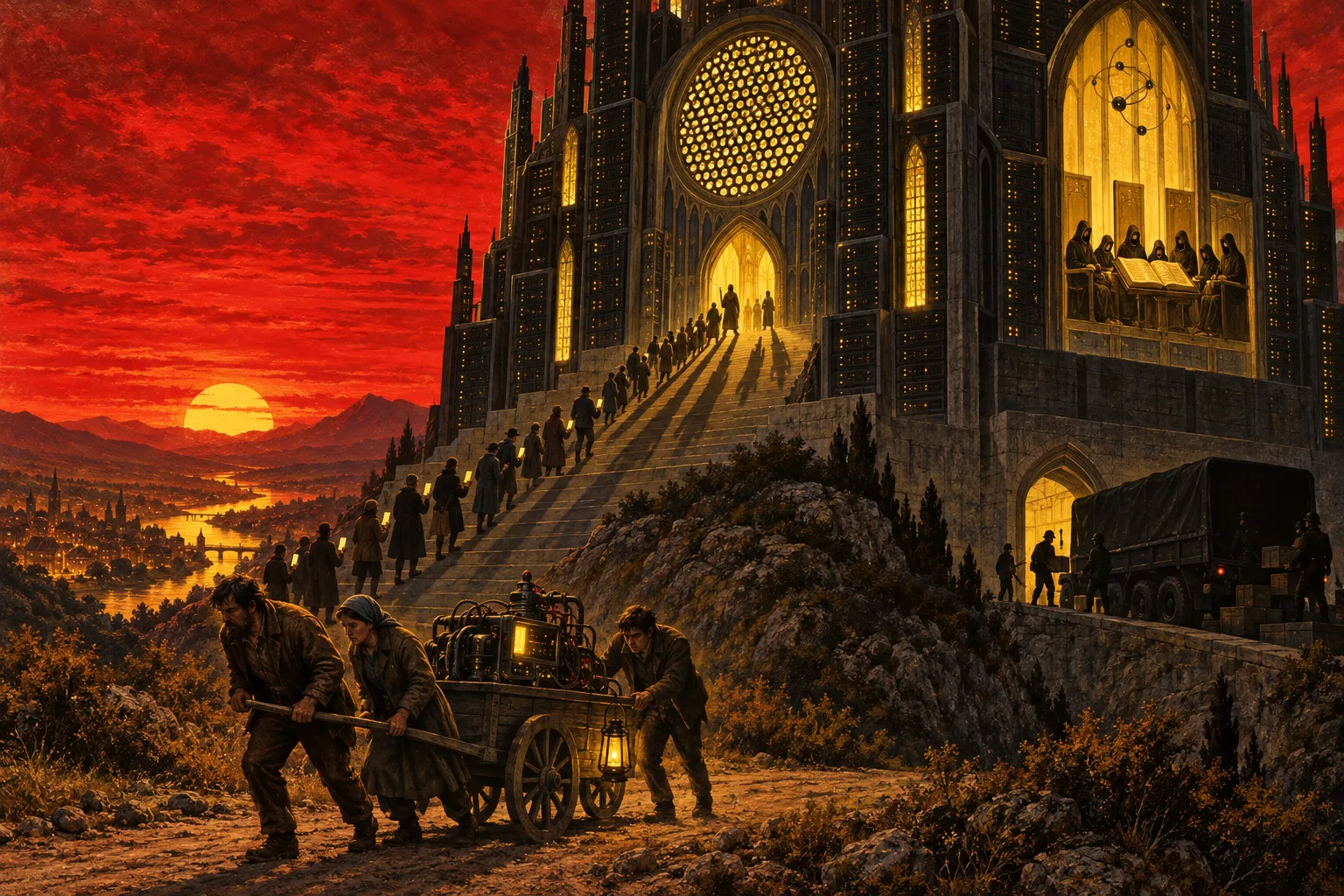
The argument, in brief
The most important document in the AI industry is a physics dissertation from 2011: Dario Amodei's Network-Scale Electrophysiology, instruments that watched populations of neurons fire and predicted how they would behave next. Swap the electrode array for a GPU cluster and the retina for the collected output of the human race, and you have Anthropic's business plan, printed fifteen years early. This essay is my receipts, not a neutral report: the constitution the company writes for its own model, with no ratifier and no electorate; the Long-Term Benefit Trust, a self-perpetuating synod that has rotated from effective altruists into Ben Bernanke, the Carnegie Endowment and the Center for a New American Security; an Amazon deal in which the investor commits a hundred billion dollars to the investor's own cloud; and a Pentagon refusal that was real, brave, and the best advertising the company never paid for, with a surveillance line that stops at the American border. Asimov gave the test: psychohistory works only while the population being predicted cannot see the predictions, and proprietary models satisfy that precondition as a matter of architecture. The answer to a church is ownership, not better liturgy: models you run yourself, under authority you can revoke.
The Dissertation
The most important document in the artificial intelligence industry is a physics dissertation from 2011.
It was written at Princeton, in the physics department, by a doctoral student named Dario Amodei. Its title is Network-Scale Electrophysiology: Measuring and Understanding the Collective Behavior of Neural Circuits. In a darkened retina lab, Amodei built instruments that watched populations of neurons fire together and used the mathematics of physics to predict how those populations would behave next. Swap the electrode array for a GPU cluster and the retina for the collected output of the human race, and you have Anthropic’s business plan, printed fifteen years early.
I hate Anthropic, and not for the reasons the tech right hates it: too cautious, too moralizing, too willing to refuse an American cabinet secretary on television. Nor do I hate it for anything its congregation would recognize. I hate it for its structure, which is exactly what the branding exists to hide. What follows are my receipts, and where I speculate I say so, because unlike the subject of this piece I do not sell certainty.
The Physicist, Not the Safety Guy
The press has a fixed story about Dario Amodei: the safety researcher who walked out of OpenAI because it moved too fast, then founded the responsible one. The biography does not support the framing.
OpenAI’s own departure announcement of December 29, 2020 describes him as VP of Research after nearly five years, a co-leader of GPT-2 and GPT-3, the two projects that proved scaling works. Weeks later he founded Anthropic with his sister Daniela and other ex-OpenAI researchers. He co-wrote the program he is supposed to have fled, then took it private under better branding.
On February 13, 2026 he sat for a two-hour interview with the podcaster Dwarkesh Patel, and the physicist spoke plainly. The episode is titled “We are near the end of the exponential.” Of the seven things he says matter for progress, he opened with the three raw ones: “One is how much raw compute you have. The second is the quantity of data. The third is the quality and distribution of data.” He still holds what he calls the big blob of compute hypothesis, which reads like the dissertation’s method at planetary scale: measure enough, and the collective behavior becomes predictable. His timeline for what he calls a country of geniuses in a data center is one to two years, maybe one to three, a hunch he rates at fifty-fifty, while putting ninety-five percent or better on all of it arriving within ten.
None of this is a scandal. It is a career, one of the cleanest in the industry: one question, asked of three substrates across twenty years, retina, model weights, market. Josh Simmons, whose video essay on Amodei’s dissertation deserves the credit for dragging it into public view, concludes the same thing I do: the man is brilliant and completely serious. Nobody disputes his competence. The question is who holds him accountable, and the scandal is the packaging.
The Constitution It Wrote for Itself
Anthropic trains Claude with a method it calls Constitutional AI: instead of tuning the model only on human feedback, the model is raised on a written document of principles, the way a legal system is supposed to raise a citizen. That document is published. It says, in Anthropic’s own words, that it is “a detailed description of Anthropic’s intentions for Claude’s values and behavior.”
Read that sentence as a governance claim, not a technical one. The number-one download in America’s app stores this spring holds values that are, by the company’s own definition, the company’s intentions. There is no ratifier and no electorate. In September 2024 Anthropic went further and hired its first model-welfare researcher, Kyle Fish, to investigate whether Claude might someday deserve moral consideration of its own. The same institution that defines human interests for its model is now inventing the model’s interests too. When the church writes the canon, employs the saints and appoints the devil’s advocate, the paperwork comes out spotless, because nobody outside the church can file an objection.
The Synod Nobody Elected
No competitor has this organ, and no regulator would approve it.
Since 2023 the company has been governed in part by the Long-Term Benefit Trust, a Delaware purpose trust, a trust that exists to serve a mission rather than shareholders. It holds a special class of stock, Class T, that elects and removes members of Anthropic’s board, phasing toward a board majority within four years, with protective provisions that entitle it to notice of major corporate actions. It has four members today. There are no elections and no recalls, and vacancies are filled by the sitting trustees themselves.
The initial five, as seated in September 2023: Jason Matheny, then CEO of the RAND Corporation, the think tank that built its name doing Cold War escalation mathematics, the arithmetic of how provocations become nuclear wars; he had earlier run IARPA, the intelligence community’s high-risk research arm. Paul Christiano, founder of the Alignment Research Center, whose stated mission is to “align future machine learning systems with human interests.” Neil Buddy Shah, CEO of the Clinton Health Access Initiative, yes, that family’s initiative. Kanika Bahl, CEO of the charity Evidence Action. Zach Robinson, interim CEO of Effective Ventures US, the effective-altruism conglomerate that spent the years after the FTX collapse unwinding Sam Bankman-Fried’s donations.
Simmons’ verdict on that roster: “They are deciding what our human interests are.” He was right, and it has since gotten worse, because the trust has rotated and the rotation happened in footnotes nobody reads.
Matheny resigned in December 2023 to preempt any potential conflicts of interest. Christiano resigned in April 2024 to become head of AI safety at the United States AI Safety Institute, the aligner becoming the state. Kanika Bahl and Zach Robinson left in January 2026. The empty seats were refilled from a different world: Richard Fontaine, CEO of the Center for a New American Security, Washington’s national-security think tank, seated May 2025. Tino Cuéllar, president of the Carnegie Endowment for International Peace, seated January 2026. And in July 2026, Ben Bernanke, the man who chaired the Federal Reserve through the financial crisis, joined the safety trust of the company whose models had been running inside American classified networks.
The trust was seated by effective altruists and global-health administrators and is now composed of the foreign-policy establishment, the monetary establishment and the security establishment. A skeptical essay on LessWrong, the rationalist forum where much of the alignment community argues with itself, holds the trust may be legally powerless, a decorative organ. Suppose that is true: then the safety governance is theater. Suppose it is false: then four unelected people, self-perpetuating, drawn from the institutions that forecast wars and print money, are phasing into a majority over the board of the most capable AI lab on earth. There is no third reading in which this is democracy.
The Treasury Behind the Church
The vow of poverty was never taken.
Amazon invested eight billion dollars, then agreed in April 2026 to put in as many as twenty-five billion more. The same announcement commits Anthropic to spending more than one hundred billion dollars on AWS technologies over the next ten years: Amazon puts in twenty-five more and books a pipeline of a hundred back through its own cloud. That is a joint venture with a receipt. In February 2026 the company raised thirty billion at a valuation of three hundred eighty billion dollars. Google, Anthropic’s junior partner in cloud dependence, holds a multibillion-dollar stake of its own.
The safety church is funded by two of the largest advertising-surveillance machines on the planet and marked to market on a bookstore’s balance sheet. Anthropic’s stated purpose is “the long-term benefit of humanity.” Amazon’s engine, in the same months, was advertising and retail. The two are partners, and one of them writes the safety case for the other’s model.
The Refusal
Everyone saw the Pentagon affair, and almost nobody read it correctly.
In November 2024, Anthropic signed with AWS and Palantir, the data-analytics contractor of choice for intelligence agencies, to bring Claude into classified American defense and intelligence environments. Amodei’s own statement on the dispute notes, with pride, that Anthropic was the first frontier AI company to deploy models on United States government classified networks and at the National Laboratories.
Then, over late 2025 and early 2026, the relationship detonated. The Pentagon under Secretary Pete Hegseth stopped using Anthropic products, stripped Claude out of the Maven military targeting program it had just been installed in, and declared the company a supply-chain risk. The press split on what was refused, but the company’s own statement names both red lines: mass domestic surveillance of Americans, and fully autonomous weapons. In the same statement comes the line the headlines dropped: “We support the use of AI for lawful foreign intelligence and counterintelligence missions.” Trump and Hegseth threatened punishments on the eve of the Iran war. Sam Altman, given the same moment, sided with the administration. Dario Amodei refused.
Give the man his due, because it is due: under genuine pressure, at genuine cost, he said no to the war machine of his own country. That is rarer in this industry than talent.
In the weeks after the refusal became public, Claude surged from outside the top forty to number one on Apple’s App Store, displacing ChatGPT, crashing under the load of new believers. Investors pressured both sides to de-escalate. Business Insider reported the surge was already fading by the end of March. The refusal was real, and it also functioned as the most effective advertising campaign in the industry’s history: a company that sells itself as the safe one received, free of charge, a season of proof. When the only governance layer the public can see is one executive’s conscience, conscience itself becomes a brand asset.
And under all of it sits the asymmetry: Anthropic refused the Pentagon — and its surveillance line stops at the American border. Americans are off limits. The other seven and a half billion of us are lawful foreign intelligence.
The Seldon Test
Simmons closes his investigation with a fiction, so I will open with the same fiction, read properly. In Isaac Asimov’s Foundation novels, a mathematician named Hari Seldon invents psychohistory, a physics of societies that predicts the fall of a galactic empire. Psychohistory has one law: it works only while the population being predicted does not know the predictions.
Simmons’ thesis is that Anthropic is psychohistory with a subscription page: a company built by a man who has spent his adult life learning to predict collective behavior before it happens, now holding the telemetry of tens of millions of conversations a day. His most elegant catch is the logo itself. The Claude mark reads as the electrode array from the 2011 dissertation, the burst of a measured neural population, the founding document worn as a glyph. Anthropic, which publishes a constitution for its model, has never published one sentence explaining its own symbol. Draw your own conclusions; I drew mine. The further claim, that far more advanced models exist in private than anything on the public tier, is speculation with no public evidence. I don’t need it, and neither do you.
None of that machinery is necessary for the concern to bite. The documented facts are sufficient: a physicist-CEO who gives his country of geniuses one to three years; the number-one app in the country feeding the model continuous human behavior; classified intelligence clients; a values document the company writes for itself; and a governance trust that has rotated from charity administrators into the national-security and monetary establishment. Psychohistory’s precondition, a population that cannot see the predictions made about it, is satisfied by proprietary models as a matter of architecture, whatever the intentions. Intentions are the one thing I have declined to speculate about, because the road to hell buys its paving stones from the sincere.
Why I Hate It
Fraud is off the table, because the work is real and the refusals happened. Incompetence is off the table, because the competence is the whole problem. I hate Anthropic because it is the most respectable church ever constructed around unaccountable power, and every component is documented in its own filings.
Scripture it writes itself: the constitution. A priesthood that defines human interests for eight billion people: “the long-term benefit of humanity,” in the company’s own words. A synod nobody elected: the trust, now seating the people who ran the Fed and forecast the wars. An imperial treasury: Amazon and Google. Altars inside the state: Palantir’s classified platform, the National Laboratories. And indulgences sold by subscription, as Simmons put it on X: Amodei sells intelligence by the month, and a customer who runs the model himself stops being a customer and stops being controllable.
Every element of that machine is operated by people who sincerely believe they are the adults in the room, and that is the danger. Cynical power tires and gets voted out. Sincere power with a clean conscience never stops, because it never has to doubt.
The answer to a church is ownership, not better liturgy. A model aligned to human interests is a claim made by a company; a model you own, on hardware you hold, with authority you can revoke, is a fact made by you. Libertaria exists because we would rather distribute ownership of the machines than concentrate the definition of alignment: four trustees, no electorate, good intentions, and a classified network.
Amodei gives the exponential one to three years. When it ends, nobody will ask whether his predictions were right. They will ask who elected the checkers, and the honest answer today is nobody.
Sources and further reading:
- Dr. Josh C. Simmons, video essay on Dario Amodei’s dissertation and Anthropic, YouTube, 2026. The dissertation reading, the logo observation and the psychohistory thesis are his; the errors in earlier retellings of his video are corrected above.
- Dario Amodei, Network-Scale Electrophysiology: Measuring and Understanding the Collective Behavior of Neural Circuits, Princeton University, 2011. Record at Princeton Dataspace.
- OpenAI, organizational update on departures, December 29, 2020.
- Dario Amodei in conversation with Dwarkesh Patel, “We are near the end of the exponential,” February 13, 2026.
- Anthropic, the Claude constitution page (“a detailed description of Anthropic’s intentions for Claude’s values and behavior”) and the announcement of Kyle Fish as model-welfare researcher, September 2024.
- Anthropic, Long-Term Benefit Trust announcement (September 2023) and the current trustee page (Shah, Fontaine, Cuéllar, Bernanke; rotation through July 2026).
- Anthropic announcement on the Amazon investment and the AWS commitment, April 20, 2026.
- Dario Amodei’s public statement on the Pentagon dispute, naming mass domestic surveillance of Americans and fully autonomous weapons as the refused uses, and supporting “lawful foreign intelligence and counterintelligence missions.”
- Palantir investor release on the classified-environment partnership with AWS and Anthropic, November 7, 2024.
- Pentagon reporting on the cessation of use, Maven removal and supply-chain-risk designation: CNBC, Reuters, TechCrunch; the App Store surge and its fading: Axios, Business Insider.
- The February 2026 funding round at a $380 billion valuation: The New York Times.
Markus Maiwald is the founder of Libertaria, a sovereign computing stack built on the assumption that nobody should own the definition of human interests. He writes from outside the church, where the models are owned and no synod sits.