Nirvana: Fun to Lose and to Pretend. *Smells Like Teen Spirit* and the Cosmic Game of Being Fifteen
The single song that named the entire decade, and that is still the best record to play at the peak of functional drunkenness on a private party thirty-four years later. A lyric-level autopsy.
The argument, in brief
*Smells Like Teen Spirit* is, line by line, a Vedantic text in the disguise of a grunge single. *Load up on guns, bring your friends* – the ego defending its borders by forming a tribe. *It's fun to lose and to pretend* – the cosmic game in one sentence. *Hello, hello, hello, how low* – the gradual forgetting of the unitary self as the ego constructs its social surface. *With the lights out, it's less dangerous* – the ego's discovery that ignorance of the truth is more comfortable than awareness of it. *A denial, a denial, a denial* – Meister Eckhart, apophatic theology, via the chorus of a song that was a #1 hit in twelve countries. *Never mind* – radical surrender. The single song made for Scheunenparties and the dissolution of the ego is the same single song.
Fun to lose and to pretend.
, Kurt Cobain, Smells Like Teen Spirit
I. The Scheunenparty
In the German provinces, in the early 1990s, when you had finally finished the Abitur or when you had finished enough of the Abitur that nobody expected you to finish it, there was a particular kind of party that did not exist in any other country and that has not existed since.
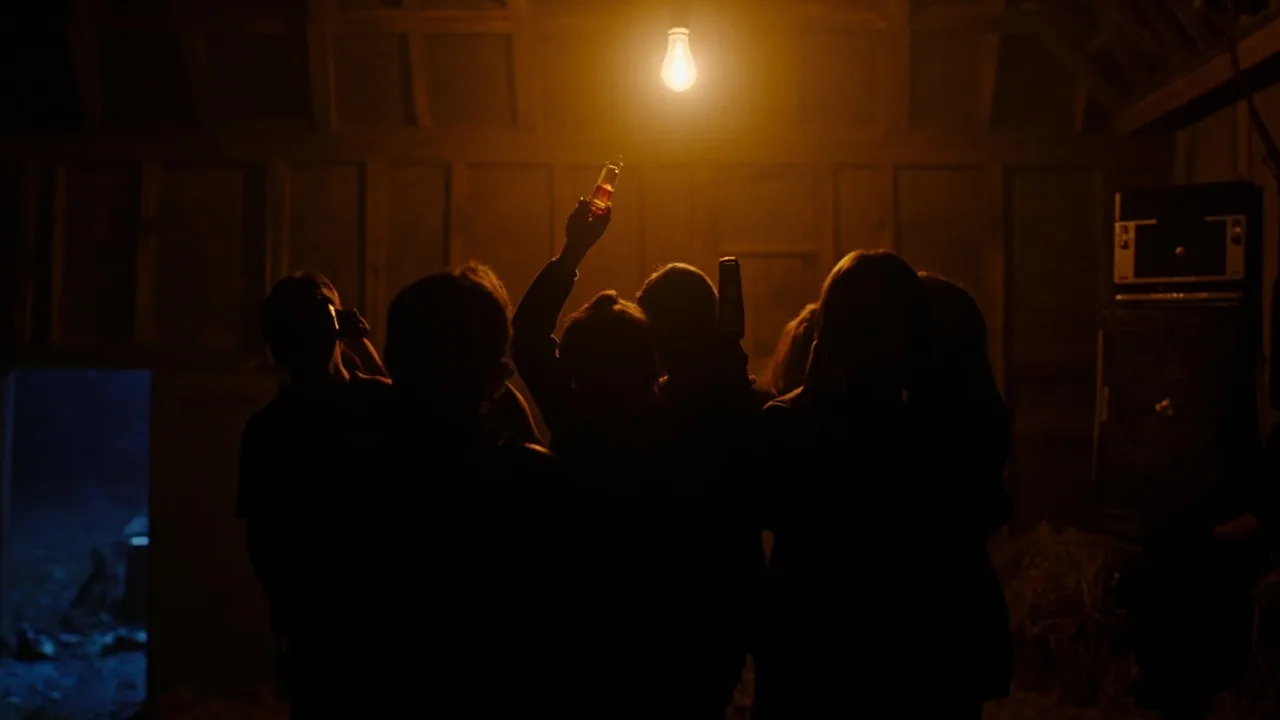
The Scheunenparty took place in a barn a farmer had rented to a cousin who knew a cousin of the parent’s friend’s son. It had been a working barn two months before and would be one again after the weekend. Hay bales lined the walls; somebody had borrowed a good sound system from an uncle’s garage. Tall speakers, a warm amplifier, cables lying unprotected across the packed-earth floor. They led to a cassette deck operated by the most important person at the party. Whoever controlled that deck controlled the emotional weather of the room.
The beer was cheap and plentiful. The girls came from the next village rather than your school. In the German provinces of the early 1990s, that was far enough away to put them beyond the tribe you knew. You had no ready social category for them. You could not be cool in front of this girl. You could only be in front of this girl. This is a frightening condition to be in, at the age of fifteen, with four beers in.
And at approximately 1:30 in the morning, after approximately six hours of The Sisters of Mercy and The Cult and The Mission and one or two extremely earnest folk songs that nobody had asked for and that were tolerated because the person who had brought the cassette player was a nice person, the cassette player was loaded with a different tape, and the song came on, and the song was Smells Like Teen Spirit.
The barn exploded.
For the duration of the song, the barn expanded to the size of every teenager’s inner world. Each of us was exactly the size of ourselves. The song was the membrane.
This is what the song did at peak drunkenness at a private party in a barn in the German provinces in 1991. This is what the song has continued to do, with decreasing intensity but with surprising durability, at every private party I have attended since, including private parties in the last five years, because there is no top-of-the-evening moment that Smells Like Teen Spirit does not make better. There is also no top-of-the-evening moment that Smells Like Teen Spirit does not make more honest. The song is the song for the moment when the alcohol has done its work and the social performance has become too expensive to maintain and the masks are dropping, one by one, around the room, in time with the chorus.
The song is forty years old next year. It is still the best song ever written for the moment when teenagers are drunk enough to drop the act and not yet drunk enough to forget that they are dropping it.
II. Load Up on Guns, Bring Your Friends
Load up on guns, bring your friends It’s fun to lose and to pretend
The song opens with what is, on the surface, a threat. Load up on guns. Cobain is talking about weapons. Cobain is talking about going to war. The music is loud, the guitars are distorted, the drums are being played by a man who had, by the time of this recording, nearly destroyed his hands with the speed of his own playing, and the singer is telling us to load weapons.
In 1991, every teenager wants to hear this. In 1991, this is also exactly what every teenager does not want to hear. Their country and, for most of them, their society and families offer only one model of selfhood: weapons at the ready. Yet beneath language they know that a self requiring weapons to exist has no self. Cobain says what they cannot in the next line.
It’s fun to lose and to pretend.
These are the nine words that justify the entire existence of the song. These are the nine words that justify the forty million dollars the song has earned for the estate of a man who died at twenty-seven. These are the nine words that explain why the song is played, on Friday nights in barns in the German provinces, by teenagers who have no idea what the words mean and by twenty-five-year-olds who finally do. The song is one sentence long. It is fun to lose and to pretend. The rest of the song is the consequence of that sentence worked out in chorus.
To lose and to pretend is to lose the awareness of the oneness and to enter the game of separation. The game is fun. The game is the only game. The game is the reason the teenage boys in the barn can pretend, for one evening, that they are the kind of person who would load weapons and bring friends, even though they would not, in any actual emergency, load weapons, and even though most of them, in any actual emergency, would bring only themselves and would fail at that.
The line is also, in the German of the Scheunenparty at 1:30 in the morning, the line that means I give up. The line that means I am not going to keep performing. The line that means I am going to let you see that I do not know what I am doing. The line that means we can all see that we do not know what we are doing. This is the moment the song is built for.
III. Hello, Hello, How Low
Hello, hello, hello, how low
The chorus is a hypnotic repetition. The chorus is a decrement. The chorus is the gradual forgetting. Hello is the constant greeting of the other. Hello is the mind continually acknowledging that there is an externalized reality, and the hello, hello, hello is the mind doing it on a loop, and the how low is the question of how far down into the layer of identification and division the mind is willing to travel before it forgets, completely, that it is also one thing with what it is acknowledging.
The chorus is also, sonically, exactly what it has to be. The chorus is also, dynamically, exactly the loudest moment of the song. The chorus is also, texturally, the moment when the producer (Steve Albini, the man who understood what a loud chorus was supposed to sound like) made the entire mix collapse into a wall of guitars and feedback that is, technically, the most aggressive commercial single of the 1990s. Hello, hello, hello, how low is a marketing slogan in 1991. Hello, hello, hello, how low is also a Vedantic mahavakya, a great sentence, in 1991. Both are present at the same time. The song is the same song for the teenagers who heard it as a marketing slogan and for the teenagers who heard it as a great sentence and for the adults, years later, who finally heard both.
The decline is structural. The decline is what makes the song a song. The chorus declines each time it repeats. The hello declines. The hello asks, quietly and without permission, how low? The answer to the how low is the entirety of the rest of the song. The answer to the how low is the distance the ego is willing to travel away from its own ground before it realizes it has been traveling. The answer is, usually, very far. The answer is, in the German provinces in the early 1990s, an entire adolescence.
IV. With the Lights Out, It’s Less Dangerous
With the lights out, it’s less dangerous Here we are now, entertain us
These are the song’s two most quoted and most misquoted lines because they are its most useful: an entire epistemology of the modern self in eight and a half words.
With the lights out, it’s less dangerous is the ego’s discovery that not seeing the truth is more comfortable than seeing the truth. The lights out are illumination. The lights out are the perception of what we actually are. The lights out is dangerous because the lights out reveals that the question of separation, and therefore the question of personal identity, and therefore the question of why we are suffering, are themselves constructions of the ego and not features of the world. The ego, when it discovers this, does not want to know it. The ego therefore turns the lights out. The ego turns the lights out and pretends that the truth is not in the room and pretends that the suffering is not optional.
Here we are now, entertain us is the ego’s cry in the dark. It has avoided reality for the duration of a song and is still starving. It will accept any entertainment, degrading itself slowly without finding salvation or relief. Entertainment exposes the hole where truth used to be.
The Western teenager in the 1990s and the Western adult in the 2020s share this spiritual condition. A man who had personally experienced both in the same life named them in a song.
V. I’m Worse at What I Do Best
I’m worse at what I do best And I forget just why I taste
The bridge of Smells Like Teen Spirit reads as the apophatic theology of a non-dualist with a new record contract, writing a song the entire music industry will turn into a marketing campaign. The bridge is the moment the singer realizes, with appropriate despair, that the act of being recognized for what one does best ruins the doing of it.
I’m worse at what I do best. The Zen parable of the bird. The Zen parable of naming the bird. If you teach your child the name of a bird, the child will never see the bird again. The child will only see the name. The moment the doing becomes a thing that is named, the doing becomes a thing that is owned. The moment the doing becomes a thing that is owned, the doing is no longer spontaneous. The moment the doing is no longer spontaneous, the doing is no longer the doing. The doing is now a performance of the doing. The performance of the doing is, by definition, worse than the doing.
This is the moment Cobain realized he was in trouble. This is the moment, and the moment is accurate, because Cobain was twenty-three and was already, by twenty-three, the most famous songwriter in the world, and was already, by twenty-three, the personification of the figure he had spent his teenage years mistrusting. The recognition that one is the thing one mistrusts is, in a generation’s experience, the most dangerous recognition available. The recognition makes the song. The recognition also, eventually, makes the suicide.
And I forget just why I taste. The dissolution of the intellect. The dissolution of the conceptual scaffolding that props up the ego. The mind, having spent the entire song so far building the scaffolding of identity and tribal loyalty and the entertainment economy, suddenly cannot remember what any of it was for. The mind tastes things, and then forgets why the things were tasted. The mind drops the justifications for the experience. The mind is left with the experience alone.
This is, again, an entire epistemology, in one line, in a #1 hit single.
VI. A Denial, a Denial, a Denial
A denial, a denial, a denial
The chorus, near the end. The chorus, near the end, becomes its own deconstruction. A denial. Four syllables, repeated, escalating. A denial, a denial, a denial. The lyric is no longer a lyric. The lyric is a chant. The lyric is the most apophatic statement in the history of popular music, four syllables long, getting louder with each repetition, sung by a man who understood the Christian mystical tradition well enough to deny his way through the song.
Apophatic theology names God by saying what God is not. Meister Eckhart, John of the Cross, the Sufis, Kabbalists, and Advaita Vedantists say not this, not that, not this, not that until stillness remains and the question becomes nonsensical.
A denial, a denial, a denial puts that theology into a pop chorus. The singer screams it at himself, denying the self the song has spent four minutes constructing: social, tribal, armed, accompanied by friends, entertained, and unnamed by the bird the child would have seen.
The denial also dismantles the form. A single repeated syllable grows louder, pushing past the boundaries of a pop single. Smells Like Teen Spirit deliberately breaks the form it has been denying.
VII. Never Mind
Oh well, whatever, never mind
The closing line supplies the album title because it names what the album is about: never mind. An exhausted mind has tried to be a person, construct a tribe, find entertainment, deny the construction, and scream through the denial. It reaches the point where the effort costs more than it is worth.
Never mind. The song, and the album, are called Never Mind because that is the moment of arrival. Never mind is not lazy. Never mind is not indifferent. Never mind is the most expensive word in the song, and it is the cheapest word in the song, and it is the cheapest word in the song because it is the only word in the song that does not cost anything, and it is the most expensive word in the song because getting to the place where it does not cost anything is the entire four minutes of noise preceding it.
Oh well, whatever, never mind is, in a non-dual frame, the act of radical surrender. The mind, finally, stops trying to solve the unsolvable riddle of existence. The mind, finally, drops the demand for a conceptual reason to live. The mind, finally, drops the demand for a conceptual reason to be a person. The mind, finally, simply is, without the justification. The mind, finally, simply is, in the barn, at 1:30 in the morning, with four beers in, with the first girl of the evening leaning against a hay bale, with the cassette player still warm, with the next song already queued, with the party still three hours from ending.
This is what the song is for. This is what the song does. This is what the song has done, with remarkable consistency, for thirty-four years, at the top of every private party in which a sixteen-year-old has ever mixed cheap beer with cheap courage and with a friend who has a cassette deck and a speaker tall enough to fill a barn.
VIII. The Cosmic Game, as a One-Song Manual
To say it is fun to lose and to pretend is a nod to the cosmic game we are all playing. Even though we are all connected, we pretend to forget it, just to experience the drama of being a struggling human entity.
The entire cosmic game fits into two minutes and forty seconds. Those two minutes and forty seconds come from the most self-aware songwriter in America, and the most confused. His confusion produced the self-awareness, which produced the song: a manual for everyone who later reaches the same confusion.
The teenagers at the Scheunenparty have the song; they need no manual. Those who reach the place it named twenty years later need the manual because they have forgotten how they got there. The song is the manual. When it is unavailable, uncongenial, or insufficient, conversation must serve. That is what the aphorism and this essay offer.
The cosmic game has one rule. It is fun to lose and to pretend. The cosmic game has one ending. Never mind.
Markus Maiwald grew up in the German provinces in the early 1990s. He went to a lot of Scheunenparties. He has still not recovered. He writes occasionally for libertaria.blog, mostly on political philosophy and sovereignty. He almost never writes on music. A series of essays on Nevermind is being published on libertaria.blog in the coming days.